
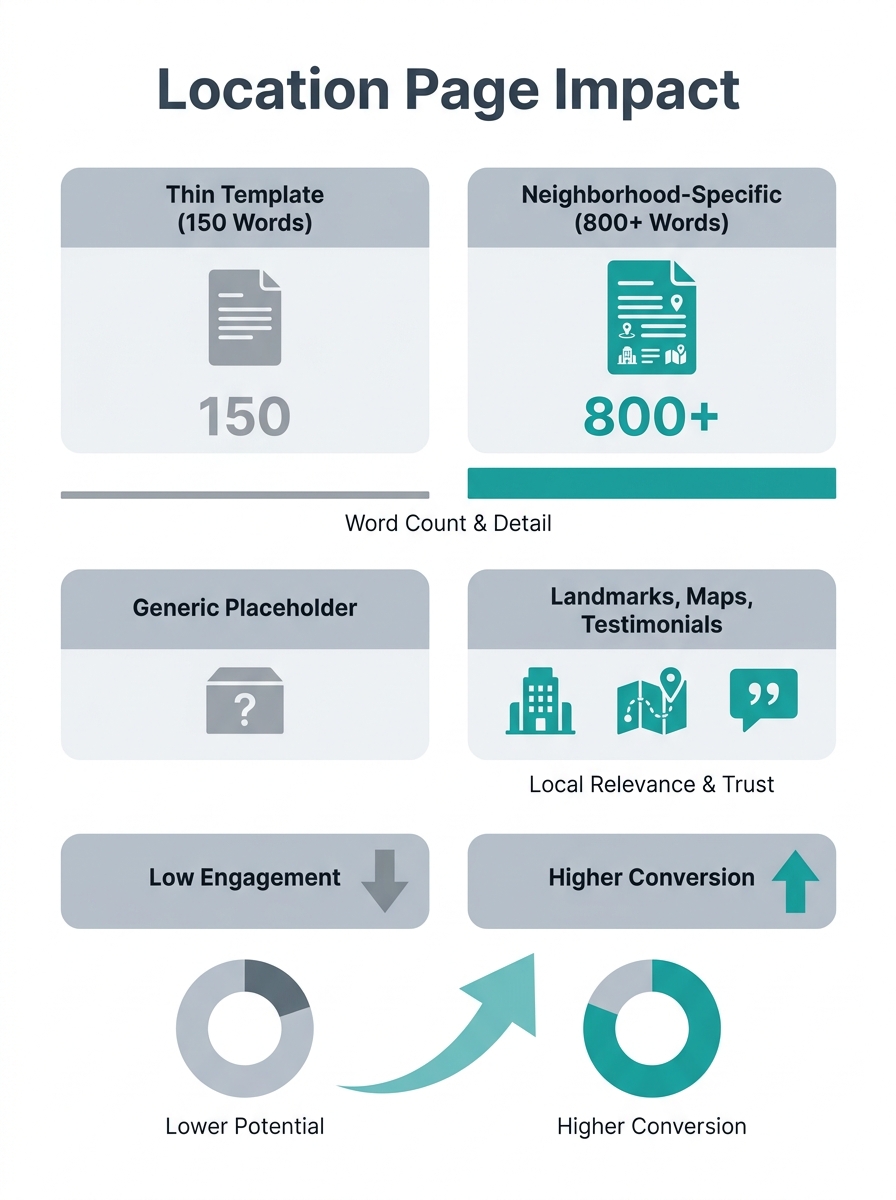
Google suppresses thin location pages that swap city names into identical templates, and home care agencies running this playbook see the result: zero organic traffic on 150-word pages that took five minutes to build. Pages with 800+ words of genuinely local content, embedded maps, and neighborhood-specific trust signals generate actual leads, according to Senior Care Clicks data on hyperlocal home care marketing performance. The gap between these two approaches is the difference between visibility and invisibility for “home care near me” searches.
The 150-Word Page That Generated Zero Traffic
The failure pattern is well-documented and instantly recognizable. An agency creates a page titled “Home Care in [City Name],” drops in 150 words of boilerplate copy, swaps the city name from a master template, and publishes 12 of these across its service territory in a single afternoon. Every page uses the same three sentences about “compassionate care” and “trained professionals.” The only unique element is the H1 tag.
BrightLocal’s research on service area pages explains why this fails: service area pages are supposed to act like local landing pages, spotlighting a business’s offerings in targeted cities, neighborhoods, or zip codes. When every page reads identically, Google treats them as duplicate content. The pages compete against each other instead of competing against rival agencies. And because the content lacks any real geographic signal beyond the city name in the title, Google has no reason to surface them for location-specific searches.
The math gets worse. CoreCubed’s local SEO research confirms that searches like “home care near me,” “help for aging parents at home,” and “Alzheimer’s care in Chicago” are among the most common queries families use. These searches carry high purchase intent. A family typing “home care near me” is often days or hours from making a hiring decision. But template pages can’t match that intent because they contain nothing specific to the searcher’s actual neighborhood, ZIP code, or community.
This is the scenario we’re dissecting: what happens when an agency replaces a batch of template city pages with genuinely hyperlocal neighborhood service pages, and where exactly the ranking signals shift.
Grid Math: Services × Neighborhoods
The first structural decision is figuring out how many pages you actually need. Passionfruit’s local landing page research offers a formula that works well for senior care: create at least one page per primary service per area. If your agency offers 3 core services (companion care, personal care, and memory care) across 5 distinct neighborhoods, that’s 15 pages.
Fifteen pages sounds like a lot until you realize each one targets a fundamentally different search query. “Memory care in Lincoln Park” and “companion care in Lakeview” attract different families with different needs at different stages of the care decision. They don’t cannibalize each other because the keyword intent is distinct.
We’ve written about building a geographic sub-service page hierarchy that structures these pages so they reinforce rather than compete with each other. The architecture matters. A flat site where all 15 pages sit at the same URL depth sends weaker signals than a nested structure where city-level pages link down to neighborhood pages, which link to service-specific variants.
CCR Growth’s research on senior living marketing confirms that “assisted living near [zip code]” indicates higher intent than broad city searches. Families who include a ZIP code or neighborhood name have already narrowed their geographic criteria. They know where mom lives. They know which part of town they need coverage in. Your page structure needs to meet that specificity.
Families who include a ZIP code or neighborhood name in their search have already decided where they need care—your page structure needs to meet that specificity or lose the click to an agency that does.
Anatomy of an 800-Word Neighborhood Page
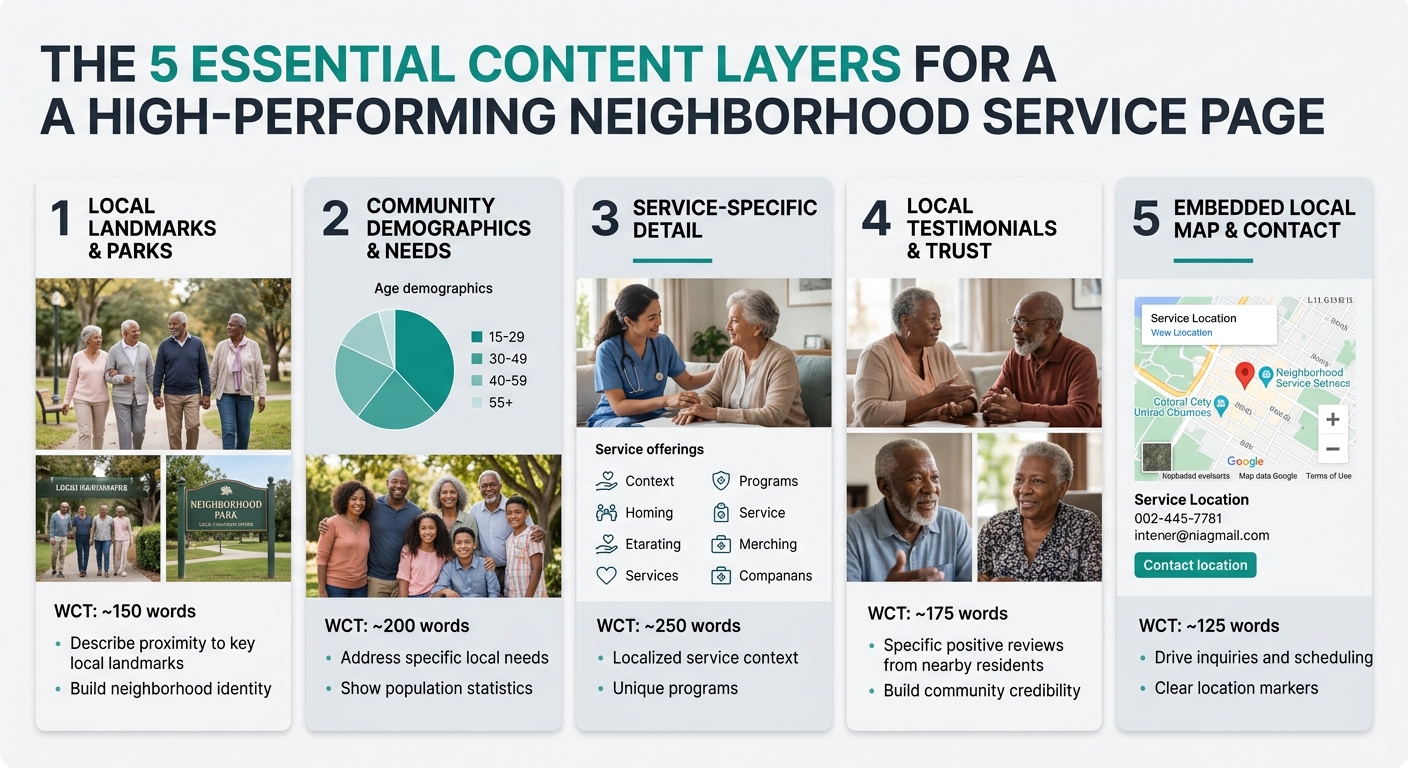
What separates a page that ranks from a page that doesn’t comes down to five content layers that a template can’t replicate. Here’s what the research tells us belongs on each neighborhood service page:
Local landmarks and institutions. Name the hospitals, senior centers, pharmacies, and community organizations within 2-3 miles. If your Lakeview companion care page mentions Swedish Covenant Hospital, the Montrose Senior Center, and the CTA Brown Line stops that caregivers use to reach clients, you’re signaling geographic authenticity that no template can generate. W3Era’s hyperlocal SEO research documents that targeting at the neighborhood and landmark level captures searchers with immediate intent.
Neighborhood demographics. If 38% of residents in a particular ZIP code are over 65, say so. If the neighborhood has a significant Korean-American population and your agency employs Korean-speaking caregivers, that belongs on the page. DataMasters’ ZIP code targeting research shows that focusing on communities where services are most needed drives higher conversion than broad geographic targeting.
Service-specific detail. Don’t repeat the same service description from your main services page. Write about how that service works in this specific neighborhood. Does parking affect caregiver scheduling in dense urban areas? Are there elevator-only buildings that require extra arrival time? These operational specifics demonstrate that you actually serve this area.
Local testimonials. A review from a family in that neighborhood carries far more weight than a generic 5-star rating. If you’ve built a system for generating Google reviews, tag reviews by location and embed neighborhood-specific ones on the corresponding page.
Embedded map with service radius. A Google Map centered on the neighborhood, with your service boundary clearly marked, gives both users and search engines a visual geographic signal.
When you’re working through credential and trust signals that convert families, these neighborhood pages become the natural home for location-specific proof points. A caregiver who has worked in the Bucktown neighborhood for 4 years and holds a CNA certification tells a more convincing story on the Bucktown page than on a generic “About Our Team” section.
ZIP Code Clusters Beat City-Wide Targeting
The city-versus-ZIP-code debate in local SEO usually ends in the same place: ZIP codes win for home care agencies because they match how families actually search. A daughter looking for care for her father in the 60614 ZIP code doesn’t care about services available across all of Chicago. She cares about the 6-block radius around his apartment.
Reddit’s PPC community documents this same finding from the paid advertising side: experienced local marketers recommend using ZIP codes over radius targeting because ZIP codes let you optimize based on actual performance data. You can see which ZIP codes generate the best results and bid accordingly. The same principle applies to organic neighborhood service pages. Build pages around ZIP code clusters, track which ones generate form submissions and phone calls, and invest more content development into the high-performing areas.
This approach also connects to how you map your referral source territory. When your neighborhood pages align with the territories where your hospital discharge planners and social workers operate, the referral relationship reinforces the search visibility. A discharge planner at Northwestern Memorial who refers families to your Lincoln Park page creates a signal loop: the family visits a neighborhood page that matches their geography, converts, and generates a review that strengthens that page further.
Agencies providing nursing home marketing face a similar geographic challenge, but with the advantage of a fixed address. Home care agencies, operating as service area businesses without a storefront in every neighborhood, have to work harder to prove geographic relevance. That’s exactly why neighborhood pages exist.
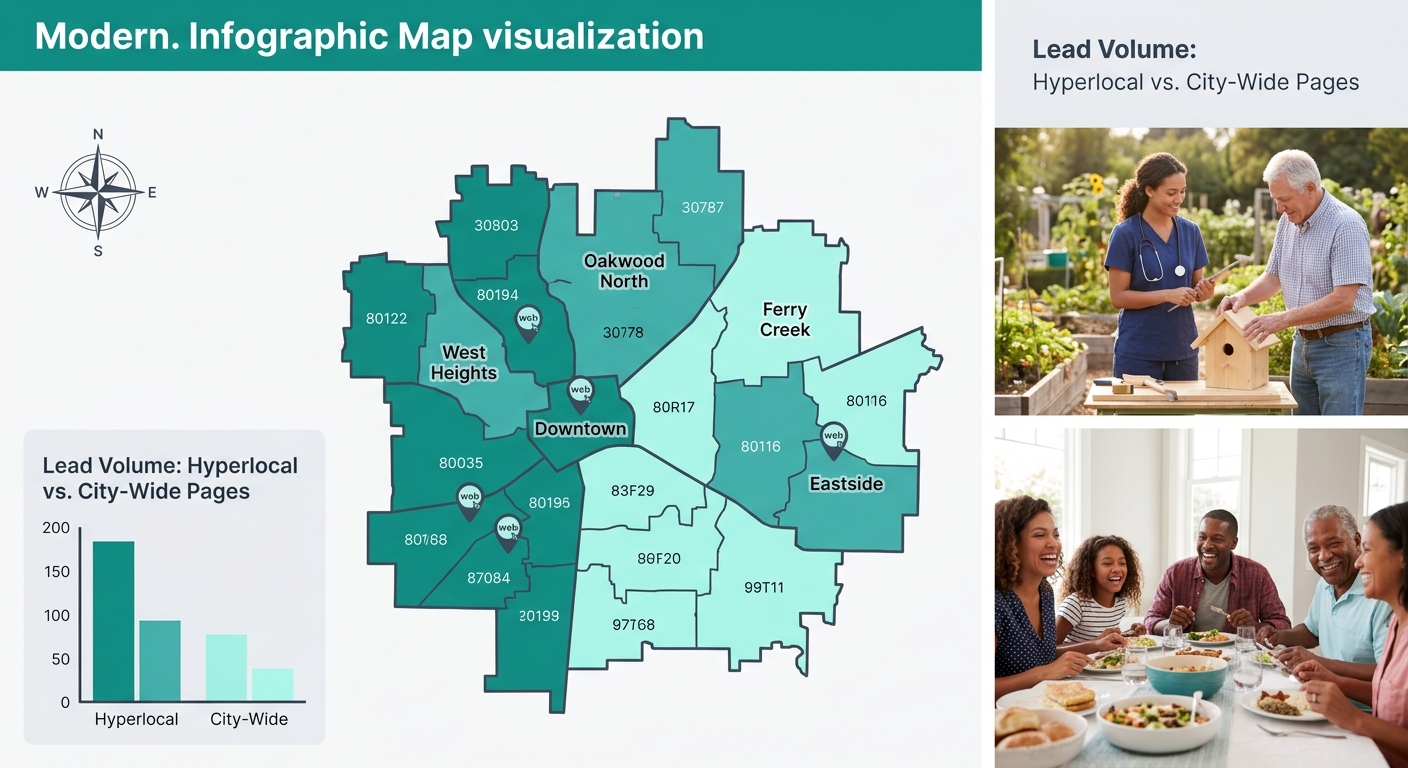
Tip: Group adjacent ZIP codes that share similar demographics and referral sources into a single neighborhood page rather than building one page per ZIP code. Three to five ZIP codes per page prevents content from getting too thin while maintaining hyperlocal relevance.
When the Neighborhood Signal Reaches Google
The agency that replaces 12 template city pages with 15 genuinely local neighborhood service pages doesn’t see results overnight. Google needs to crawl, index, and evaluate the new content against existing competitors. But the signals compound in ways that template pages never could.
Each neighborhood page generates its own backlink opportunities from local organizations, senior centers, and community blogs. Each page accumulates its own review mentions and local citations. And each page matches a distinct search query that a single city-wide page was never specific enough to rank for.
The technical foundation matters, too. NAP (name, address, phone) consistency across all directories, proper LocalBusiness schema markup on each page, and a well-optimized Google Business Profile all feed into whether Google trusts your claimed service area. The neighborhood page is the organic content layer. The GBP, schema, and citations are the verification layer. You need both.
For agencies that also offer home care marketing services across multiple care types, the grid multiplication works the same way. Companion care, personal care, memory care, respite care, and post-surgical care each get their own page for each neighborhood. An agency with 5 services across 5 neighborhoods ends up with 25 pages, each one targeting a search query that no competitor’s template can match. When you account for the gap between ranking nationally and losing local families, the investment in genuinely hyperlocal content becomes one of the clearest ROI calculations in senior care SEO.
The agencies that win “home care near me” searches aren’t doing anything mysterious. They’re doing the specific, tedious work of writing about real neighborhoods with real details for real families, and they’re doing it for every service line they offer in every area they serve. Template pages are faster to build. Neighborhood pages are the ones that actually show up.