
Direct Google review links sent via SMS within two hours of a care visit generate three times more completed reviews than generic listing URLs. An effective review request automation system for senior care connects your scheduling software to a messaging platform, triggers requests at service completion, and filters respondents by satisfaction level before they ever reach Google.
Review Velocity Has Replaced Static Volume
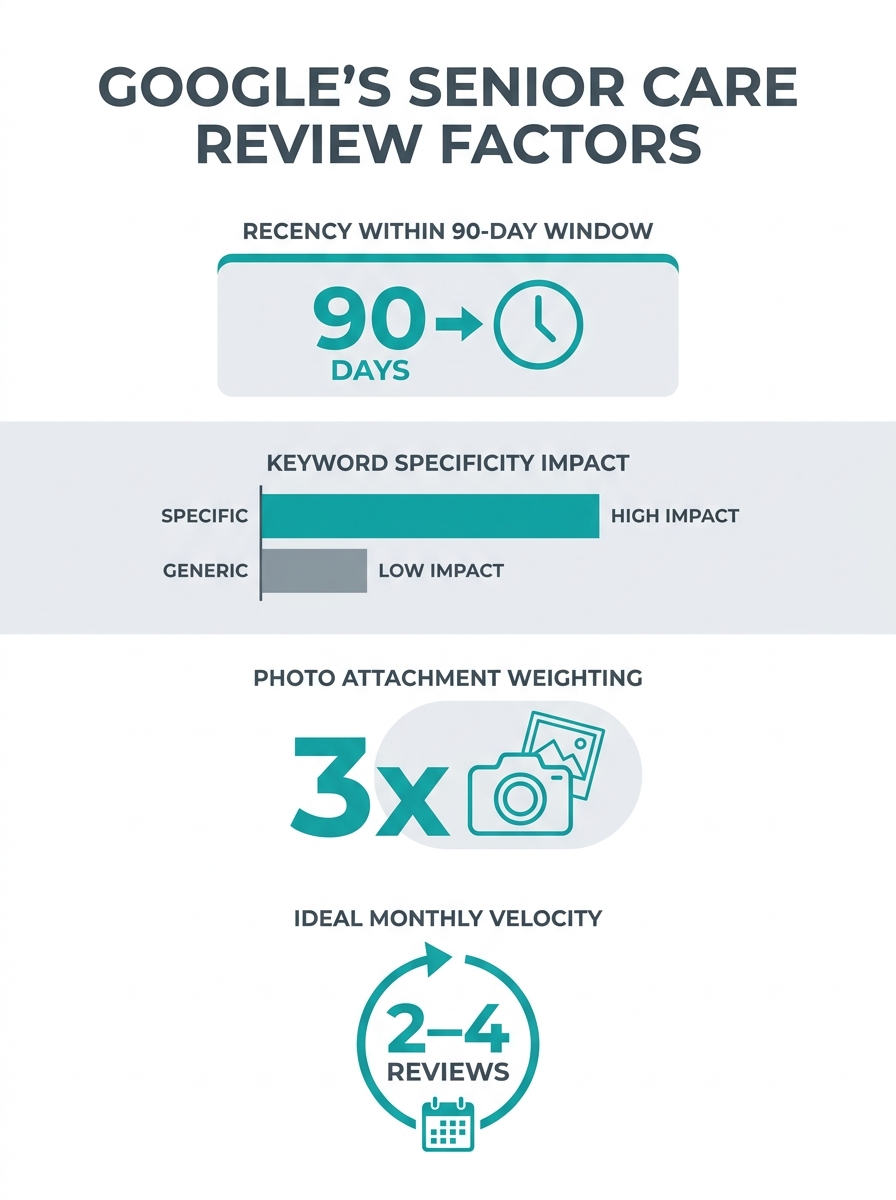
Google’s local ranking algorithm in 2026 weights the consistency of incoming reviews more heavily than the total number on a profile. A senior living community with 200 reviews from 2023 will rank below a competitor receiving two to four fresh reviews per month, because Google now evaluates recency within a 90-day window as a primary local signal. This shift punishes agencies that ran a one-time review push years ago and haven’t asked since. For home care reputation management, the implication is straightforward: your review system needs to produce steady output, not occasional bursts.
The algorithm also performs sentiment analysis that goes beyond star counts. Reviews containing specific service keywords (“in-home physical therapy,” “dementia care,” “medication reminders”) and location references (“Scottsdale,” “North Austin”) carry more ranking weight in local pack results. Photos attached to reviews carry three times the ranking influence of text-only reviews. The specificity of what your families write matters as much as the numerical rating they assign. If your Google Business Profile isn’t properly configured to receive and display this content, even a strong review flow won’t reach its full potential.
Healthcare and senior care rank among the top five industries where online reviews influence purchasing decisions, with families researching online and trusting peer opinions more than advertising. With more than 36,000 assisted living communities nationwide and a median monthly rate of $2,575 per Caring.com’s data, the financial stakes of each family’s decision make them unusually thorough researchers. Your assisted living star ratings are the first filter they apply, and a stale profile with no reviews from the past 90 days signals abandonment.
How the Timed Request Actually Works
The mechanical system behind review request automation is simpler than most agency owners expect. You need three connected components: a trigger event (service completion or visit sign-out), a messaging channel (SMS or email), and a destination link (a direct URL to your Google review form, not your general listing page). Tools like Podium, Birdeye, and WiserReview connect to scheduling software and CRMs to send requests without anyone on your team touching a button. AccuShield, built specifically for senior living, automatically texts visitors a few hours after sign-in if they forget to sign out, prompting them to leave a Google review.
SMS is the dominant channel because text messages carry open rates between 90% and 98%, compared to email’s typical 20-25% open rate in senior care. The timing window matters enormously: sending the request one to two hours after service delivery catches the family member while the positive interaction is still fresh but after they’ve had time to settle back into their routine. Sending immediately feels transactional, and waiting a full day allows the emotional momentum to dissipate entirely. That one-to-two-hour window is the sweet spot confirmed across healthcare reputation platforms, where automated systems send customizable requests after appointments and filter negative feedback before it reaches public profiles.
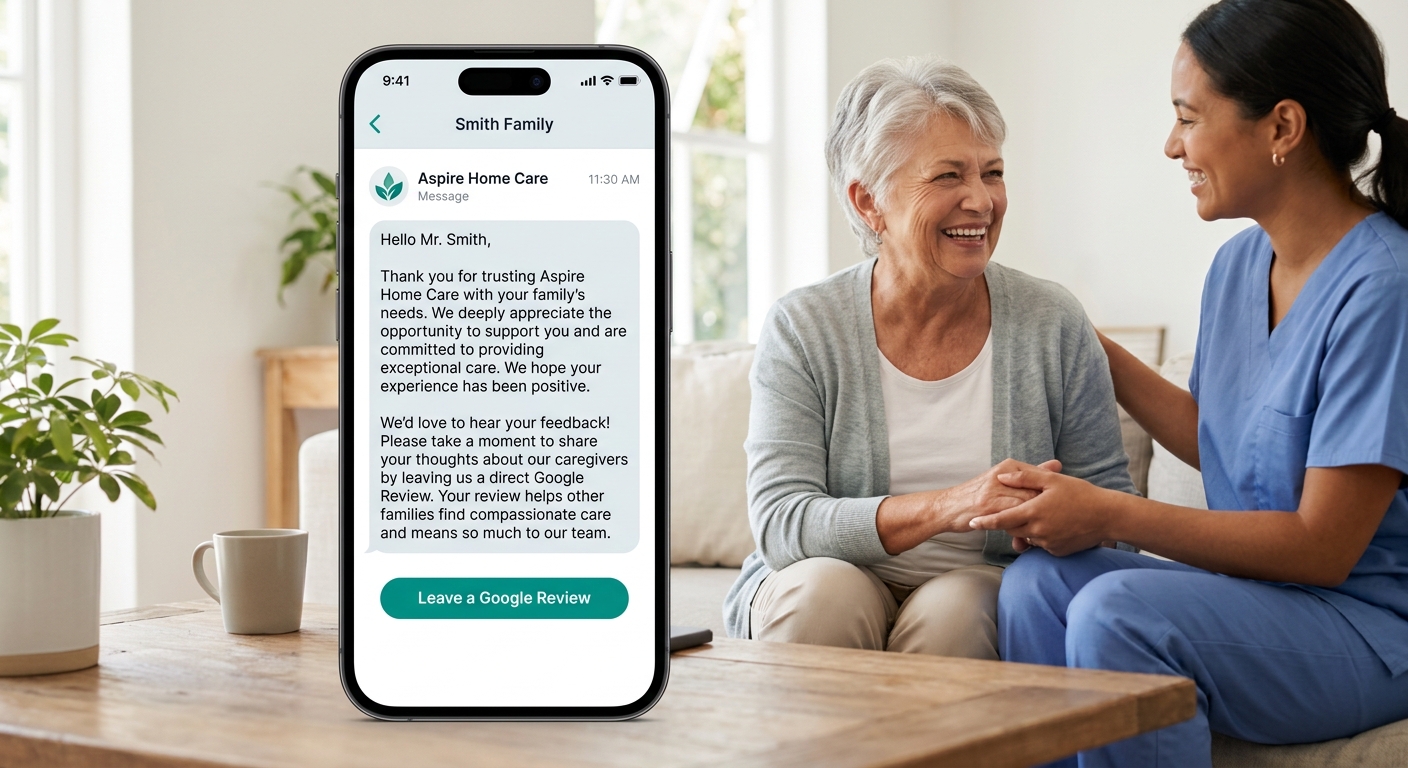
The direct review link is a detail many agencies get wrong. Google allows you to generate a URL that opens the review submission form directly, skipping the search-and-browse steps that lose people along the way. This single change produces three times more completed reviews because it eliminates friction. Every extra tap a family member has to make between receiving your message and typing their review is a dropout point. If you’re already running email marketing for care providers to nurture client relationships, adding the direct review link to post-service emails creates a second touchpoint that reinforces the SMS request without feeling redundant.
A profile receiving two to four reviews per month ranks higher than one with 100 stale reviews from prior years. Consistency is the signal Google rewards.
Routing Satisfaction Before It Hits Your Profile
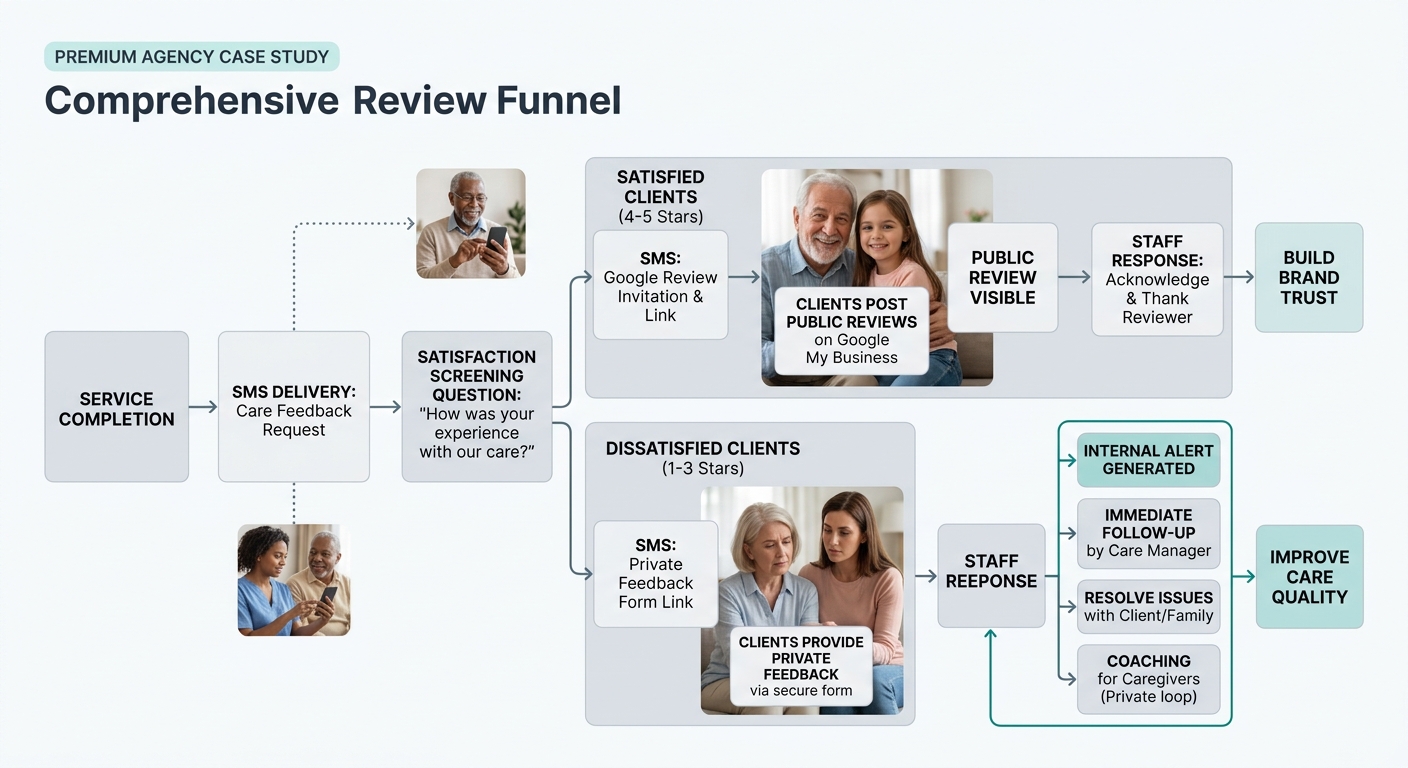
The concept that separates a mature caregiver agency online reputation system from a basic one is sentiment routing, sometimes called a “review funnel.” Before directing a respondent to Google, you first ask a simple satisfaction question, often on a one-to-five scale or a thumbs-up/thumbs-down prompt. Respondents who indicate high satisfaction (four or five stars) receive the direct Google review link. Respondents who indicate dissatisfaction get routed to a private feedback form where your team can address the concern directly.
This approach channels criticism to where your operations team can actually respond and fix problems, rather than letting a frustrated family member’s first public statement become your permanent record. As a McKnight’s Home Care industry report noted, “Top-performing home-based care providers don’t leave their reputation to chance; they manage it with intention.” The intentional part is creating a structured path for every type of feedback rather than hoping for the best.
Configure your satisfaction screening with categories relevant to senior care. AccuShield’s platform offers standard categories including Overall Satisfaction, Safety, Cleanliness, and Friendliness, plus up to three customizable categories that you define. These pre-review ratings give your internal team a real-time quality dashboard while simultaneously warming up the reviewer before they write their Google text. A family member who has already clicked “5 stars” for Safety and Friendliness is primed to write a specific, keyword-rich review rather than a generic “great place.” And specific reviews, as discussed above, carry more ranking weight in Google’s local algorithm.
The response side of the system matters as much as the request side. Agencies that respond to 100% of reviews within 24 hours see measurable local SEO lift. Your response to a positive review signals engagement to Google’s algorithm, and your response to a negative review signals accountability to every future family reading that thread. Monitoring platforms track reviews across Google, Caring.com, A Place for Mom, and other platforms simultaneously, offering response templates designed for senior care contexts. Quarterly reputation audits tie the system together: look at the specific language families use, identify recurring themes, and close the loop between what families say publicly and what changes internally. This feedback loop connects directly to whether your trust signals actually convert families and how effectively your empathy-driven messaging resonates with searchers who haven’t contacted you yet.
The Tension Between Automation and Authenticity
Building a review request system that generates consistent five-star senior care Google reviews raises a question worth sitting with: at what point does systematic reputation management shade into something less honest? The review funnel, by design, increases the probability that satisfied clients post publicly while dissatisfied clients get redirected privately. The result is a Google profile that looks better than your average service experience across all interactions. Every agency using this system should be clear-eyed about that asymmetry.
The ethical line sits at incentivization and fabrication. Google’s policies prohibit offering discounts, gifts, or any form of payment in exchange for reviews, and violations result in profile suspension. The system described here doesn’t cross that line because it asks for honest feedback and provides a convenient path to share it. But the spirit of the question persists. If your automated system produces a 4.8-star average while your actual family satisfaction surveys average 3.9, the gap will eventually surface in ways that damage trust more than a lower Google rating ever would. The automation should reflect operational reality, not paper over it.
There’s also a demographic consideration specific to senior care. The family members writing reviews are often adult children, not the care recipients themselves. Their perspective is valid but filtered through limited direct observation. A daughter who visits on Sundays and finds her mother well-dressed and cheerful will write a glowing review, even if weekday staffing patterns create a different experience. Your review system will disproportionately capture the visitor’s impression, and your internal quality metrics need to account for what reviews can’t see. Consistent operational measurement, tracked through tools like Home Care Pulse satisfaction surveys alongside your public review profile, is what keeps the gap between perception and reality narrow enough to defend.
The agencies that sustain high ratings over years are the ones where the automation serves as a distribution mechanism for genuinely good care. A review request system is infrastructure. The five-star rating it generates is a reflection of something your team built in the home, at the bedside, during the tour. When those two things align, the automation earns its keep. When they don’t, the system accelerates a reckoning you’d face eventually anyway.