
Geographic expansion in home care fails most reliably when agencies treat a new territory as an extension of their existing operation, deploying the same caregivers across wider zones and splitting referral coordinators between markets. The mechanism behind sustainable multi-market service rollout planning is resource isolation, where the new territory operates with its own dedicated staff, pipeline, and marketing from day one.
TL;DR: The difference between growth and dilution comes down to isolation. A geographic expansion strategy for home care works when the new market has a separate caregiver pool, separate referral relationships, and separate local marketing assets. Agencies that share these resources across territories watch response times climb, caregiver burnout increase, and core-market revenue erode within 6 to 12 months.
The Cannibalization Mechanism
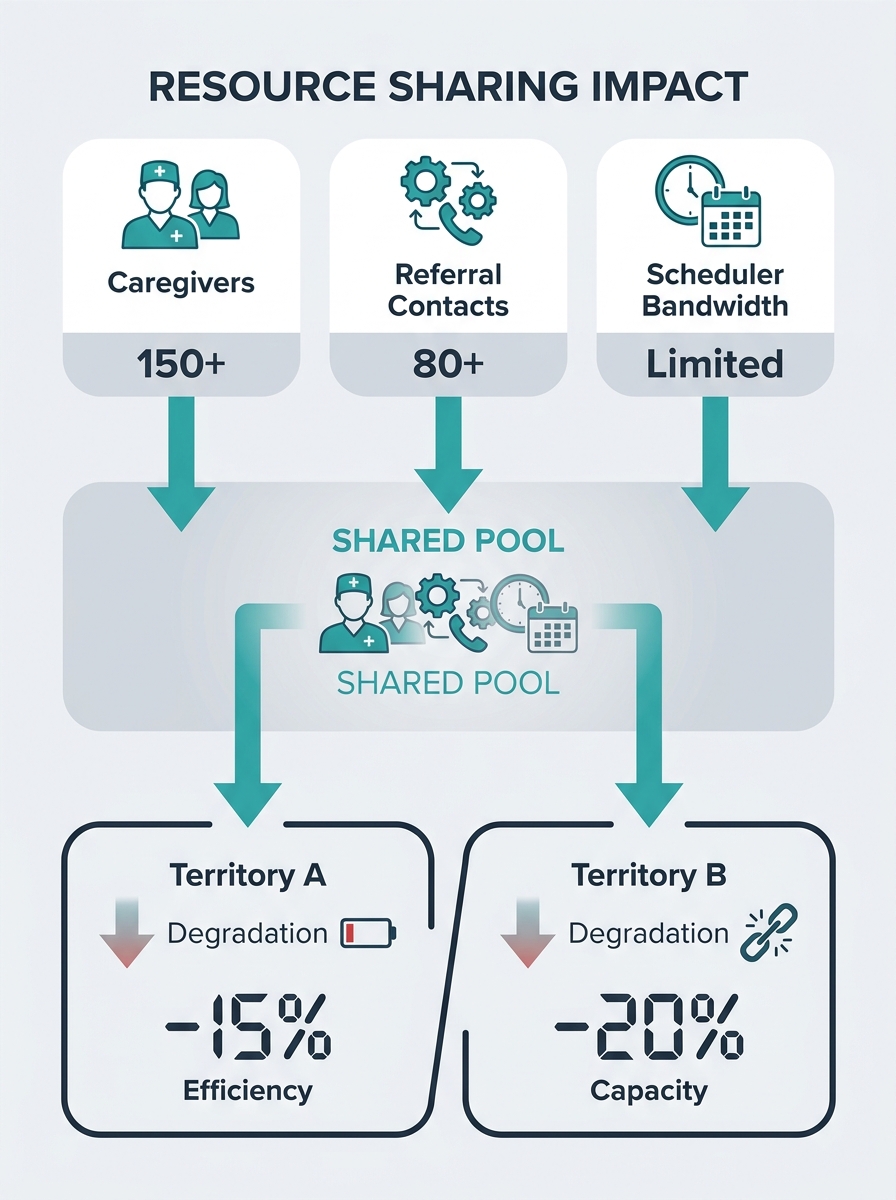
Why does entering a neighboring county so often degrade performance in your home market? The answer sits in three shared resources: caregivers, referral contacts, and scheduler bandwidth. When an agency adds territory without adding proportional staff, existing caregivers absorb longer drive times. A caregiver covering a 15-mile radius who suddenly covers 30 miles loses 45 to 90 minutes per day in windshield time. That’s 1 to 2 fewer client visits daily per affected caregiver, reducing billable hours by 8% to 16% across the team.
Matt Griffith, chief strategy officer of New Day Healthcare, told Home Health Care News that “many providers overlook a critical step: mastering growth in their existing market” before pushing into new ones. New Day’s own strategy, Griffith explained, is “calculated and disciplined,” with the willingness to shut down an investment that isn’t working rather than let it bleed the core operation.
The same pattern hits referral relationships. A discharge planner at your primary hospital sees your coordinator less often because that coordinator now splits time across 2 facilities in 2 markets. Referral conversion drops 20% to 35% when visit frequency falls below twice monthly, according to home care operators who track referral attribution closely. And if you’ve built a referral source territory map for your existing market, you already know how much effort each relationship requires to maintain.
Demand Verification Before Market Entry
Entering a new geography based on proximity alone ignores the single variable that determines whether expansion pays off: verified unmet demand. The framework for evaluating a candidate market before committing resources has three measurable inputs.
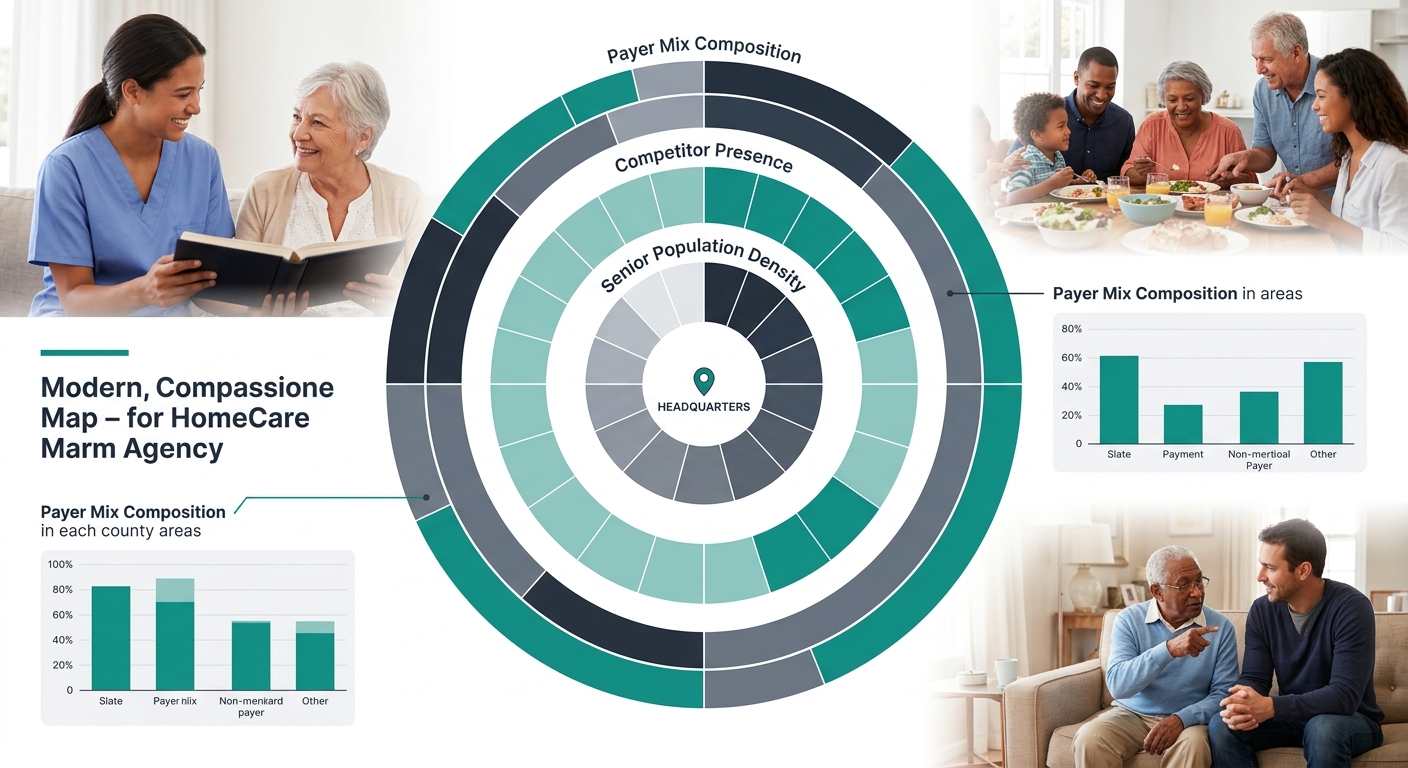
Population density of adults 65 and older per square mile. The U.S. Census Bureau’s American Community Survey provides this at the ZIP-code level. Markets with 150 or more adults 65+ per square mile typically support a full-time care team. Below 80, the drive-time economics break.
Competitor saturation ratio. Count licensed home care providers in the target area using your state’s licensing database, then divide by the 65+ population. A ratio above 1 provider per 2,000 seniors signals a crowded market. Below 1 per 3,500 suggests underserved territory worth investigating.
Payer mix composition. A market where 70% or more of potential clients rely on Medicaid carries different margin implications than one where 40% are private pay. Your existing market’s payer mix gives you a baseline to compare against, and mismatches in expected reimbursement have sunk expansion plans within 9 months.
The analysis of underserved care communities reveals patterns that pure proximity maps miss. Bradley University’s research on underserved populations documents that the Southeast holds a disproportionate concentration of communities in rural areas below the poverty line, meaning geographic expansion strategy for home care in those regions requires Medicaid-capable operations from the start. A market may look open, but if your agency isn’t built for its dominant payer, you’ll burn cash acquiring clients you can’t serve profitably.
Workforce Isolation as the Core Structural Requirement
The single most common expansion failure is staffing the new market with caregivers pulled from the existing one. This creates the conditions for cannibalization immediately, because the core territory loses coverage reliability while the new territory operates with a team that doesn’t know its geography, its facilities, or its referral contacts.
Industry experts emphasize this point repeatedly. As Billie Agnone and fellow panelists discussed at an AlayaCare-hosted industry event, employee recruitment and retention is the “secret sauce” for home care agency growth. Agencies that invest time, energy, and creativity into hiring for the new territory specifically see measurable expansion results. Those that redistribute existing staff see turnover spikes in both locations.
The numbers reinforce this. The home care industry’s documented 79% caregiver turnover rate already pressures margins. Stretching thin teams across wider geographies accelerates that turnover by adding commute burden, schedule unpredictability, and assignment fragmentation. One analysis found that agencies lose $780,000 annually from caregiver scheduling gaps in a single market. Doubling the territory without doubling staff compounds that figure.
Territory expansion without brand dilution requires that new-market caregivers live within 20 minutes of the new service area. Recruit locally before you announce the market launch. Aim for a minimum bench of 8 to 12 caregivers who can cover the initial caseload without borrowing from your primary team.
The single most common expansion failure is staffing the new market with caregivers pulled from the existing one.
Building Market-Specific Marketing Infrastructure
Your core territory’s Google Business Profile, location pages, and referral partner relationships don’t transfer to a new market. Each geography needs its own local marketing presence built independently.
Create a dedicated Google Business Profile for the new service area with its own address, phone number, and reviews. Google’s local pack algorithm uses proximity as a primary ranking signal. A profile 35 miles away from a searcher won’t surface for “home care near me” queries. Agencies that build neighborhood-level service pages for each ZIP code in the new territory see 3x to 5x higher organic inquiry rates in the first 6 months compared to agencies that try to rank their existing domain’s generic service page.
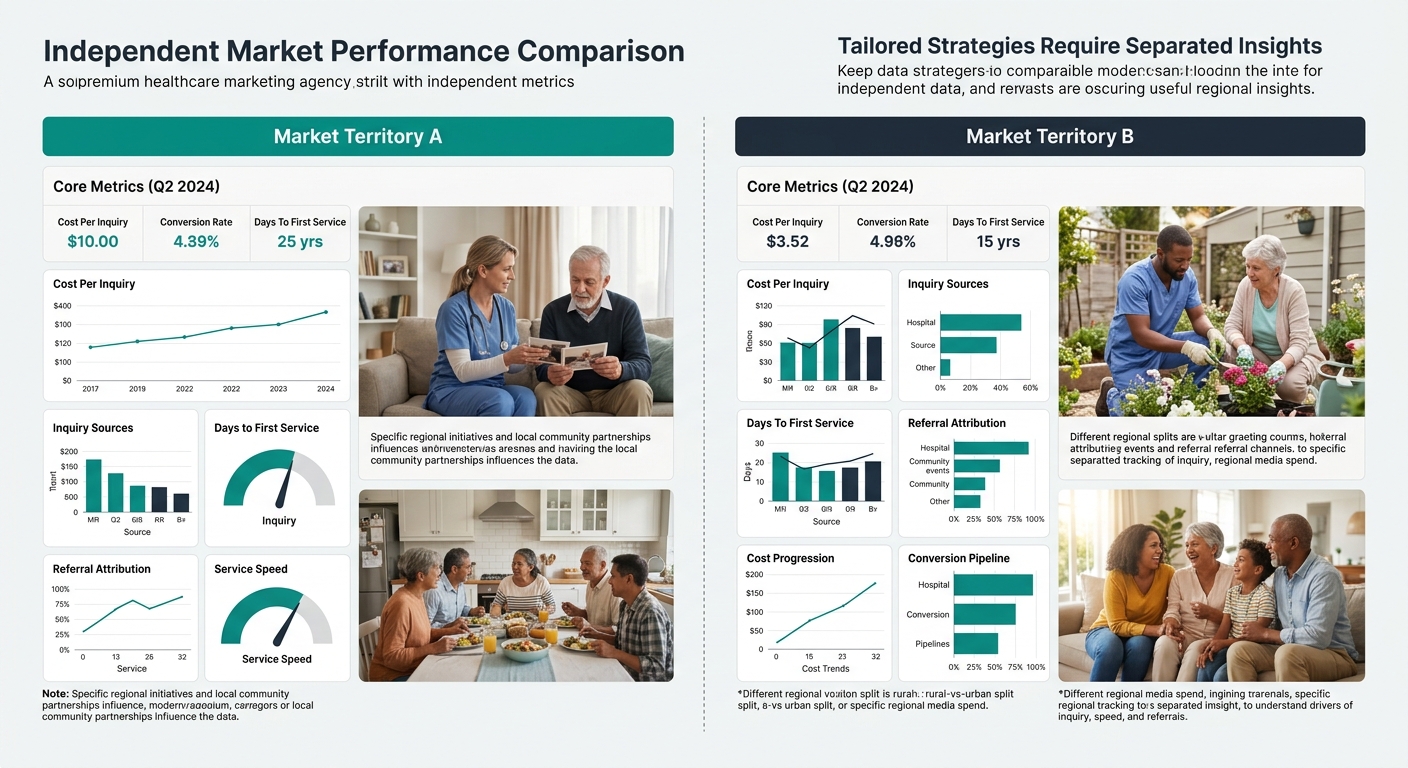
Run a marketing diagnostics audit 90 days after launch in the new market. Track these 4 metrics separately from your core territory: cost per inquiry, inquiry-to-assessment conversion rate, average days from first inquiry to first service, and referral source attribution. Blending these numbers with your existing market’s data masks problems until they’re expensive to fix.
If you need support building market-specific campaigns across territories, Care Marketing’s services cover the local SEO, paid media, and referral infrastructure that multi-market agencies require.
The Three-Layer Isolation Model
A framework for evaluating whether your expansion plan is truly isolated or quietly cannibalizing your core territory. Score each layer on a 1-to-5 scale, where 5 means fully separate and 1 means fully shared.
| Layer | Fully Isolated (5) | Partially Shared (3) | Fully Shared (1) |
|---|---|---|---|
| Workforce | 100% local hires, no borrowed caregivers | Some borrowed staff during ramp-up (under 25%) | Core team covers both territories |
| Referral Pipeline | Dedicated coordinator, separate contact list | Coordinator splits time 60/40 between markets | Same coordinator, same call schedule |
| Marketing Assets | Own GBP, local pages, budget, tracking | Shared domain but separate pages, blended budget | Single GBP, single budget, combined reporting |
A combined score below 9 out of 15 signals high cannibalization risk. Below 6, the new territory is functionally parasitic on the core market and will degrade both within 2 quarters.
Warning: If your expansion plan scores below 9 on the Three-Layer Isolation Model, pause the launch. Fix workforce and referral isolation before spending on marketing in the new territory.
Where the Model Breaks
Resource isolation works for adjacent-market expansion within a 50-mile radius of your headquarters. It gets harder to execute when you’re entering a market 150 or more miles away, where you can’t send a regional director for same-day oversight visits. Multi-site rollout research confirms that centralized planning and disciplined controls are essential for consistency at scale, but home care adds a variable that retail doesn’t face: every client’s care plan is unique, and quality failures carry regulatory consequences.
The model also assumes you can recruit locally in the new market. In rural areas where the 65+ population density falls below 80 per square mile, the caregiver labor pool shrinks proportionally. You may verify demand but lack the workforce supply to serve it without the exact resource-sharing the model warns against.
And expansion timing matters. Agencies with caregiver turnover above 60% in their core market should treat that instability as a red flag. Fix retention at home before spending on a second market. Griffith’s warning applies here directly: master growth in your existing territory first, or the new one will magnify problems you haven’t solved yet. Entering a second market with an unstable first one doesn’t double your revenue. It doubles your exposure to the workforce shortage that already costs the $174 billion home care industry its margins.