
Applicant tracking systems used by home care agencies automatically disqualify qualified caregivers through misconfigured employment-gap filters, broken background-check integrations, and non-mobile-friendly application flows. These compliance gaps in caregiver screening cost agencies 25% to 35% of annual compensation per lost hire while compounding annual turnover that already exceeds 60%.
The Default Configuration Nobody Audited
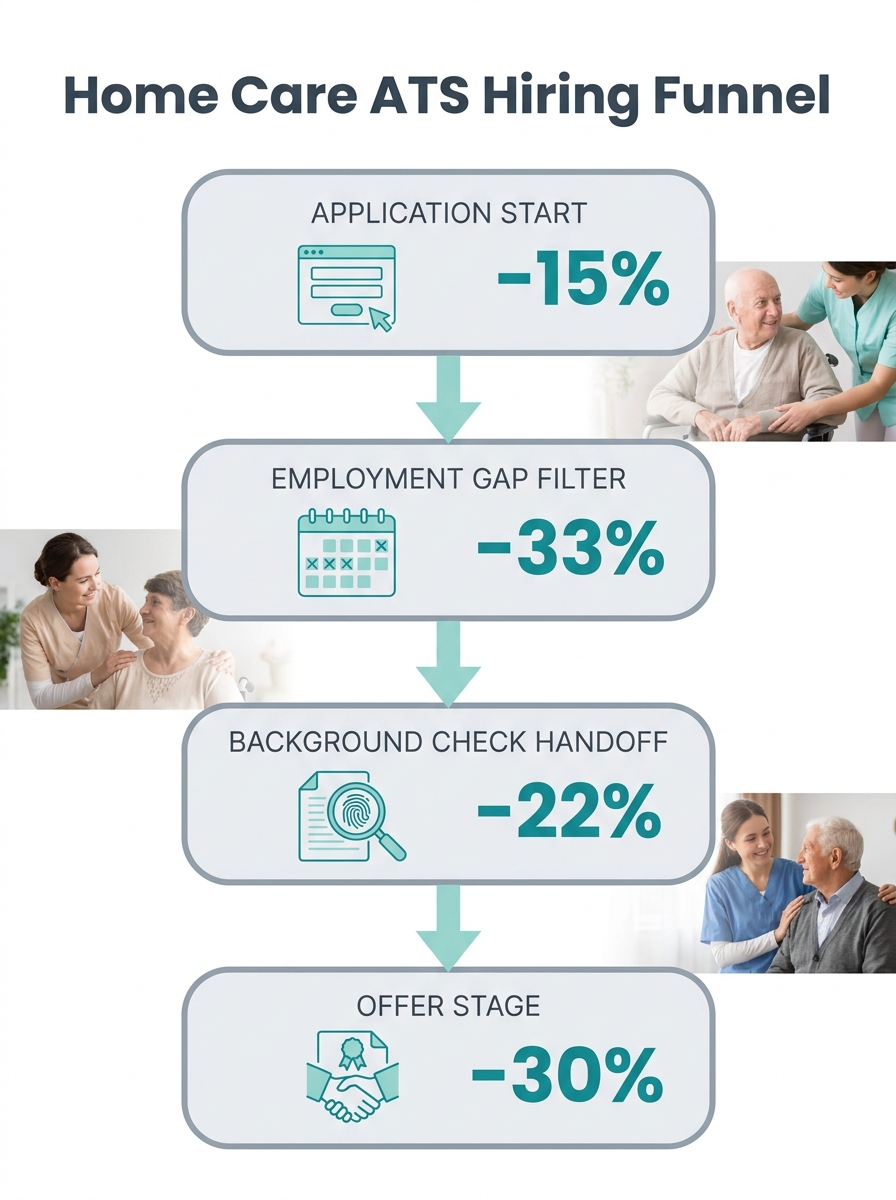
When a home care agency purchases an ATS, the platform ships with generic screening filters designed for white-collar hiring. The defaults include employment-gap thresholds, keyword-match scoring, and credential verification sequences built for industries where candidates hold four-year degrees and submit polished résumés. Approximately 50% of employers using these systems automatically drop candidates with employment gaps exceeding six months, according to industry hiring data. For caregiving, that filter is devastating.
Caregivers leave and return to the workforce constantly. They pause to care for aging parents, manage childcare, recover from burnout at a previous agency, or complete CNA certification programs that can take 4 to 12 weeks depending on state requirements. A six-month gap is ordinary in this labor market. An ATS that treats it as disqualifying throws away the exact candidates an agency needs.
The problem compounds because most agencies never revisit these default settings after initial setup. As myEZcare’s home care software analysis documented, “most failures happen because the software was chosen before the agency clearly defined how care is delivered day to day.” That finding applies with equal force to applicant tracking: the platform was configured before anyone mapped the actual profile of a viable caregiver candidate.
How Background Check Handoffs Fracture the Pipeline
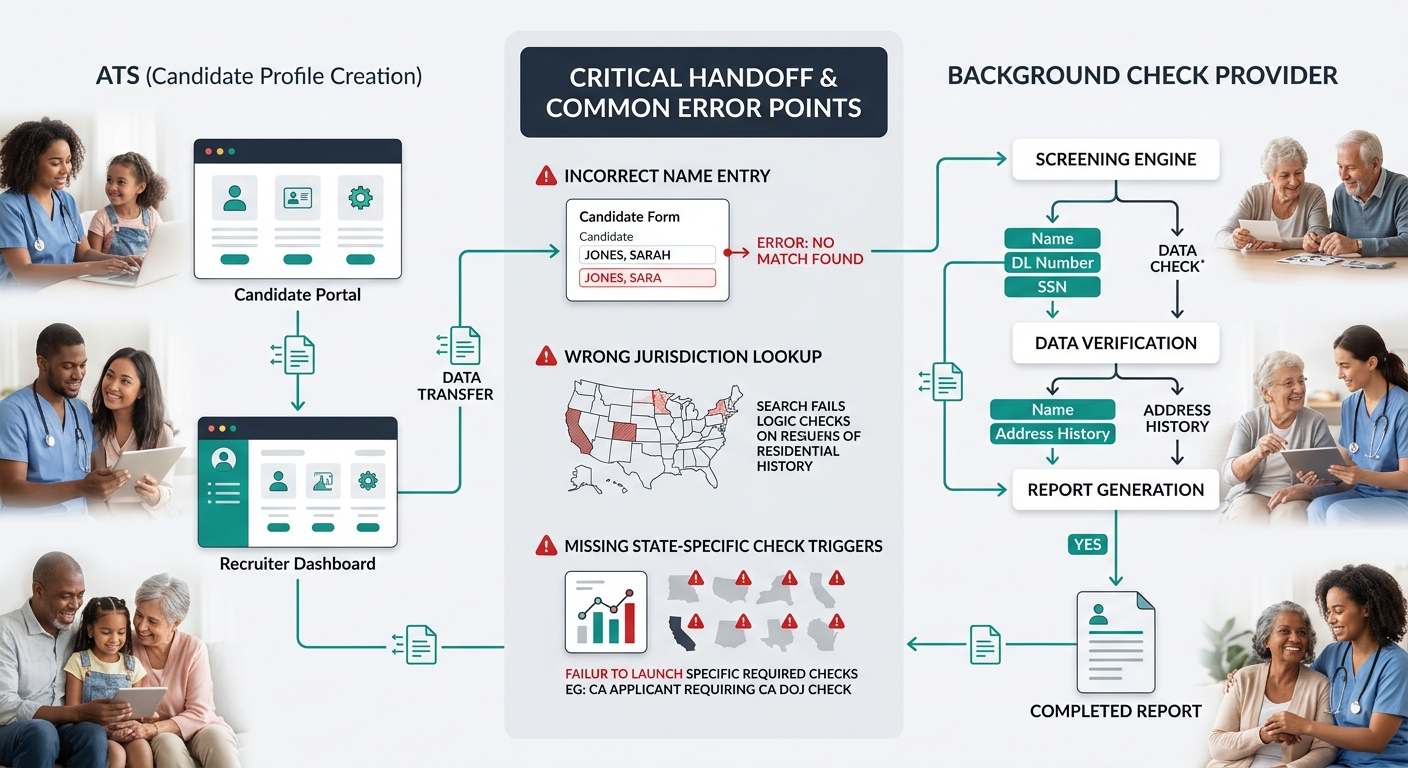
The integration between an ATS and a background screening provider is where most compliance gaps in caregiver screening become invisible, and where home care recruitment software failures cause real regulatory exposure. A caregiver applicant clears the ATS filters, gets flagged as viable, and then enters a background check workflow. This handoff is the critical juncture.
iprospectcheck’s 2026 employer guide to ATS background checks identified the core vulnerability: “Staff can make mistakes when manually entering data, which can result in inaccurate background checks.” Those errors produce three distinct failure modes. First, a candidate’s name or date of birth gets transcribed incorrectly, generating a false-positive criminal record hit that disqualifies a clean applicant. Second, the system searches the wrong jurisdiction because the address field defaulted to the agency’s zip code rather than the candidate’s. Third, required state-specific checks (like OIG exclusion list queries or state nurse aide registry verifications) get skipped entirely because the ATS wasn’t configured to trigger them for the agency’s operating state.
Each of these errors carries compliance consequences. As iprospectcheck’s caregiver background check guide warns, “failing to conduct in-depth caregiver background checks could expose you to substantial fines and extensive liability.” DISA’s caregiver screening analysis adds that checks requiring verification from multiple jurisdictions take longer than single-source checks, and agencies that don’t build this delay into their hiring timeline lose candidates who accept offers from faster-moving competitors.
The timeline pressure is real. The average home care agency operates in a market where qualified caregivers receive 2 to 3 competing offers within 72 hours of beginning a job search. If your ATS adds 5 to 7 extra business days because of a manual data-entry step or an unconfigured multi-state check, you’ve already lost that candidate. And you’ve also created an undocumented compliance gap that an auditor could flag months later.
The Application That Never Loaded on a Phone
Caregiver ATS implementation mistakes often have nothing to do with filters or background checks. They start at the application itself. Caregivers apply for jobs from their phones, often during breaks between client visits or while riding transit. An ATS application page that requires desktop-style form completion, multi-page uploads, or browser-based document scanning eliminates these applicants before they finish page one.
The drop-off rate for non-mobile-optimized applications in hourly healthcare roles runs between 40% and 60%. That means an agency posting on Indeed, myCNAjobs, or Care.com (as Ankota’s caregiver recruiting analysis recommends) is paying for visibility on niche job boards only to funnel candidates into an application flow that half of them will abandon.
Agencies that have explored alternative recruitment channels beyond Indeed already know that sourcing is only half the equation. If your ATS can’t accept a photo of a CNA certificate taken on a phone camera, your sourcing spend is subsidizing your competitors’ hiring.
If your ATS can’t accept a photo of a CNA certificate taken on a phone camera, your sourcing spend is subsidizing your competitors’ hiring.
myEZcare’s implementation research documented a pattern where peer adoption drove caregiver technology acceptance: “When other caregivers see one of their peers successfully using the new mobile app, resistance often turns into curiosity.” The inverse is also true. When a caregiver tells three colleagues that an agency’s application crashed on her phone, those three colleagues never apply.
Edify Background Screening’s compliance analysis identifies a structural problem underneath the mobile issue: “By conducting periodic reviews of your background check policies and procedures, you can identify potential gaps or areas of weakness that may lead to non-compliance.” Agencies that audit their background check policies quarterly still miss the ATS application layer because it sits upstream of the compliance review. The application flow and the screening flow belong in the same audit cycle.
The Replacement Math Your Dashboard Hides
Cadient’s applicant tracking system ROI analysis frames the cost question bluntly: “Too many recruiting tools automate tasks but fail to prove value. They make hiring look busy instead of better.” For home care agencies, that distinction between busy and better shows up in three measurable numbers.
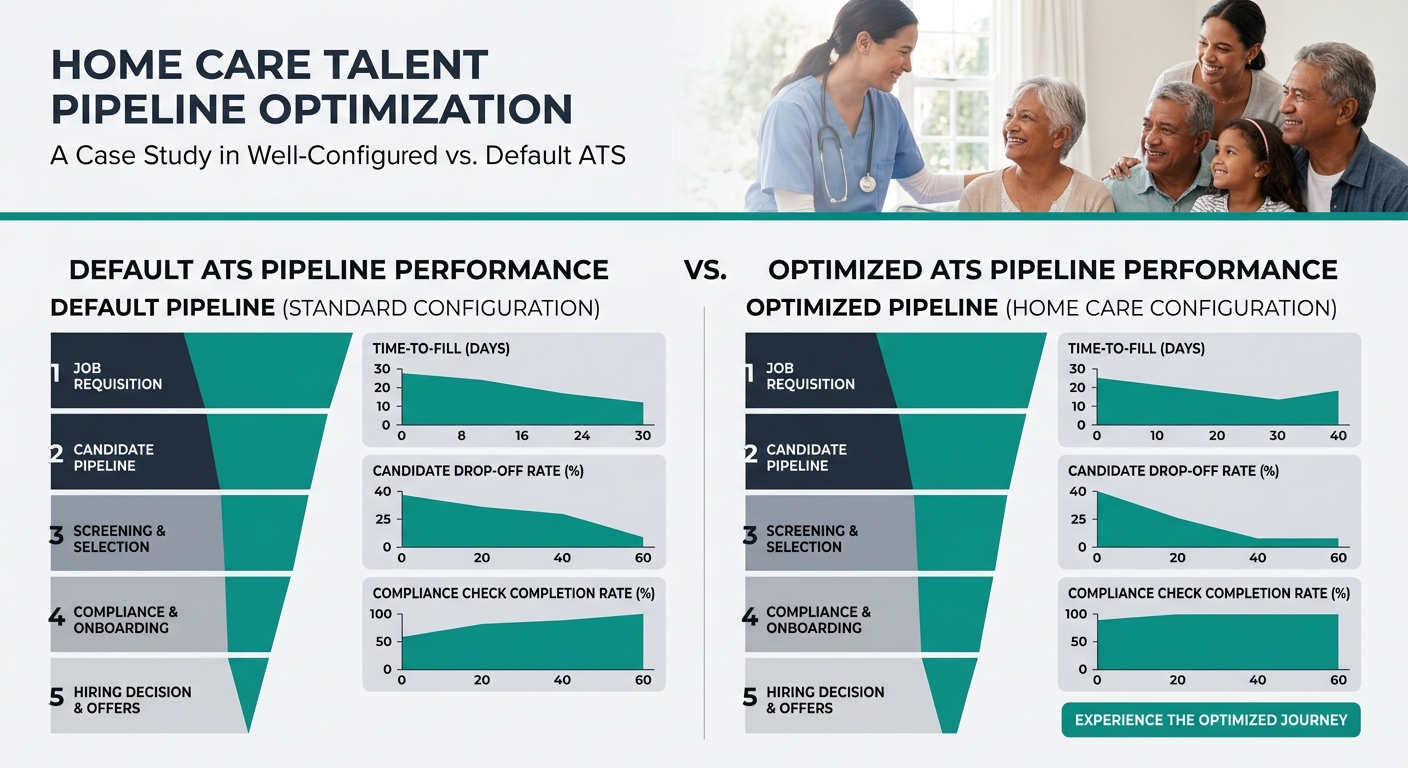
First, time-to-fill. TechTarget’s ATS ROI metrics framework measures this in days. The home care industry benchmark for time-to-fill sits between 14 and 21 days for direct-care roles. Agencies with poorly configured ATS platforms routinely exceed 30 days because of the compounding delays described above: gap filters reject viable candidates, background check handoffs stall on manual data entry, and mobile-unfriendly applications drain the top of the funnel.
Second, cost-per-hire. With caregiver annual compensation averaging $28,000 to $34,000 depending on market, and replacement costs running 25% to 35% of that figure, each lost hire costs $7,000 to $11,900. An agency losing 5 candidates per month to ATS configuration errors is burning $35,000 to $59,500 monthly in replacement costs alone.
Third, the compliance exposure that doesn’t appear on any recruitment dashboard. When an ATS skips a required background check step or searches the wrong jurisdiction, the agency carries a liability that compounds with every shift that caregiver works. A single negligent hiring claim in home care can generate six-figure legal costs. That risk never shows up in applicant tracking system ROI calculations because most ATS dashboards track applications received, interviews scheduled, and offers extended. They don’t track checks that should have run but didn’t.
Agencies already tracking software overhead at the coordinator level know that hidden operational costs accumulate fast. The ATS layer adds another category of invisible expense: the cost of candidates you never knew you lost, and the compliance gaps you won’t discover until an incident forces the audit.
The Audit That Should Have Happened at Go-Live
The pattern dissected here reproduces across agencies of every size. An ATS gets purchased, configured with factory defaults, connected to a generic background check provider, and pointed at job boards. Nobody maps the system’s filter logic to the actual profile of a viable caregiver candidate. Nobody tests the application flow on a phone with a cracked screen and a slow data connection. Nobody verifies that the background check integration triggers every state-mandated screening element.
Tip: Audit your ATS against four specific failure points: employment-gap filter thresholds (set them to 18 months minimum, or disable them entirely for direct-care roles), background check data-entry automation (eliminate manual transcription between the ATS and the screening provider), mobile application completion rates (measure them weekly, not quarterly), and jurisdiction-specific check configurations (verify every required screening element fires for every operating state).
Agencies investing in caregiver career advancement systems and migrant caregiver recruitment pipelines already understand that hiring is a system problem, not a sourcing problem. The ATS sits at the center of that system. When it’s misconfigured, every dollar spent on recruitment channels, referral programs, and employer branding flows through a pipeline with holes in it.
Care Marketing can help you identify where your recruitment funnel leaks before candidates reach a human being. The most expensive hire is the one your ATS rejected on your behalf, silently, while you wondered why nobody was applying.