
CareCrown founder Elizabeth Moss reduced caregiver turnover costs by tracking “revenue leaks” worth up to $780,000 annually through a points-based mobile platform now used by home care agencies for as little as $100 per month, according to a May 29 interview published by Home Care Post. Moss launched the platform in 2020 after quantifying $250,000 in annual revenue losses tied to late clock-ins and unfilled shifts at her Nashville-area agency.
TL;DR: Elizabeth Moss built CareCrown after measuring how late caregivers, callouts, and unstaffed shifts cost her Tennessee home care agency $250,000 per year, creating a points-based app that now integrates with major scheduling systems to align caregiver behavior with agency profitability.
The platform addresses a workforce problem that intensified after 2015 regulatory changes eliminated overtime exemptions for home care workers, forcing agencies to restructure staffing models that had relied on caregivers working 60–65 hour weeks. Moss, who founded her agency in 1997, estimates that a 500-hour weekly gap between scheduled and billable hours costs an agency approximately $15,000 per week at $30 per billable hour—or $780,000 annually when compounded with client churn and rehiring expenses.
From Agency Owner to Software Founder
Moss operated Caregivers by WholeCare in the Nashville area for more than two decades before separating the CareCrown technology from her agency operations. She piloted the performance-tracking system internally in 2019, then spun out CareCrown as a standalone company in 2020 after external interest grew and she fielded acquisition offers for her agency, the Home Care Post interview shows.
“Caregivers have been hugely underserved, underappreciated, underrecognized and undervalued,” Moss said in the published interview.
Her background spans nursing, assisted living roles, and private-duty care before she launched her own agency. That operational experience shaped CareCrown’s focus on measurable behaviors—clock-in punctuality, shift completion, supervisor kudos—rather than tenure-based compensation alone.
How Regulatory Changes Exposed Revenue Gaps
Moss traces CareCrown’s origin to 2016 regulatory disruptions around overtime and wage structures that eliminated the home care exemption in Tennessee. Agencies that had staffed operations with caregivers working extended weekly hours faced immediate labor shortages when families couldn’t absorb overtime costs and agencies couldn’t maintain staffing elasticity.
Caregivers began working across multiple agencies to reconstruct full-time income, creating overlapping schedules and rising callout rates. Even agencies paying above minimum wage—Moss notes she was already doing so—lost scheduling predictability and the ability to accept new clients due to staffing constraints.
Working with a fractional chief financial officer and benchmarking tools, Moss connected workforce behavior directly to financial outcomes. If a scheduler books 1,500 hours per week but only 1,000 are billable due to staffing inefficiencies, that 500-hour gap translates to approximately $15,000 per week in lost revenue, the interview details. Annualized, that approaches $780,000, excluding secondary losses from onboarding delays and client churn.
The Performance-Based Compensation Model
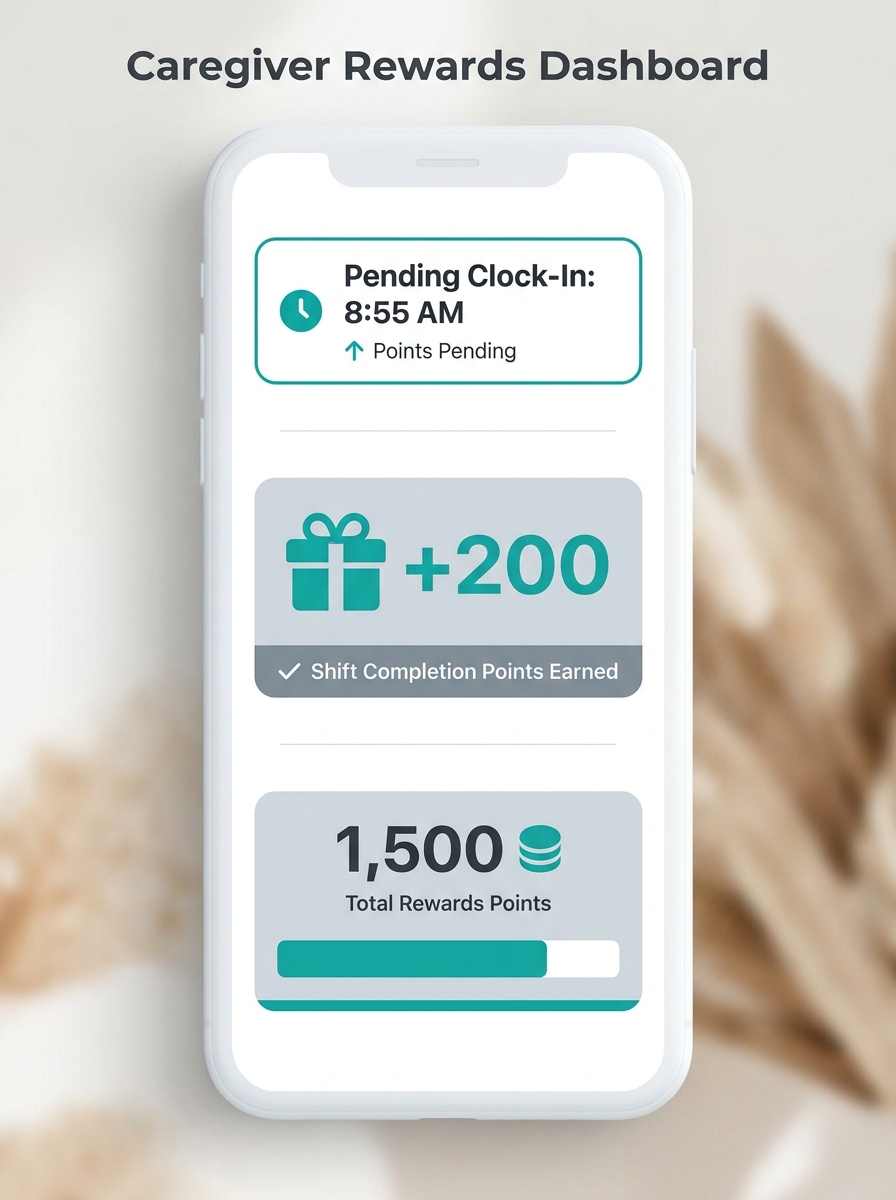
CareCrown reframes caregiver engagement as a margin driver by tying observable behaviors to structured rewards. The platform tracks late clock-ins, last-minute callouts, open shifts, and lost new-client capacity due to staffing gaps in real time.
Moss described the compensation model as inspired by a “Starbucks game” rewards structure: points earned for completing shifts on time, clocking in without delays, and receiving supervisor recognition. The system sits alongside existing scheduling platforms—CareCrown integrates with Rosemark, AxisCare, and WellSky—pulling shift data, clock-in times, and completion records directly from agency workflows.
Agencies using the platform pay as little as $100 per month for smaller operations, according to the Home Care Post profile. The cost structure scales with agency size and caregiver count.
Agencies struggling with caregiver recruitment and retention have increasingly turned to technology-driven performance systems as wage increases alone fail to stabilize workforce turnover. The platform’s focus on daily operational activity mirrors broader industry efforts to build caregiver referral programs and career advancement structures that retain experienced workers.
Platform Mechanics and Integration
Caregivers interact with CareCrown through a mobile app that connects to their scheduling system. Activities tracked include clocking in on time, completing assigned shifts, and receiving kudos from supervisors. Each action accumulates points that convert to rewards or recognition within the agency’s compensation structure.
The integration layer pulls shift assignments, clock-in and clock-out times, and scheduling changes from platforms caregivers already use daily. Moss noted that connecting directly to scheduling systems eliminates duplicate data entry and ensures real-time tracking without adding administrative burden to agency staff.
The platform launched its pilot phase in 2019 within Moss’s own agency before external rollout began in late 2022. Partnerships with major home care scheduling vendors followed, embedding CareCrown into caregiver workflows across multiple agencies.
Context and Outlook
CareCrown’s growth trajectory follows a broader industry shift toward operational analytics in home care, where agencies increasingly treat workforce stability as a measurable financial input rather than a cultural initiative disconnected from revenue. The platform’s $100-per-month entry point positions it as accessible to smaller agencies navigating the same staffing fragmentation that Moss documented in her Nashville operation.
The 2015–2016 regulatory changes that disrupted Moss’s agency remain a structural pressure across home care markets, particularly in states where Medicaid reimbursement rates have not kept pace with labor costs. Agencies that cannot absorb overtime expenses or raise rates face persistent staffing constraints, making retention systems that reduce callouts and late arrivals a direct profitability lever.
By quantifying revenue loss in hourly terms—$15,000 per week for a 500-hour scheduling gap—Moss provides agency operators a financial framework for evaluating workforce performance investments. Whether that calculus extends beyond CareCrown’s current integrations to broader workforce management systems will depend on how agencies prioritize caregiver engagement relative to other operational pressures in a market where skilled care staff shortages continue to constrain capacity.