
Senior living communities match or undercut home care costs for aging adults requiring more than basic assistance, yet 59% of potential residents believe facilities are unaffordable, according to a May 2026 American Seniors Housing Association report prepared with ATI Advisory and separate consumer research from Whittington Consulting.
TL;DR: The ASHA research documents that 12-hour daily home care costs approximately $12,000 monthly—double the assisted living rate in multiple markets—while Pew data shows only 18% of adults 65 and older plan to move to assisted living when they need care, with cost perception cited as a primary barrier.
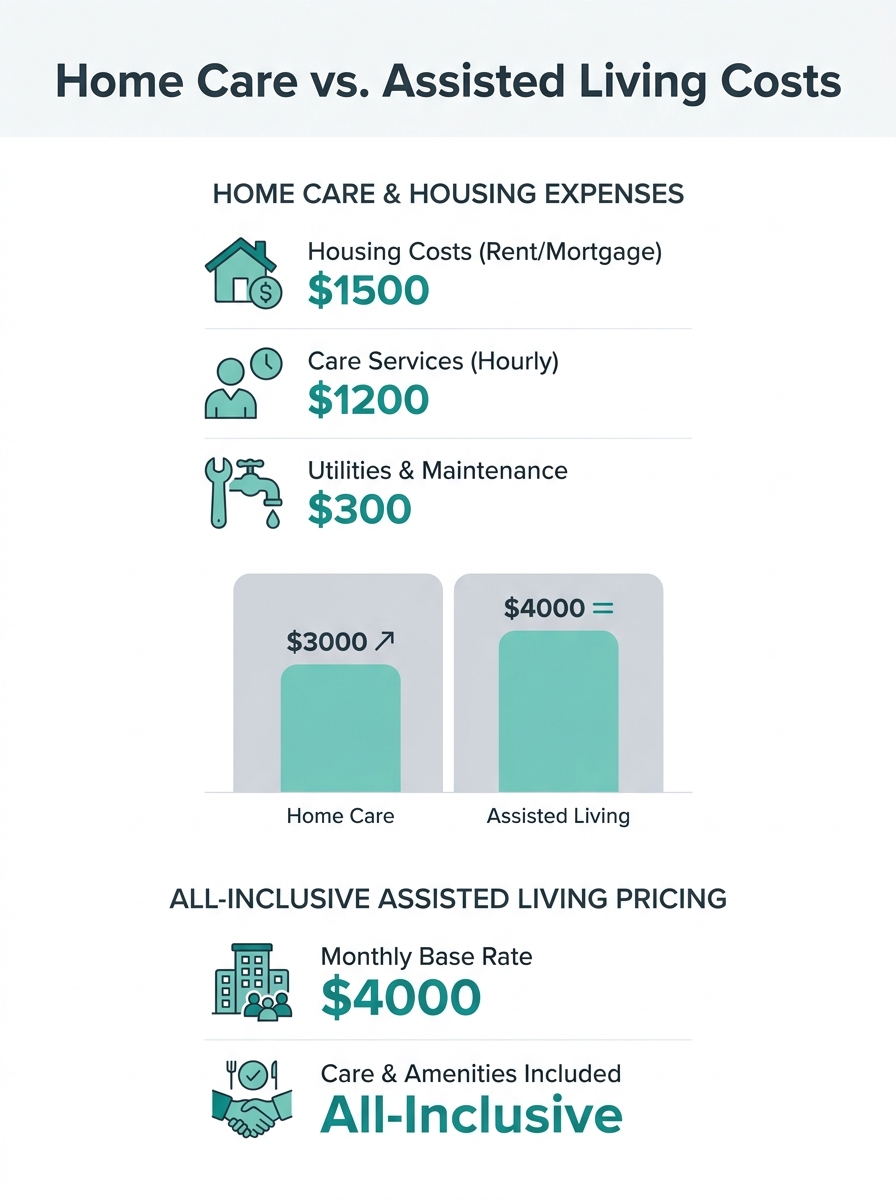
The cost comparison centers on a simple math problem most families miss: Genworth’s most recent Cost of Care survey pegged 40-hour-weekly home care at $6,300 per month and assisted living at approximately $6,400 monthly, the ASHA analysis noted. When families add mortgage or rent, property taxes, utilities, groceries, and home maintenance to the care bill, living at home “can quickly match or exceed the cost of assisted living,” the report authors wrote.
Twelve-hour daily home care—totaling 84 hours weekly—runs roughly $12,000 per month across multiple U.S. markets, twice the median assisted living rate, according to cost data compiled in the ASHA study. Around-the-clock home care can exceed $20,000 monthly, the association found.
Cost Perception Disconnected From Actual Spending
Pew Research data released earlier in 2026 showed that 60% of adults age 65 and older want to remain at home with a caregiver when they require assistance, compared with 18% who said they want to move to assisted living. Income stratification appeared in those preferences: 28% of higher-income respondents said they wanted assisted living, versus 19% of middle-income adults and 13% of lower-income adults, the Pew survey found.
“Many families still believe that accessing home care is easy and cost-effective compared to senior living,” the ASHA report authors wrote, noting that perception holds true for short-term, low-acuity scenarios but breaks down as care needs escalate.
Just under half of respondents to the 2025 Whittington Consulting survey said they expect senior living to cost “much more” than aging in their own homes, while 59% said they believe senior living communities are not affordable, according to that firm’s research.
Operators raised rates to cover rising care expenses over the past six years, which “led some residents to perceive reduced value in their communities, though many residents report that their perception of value has not changed,” a separate ASHA report on resident financial profiles stated.
Income and Retirement Readiness Shape Decisions
Approximately 56 million U.S. workers across all age groups lack access to workplace retirement plans, Pew Research reported in 2026, citing AARP data. A 2022 Federal Reserve survey found that roughly 75% of non-retired Americans hold some retirement savings, but fewer than one-third believe they are “on track for retirement,” Pew noted in its analysis.
The gap between people who have saved and people who believe their savings are sufficient suggests many aging adults doubt they will afford senior living when the time comes, even if the math would support the move, according to the ASHA authors’ interpretation.
About 37% of older adults who want to stay home with a caregiver see that outcome as extremely or very likely, while 18% said it is not likely to happen, Pew data showed. A similar 35% of adults who want assisted living view that outcome as extremely or very likely, with 16% saying it’s unlikely.
The Value Communication Challenge
Senior living operators have historically differentiated their offerings through resort-style amenities, social programming, and clinical quality rather than through direct cost comparisons with home-based care, the ASHA report observed. “I still think the senior living industry can do a better job advocating for its current value to prospective residents,” one industry observer wrote in the Senior Housing News analysis accompanying the research.
Facilities face a structural marketing problem: cost perceptions are set before families run detailed comparisons, and by the time acuity rises enough to make senior living the clear value play, the family may have already dismissed the option as unaffordable.
Building middle-market senior housing inventory remains “out of reach for most companies seeking to do it” in the short and medium term, the ASHA discussion noted, meaning operators must work with existing price points and reframe the value message rather than wait for new affordable supply.
The decision-making dynamic differs between adult children and seniors themselves, with income levels shaping which families even consider assisted living as an option when initial care needs arise.
The Takeaway
This research documents what operators already suspected: families systematically underestimate home care costs when acuity climbs and overestimate senior living rates relative to the all-in expense of aging at home. The strategic opening for admissions teams lies in reframing assisted living not as a lifestyle upgrade that carries a premium, but as a cost-equivalent or cost-advantaged option once families account for housing, meals, utilities, and escalating care hours.
Marketing messaging that builds trust through transparency around total cost of ownership—rather than leading with amenities—can shift the perception gap that currently keeps 59% of prospects convinced senior living is out of reach. Operators competing against the “aging at home” default need cost calculators, itemized comparisons, and care-hour breakpoints baked into the inquiry process so families see the math before dismissing the option.
The window for this repositioning is narrow: developing genuinely middle-market inventory won’t arrive in time to capture the current wave of aging boomers, meaning differentiation on value—rather than on price reduction—represents the tactical path forward for operators working with existing rate structures.