
Pull up the careers page for any mid-sized home care agency and you’ll probably find a career ladder graphic. It’s usually a staircase with three to five steps: CNA at the bottom, maybe a supervisor title at the top, some vague middle rungs labeled “Senior Caregiver” or “Lead.” The graphic gets posted on Indeed. It shows up in orientation binders. And then nothing happens.
The 90-day turnover rate in home care sits around 80%, driven by rushed hiring, erratic schedules, low pay, and the emotional weight of the work itself, according to AxisCare’s research. Caregiver career advancement messaging is supposed to counteract that churn by giving new hires a reason to stay past the first paycheck. But when the ladder is decorative rather than functional, recruits see through it fast.
So which model of career advancement actually converts applicants into long-tenure caregivers? Three distinct approaches dominate the industry right now, and each carries real tradeoffs.
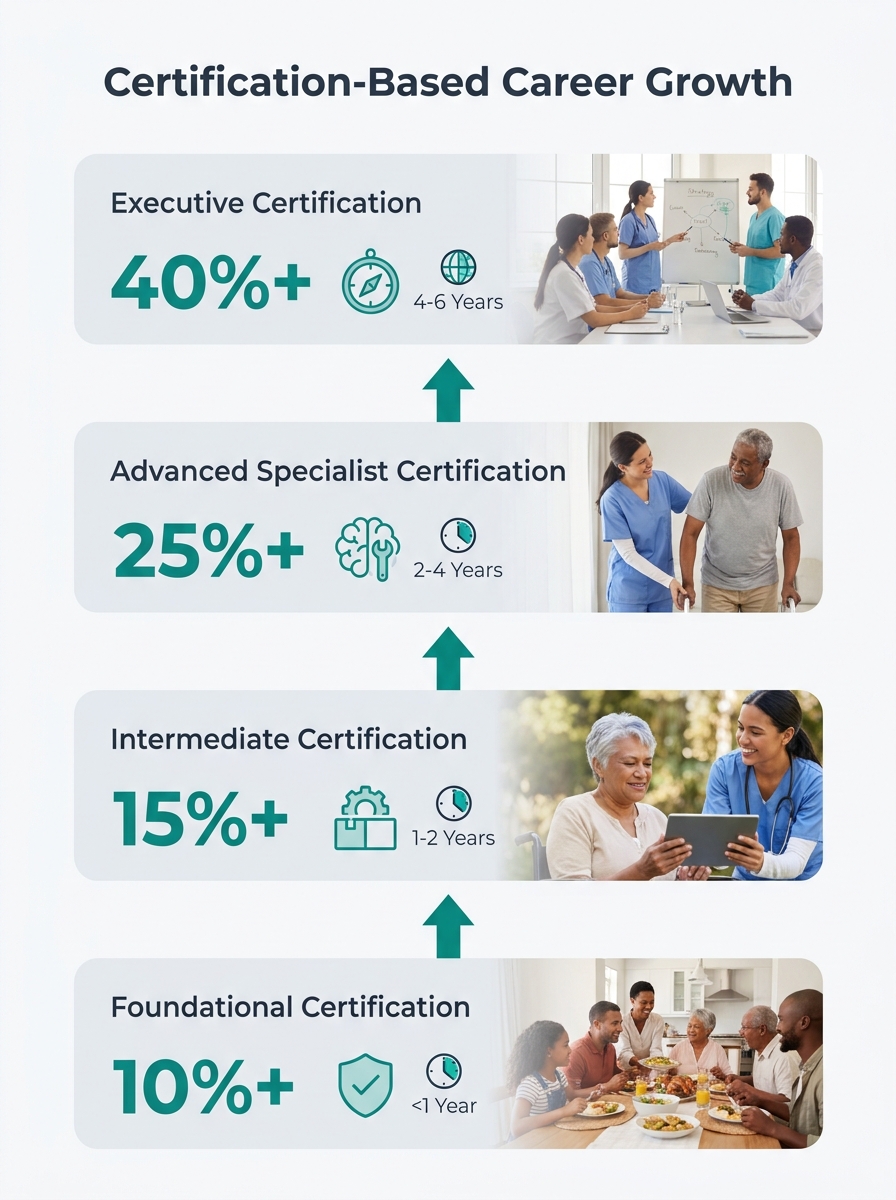
The Certification Stack
This is the most common career ladder in home care. It’s built around credentials: a caregiver starts at a basic level, earns certifications in CPR, dementia care, medication management, or wound care, and moves upward as they accumulate qualifications. Organizations like the Center for Caregiver Advancement have built entire training ecosystems around this model, measuring impact through collaborative research and tying credential attainment to policy change.
The appeal is obvious. Certifications are portable, respected, and concrete. A caregiver who earns a dementia care certification can point to it on a resume, and families can trust that their provider has verified skills. When you’re crafting job ads, being able to list specific training opportunities carries weight with candidates who are comparing your posting against three others on their phone. (If your mobile application process is already losing candidates, adding credential-based promises to a broken funnel won’t help.)
Where Certification Stacking Falls Apart
The failure point is almost always the same: agencies promote the certifications but don’t tie them to pay increases or role changes. A caregiver completes 40 hours of Alzheimer’s training and gets the same hourly rate and the same shifts. Training itself may improve job satisfaction and confidence, as HHAeXchange’s research confirms, but satisfaction without compensation movement eventually feels like a bait-and-switch.
Certification stacking also tends to be slow. If a new hire won’t see a meaningful change in their role for 12 to 18 months, the model does almost nothing to address that brutal 90-day window where most turnover happens. You’re building retention through professional development on a timeline that doesn’t match the urgency of the retention problem.
When This Model Works
Certification-based ladders work best when every credential triggers an immediate, visible change. That could be a $1.50/hour bump, a new client assignment type, or a shift in scheduling priority. The credential itself becomes a marker the caregiver can see on their paycheck, not on a wall certificate alone.
Title-and-Pay Progression
The second model skips the credential emphasis and focuses on structured promotions. A caregiver starts as a Caregiver I, moves to Caregiver II after meeting tenure and performance benchmarks, advances to Senior Caregiver, and potentially transitions into a Care Coordinator or Scheduling Lead role. Each rung comes with a defined pay bump and expanded responsibilities.
This approach is borrowed from industries that solved hourly-workforce retention decades ago. Retail chains, restaurant groups, and hotel operators all use tiered progression systems because they work on a fundamental psychological level: people want to know what’s ahead. When your caregiver career advancement messaging includes specific titles, specific dollar amounts, and specific timelines, you’re giving candidates a tangible reason to choose you over an agency paying the same starting rate with no visible future.
Research from the Bell Policy Center on career ladders for long-term care workers found that partnerships creating intermediary positions decreased worker turnover and improved quality of care. The mechanism is straightforward: when people can see the next rung, they’re more likely to keep climbing.
When your advancement messaging includes specific titles, specific dollar amounts, and specific timelines, you’re giving candidates something concrete to choose and a reason to stay past the first 90 days.
Where Title-and-Pay Progression Falls Apart
Budget. There’s no way around it. If you build a five-tier system where each tier carries a $1.50 raise, you need the margin to sustain that across your workforce as people actually advance. Small agencies with thin margins often design beautiful ladders they can’t fund, and when a caregiver hits the promotion threshold and gets told “we’re not doing promotions this quarter,” the trust damage is worse than having no ladder at all.
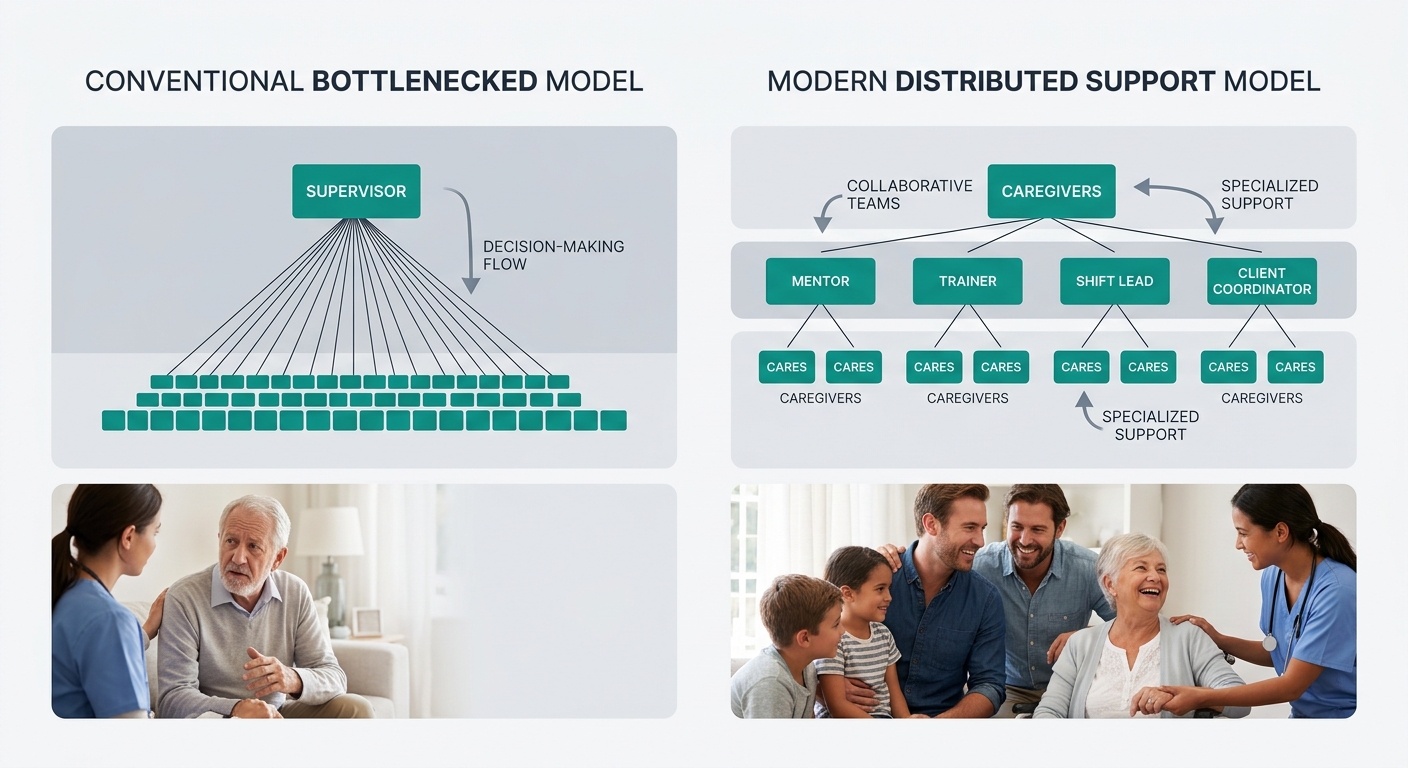
The other risk is bottlenecking. If your top tier is “Care Coordinator” and you only need two coordinators, your senior caregivers hit a ceiling and start looking elsewhere. Title-and-pay models need enough rungs and enough capacity at each level to absorb the people moving through the system.
When This Model Works
Title-and-pay progression shines at agencies with 50+ caregivers, where there’s enough volume to support multiple tiers and enough revenue to fund raises. It’s also the easiest model to communicate in job ads that actually attract caregivers, because you can state “Caregiver I starts at $17/hr, Caregiver III earns $22/hr” and let the numbers do the recruiting.
Skill-Based Micro-Advancement
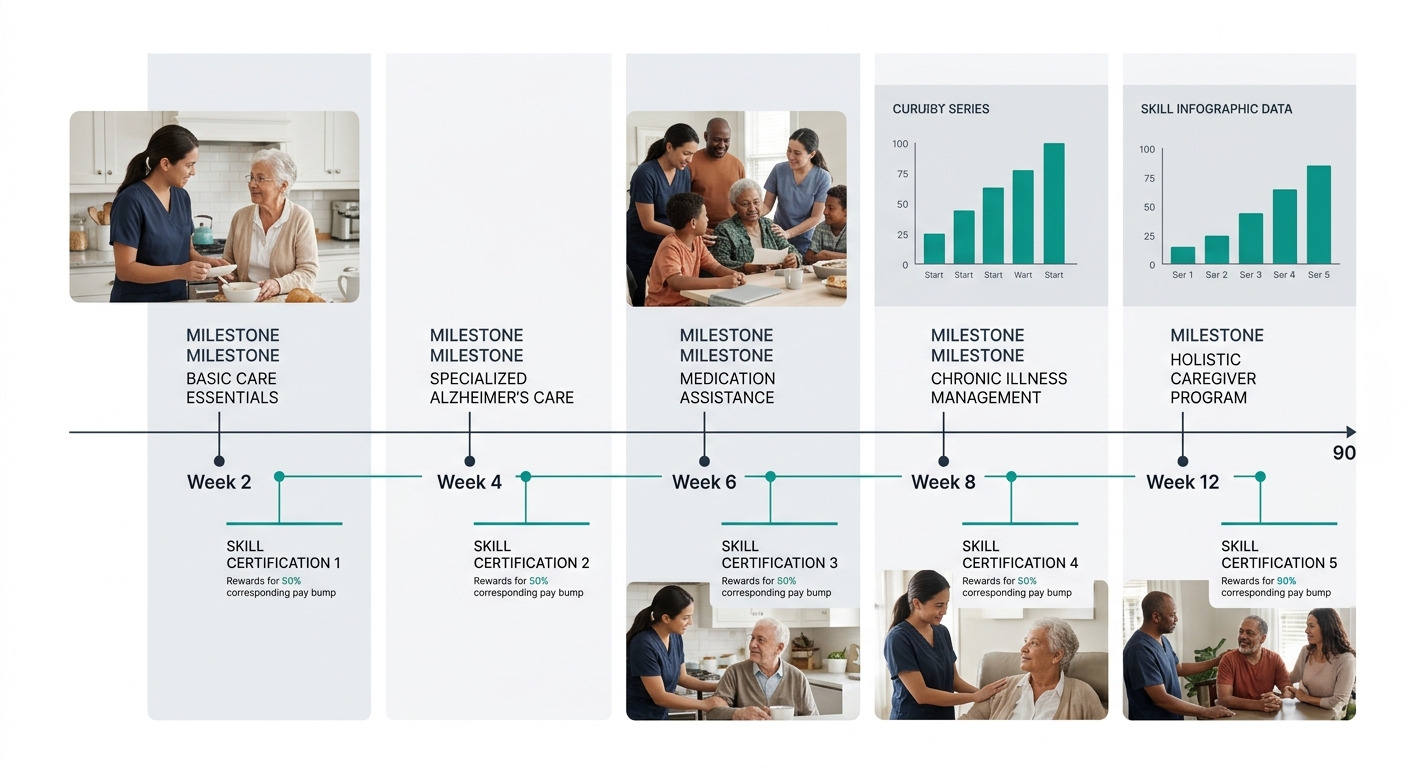
The third model is newer and less common, but it’s gaining traction precisely because it addresses the 90-day turnover window that the other two models struggle with. Skill-based micro-advancement breaks the career ladder into much smaller increments. Instead of waiting months for a certification or a title change, caregivers earn recognition (and small pay bumps) for demonstrating specific competencies on the job.
Think of it this way: a caregiver who masters safe transfer techniques in week three gets acknowledged for it. Someone who handles a difficult family conversation well in week six gets a skill badge and a $0.50/hour bump. The increments are small, but they happen frequently enough that new hires feel forward motion from the start.
This model borrows from how tech companies use skill matrices for engineers. The difference is that in home care, the skills being tracked are things like medication reminders accuracy, client communication quality, and emergency response readiness. Agencies using platforms like CareAcademy or Home Care Pulse can track some of these competencies digitally, which makes the system measurable rather than subjective.
Where Micro-Advancement Falls Apart
The biggest risk is perception. If each increment is too small, caregivers can feel like they’re collecting participation trophies rather than building a career. A $0.25 raise for completing a module might feel insulting to someone who could earn more by switching agencies. The system also requires consistent, fair evaluation from field supervisors, and inconsistent managers can turn the whole thing into a source of resentment rather than motivation.
And there’s a communication problem. Try explaining a 15-tier micro-skill matrix on a Facebook recruitment post or an Indeed listing. Certification stacking is easy to summarize (“Earn your dementia care certification with us”). Title-and-pay is easy to summarize (“Advance from Caregiver I to Care Coordinator”). Micro-advancement requires more explanation, which means it often gets lost in initial recruiting competitive advantages for home care agencies and only becomes visible after onboarding.
When This Model Works
Micro-advancement excels at agencies where early turnover is the primary problem. If you’re losing caregivers before they’ve been on the job 90 days, the other two models won’t even get a chance to take effect. Frequent, small wins create early engagement. Pair micro-advancement with a strong caregiver referral program, and your retained caregivers become your best recruiters because they can credibly say “I’ve already moved up twice in three months.”
How to Choose Between These Three
The honest answer is that most agencies performing well on caregiver turnover prevention strategies aren’t running a pure version of any single model. They’re combining elements based on where their retention problem actually lives.
If your turnover is concentrated in the first 90 days, start with micro-advancement. You need wins that happen before a caregiver has time to disengage. Bolt on certification opportunities at the six-month mark, once they’ve decided to stay.
If your turnover happens at the 12-to-24-month mark, the problem is probably a ceiling. Title-and-pay progression gives experienced caregivers something to reach for. Build at least four tiers with meaningful pay differences between each one.
If you’re struggling to attract applicants at all, lead with the certification stack in your recruiting messaging. Candidates searching job boards respond to visible training investments because they signal an agency that takes the work seriously. Families notice this too, which is why trust signals drive care facility decisions as much as they drive caregiver recruitment.
Tip: Before committing to a model, pull your turnover data and segment it by tenure length. The shape of the problem tells you which ladder design to prioritize. Agencies investing in the wrong model often see no retention improvement and conclude that career ladders “don’t work here.”
Whatever combination you choose, one rule holds across all three: if advancement exists on paper but not in practice, you’re doing more harm than no ladder at all. Agencies where retention through professional development is real and funded see measurable improvements in caregiver tenure and client outcomes. Agencies that use career ladder graphics as decoration see their best people leave for competitors who actually follow through.
The career ladder that converts recruits is the one a current employee can describe to a friend without hedging. If your caregivers can say “I started at $16 and I’m at $19.50 now, and here’s exactly what I did to get there,” your ladder is working. If they can’t, the staircase graphic on your website is costing you more credibility than it earns.