Central Bark, a dog daycare in Madeira, Ohio, launched a monthly visitation program in 2025 that brings therapy dogs to the memory care unit at Traditions at Camargo assisted living facility, creating what staff describe as therapeutic sessions that help residents reconnect with memories of pets they once owned, according to WCPO.
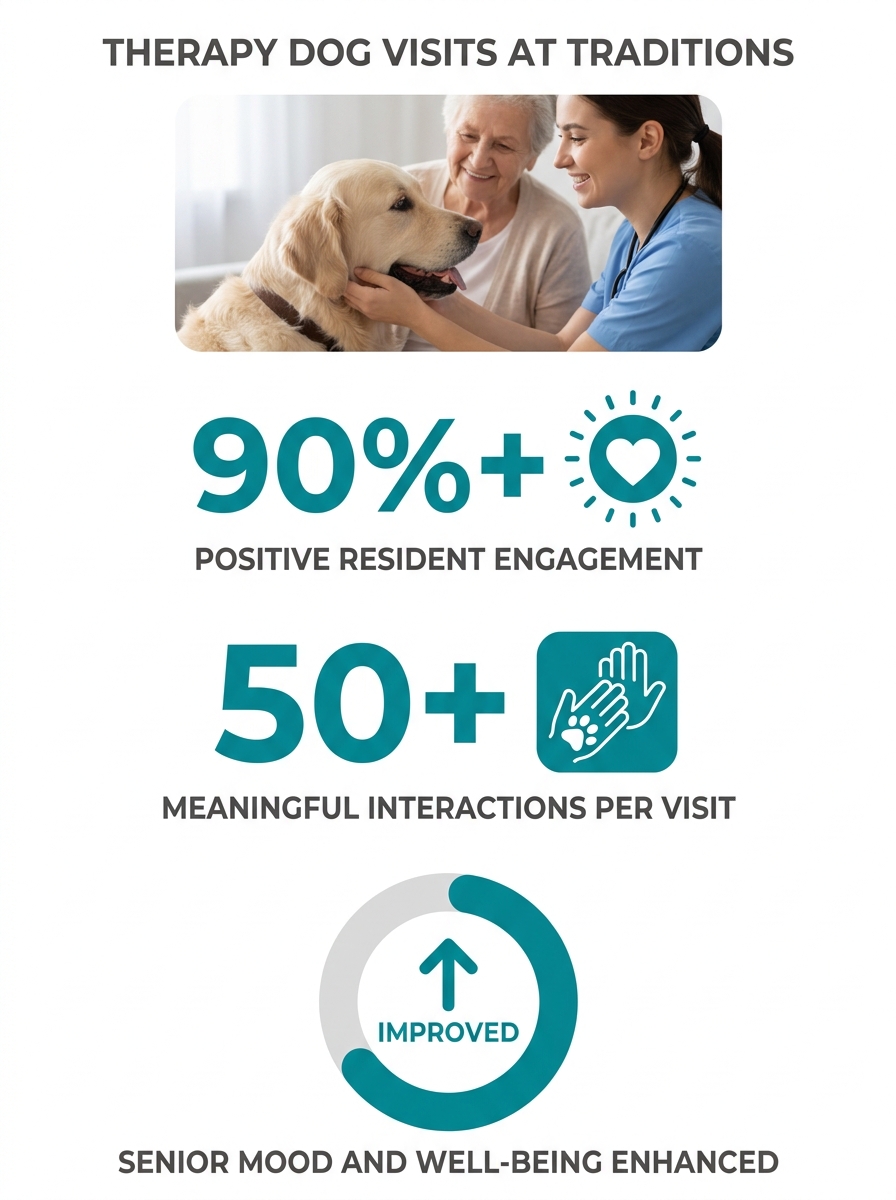
Rebecca Thompson, community relations director at Traditions at Camargo, told reporters that residents “swarmed” the dogs when handlers first brought them to the memory care floor. The facility documented immediate engagement from residents who typically show limited responsiveness to other activities.
The partnership addresses a documented gap in emotional support for memory care residents who spent decades as pet owners before entering facility care. Thompson explained that residents who grew up with animals their entire lives experience a void when those relationships end.
Program Structure and Resident Response
Central Bark sends handlers and dogs to the facility once monthly. Hannah Kraly, the daycare’s social media and marketing coordinator, reported that handlers prepare dogs for the visits with extra grooming before transport to the assisted living community.
During visits, residents share stories about pets from earlier decades. One resident recounted a wartime memory involving her dog and her uncle during multiple visits, according to Kraly, who said she hears the same stories repeatedly but finds each telling meaningful.
Beverly Groene, a resident whose husband died in October 2025 after a dementia diagnosis, participated in the April visit. She had moved to Traditions at Camargo with her husband before his death. While Groene does not live in the memory care unit herself, she described Alzheimer’s disease as “terrible” and participated in the dog visit.
Experience-Based Programming as Differentiation
The program represents a category of resident experience initiatives that assisted living operators increasingly deploy to differentiate their communities from competitors. Unlike capital-intensive amenities, partnership programs with local businesses require minimal infrastructure investment while generating tangible engagement metrics.
Memory care units face particular challenges in activity programming because traditional group events often fail to reach residents with advanced cognitive decline. Animal-assisted interventions access memory pathways that remain intact even when other cognitive functions deteriorate.
Thompson’s description of residents “swarming” the dogs suggests measurable behavioral activation—a response that families evaluating memory care placements notice during tours. Facilities that document consistent resident engagement through programming create proof points for family decision-makers researching options.
The monthly cadence also creates anticipation cycles. Regular but not constant visits prevent habituation while giving staff recurring content opportunities for family communication channels and social media documentation.
What Happens Next
Assisted living and memory care operators looking to replicate partnership models can approach local pet daycares, veterinary clinics, and animal rescue organizations already conducting therapy visits in healthcare settings. Unlike one-time events, recurring monthly programs build relationships between specific dogs and residents, deepening therapeutic impact over successive visits.
The Madeira program’s success metrics—immediate swarming behavior, repeated story-sharing, and visible emotional responses—provide documentation that marketing teams can convert into family-facing content. Video of residents engaging with therapy dogs performs well in facility tours and digital channels, particularly for families researching memory care placements who prioritize quality-of-life programming over amenity lists.
Facilities that establish these partnerships gain referral-source relationships with the partnering businesses. Central Bark staff now interact monthly with Traditions at Camargo residents and families, creating bidirectional awareness that functions similarly to healthcare provider referral networks but reaches community members through consumer service touchpoints rather than clinical channels.