
Families choosing a home care agency evaluate your careers page before your service pages. Employee treatment signals—caregiver testimonials on Glassdoor, visible benefits, transparent scheduling policies—have become the primary trust indicator for family decision-makers, outperforming service descriptions and facility photos in driving inquiry conversions.
When Every Marketing Dollar Went to the Service Page
For the better part of a decade, home care and senior care agencies built their websites around one assumption: the service page is where families make decisions. Agencies invested in photography, wrote detailed descriptions of personal care tasks, and optimized for keywords like “in-home care services” and “assisted living amenities.” The careers page, by contrast, was an afterthought. It held a list of open positions, maybe a paragraph about “joining our team,” and a link to an application form.
This made intuitive sense. Families were the buyers. Caregivers were the supply. Marketing budgets went toward the buyer, and recruitment budgets stayed small and transactional. A Built In analysis of 15 high-performing careers pages found that even companies known for strong employer branding treated careers content as secondary to product and service messaging. In home care, the gap was wider still.
The problem showed up gradually. Service pages all looked the same. Every agency described “compassionate, personalized care.” Every page listed identical services: bathing assistance, medication reminders, meal preparation, companionship. Families scrolling through 3 or 4 agency websites couldn’t tell them apart. The differentiator everyone claimed to have, quality caregivers, was invisible on the service page.
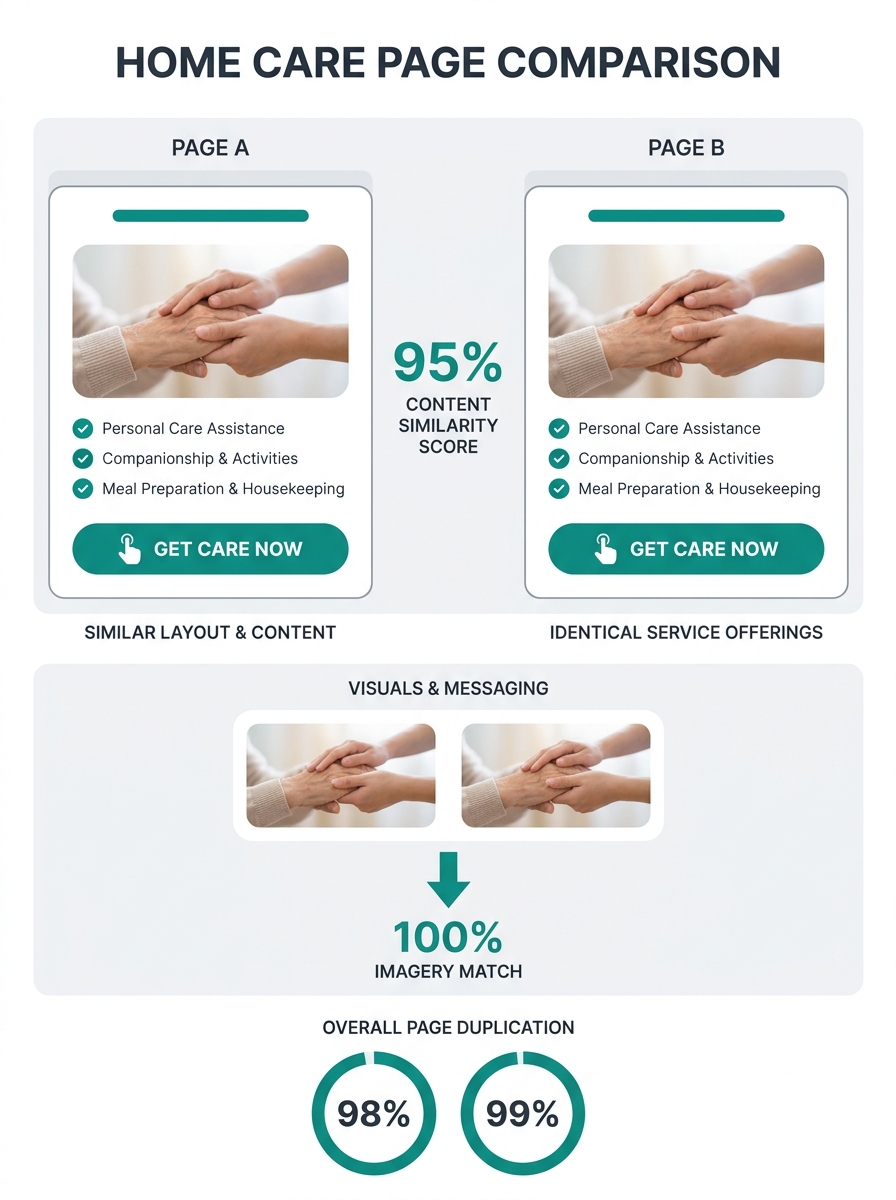
As we’ve written about before, the phrase “compassionate care” has become one of the most expensive and least effective phrases in senior care marketing precisely because every provider uses it. The service page arms race produced identical content across thousands of agencies competing for the same families.
The Glassdoor Effect Hits Home Care
The shift began when review platforms expanded beyond restaurants and hotels into employer reputation. Glassdoor launched employer reviews in 2008, but critical mass in the home care sector arrived much later, around 2022 and 2023, as enough caregivers began posting about their work experiences that clear patterns became visible to anyone searching an agency by name.
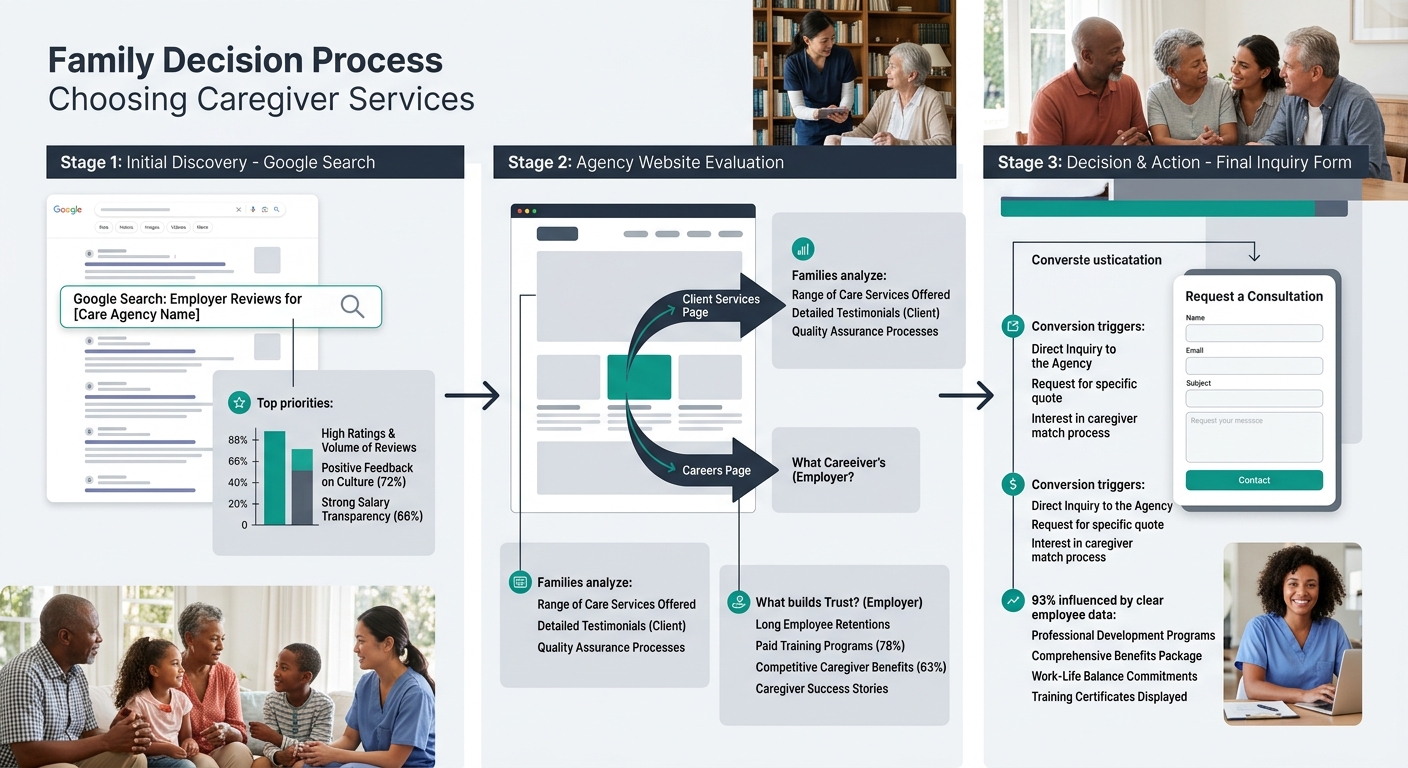
Families noticed. A daughter researching “Sunrise Home Care” would see Google surface a 2.8-star Glassdoor employer rating alongside the agency’s own 4.7-star client review page. That dissonance raised an obvious question: if the agency treated its workers poorly, how good could the care actually be?
The Home Care Marketing Pros research team documented this connection directly: “Positive employee reviews signal a supportive work environment, which often translates to better care for clients and a stronger overall reputation.” The causal chain turned out to be straightforward. Families weren’t reading employee reviews out of idle curiosity. They were reading them as a proxy for care quality.
This was the first crack in the service-page-first model. An agency could write whatever it wanted on its own website, but Glassdoor and Indeed told a different story. And Google was surfacing that story prominently in branded search results.
Families Started Clicking “Careers” on Purpose
By 2024, a second behavior emerged. Families weren’t only stumbling across employer reviews on third-party platforms. They were clicking the “Careers” tab on agency websites deliberately.
The logic held up under scrutiny: if an agency struggles to attract and keep good caregivers, the person showing up to care for Mom might be underqualified, overworked, or brand new. The 79% caregiver turnover rate reported across the home care industry had become public knowledge through media coverage and industry reports. Families who read about the staffing crisis started checking whether their chosen agency was part of the problem.
What they found on most careers pages was alarming in its emptiness. A generic “We’re Hiring!” banner. A list of open CNA and HHA positions with no salary range. Zero information about training, benefits, or advancement. No photos of actual staff. No testimonials from caregivers describing their day-to-day experience.
Contrast that with what the best-performing careers pages in other industries were doing. Research from Workable found that organizations with transparent recruitment processes, including clear timelines, honest descriptions of working conditions, and FAQ sections for applicants, built measurably stronger candidate pipelines and better employer reputations. A 2022 employee benefits survey confirmed that healthcare coverage, retirement savings, leave policies, family care support, and flexible scheduling ranked as the 5 most valued benefits across all industries, reinforcing that job seekers and family researchers want to see the same information.
The absence of this information on a home care careers page told families everything. If the agency couldn’t articulate why a caregiver should work there, the agency probably didn’t have a good answer.
The Careers Page Becomes a Trust Signal for Families
The Aaniie (formerly Smartcare Software) research team put the relationship bluntly: “Engaged caregivers and office staff are important allies in defending your business’s reputation, which is why the employee experience you provide needs to be excellent.” This framing recast employee treatment as a marketing asset. Staff credibility in home care marketing depends on proving, publicly and on your own website, that you invest in the people delivering care.
Agencies that understood this started treating their careers pages like conversion pages for two audiences simultaneously: prospective caregivers and prospective client families.
The overlap in what these two audiences want to see is striking. Both want evidence of:
- Competitive pay and benefits listed with specifics, not vague promises about “great compensation”
- Training and advancement pathways (agencies with structured onboarding programs have reported 40% faster time-to-fill for open positions)
- Real caregiver voices sharing their actual work experience at the agency
- Transparent scheduling and workload expectations that show respect for caregiver time
BizInsure’s recruitment research confirms that including testimonials from current staff and patients helps sell the agency to both applicants and families evaluating care options. When a family sees a careers page filled with caregiver video testimonials, named employees describing their growth from HHA to care coordinator, and specific benefits like tuition reimbursement or $0.58/mile mileage reimbursement, they’re getting a quality signal that no service page can replicate.
A careers page that convinces a caregiver to apply will also convince a family to call. Both audiences want proof of the same thing: that this agency treats people well.
How the Best Agencies Restructured Their Messaging
Activated Insights (formerly Home Care Pulse) published a data-driven retention strategy recommending that agencies “capitalize on what makes the long-term and post-acute care industry different from other jobs on the market: a fulfilling career.” The agencies that acted on this didn’t just update their job postings. They rebuilt their careers pages as brand assets.
The structural changes followed a pattern. Agencies that saw measurable lifts in both applicant volume and family inquiry rates typically made 5 moves:
- Added salary ranges and benefits to every posting. Transparency replaced vagueness. Agencies listing starting pay ($16-$19/hour plus mileage, for example) saw higher-quality applicants and, unexpectedly, more family inquiries that referenced “fair pay” as a reason for choosing the agency.
- Featured named caregiver profiles. Real photos, first names, tenure length, and a 2-3 sentence quote. “I’ve been with [Agency] for three years. The training program helped me earn my CNA, and I’m now a shift supervisor.” These profiles did double duty as recruitment marketing and caregiver reputation trust signals for browsing families.
- Published their training curriculum. Agencies that listed their 40-hour orientation program, ongoing in-service training topics, and specialty certifications available (dementia care, fall prevention, hospice support) gave families evidence of quality and gave applicants evidence of investment.
- Included a “What Our Caregivers Say” section on both the careers AND services pages. This cross-pollination was the critical move. The caregiver testimonial served as an employee treatment signal for senior care branding regardless of which page a visitor landed on first.
- Made the application process transparent. Following best practices documented by Workable and TBH Creative in their careers page analyses, agencies added FAQ sections explaining what happens after you apply, the 7-10 day average hiring timeline, and what the first week on the job looks like. This transparency signaled organizational competence to both audiences.
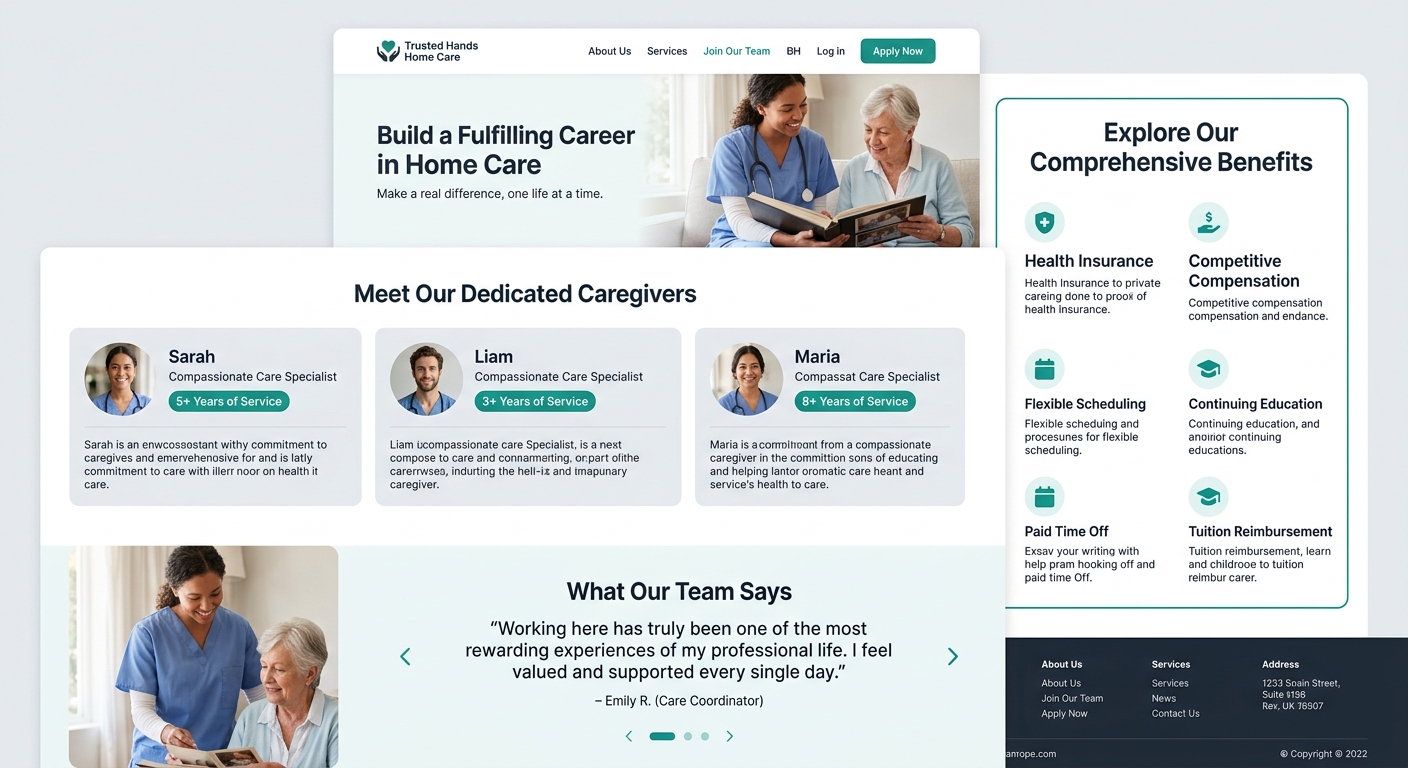
The Care Marketing team has seen this pattern across dozens of agency websites: careers page conversion rates correlate with family inquiry volume in ways that service page design changes do not.
The Service Page Paradox
Service pages still get more total traffic. They still rank for the keywords families search. They still need to exist and communicate clearly. But the conversion signal, the thing that moves a family from browsing to calling, increasingly comes from elsewhere on the site.
When a family evaluates which trust signals actually convert, the caregiver’s visible presence on the website outperforms every other design element. Named staff, visible credentials, evidence of retention and satisfaction carry more weight than a polished 500-word description of personal care services.
Service pages describe what you do. Careers pages reveal who does it and how you treat them. For families making a decision that involves inviting a stranger into their parent’s home, the second question carries more weight than the first.
The State Of Play
The projected 4.6 million healthcare worker shortage has made caregiver recruitment the defining operational challenge for home care agencies. Families know this. They read the same headlines you do. They understand that the agency with the strongest caregiver pipeline will deliver the most consistent care.
Your careers page is the public-facing proof of your pipeline’s health. A thin, generic careers page with 12 open positions and no information about why anyone should fill them signals staffing problems. A detailed, transparent, testimonial-rich careers page with named employees, listed benefits, and clear growth pathways signals stability. And stability is what families are buying when they choose an agency for a parent who needs daily help.
The agencies gaining ground in 2026 have stopped treating the careers page as an HR function and started building it as the centerpiece of their employee treatment strategy for senior care branding. Every caregiver profile, every listed benefit, every transparent job posting sends a message to two audiences at once. The recruitment content is the marketing content. The line between the two disappeared when families started clicking “Careers” and making their care decisions based on what they found there.