
Independent living operators are dual-licensing properties with assisted living credentials and contracting with home health agencies to accommodate residents entering communities at older ages with higher care needs, according to data released by the American Seniors Housing Association and ProMatura. The 2025 independent living resident average age reached 80.6 years, with average length of stay at 4.8 years, while assisted living residents averaged 83.8 years old with 3.5-year stays.
TL;DR: Independent living operators are expanding care service offerings through dual-licensing and third-party partnerships as residents enter communities older and with higher acuity than in prior decades, requiring operators to balance hospitality expectations with clinical coordination.
Operators report residents who would have qualified for assisted living placement fifteen years ago now move into independent living units, and residents who previously required skilled nursing now enter assisted living. The shift reflects older adults delaying senior living transitions while seeking communities they can afford and aging in place longer with community-based health services before making a move.
Operators Adopt Dual-Licensing to Deliver Discreet Care Services
Seattle-based Merrill Gardens dual-licenses its independent living communities with assisted living credentials to allow care services to be administered in units without requiring residents to relocate. The operator’s current independent living resident population averages 84 years old.
“The difference we’ve seen now is we don’t have as long a resident moving into independent living before they need services,” said Jason Childers, chief operating officer at Merrill Gardens, in the June 12 report. “For the most part, the percentage of residents requiring care services really hasn’t changed but I think length of stay has come down slightly.”
Dover Companies CEO Joshua Jennings reported Cedarhurst Senior Living, the firm’s management arm operating across Midwest markets, sees older adults entering independent living with care needs as the primary move-in driver rather than lifestyle amenities. “Most of the independent living we do today is needs-based independent living,” Jennings said. “We have all the amenities that people would want, but folks are moving in not for lifestyle but moving in based on care.”
Clinical Partnerships Replace Direct Staffing in Lower-Acuity Settings
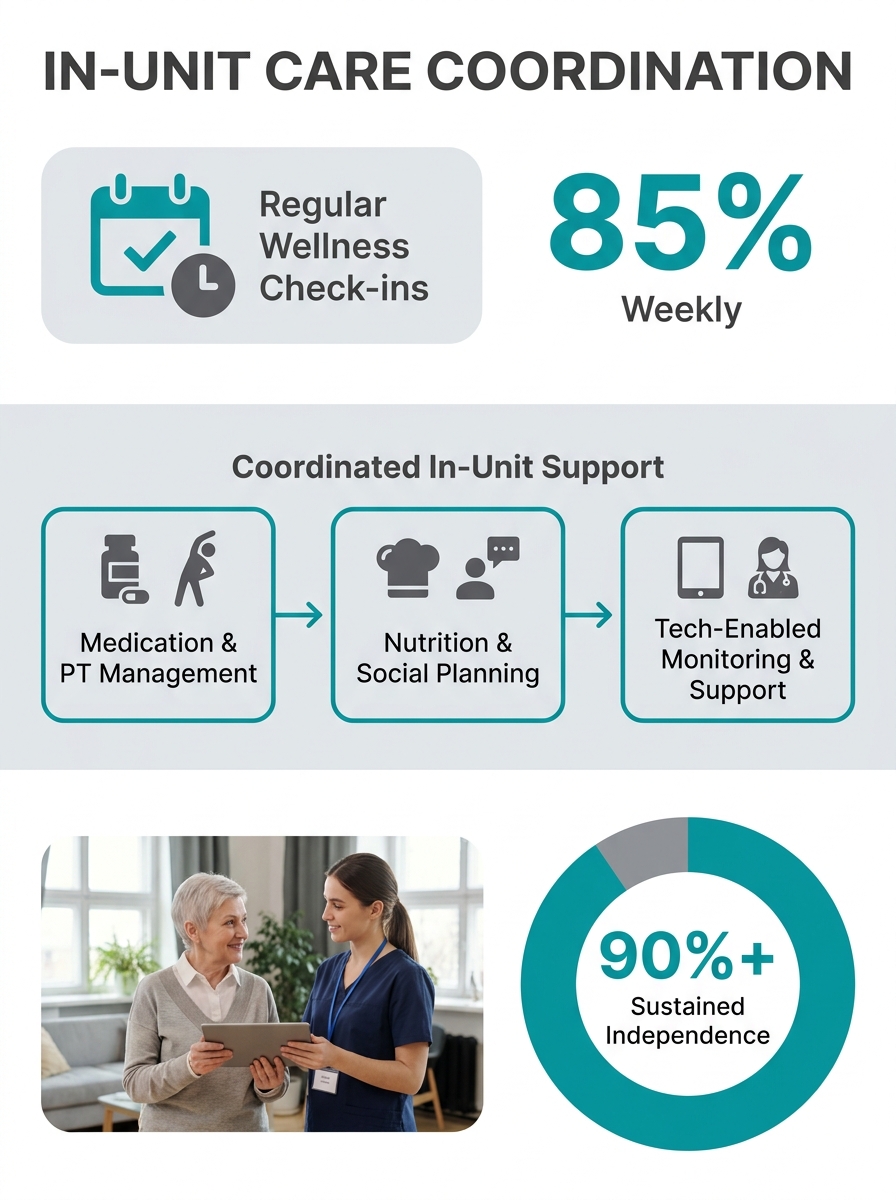
Chicago-based Senior Lifestyle connects independent living residents with state, county and local market resources including home health services, private-duty caregivers, therapy providers, transportation services and community-based support programs rather than expanding direct clinical staff in independent living buildings.
“This approach allows many residents to remain in independent living longer while receiving additional support tailored to their individual needs,” said Angel Morrison, senior vice president of clinical services at Senior Lifestyle. Morrison noted increased demand for care coordination, medication management support, fall detection and proactive wellness monitoring in settings traditionally defined as non-clinical.
The clinical partnership model allows operators to deliver marketing for caregiving agencies and home health providers access to residents while maintaining the hospitality-focused atmosphere families expect when touring independent living properties. Senior Lifestyle reported the traditional distinction between independent living and assisted living is becoming less pronounced from a resident’s perspective as older adults wait longer to move and supportive services can be brought to them in any unit type.
Some Operators Maintain Acuity Separation Through Assessment Protocols
Dallas-based 12 Oaks Senior Living manages standalone independent living properties alongside full-continuum communities and enforces stricter resident assessment protocols to maintain younger, more active populations in independent living buildings.
“Our view is that it’s important that the identity and acuity of each of the care cohorts is separated,” said Greg Puklicz, president at 12 Oaks. “The lines get very fuzzy when you mix independent living and assisted living units in the same building.”
Puklicz noted delivering care becomes more complicated when spread across an entire building rather than concentrated in a designated wing. The assessment approach prioritizes maintaining vibrant independent living environments less focused on acuity needs while offering residents the security of knowing additional services are available if health changes.
Context and Outlook
The dual-licensing trend and clinical partnership expansion create admissions opportunities for home care agencies positioned to serve as referral partners with independent and assisted living operators. Operators managing higher-acuity independent living populations require reliable home health and private-duty caregiver networks to deliver services that keep residents in place without relocating to higher levels of care.
The acuity shift also affects how operators position communities to families during tours and in digital marketing. Communities emphasizing purely lifestyle amenities may face friction when prospects arrive expecting robust care coordination and clinical partnerships. Operators able to demonstrate specific partnerships with named home health agencies, therapy providers and caregiver recruitment systems that ensure service continuity gain competitive advantage with families evaluating multiple properties.
The 4.8-year average length of stay in independent living, down from longer historical averages, compresses the revenue window operators have to recover acquisition costs. Marketing strategies optimized for family decision journeys that acknowledge care needs upfront rather than positioning independent living as purely social may convert prospects entering the market at older ages more efficiently than hospitality-only messaging.