
Each combination of service and location your senior care agency covers needs its own dedicated webpage to rank in local search. A single “Service Areas” page listing Scottsdale, Tempe, Mesa, and Chandler won’t rank for any of them individually. Google needs distinct content, distinct NAP data, and distinct local references for each city-and-service pairing, and as Figment Agency’s multi-location SEO research confirms, a healthcare group with ten locations cannot rely on a single page to rank everywhere.
This matters because families searching for “dementia care in Chandler AZ” and “companion care in Scottsdale” are two completely different searchers with different needs, different urgency levels, and different decision timelines. If both queries land on the same generic page, neither visitor gets what they came for. Bounce rates climb. Conversions flatline. And a competitor with a dedicated page for each phrase takes the click instead.
The fix is a geographic SEO structure for senior care that treats every service-location pair as its own entity. Here’s how to build it without creating a bloated, thin-content mess.
The Service-Location Matrix
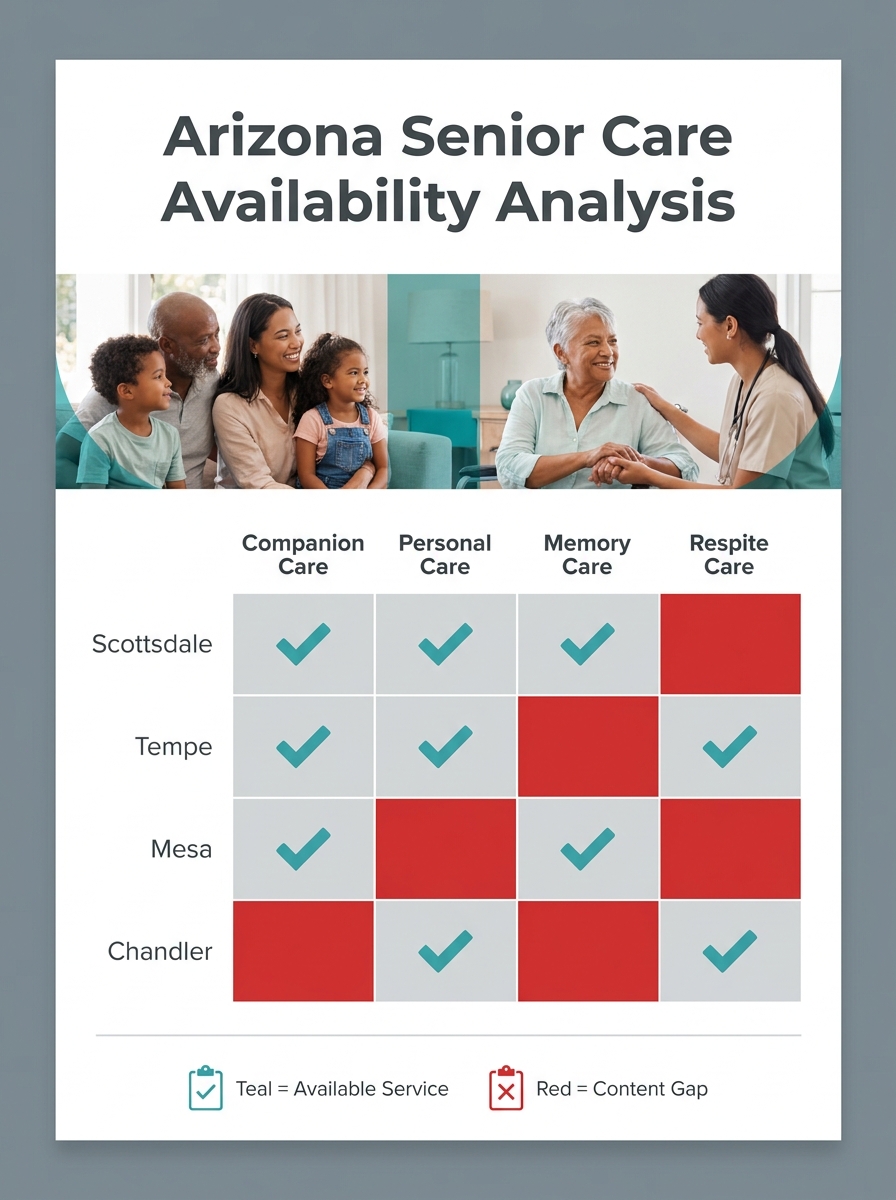
Before you create a single page, build a grid. Put your service lines across the top: companion care, personal care, memory care, respite care, post-surgical care, whatever you offer. Put your cities, neighborhoods, and ZIP code clusters down the side. Every cell in that grid represents a potential sub-service page.
A mid-sized home care agency serving four cities with five service lines has twenty cells. An assisted living community marketing to eight nearby towns with three care levels has twenty-four. The healthcare strategy team at Authority Specialist recommends this exact approach: map every service against every geographic market to create a visual gap analysis. When you look at the grid and see empty cells, you’re looking at search results you’re handing to competitors.
But you don’t need to fill every cell on day one. Prioritize cells where search volume meets your actual capacity. If you’ve got four dementia care clients in Gilbert and a waitlist in Tempe, build the Tempe page first. The grid gives you a roadmap, not a mandate.
URL Architecture That Google Can Follow
Your sub-service page organization shows up in your URLs, and Google pays attention to hierarchy. The cleanest structure nests services under locations:
- yoursite.com/scottsdale/ (primary location page)
- yoursite.com/scottsdale/memory-care/ (sub-service page)
- yoursite.com/scottsdale/companion-care/ (sub-service page)
- yoursite.com/tempe/ (primary location page)
- yoursite.com/tempe/memory-care/ (sub-service page)
This tells Google that memory care in Scottsdale and memory care in Tempe are distinct offerings worth ranking separately. It also passes authority downward: when your Scottsdale location page earns a backlink, that link equity flows to the sub-service pages nested beneath it.
The alternative structure—yoursite.com/memory-care/scottsdale/—works too, but it prioritizes service over geography. For senior care agencies where families search by city first (“home care in Mesa”), the location-first hierarchy tends to perform better because it mirrors how people actually phrase their queries. Understanding how local keywords drive home care leads will help you decide which structure matches your audience’s search behavior.
Tip: Don’t create pages for cities where you have no physical presence, no caregivers, and no clients. Google’s [2026 medical SEO guidance](https://www.localmighty.com/blog/local-seo-for-doctors/) is explicit: avoid creating fake service area pages. If you can’t include a real embedded map, a real local phone number, and real details about serving that area, the page will hurt more than it helps.
Writing Unique Content Without Losing Your Mind
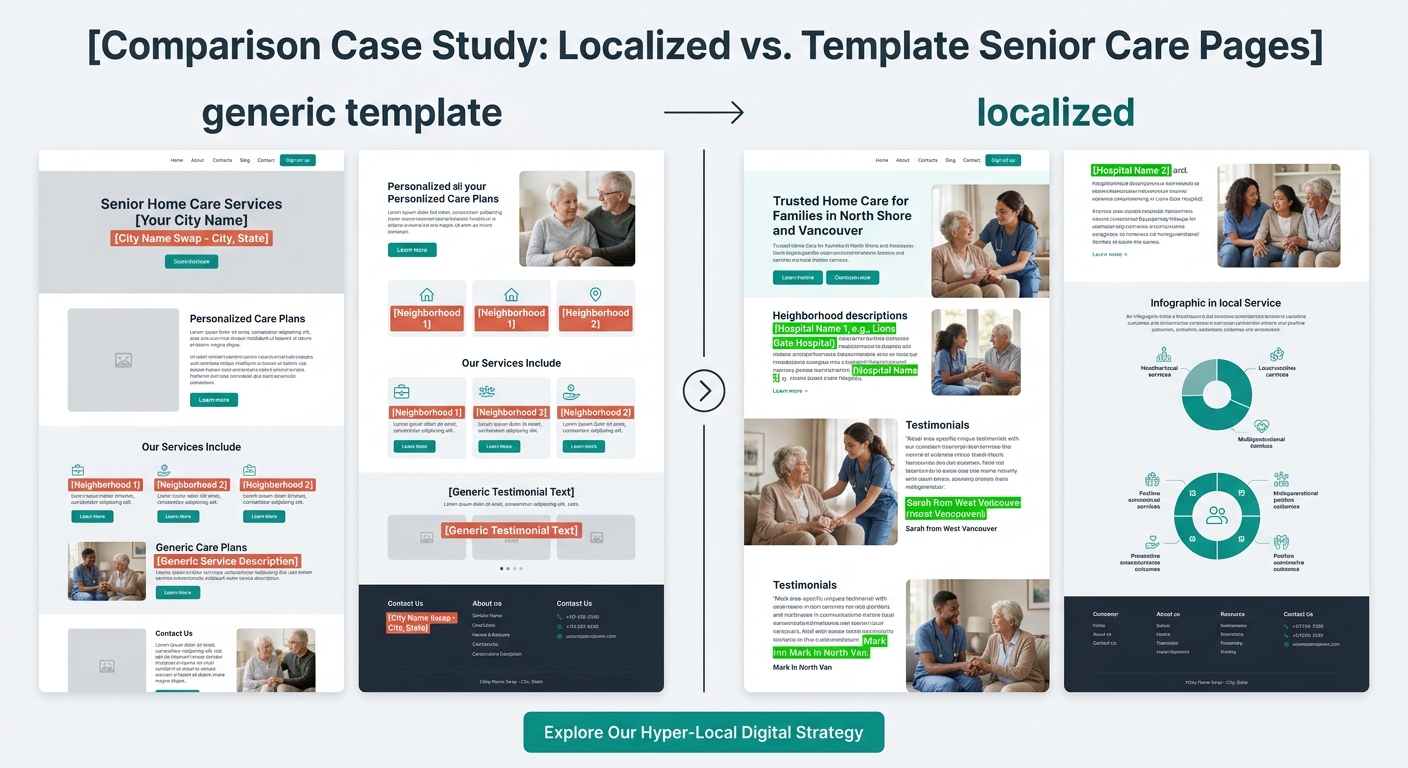
The biggest failure point in any location page hierarchy is duplicate content. Agencies copy their companion care page, swap “Scottsdale” for “Tempe,” and call it done. Google sees through this immediately. Templated pages with city-name swaps rank poorly because they offer no unique value.
Each sub-service page needs at least three elements that differentiate it from its counterparts in other cities:
Local care context. Mention the neighborhoods you serve within that city. Reference nearby hospitals, rehab centers, or senior centers by name. If your Chandler memory care clients frequently transition from Chandler Regional Medical Center, say so. If your Tempe companion care team works with residents near Arizona State University’s Osher Lifelong Learning Institute, include that. These local references are signals Google uses to confirm geographic relevance.
Service-specific detail for that market. Your memory care page for Mesa might emphasize bilingual caregivers because Mesa has a significant Spanish-speaking senior population. Your companion care page for Scottsdale might focus on active-lifestyle support because that community skews toward independent, mobile retirees. Same service, different emphasis, different page.
Testimonials and case descriptions from that area. Even a brief anonymized description (“A family in the San Tan neighborhood contacted us when their mother started showing signs of wandering”) roots the page in a specific place. This is where understanding why families make care decisions based on trust signals pays off directly in your page content.
Google Business Profile Alignment
Your medical SEO site architecture only works if your Google Business Profile points to the right pages. For agencies with a single physical office, link your GBP to your primary location page. For multi-location assisted living or home care operations, each GBP listing should link to its corresponding location page, not the homepage.
This seems obvious, but an enormous number of senior care providers still point every GBP listing to the homepage. The result: Google sees a disconnect between the local signals in GBP (specific address, specific service area) and the generic content on the homepage. That disconnect weakens your local ranking structure across the board.
Update your GBP categories to match your sub-service pages too. If you have a dedicated Alzheimer’s care page for a specific city, make sure your GBP listing for that location includes “Alzheimer’s care” as a service category. Weekly GBP posts that link back to specific sub-service pages reinforce the connection between your profile and your site hierarchy.
Every empty cell in your service-location matrix is a search result you’re handing to a competitor who bothered to build the page.
Internal Linking Between Location and Service Pages
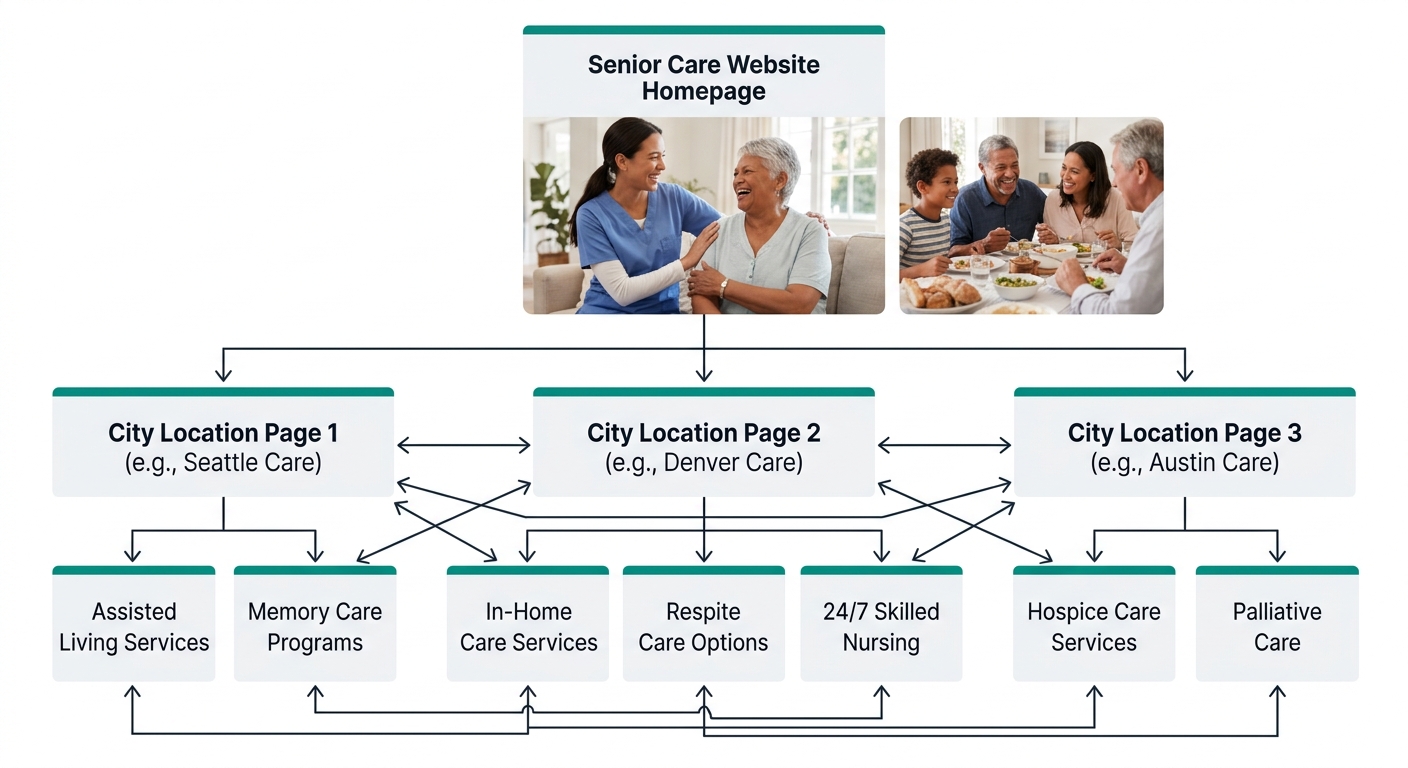
A sub-service page that exists in isolation won’t rank well. Your internal linking structure needs to create clear pathways:
- Your primary location page (yoursite.com/scottsdale/) should link to every sub-service page beneath it
- Each sub-service page should link back to its parent location page
- Sub-service pages in the same city should cross-link to each other (“If you’re exploring memory care options in Scottsdale, you may also want to learn about our respite care services for family caregivers”)
- Blog posts about caregiving topics should link to relevant sub-service pages with geographic anchor text
This linking pattern tells Google which pages are structurally related and distributes ranking authority across your site. It also helps families navigate naturally. Someone reading about companion care in Tempe who realizes they actually need personal care should be one click away from that page.
If you’re also working on converting website visitors into inquiries, strong internal linking directly supports that goal by keeping visitors on-site longer and routing them to the most relevant page for their situation.
Schema Markup for Each Sub-Service Page
Every sub-service page should include LocalBusiness schema markup with the specific service type, geographic coordinates, and service area. For home care agencies, the HomeHealthCareService schema type is the most accurate fit. Include your business name, address, phone number, service area, and operating hours in the structured data.
Adding FAQPage schema to sub-service pages that include a FAQ section increases your chances of appearing in featured snippets and AI-generated answers. A memory care page for Mesa with three FAQs about memory care costs, caregiver qualifications, and what to expect during the first week gives Google structured content it can pull directly into search results.
ThatWare’s website structure blueprint recommends reviewing and updating your site architecture every six months or whenever you add services or expand into new locations. Schema markup should be part of that review cycle.
Measuring Whether Your Pages Actually Work
Rankings alone won’t tell you if your sub-service pages are performing. Track these metrics for each page individually:
- Phone calls and form submissions originating from each sub-service page (use unique tracking numbers per page if possible)
- Organic traffic by page in Google Search Console, filtered to the specific queries each page should target
- Click-through rate from search results, which tells you whether your title tags and meta descriptions are compelling enough for the queries you’re ranking for
- Map pack appearances by location, measured with geo-grid tools that check rankings from multiple points across a city rather than from a single location
Since adult children and seniors search for care in fundamentally different ways, segment your data by the types of queries driving traffic. A page that ranks well for “home care for elderly parent in Scottsdale” is serving a different audience than one ranking for “senior companion services near me,” and the conversion paths will look different.
Review performance quarterly. If a sub-service page has ranked on page two for six months without movement, it likely needs stronger local content, more internal links pointing to it, or better GBP alignment. Pages that rank well but don’t convert need UX attention: clearer calls to action, a more prominent phone number, or faster load times on mobile.
The Unresolved Parts
Google’s increasing reliance on AI-generated search results introduces uncertainty into this entire framework. When a family searches for “best memory care near me” and Google’s AI overview assembles an answer from multiple sources, your sub-service page might provide the underlying data without ever getting the click. Tracking AI citations is still immature. The tools exist, but they’re expensive and imperfect.
There’s also the question of scale. An agency expanding from four cities to twelve will eventually manage dozens of sub-service pages, each needing genuinely unique content, updated schema, and ongoing performance monitoring. The operational burden is real. Agencies with two-person marketing teams will need to prioritize ruthlessly, building pages for high-volume, high-intent combinations first and filling in the rest over quarters, not weeks.
And the tension between service area pages and physical presence isn’t fully resolved by Google’s guidelines. Home care agencies by definition serve areas without a brick-and-mortar location in each city. How much local signal is enough to convince Google that your Chandler page deserves to rank when your office is in Scottsdale? The answer changes as Google’s algorithms evolve, and the only reliable approach is to build pages dense with genuine local detail and watch what the data tells you month by month.