Email nurture sequences for home care leads fail at a specific, predictable point: the consultation ask arrives in email five, six, or seven, long after engagement has cratered. Agencies using a compressed 4-email cadence over 3–4 weeks with an earlier call-to-action see up to a 20% lift in qualified leads and a 15% improvement in sales conversion, according to 2026 funnel benchmarks.
The Opt-In: What Actually Happens at Download
A family member finds your “Home Care Cost Comparison Guide” at 11:14 PM on a Tuesday. They’re stressed, probably comparing three agencies, and they hand over their email address in exchange for answers. That’s the moment your home care lead magnet performance matters most, and it’s the moment most agencies squander.
The problem starts with what the lead magnet promises versus what the sequence delivers. Focus Digital’s 2025 industry analysis found that the highest-performing lead magnets “serve as complete solutions for narrow problems, designed to demonstrate expertise and build trust while positioning prospects for future purchases.” But the typical home care PDF — a generic “10 Tips for Choosing a Home Care Provider” — solves nothing specific. It reads like a brochure, and it sets a brochure-like expectation for every email that follows.
If your lead magnet is a broad overview rather than a targeted tool (a cost calculator, a caregiver interview checklist, a care-level assessment worksheet), you’re already fighting an uphill lead-to-consultation conversion audit before email one even sends. The family who downloaded at 11 PM is the same person we’ve written about as the after-hours decision-maker, and they need specificity, not platitudes.
The Welcome Email: 24 Hours That Define Everything
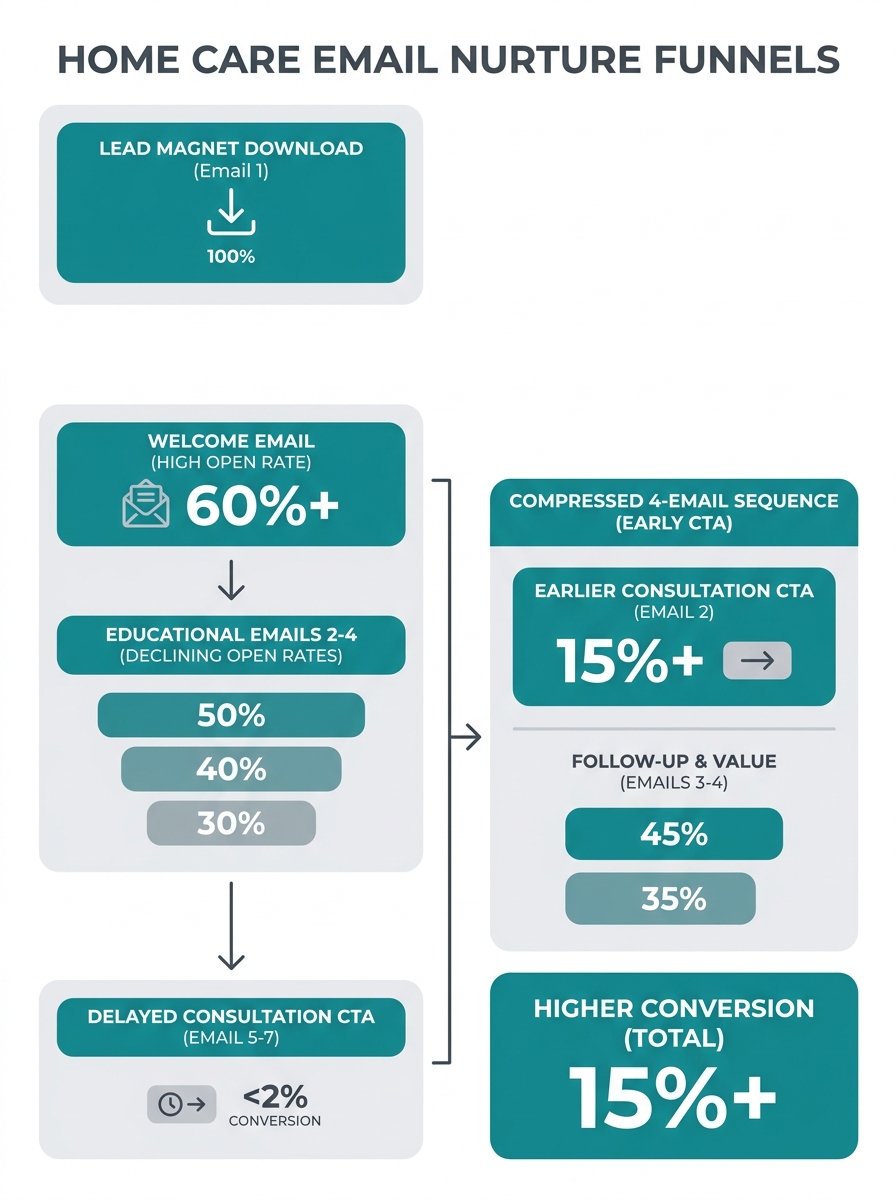
The welcome email is the highest-performing message in any email marketing automation home care sequence. Open rates on welcome emails run 50-80% across industries — two to three times the rate of any subsequent message. What you do with that attention determines whether the rest of the sequence matters at all.
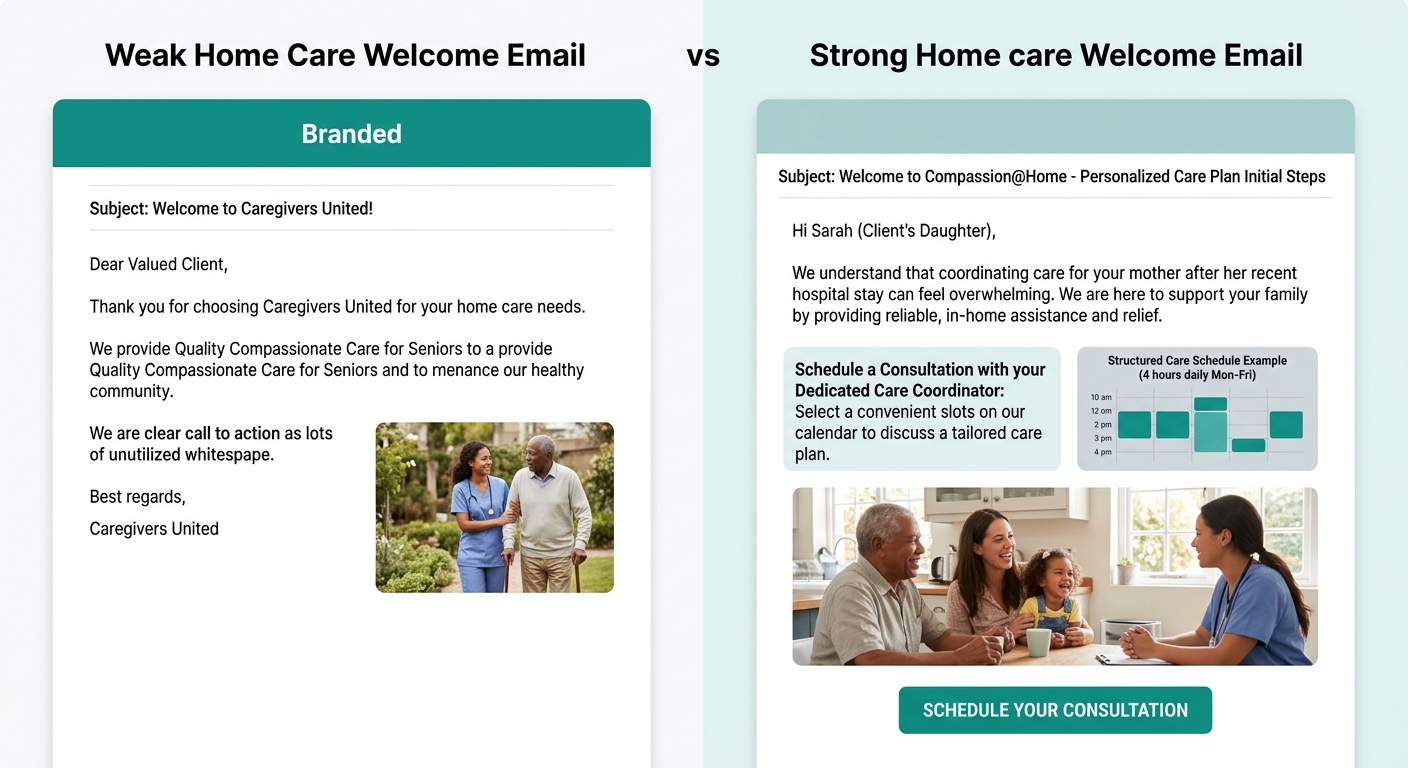
Here’s where most agencies go wrong: they send a delivery confirmation. “Thanks for downloading our guide! We hope you find it helpful.” That’s it. No next step. No consultation link. No acknowledgment of why this person is actually looking for home care.
The Blogrator 2026 email nurture framework lays out a 7-step core sequence where email one combines a welcome message with an appointment booking opportunity. The logic is sound: the person who just downloaded your resource has the highest intent they’ll have for the next two weeks. Waiting until email five to mention scheduling is like greeting a walk-in family at your office and telling them to come back Thursday.
A welcome email that converts does three things in under 200 words: confirms the download, names the specific problem the lead is trying to solve (using whatever form data you captured), and offers a 15-minute consultation with a direct calendar link. That calendar link matters more than anything else in the email. Every click between “I want to talk to someone” and an actual scheduled time is consultation scheduling friction, and each extra step costs you roughly 10-20% of the remaining interested leads.
Emails Two and Three: The Engagement Cliff
By the time email two arrives — typically 3-5 days after the download — the family’s urgency hasn’t disappeared, but their attention has. They’ve continued researching. They may have already called another agency that answered the phone. Open rates on email two drop to 25-35% in home services sequences, and by email three, you’re often looking at 15-22%.
This is the window where email nurture sequences for home care either build toward a conversion or drift into noise. According to Martal Group’s lead nurturing research, “By Email 3, it gently introduces a call-to-action (consultation) once some trust is built. The tone is warm and helpful, setting a positive first impression.” If your sequence waits past email three to introduce the consultation option, you’ve missed the window where the majority of your engaged audience still opens your messages.
What should emails two and three contain? The HCMP blog on senior care nurture campaigns recommends that agencies “personalize the experience by using your lead’s name, referencing the service(s) they’ve expressed interest in, or sending well-wishes on local holidays and events.” Personalization at this stage means more than a first-name merge tag. It means segmenting by the type of lead magnet they downloaded (dementia care guide vs. general home care cost sheet) and sending content that matches that specific concern.
Email two works best as a single client testimonial — not a wall of five-star reviews, but one family’s story that mirrors the reader’s situation. Email three introduces a specific, low-commitment next step: a 15-minute phone call, a free care assessment, or a virtual consultation. Not a sales pitch. A service.
Every click between “I want to talk to someone” and an actual scheduled time is consultation scheduling friction, and each extra step costs you 10-20% of remaining interested leads.
The Consultation CTA That Arrives Too Late
The standard 7-step nurture sequence from most email marketing platforms follows a pattern designed for general healthcare practices: welcome, educational content, more educational content, testimonials, appointment reminder, post-visit follow-up, re-engagement. Sequenzy’s editorial team observed that the best nurture sequences “feel like helpful content series, not marketing campaigns,” which is true — but home care has a conversion window that most content series aren’t built for.
A daughter researching home care for her father isn’t on a 45-day consideration cycle. The median time from initial research to hiring a home care agency is 2-4 weeks for non-emergency situations. A 7-email sequence spread over 6-8 weeks means your consultation offer lands after the decision has already been made with a competitor who called back on day one. Estatehub’s 2026 benchmarks for home services reinforce that high-converting home service businesses “prioritize attracting high-quality leads using strategies like local SEO, paid advertising, and well-optimized website content” — but attraction means nothing if the nurture cadence operates on the wrong timeline.
This is where a lead-to-consultation conversion audit gets specific. Pull your email platform data and look at three numbers: the open rate on each email in the sequence, the click-through rate on your consultation CTA by email position, and the time-to-first-consultation-booking from opt-in. If your average booking happens after email four and your open rate on email four is below 15%, you’ve identified the structural problem. The CTA is there — but nobody’s seeing it.
If you’ve already done a broader marketing diagnostics audit, the email data fills in the specific gap between lead capture and conversion.
The Rebuilt Sequence: Four Emails, Three Weeks
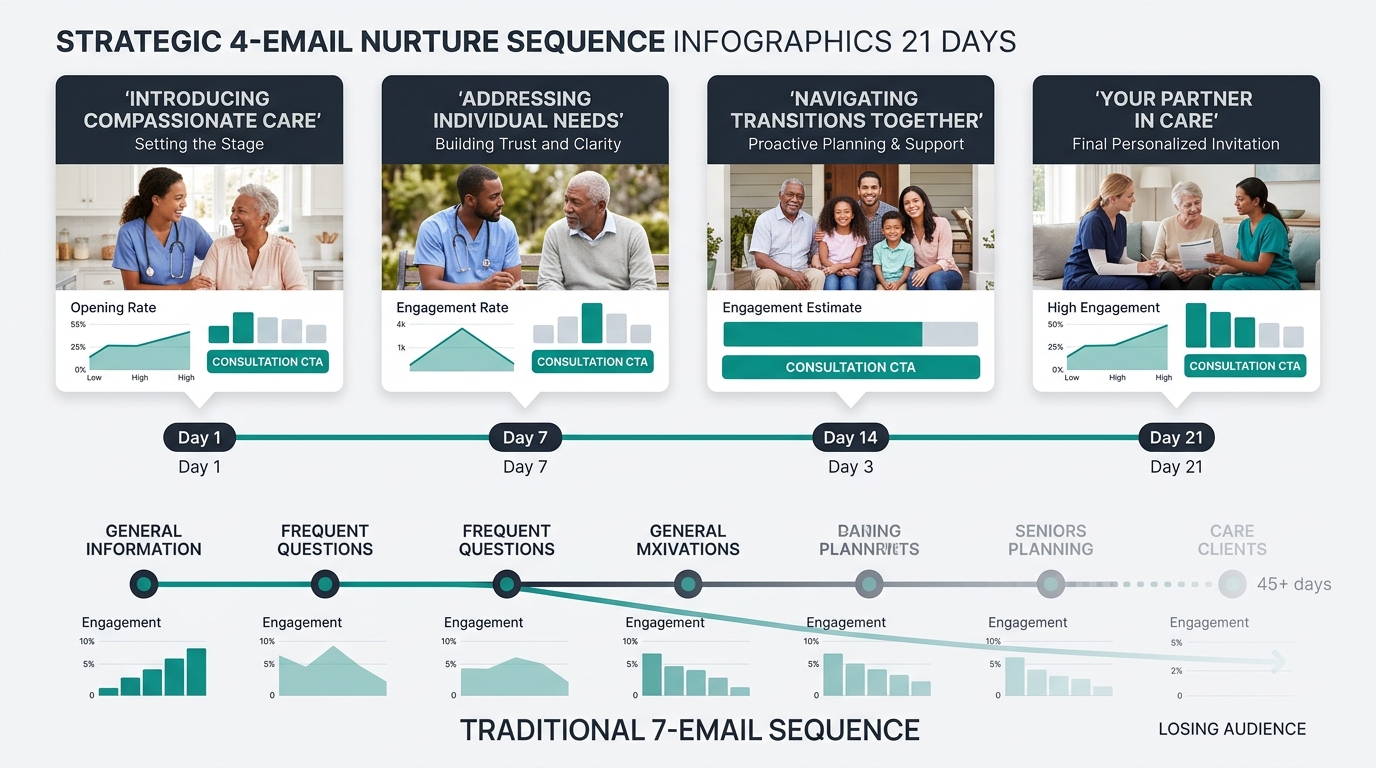
The fix is compression, not more content. A 4-email sequence over 3 weeks, with the consultation ask present from email one and escalating in specificity through email four, outperforms the standard 7-email drip by reducing the gap between peak intent and the conversion action.
Here’s what the rebuilt cadence looks like:
| Timing | Content | CTA | |
|---|---|---|---|
| 1 — Welcome | Immediate (within 5 min of download) | Deliver the resource, name the lead’s specific concern, introduce your agency in 2 sentences | Direct calendar link for 15-min consultation |
| 2 — Social Proof | Day 4 | One client testimonial matching the lead’s care type, plus a relevant local statistic (e.g., “87% of families in [county] who start care within 2 weeks report higher satisfaction”) | Same calendar link, framed as “still available this week” |
| 3 — Value Add | Day 10 | A specific, actionable resource: caregiver interview questions, a medication management checklist, or a care transition timeline | Offer a free care needs assessment (different from the consultation — lower friction) |
| 4 — Direct Ask | Day 18-21 | Address the most common objection (cost, commitment length, or “we’re not ready yet”) with data and a case study | Final consultation offer with a specific time window (“openings this Thursday and Friday”) |
This structure ensures the consultation CTA appears in every email, but the framing evolves. Email one offers it as an option. Email four offers it with urgency and specificity. No email wastes its open on pure education with zero conversion path.
For agencies already running marketing automation platforms, the technical rebuild takes an afternoon. The strategic rebuild — writing four emails that actually reflect your agency’s voice, your local market, and your specific service differentiators — takes longer but determines whether the sequence works.
Tip: Set a behavioral trigger: if a lead clicks the consultation link in any email but doesn’t complete the booking, fire a follow-up email within 2 hours with a direct phone number and the name of the person who will answer. That single automation can recover 8-12% of abandoned bookings.
Where the Data Looks Today
Home care agencies that have compressed their sequences and moved the consultation ask earlier are reporting measurable shifts. Case study data from nurture optimization campaigns shows a 20% increase in qualified leads and a 15% boost in sales conversion when sequences shift from educational-first to action-embedded structures. The agencies seeing those numbers share two traits: they segment by lead magnet type (a dementia care download gets a different sequence than a general cost guide), and they treat the welcome email as a conversion opportunity rather than a receipt.
The audit itself is straightforward. Export your sequence data. Map open rates and click rates by email position. Identify the email where your CTA first appears and compare it to the email where your open rate drops below 20%. If the CTA comes after the drop, you’ve found the gap. If you’re also seeing phone-based drop-offs, pair this audit with a call recording review to capture the full picture from download to conversation.
Home care lead magnet performance has never been about the PDF itself. The download is a signal of intent. What you do in the 21 days after that signal — how quickly you respond, how specifically you acknowledge the person’s situation, and how few clicks stand between them and a real conversation — determines whether that intent becomes a consultation or evaporates into an unsubscribe.