
Sen. Susan Collins (R-Maine) introduced legislation on August 7 that would reset Medicare home health payment rates to levels predating several years of cuts and grant the Centers for Medicare & Medicaid Services expanded authority to screen and penalize agencies presenting extreme fraud risk, according to Home Health Care News.
TL;DR: The Medicare Home Health Payment Integrity and Protection Act of 2026 would reverse years of rate reductions while requiring fingerprinting, liability insurance proof, and increased survey frequency for agencies CMS identifies as high-risk.
The Medicare Home Health Payment Integrity and Protection Act of 2026 was referred to the Senate Committee on Finance after introduction. The bill targets what Collins described as “billions of dollars improperly siphoned from the Medicare home health program” that threaten care access for Medicare beneficiaries while distorting reimbursement data used to pay legitimate agencies.
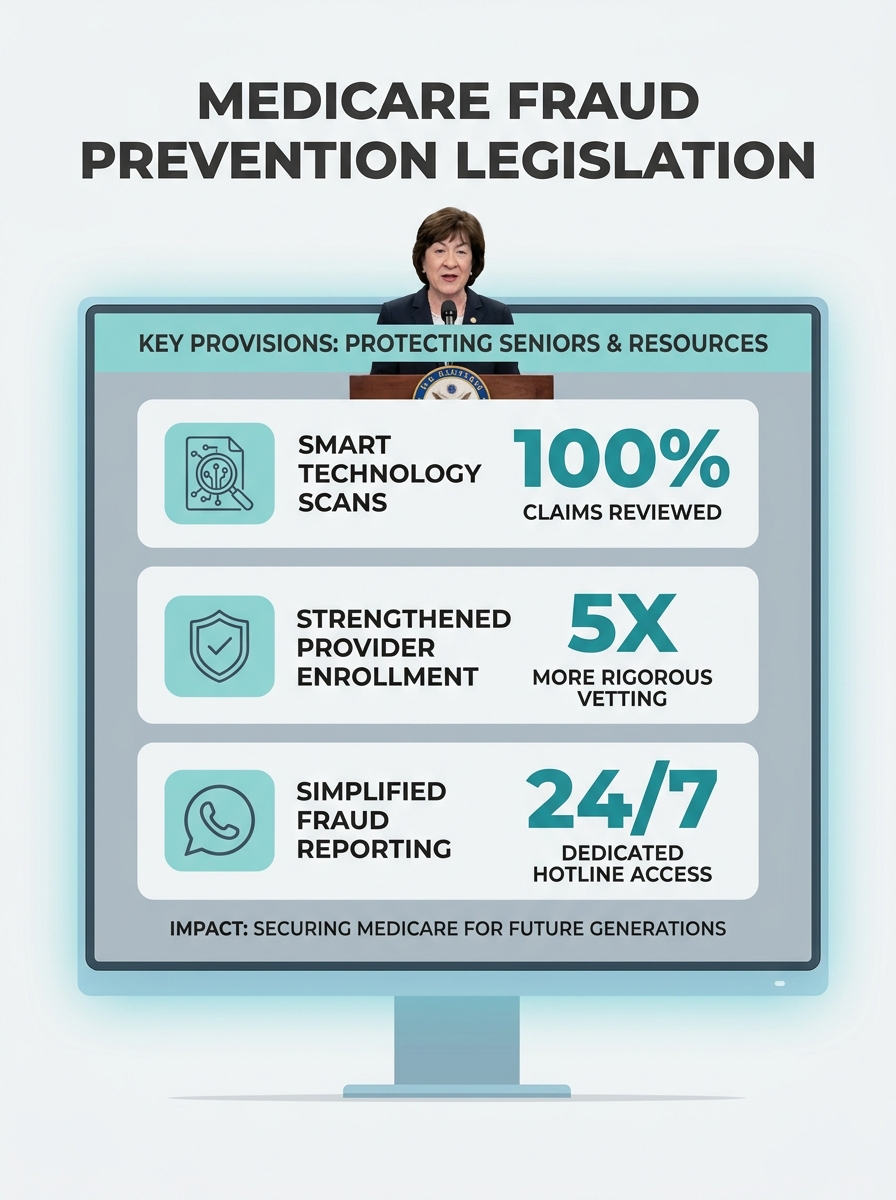
The legislation comes as CMS imposed a nationwide enrollment moratorium on home health and hospice providers earlier this year, a sweeping enforcement approach that industry groups warned could burden compliant operators alongside bad actors. Collins’ bill attempts a more targeted strategy by giving CMS discretion to define fraud-risk factors and apply stricter requirements only to agencies meeting those criteria.
Bill Provisions Target Pre-Enrollment Screening and Payment Methodology
The bill would require fingerprinting of administrators at home health agencies CMS deems to present extreme fraud risk, along with proof of liability insurance for those same high-risk entities. CMS would gain authority to determine which factors indicate extreme fraud risk and impose correspondingly strict screening requirements.
Survey frequency would increase for newly enrolled Medicare home health agencies, those undergoing ownership changes, and those reactivating billing privileges. Agencies failing to submit quality data to CMS or engaging in potentially fraudulent behavior would face more frequent inspections and higher financial penalties for quality-data non-submission.
The bill directs CMS to reset home health payment rates to adjust for fraud in the system and changes in utilization patterns since the COVID-19 pandemic. According to the National Alliance for Care at Home, CMS rate cuts over the past several years relied on data “entirely unrelated to the payment system adopted in 2020, along with data tainted by the inclusion of fraudulent providers in the rate analysis.”
Funding authorization for CMS and federal law enforcement to investigate organized home health fraud schemes appears in the bill, alongside funding for state agencies to conduct accelerated surveys, enrollment validation, unannounced site visits, and operational verification. The legislation grants CMS rulemaking authority to carry out its provisions and requires the agency to report implementation progress to Congress.
Industry Groups Support Payment Reset and Targeted Enforcement Approach
Jennifer Sheets, CEO of the National Alliance for Care at Home, said the bill “corrects longstanding flaws in home health reimbursement and takes a meaningful step toward a home health benefit that is stable and built for how care is delivered today.” Sheets endorsed the program-integrity elements as a way to stop bad actors “without relying on sweeping enforcement strategies that could implicate legitimate providers.”
Katie Smith Sloan, president and CEO of LeadingAge, called the bill’s oversight provisions “reasonable, appropriately targeted policies that would help maintain the benefit’s integrity.” Sloan noted LeadingAge has expressed concern about the disproportionate increase in home health providers in Los Angeles County, a known fraud hot spot.
The National Alliance for Care at Home has urged CMS to use existing authorities and narrow enforcement to fraud hot spots rather than nationwide approaches. A coalition letter signed by the Alliance and other advocacy organizations stated, “The overwhelming majority of providers serve their communities with integrity. Any federal response must be carefully targeted to protect patients and preserve access to high-quality care from providers who have earned the trust of the families they serve.”
The Alliance has positioned itself as supportive of CMS fraud-fighting efforts while advocating for enforcement that distinguishes compliant operators from bad actors. The organization argued that previous CMS rate-setting methodology punished legitimate agencies by calculating cuts based on fraudulent-provider data mixed into utilization trends.
Providers Implications
Home health agencies should monitor the bill’s progress through the Senate Finance Committee, as passage would materially alter both reimbursement levels and pre-enrollment compliance requirements. Agencies in markets CMS identifies as high fraud risk—particularly Los Angeles County and other known hot spots—should prepare for potential fingerprinting mandates, liability insurance verification, and increased survey frequency if the legislation advances.
The payment-rate reset provision represents the most immediate financial impact for compliant operators. Industry groups estimate years of CMS rate cuts based on fraud-distorted data have compressed margins for agencies delivering legitimate care. A reset to pre-cut levels would improve cash flow for agencies that have absorbed cumulative reductions while maintaining quality outcomes, though the bill does not specify a dollar figure or percentage restoration.
Operators should review current quality-data submission processes and accreditation standing, as the bill increases penalties for non-submission and raises surveyor training standards. Agencies with recent ownership changes or those planning to reactivate dormant billing privileges would face mandatory surveys under the legislation, adding timeline and cost considerations to M&A transactions and market re-entry strategies.