
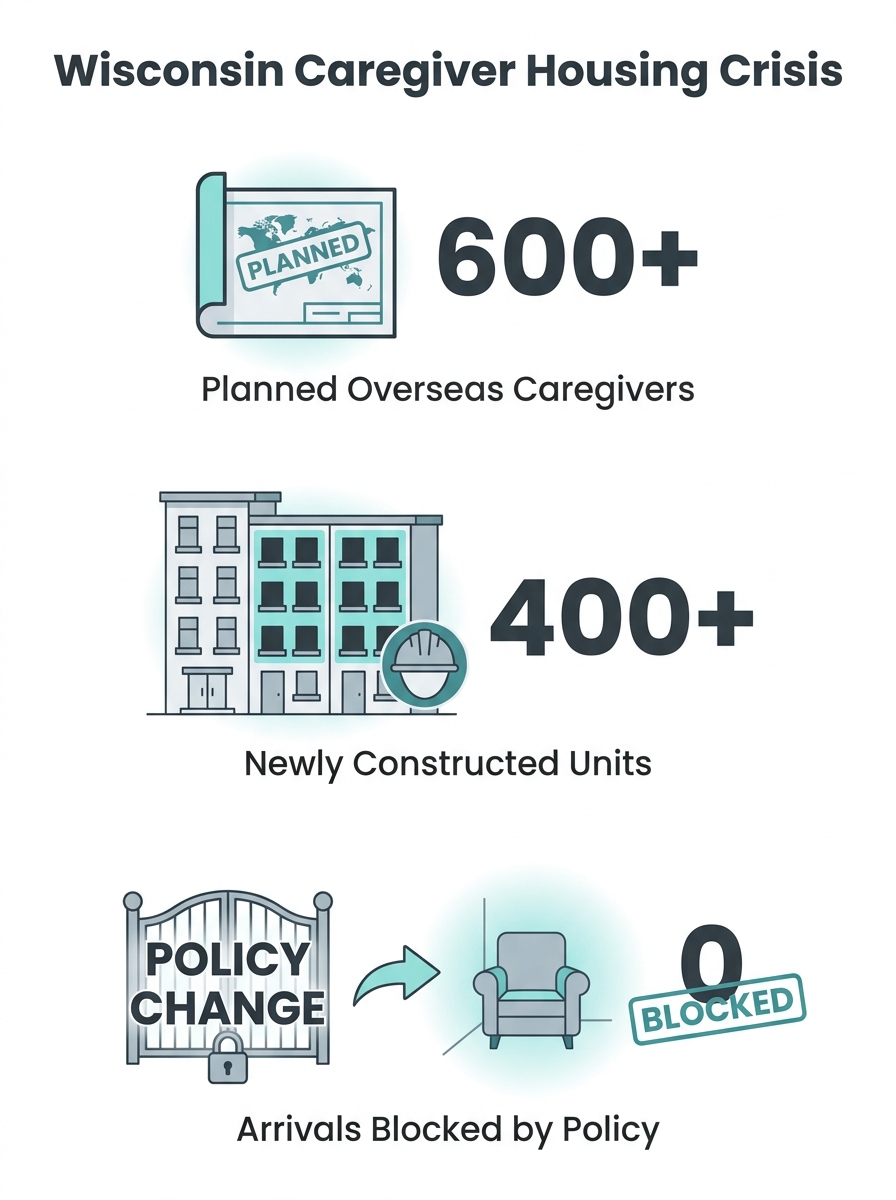
Wisconsin nursing homes and home health agencies abandoned multi-year plans to hire overseas workers after the Trump administration suspended refugee programs and terminated Temporary Protected Status for 13 countries in January 2025, according to industry leaders who reported facilities now limiting admissions due to workforce shortfalls. One Sparta nursing home CEO invested over $100,000 building five apartments for overseas workers who never arrived, LeadingAge Wisconsin reported September 30.
TL;DR: Federal suspension of refugee programs and Temporary Protected Status in January 2025 forced Wisconsin long-term care providers to scrap multi-year overseas recruitment plans, with facilities now limiting admissions as 30% of nationwide direct care workers are immigrants.
The policy changes eliminated what LeadingAge CEO Katie Smith Sloan described as the primary pipelines for foreign-born workers in aging services, a sector that faces severe domestic recruitment challenges. Agencies that provide marketing for caregiving agencies now confront a tighter labor pool as facilities turn away new clients and close beds.
Facilities Closed Wings, Turned Away Clients After Recruitment Pipelines Halted
Nursing homes closed beds and entire wings while home health agencies stopped accepting new clients, Sloan said in statements to Milwaukee media outlets. The capacity reductions shift care burdens to hospitals and family members when long-term care facilities cannot admit residents.
“Home health agencies just not able to take new clients” became a pattern across LeadingAge member organizations following the January suspension, Sloan said. The network includes nonprofit nursing homes, home health agencies, and other organizations serving older adults nationwide.
Robin Wolzenburg, operations director at Koru Health, which operates multiple Wisconsin senior living communities, led refugee placement efforts at LeadingAge Wisconsin before the policy change. Resettlement agency partnerships that placed refugees in nursing home positions stopped completely in January 2025, according to Wolzenburg’s account. The White House cited resource availability concerns for Americans as justification for the suspension.
Thirty percent of all direct care workers nationwide are immigrants, according to KFF, a nonprofit health policy research organization. Direct care workers include nursing assistants, personal care aides, and home health aides who provide daily living assistance or medical care to people with disabilities and older adults.
Sparta Nursing Home CEO Redirected $100,000 Housing Investment to Current Staff
Kate Battiato, vice president of media and community impact for LeadingAge Wisconsin, cited the Sparta case as an example of disrupted multi-year strategies. The CEO built five apartments specifically for incoming overseas workers, an investment exceeding $100,000 that became obsolete when visa procurement became difficult under the new immigration policies.
The facility redirected the housing units to current workers rather than leave the investment idle, Battiato said. She noted that international recruitment operates as a multi-year strategy that cannot shift overnight, and a single election can overturn years of planning. The policy reversal compounds existing recruitment and retention challenges for marketing for nursing homes and workforce development efforts.
Bipartisan state legislation responded to the workforce crisis before the federal changes took full effect. State Sen. Jesse James, R-Thorp; Rep. Joel Kitchens, R-Sturgeon Bay; and Rep. Sylvia Ortiz-Velez, D-Milwaukee, co-authored a bill that passed in April 2025 allowing DACA recipients to obtain professional nursing licenses and other credentials in Wisconsin.
Labor Market Faces 847,000 Job Growth Against $35,800 Median Salary
The U.S. Bureau of Labor Statistics projects home health aide jobs to grow by 847,000 over the next 10 years, more than any other job sector in the country, according to data cited by LeadingAge. The home health and personal care aide position expansion faces a recruitment obstacle in the $35,800 median salary for 2025, making it difficult to attract domestic workers.
Wolzenburg characterized caregiving as demanding work serving the most vulnerable populations, with market competition intensifying as the domestic worker supply remains insufficient. Assisted living facilities across Wisconsin have limited admissions due to staffing constraints, according to Wolzenburg’s operational reports.
The admission limits force elderly residents to seek care in communities farther from where they lived for 50 or 60 years, Wolzenburg said. Local assisted living facilities and nursing homes may lack sufficient staff to meet needs even when residents remain in their long-established communities.
In Sheboygan, Myranda Gereau, 30, who is quadriplegic and has a tracheostomy requiring 24/7 care, described years-long struggles finding nurses for in-home care. The caregiver shortage creates constant scheduling uncertainty for people who depend on consistent care to live independently, according to Gereau’s account to Milwaukee media.
Providers Implications
Wisconsin’s disrupted overseas recruitment plans signal a workforce bottleneck that affects admissions capacity and census management across the upper Midwest. Facilities that invested capital and years of planning into international hiring pipelines now face the operational challenge of filling 30% of direct care positions—the national immigrant share of the workforce—from a domestic pool that shows limited interest in $35,800-median-salary caregiving roles. Providers relying on caregiver marketing strategies must recalibrate messaging and compensation structures when one policy shift can eliminate entire talent channels.
The Sparta CEO’s $100,000 housing investment illustrates the financial exposure in multi-year workforce strategies vulnerable to federal policy reversals. Operators considering similar capital outlays for caregiver housing or training infrastructure should factor political risk into ROI calculations, particularly when recruitment timelines extend beyond single election cycles. Facilities that closed wings or limited admissions face revenue pressure that compounds when waiting lists grow but staffing cannot expand to serve demand.
Assisted living operators and home health agencies should monitor the bipartisan Wisconsin licensing bill for DACA recipients as a potential model for incremental workforce expansion within existing immigration frameworks. Agencies targeting the 847,000 projected home health aide job openings nationwide will compete against sectors offering higher median salaries unless they differentiate through scheduling flexibility, advancement paths, or mission-driven employer branding that appeals to domestic caregivers willing to serve vulnerable populations. The New Jersey home care caregiver shortage and similar regional workforce crises suggest this is a national rather than Wisconsin-specific challenge.