
The Leonard Florence Center for Living in Chelsea, Massachusetts houses 50 residents with amyotrophic lateral sclerosis and extends their average survival to 10 or more years—double to quintuple the typical 2-5 year life expectancy—by deploying eye-movement door controls, brain-wave activated elevators, and staffing levels that exceed the national nursing home average by more than 100 percent, according to a Forbes profile published August 13.
TL;DR: A Massachusetts nonprofit nursing home claims to operate the world’s largest ALS care program by combining assistive technology that lets paralyzed residents control their environment through eye movements with a staffing model that more than doubles the national average, extending patient lifespans far beyond disease norms.
The facility’s current building opened in 2010 following a collaboration between Chelsea Jewish Lifecare CEO Barry Berman and Steve Saling, an architect and ALS patient who co-designed the specialized care environment. Saling has lived with the disease for more than 20 years—four times the median survival duration—and continues to reside at the center, where one of the 10 residential households bears his name.
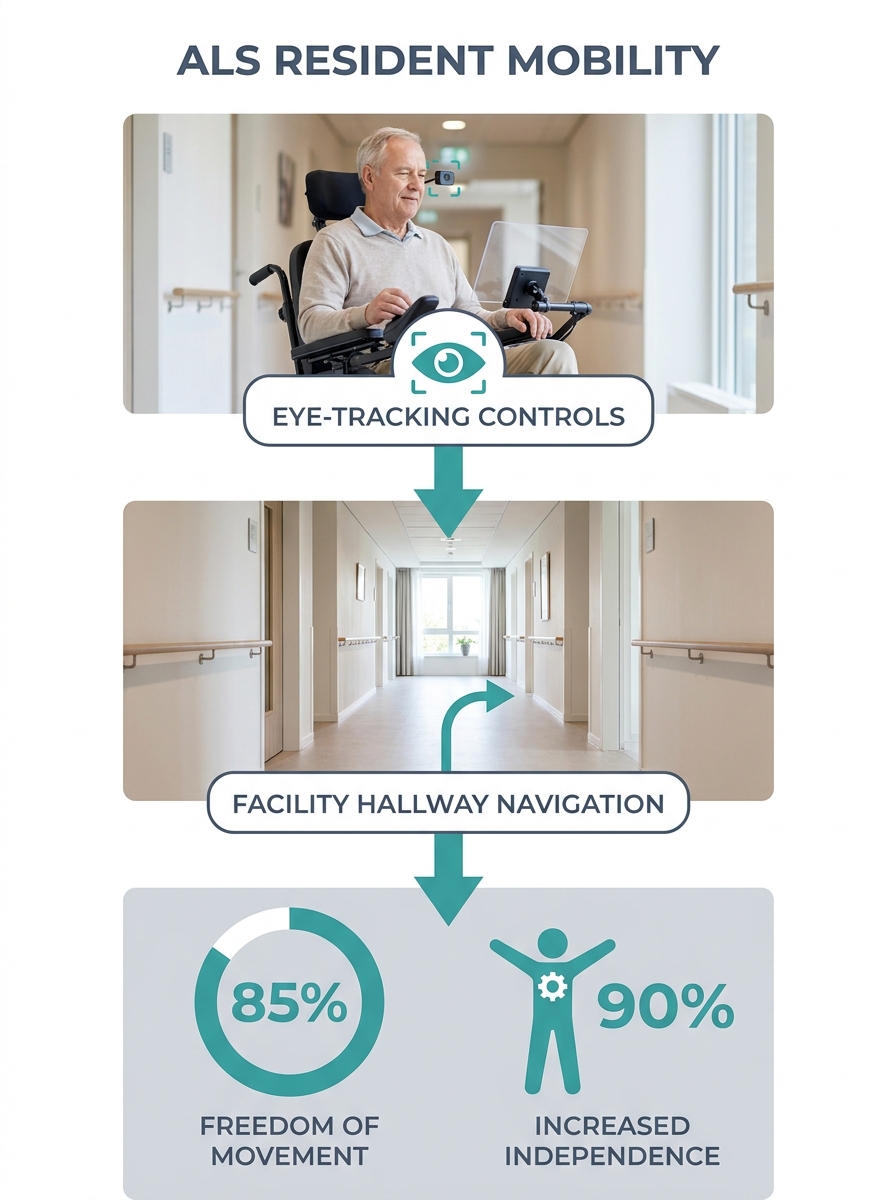
Technology Grants Immobilized Residents Building-Wide Independence
Residents who have lost the ability to move their limbs operate lights, televisions, doors, and elevators through eye-tracking systems and brain-wave sensors that respond to thought commands. One resident who cannot speak or move independently conducted a building tour by navigating hallways and summoning elevators using only eye movements to control a motorized wheelchair, the Forbes report noted.
“If I did not have this equipment, I’d have to wait 30 minutes for an aide to come and open my apartment door for me,” one resident told Forbes contributor Howard Gleckman. The assistive technology frees staff to focus on clinical care rather than basic environmental controls, according to facility administrators.
The center provides ventilator care—a service most nursing homes decline due to cost and complexity—and also serves residents with multiple sclerosis. Federal data shows the facility’s staffing ratio exceeds national nursing home benchmarks by a factor of more than two.
Green House Model Organizes 100 Private Rooms Into Ten Households
The 100-bed facility operates on the Green House model, organizing residents into 10 autonomous households of 10 private rooms each. Each household maintains dedicated staff who handle personal care, meal preparation, and social activities within a single unit, mimicking the dynamics of a home rather than an institutional ward.
Rooms function as efficiency apartments decorated to individual specifications, and residents share meals at communal tables in household living areas. The universal staffing design allows a single aide to manage all aspects of a resident’s care without waiting for nurse authorization for routine decisions, mirroring the autonomy structure of marketing for nursing homes that emphasize dignity and personalization.
A 2022 RAND Corporation study examined how resident and staff autonomy interact to improve outcomes in Green House environments. The Florence Center’s structure enables residents to leave the building for outside activities, including adaptive skydiving excursions and community outings organized by staff.
Inadequate Medicaid Reimbursement Threatens Financial Sustainability
The facility faces substantial financial pressure from Medicaid reimbursement rates that do not cover the cost of its intensive staffing and technology infrastructure. Chelsea Jewish Lifecare, the nonprofit parent organization that also operates communities in Peabody and Longmeadow, Massachusetts, traces its lineage to a house for the aged founded more than a century ago.
The organization launched its dedicated ALS program when Saling, then an assisted living resident watching his disease progress, convinced Berman that traditional senior housing could not meet his escalating care needs. Saling’s architectural expertise shaped the physical design of the 2010 building, which prioritizes accessibility and technological integration over institutional efficiency.
Despite financial constraints common across the nursing home sector, the center rarely transfers residents to hospitals for acute care, reducing the cascading medical costs and stress that typically accompany ALS progression.
Providers Implications
Nursing home operators struggling with marketing for nursing homes in a reputation-challenged sector can point to the Leonard Florence Center model as tangible proof that high-acuity care, extended patient longevans, and resident autonomy are operationally achievable. Administrators negotiating with referral sources—hospital discharge planners, neurologists, ALS clinics—gain a concrete case study to counter the perception that nursing facilities uniformly deliver substandard care.
The facility’s reliance on named technology partners (eye-tracking controls, brain-wave interfaces) and a documented staffing ratio that federal data confirms as double the national average provides verifiable proof points for marketing materials, website case studies, and family consultations. Operators cannot replicate the model without addressing Medicaid reimbursement gaps, but the Chelsea example demonstrates that clinical excellence and patient-centered design can differentiate facilities willing to invest in specialized programs.
For nursing homes serving ALS, MS, or ventilator-dependent populations, the Florence Center’s decade-plus patient survival rates and hospital-avoidance record offer outcome benchmarks that administrators can reference when building referral partnerships with neurology practices and ALS advocacy organizations that steer families toward placement decisions.