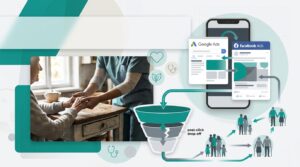
Three methods dominate call recording analysis for home care: manual listening audits, call tracking platforms like CallRail, and AI conversation intelligence tools. Each catches different lead conversion bottlenecks at different price points. Picking the wrong one wastes months while families sign with your competitor.
TL;DR: Manual audits cost nothing but cap around 20 calls per week. CallRail adds HIPAA-compliant tracking and source attribution from $130/month. AI conversation intelligence automates scoring for high-volume agencies but needs 200+ monthly calls to justify the spend. Match the method to your call volume.
Home care intake calls carry enormous stakes. A family calling about care for a parent is often stressed, confused about costs, and comparing two or three agencies simultaneously. The intake coordinator’s first 90 seconds on that call determine whether the family books a consultation or hangs up and tries the next Google result.
A home services call performance report published by Supply House Times found a 46% lead conversion rate across home services calls, with tracking confirming whether each call was answered, resulted in a qualified lead, or ended in conversion. That 46% benchmark means more than half of inbound callers leave without converting. For home care agencies spending $3,000–$8,000 per month on PPC for home care and organic search, that unconverted 54% represents real revenue walking out the door.
So where in the call do those leads actually drop off? Pricing discussion? Service area confusion? Hold times? A vague “we’ll call you back”? The answer depends on which audit method you use.
Manual Listening Audits Reveal Problems That Dashboards Hide
A manual audit means someone on your team sits down with headphones and listens to 15–25 recorded intake calls, scoring each one against a rubric. No software subscription required. The only cost is time, and the insights can be immediate.
Curogram’s healthcare workflow analysis describes the core problem well, noting that workflow bottlenecks show up as daily friction where “tasks take longer than they should, calls stack up, and staff spend more time moving information than caring for people.” That friction is audible on a recorded call. You can hear the intake coordinator fumble for a service area answer, pause too long when asked about pricing, or promise a callback that never happens.
What to listen for
Build a simple scorecard with five columns: caller question, coordinator response, hold time, outcome (booked, callback, or lost), and the moment the call’s tone shifted. After 20 calls, patterns emerge. Common findings from agencies running their first manual audit include:
- Pricing hesitation: the coordinator deflects cost questions instead of anchoring to a range, and the caller disengages within 30 seconds
- Service area confusion: the caller asks about a zip code the coordinator isn’t sure about, leading to “let me check and call you back” (they rarely do)
- After-hours voicemail without follow-up: if your agency struggles with after-hours inquiries from family researchers, call recordings confirm whether those voicemails get returned within 4 hours or 4 days
Where manual audits fall short
The ceiling is real. One person can score 20–25 calls per week before the work becomes unsustainable. You get no marketing source attribution, so you can’t tell whether the dropped lead came from a Google Ad, a referral partner, or an organic search result. And bias creeps in: the person scoring the calls knows the intake team, which makes objective grading difficult after the first few sessions.
OptiMantra’s intake optimization research reinforces this limit, noting that “regular audits and workflow reviews help identify bottlenecks and continuously improve the process” but that even advanced intake systems require structured human oversight to remain effective.
CallRail Connects Each Call to the Marketing Channel That Generated It
CallRail implementation for senior care solves the biggest gap in manual audits: attribution. By assigning unique tracking numbers to each marketing channel (one for your Google Business Profile, another for your A Place for Mom listing, a third for your home care SEO landing pages), CallRail logs which source generated each inbound call before the phone even rings.
ALM Corp’s CallRail setup guide describes the platform as making “the biggest difference for businesses where calls are a meaningful part of revenue,” listing home services companies and medical practices as primary use cases. Home care sits squarely in both categories.
HIPAA compliance is non-negotiable
Any call recording in home care must comply with HIPAA and HITECH regulations. CallRail offers a Healthcare plan specifically designed to maintain compliance with encryption during both transmission and storage. Standard CallRail plans do not include these protections, so agencies must upgrade to the Healthcare tier before recording any calls that might contain protected health information. The Healthcare plan starts around $130/month for 10 tracking numbers and 500 minutes of recording.
Warning: Recording intake calls without HIPAA-compliant infrastructure exposes your agency to fines of $100–$50,000 per violation. CallRail’s standard plans are not HIPAA-compliant. You need the Healthcare plan specifically, and you need a signed Business Associate Agreement (BAA) before you start recording.
What CallRail shows that manual audits can’t
With tracked numbers in place, you can answer questions like: Are Google Ads calls converting at 38% while referral partner calls convert at 62%? Do calls from your neighborhood-level service pages last an average of 7 minutes (a good sign) versus 2 minutes from generic PPC landing pages (a bad one)? CallRail’s keyword spotting feature flags calls where specific phrases appear, such as “too expensive,” “insurance,” or “how soon can you start.” This is where intake call optimization starts to operate at scale.
If you’ve already run a marketing diagnostics audit on your lead flow, CallRail data fills in the channel-level detail that Google Analytics alone misses. Analytics shows that 40 calls happened. CallRail tells you 40 calls happened, 22 came from organic search, 11 came from paid ads, 7 came from your referral portal, and 18 of the 40 went unanswered.
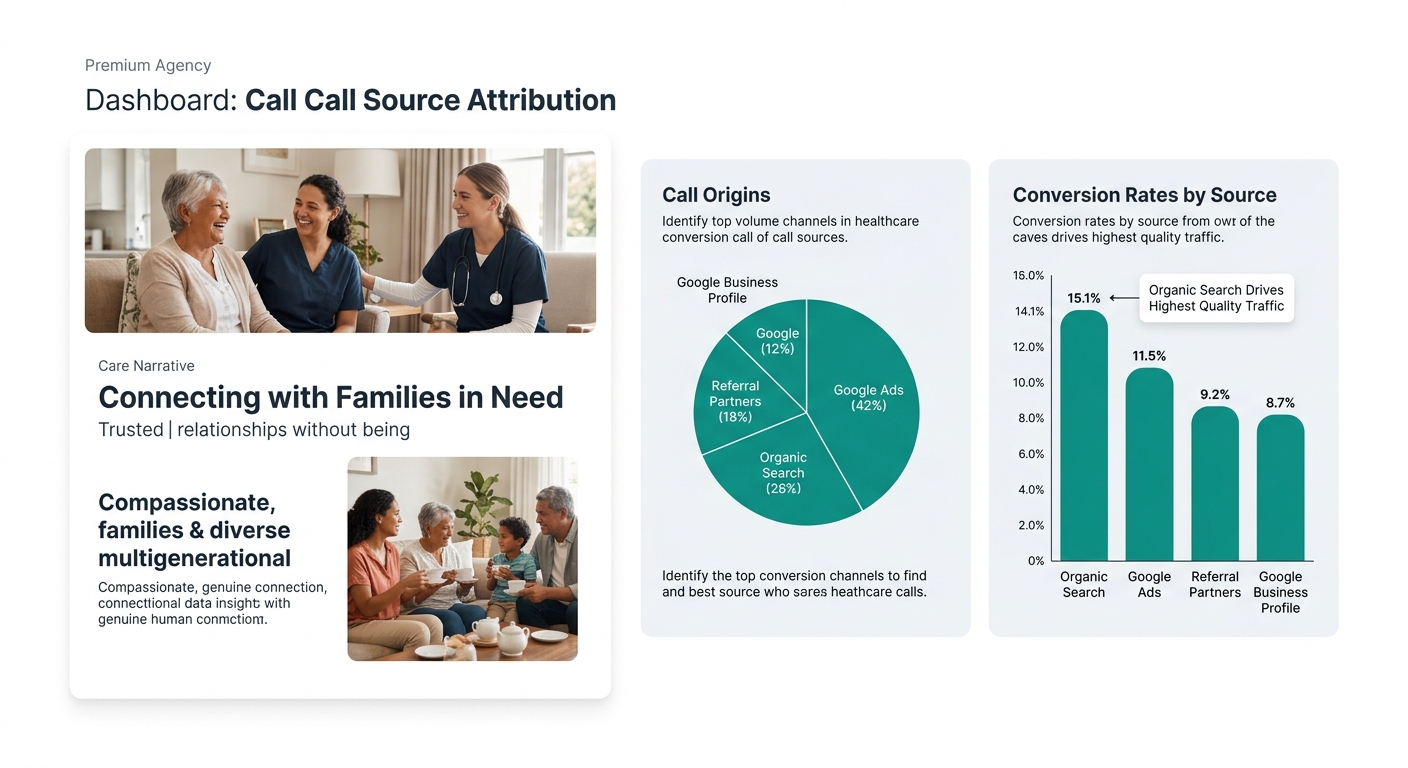
Eighteen of forty calls going unanswered is a conversion problem that no amount of ad spend can fix.
AI Conversation Intelligence Scores Every Call Without a Human Listener
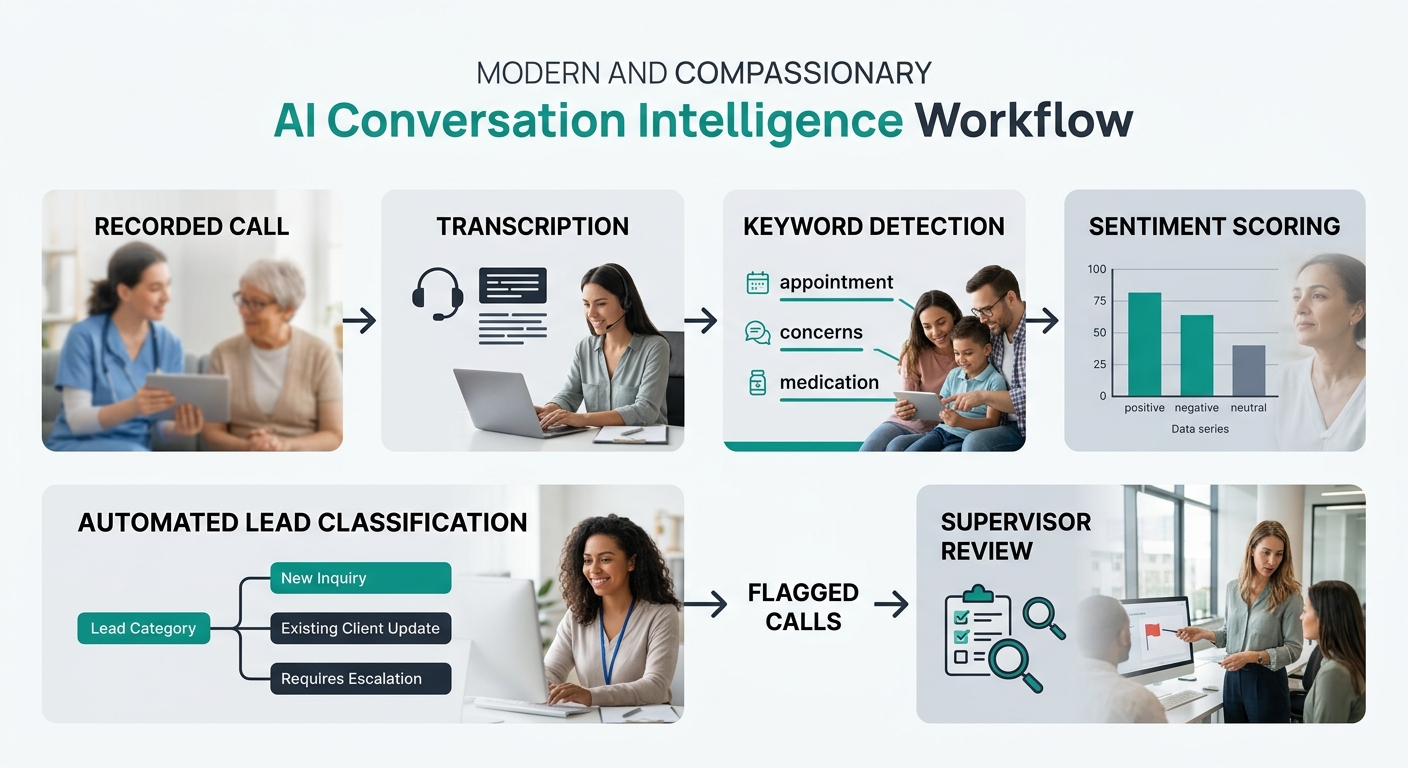
Conversation intelligence platforms (CallRail includes a version called Conversation Intelligence; competitors include Invoca and Marchex) use speech-to-text transcription and AI models to automatically classify, score, and tag every recorded call. No human needs to listen unless the AI flags something unusual.
How it works in practice
The AI transcribes each call, identifies the caller and agent, detects keywords and sentiment, and assigns a lead quality score. Some platforms distinguish between a first-time inquiry, a scheduling call, and a billing question automatically. For agencies handling 200+ intake calls per month across multiple locations, this eliminates the manual bottleneck entirely.
The cost reflects that automation. Expect $200–$500/month on top of base call tracking fees, depending on call volume and the platform’s feature set. For a single-location agency taking 60 calls per month, the per-call cost is difficult to justify. For a multi-location operation fielding 400+ calls monthly, the math shifts dramatically.
The risk of over-relying on automation
AI scoring works well for surface-level patterns like keywords mentioned, call duration, and whether the caller booked an appointment. It struggles with nuance. When a family member says “that sounds fine” in a flat tone that signals they’re already mentally calling the next agency, the AI scores it as a positive interaction. A human listener catches the hesitation. The best-performing agencies combine AI scoring to triage calls with targeted manual review of the 10–15% the system flags as problematic.
Research into intake bottlenecks at healthcare practices confirms this gap, noting that even optimized digital systems require regular human workflow reviews to catch the problems automation misses.
How To Choose Between These Three
The decision rests on three variables: monthly call volume, marketing channel diversity, and budget.
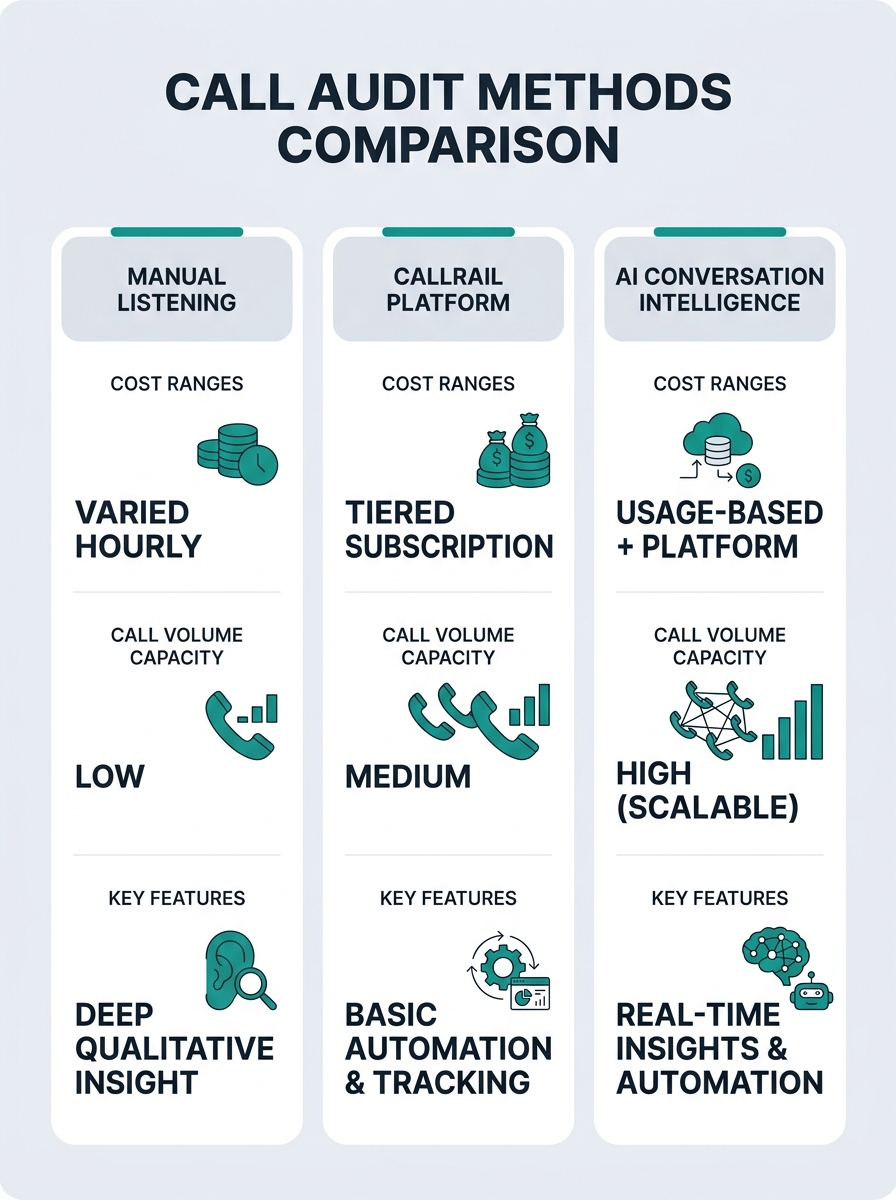
| Feature | Manual Audit | CallRail Healthcare | AI Conversation Intelligence |
|---|---|---|---|
| Monthly cost | $0 (staff time only) | $130–$200/month | $300–$700/month |
| Calls audited per month | 80–100 max | Unlimited recording, manual review | Unlimited recording + auto-scoring |
| Marketing source attribution | None | Full (by tracking number) | Full (by tracking number) |
| Keyword/phrase detection | Human ear only | Rule-based keyword spotting | Automated NLP classification |
| HIPAA-ready | Depends on recording tool | Yes (Healthcare plan + BAA) | Varies by vendor, confirm before signing |
| Best for | Agencies with fewer than 80 calls/month | Agencies with 80–300 calls/month | Multi-location, 300+ calls/month |
Under 80 calls per month: start with manual listening. Build your scorecard. Identify whether the problem is pricing talk-tracks, response time, or service area gaps. This costs nothing but attention, and the patterns you find will inform every tool decision that follows.
80–300 calls per month: CallRail’s Healthcare plan gives you source attribution, call recording, and keyword spotting at a price point most single-location agencies can absorb. You’ll know which marketing channels produce calls that convert and which produce calls that die on the vine.
300+ calls per month across multiple locations: AI conversation intelligence earns its cost here. Scoring 400 calls manually every month is unrealistic. Automated transcription and classification let your intake manager focus on coaching the calls the AI flags as problematic instead of listening to all of them.
Tip: Whichever method you choose, audit a minimum of 20 calls before drawing conclusions. Patterns in 5 or 6 calls can mislead. At 20+, you’ll see whether the drop-off is systemic (a training issue) or situational (one coordinator struggling on Tuesday afternoons).
The agencies that close more families aren’t necessarily running better ads. They’re listening to what happens after the phone rings, measuring where the conversation breaks down, and fixing the intake experience one talk-track at a time. Call recording analysis for home care is the diagnostic step that connects your marketing spend to your signed-client count. Pick the tool that fits your volume, get HIPAA compliance locked down before you record a single call, and start listening.