
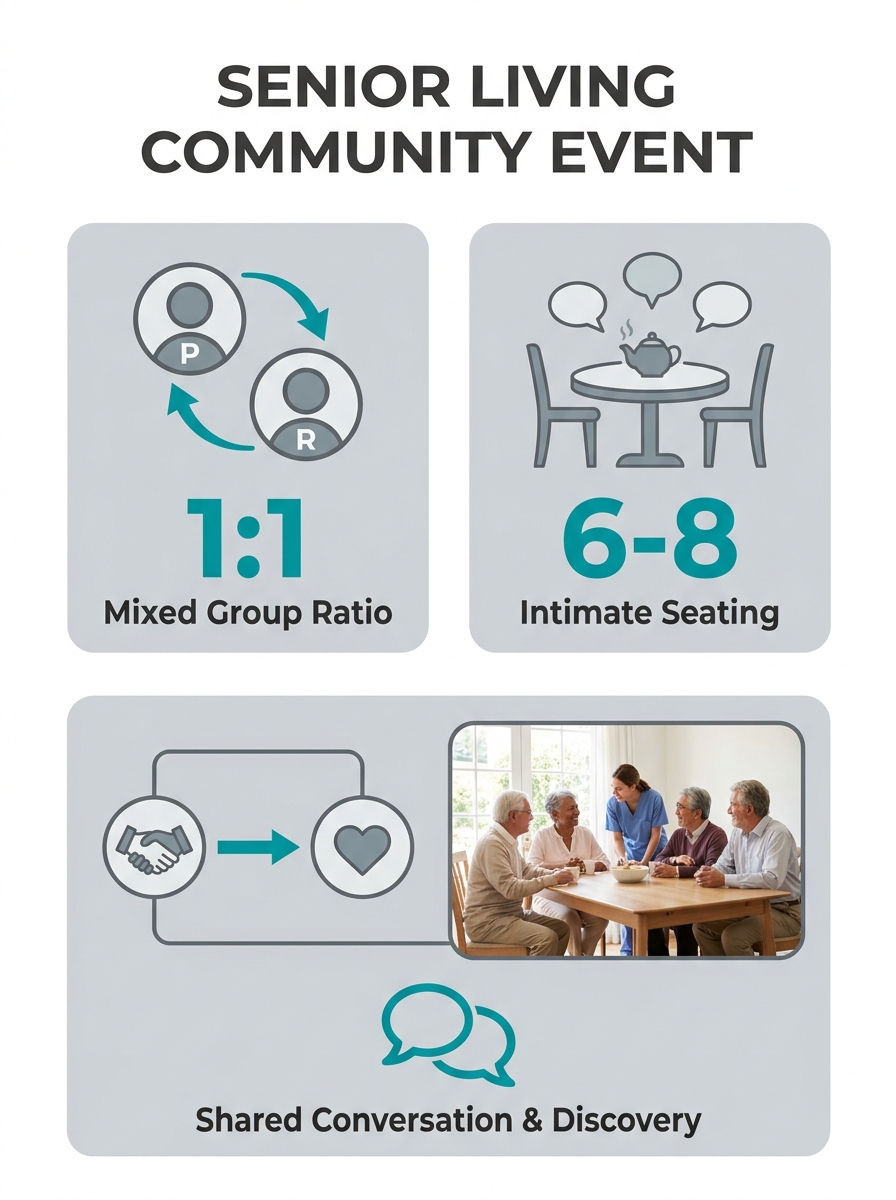
Four senior living operators have replaced broad open-house events with invitation-only gatherings of 20 to 25 prospects, shifting event goals from lead generation to relationship building as occupancy rates rise and waitlists lengthen across the sector, according to Senior Housing News. Atria Senior Living, Mather, Judson Senior Living, and Beztak reported on August 18, 2026 that they now pair prospects with current residents or department heads at monthly social events rather than presenting to large prospect groups.
TL;DR: Atria’s 199 communities use centralized event templates for two monthly programs—Social Series and Taste of Atria—while Judson caps events at 20-25 guests and asks whether attendees would pay for the programming if held at a cultural center.
Atria Centralizes Event Planning Across 199 Communities
Atria Senior Living centralized event planning and management at the corporate level to create flexible templates that all 199 communities adapt to local market demand. The operator refined its framework around two monthly installments: the Social Series and Taste of Atria events, which focus on creating connections rather than formal sales presentations.
“We never want it to be a bunch of prospects coming together and presenting to them. We know they’re coming to an event, enjoying themselves and meeting people, and the social element is really important for us,” said Sanela Graziose, Atria’s chief marketing officer, in the company’s statement.
Corporate leaders develop event concepts, marketing materials, themes, flyers, and social media promotion guidance for local community teams. Sales staff invite select prospect families and often pair them with residents or department leaders during events. Atria combines tours with social programming depending on prospect urgency or buying stage, differentiating social events as lead-generation opportunities while using educational seminars to nurture online leads and qualify interest.
Atria tailors follow-up events to address prospect concerns about downsizing and selling a home, aiming to provide “uncommon hospitality” throughout the sales process, Graziose said.
Judson Limits Events to 25 Guests, Tests Programming Against Cultural Center Standards
Judson Senior Living moved away from broad open-house formats to create targeted gatherings that help waitlist members integrate into community life before moving in. The operator limits events to 20 to 25 guests and varies formats from speaking engagements to coffee roundtables and creative workshops to maintain interest and create urgency around senior living marketing transitions.
“We always ask ourselves if people would buy a ticket to attend the event if it were held at a local university or cultural center,” said Dianna Huckestein, Judson’s vice president of sales and marketing. “When the answer is yes, we know we have found a winning idea.”
Judson combines cultural, intellectual, and culinary programming with resident ambassadors so prospects experience community lifestyle without sales pitches, according to Huckestein.
Mather Shifts to Decision-Oriented Programming for Waitlist Prospects
Mather, an Evanston, Illinois-based nonprofit operator of life plan communities, shifted event programming to focus on prospects whose urgency and needs align with specific communities within the organization’s network. For prospects joining a waitlist, Mather emphasizes decision-oriented programming covering life care, financial structure, home options, services, and dining.
Once a prospect joins a waitlist, sales leaders shift to maintaining social connections through events where future residents meet current Mather community members. “They do not want a heavy sales pitch. They value a direct, sophisticated and transparent presentation that respects their time and provides the information they need,” said Gale Morgan, Mather’s senior vice president of sales.
Mather uses personal invitations and sends event confirmations via text, email, and phone calls to secure attendees, then follows up after events conclude, Morgan said.
Why This Matters Now
Senior living operators face a prospect engagement paradox: rising occupancy rates and longer waitlists create urgency, but prospects increasingly resist traditional sales presentations. The shift from open houses to curated 20-25 person events addresses this tension by treating event programming as a preview of daily community life rather than a lead-generation tactic. Operators who adapt event strategy to match the relationship-focused approach that drives occupancy growth gain an advantage in markets where high demand has made first impressions more competitive.
The centralized-template model Atria implemented across 199 communities offers a scalable framework for operators balancing corporate consistency with local market adaptation. By developing event concepts, collateral, and promotion guidance at the corporate level while allowing communities to tailor programming, operators reduce the resource burden on local sales teams while maintaining quality control. This approach matters particularly for mid-sized operators who lack dedicated event-planning staff at every property.
The test Judson applies—asking whether prospects would pay for programming if held elsewhere—establishes a measurable quality threshold for event development. Operators who build event calendars around this standard create programming that delivers value independent of the sales context, which strengthens relationship building during the consideration and waitlist stages when prospects are evaluating multiple communities.