Integration architecture between your scheduling software, CRM, and marketing automation platform determines your agency’s marketing ROI more reliably than any individual tool selection. Home care agencies running well-connected mid-tier platforms consistently outperform agencies with disconnected best-in-class tools and manual data transfers between them.
The Selection Problem That Actually Matters
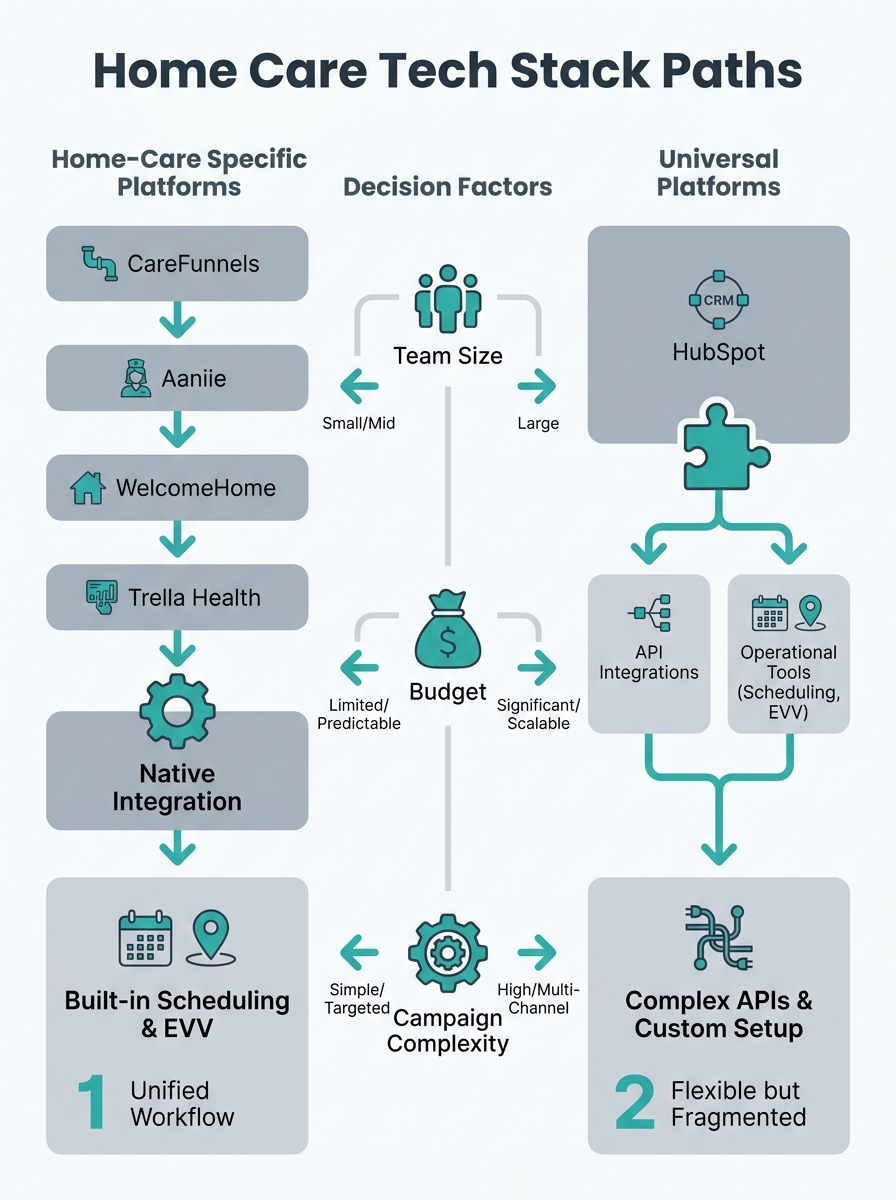
Why does platform selection paralyze so many home care operators? Because the market offers two genuinely different paths, and the wrong choice creates months of rework. On one side sit home-care-specific platforms like CareFunnels, Aaniie, WelcomeHome, and Trella Health, each bundling CRM features alongside scheduling, EVV, and compliance tools. On the other side sit universal marketing automation platforms like HubSpot, which offer far deeper campaign capabilities but know nothing about caregiver matching or visit verification out of the box. Modern marketing stacks across healthcare average 15-25 integrated platforms, according to a 2026 industry analysis, with marketing operations teams spending 40-60% of their time on integration maintenance rather than campaign optimization.
The distinction matters more in home care than in most industries. Your marketing automation platform setup has to account for data that general-purpose tools weren’t designed to handle: caregiver availability windows, referral source attribution tied to specific discharge planners, payer mix segmentation, and service area boundaries that shift by zip code. According to Activated Insights’ CRM guide, ClearCare launched a HubSpot integration specifically to let agencies use both platforms in tandem while remaining HIPAA-compliant, an acknowledgment that neither platform alone covers the full scope of what a home care agency needs. Trella Health, another favorite among home care agencies, takes a different approach by offering CRM features designed around referral analytics and market intelligence rather than general-purpose email automation.
Before you start comparing feature matrices, the Home Care Marketing Pros team offers advice worth taking seriously: stack-rank the types of campaigns you want to run and the types of data you want to gain before shopping. Consider your financial resources, how many people you have to manage campaigns, and how much time they can dedicate to the work. An agency with one part-time marketing coordinator needs a different platform class than one with a three-person growth team. The platform that wins awards in G2 reviews may be the platform that sits half-configured on your server six months from now, adding $500-$1,500 per month in subscription costs while generating zero additional inquiries.
What Home Care CRM Integration Demands in Practice
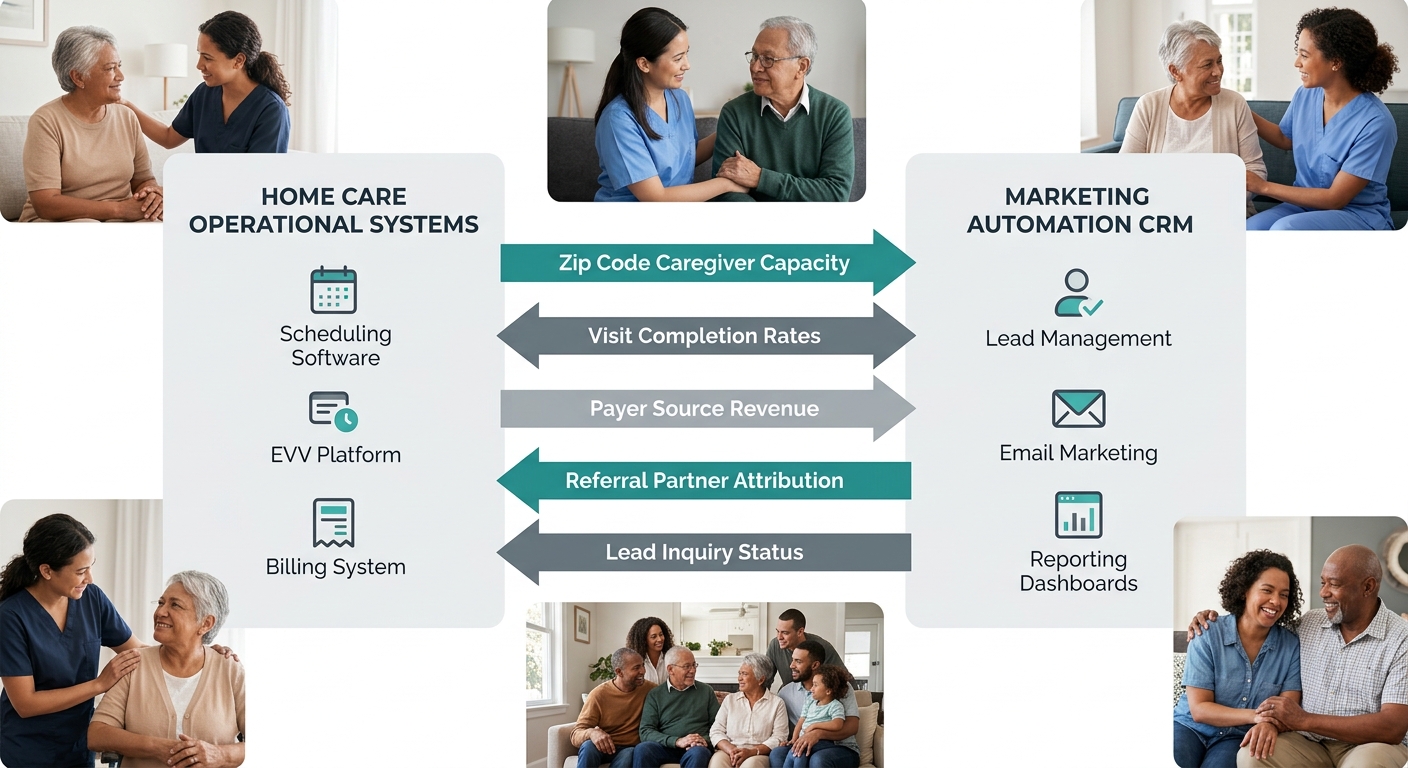
Home care CRM integration is tossed around as if plugging two systems together is a weekend project. In practice, the data that drives your marketing decisions lives inside operational systems your marketing platform has never seen. Your scheduling platform knows which zip codes have open caregiver capacity across 10-15 service areas. Your EVV system tracks visit completion rates that directly affect client satisfaction and retention. Your billing software knows which payer sources generate the highest lifetime value per client, with Medicaid waiver clients averaging different revenue profiles than private-pay families or long-term care insurance holders. None of that is marketing data by origin, but all of it should inform which leads you pursue and how aggressively you pursue them.
Testing during a trial period is the step agencies skip most often, and it’s the step that prevents the most expensive mistakes. Vendor claims about easy integration deserve skepticism until you’ve verified actual data sync for lead status updates, referral source tracking, and care inquiry details flowing between systems. WelcomeHome advertises automated caregiver matching, lead tracking, and AI-assisted scheduling within its CRM, with a dedicated implementation team ensuring the platform connects to existing tools. That sounds promising in a 45-minute demo. The real questions emerge afterward: Does your specific scheduling software have a supported API? Does lead data sync in real time, or in overnight batch transfers that leave your intake team working with stale information? Can your sales coordinator see, inside the marketing platform, that a lead’s preferred service area currently has 3 available caregivers versus 0?
This is where choosing between a dedicated referral partner portal and a standard CRM becomes especially relevant. If referral relationships with discharge planners and social workers generate 30-50% of your inquiries, your integration architecture needs to capture which referral source sent each lead, what care need was identified, and how quickly your team responded. Lose that attribution data in the handoff between systems, and you can’t measure which referral partnerships actually produce revenue. Alora Health’s AI roadmap signals deeper analytics identifying patterns in referral sources, caregiver performance, and cost per service line, but those analytics only deliver value if the underlying data connections are clean from day one. SOC 2 Type II compliance adds another filter, especially for agencies handling protected health information across multiple connected platforms.
Lead Nurture Workflows Built for How Families Decide
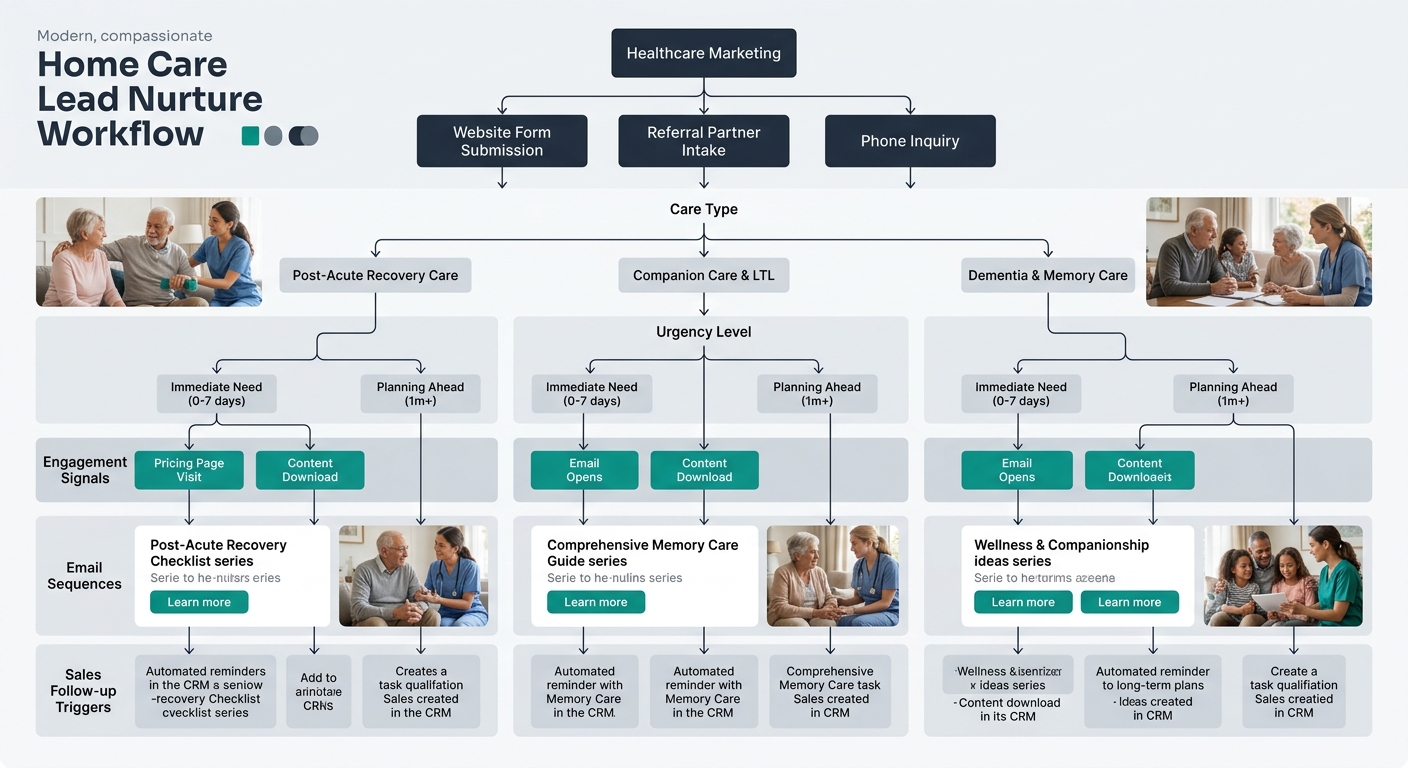
Lead nurture workflow implementation in home care has to account for a decision timeline that looks nothing like e-commerce or SaaS. Families evaluating home care often spend 3-8 weeks moving between awareness, research, and commitment, frequently cycling back through earlier stages as medical situations change or family dynamics shift. Understanding how family decision journeys actually unfold is prerequisite knowledge before you build a single automated workflow. A 2026 healthcare lead generation guide recommends setting up automated workflows that maintain consistent touchpoints with prospects over extended evaluation periods, ensuring leads receive the right content at the right time without manual intervention. That advice sounds obvious, but the implementation is where agencies stumble.
The challenge specific to home care is segmentation depth. A daughter researching care for a parent recovering from hip surgery has different information needs, urgency levels, and objections than an aging couple proactively exploring companion care. Your workflows need to branch based on care type requested, geographic service area, referral source, and engagement signals like which pages the lead visited or whether they opened your last 3 emails. HubSpot’s workflow engine allows triggers based on industry, engagement level, page views, and lead score, where a lead scoring above 70 enters a high-priority workflow. Translating that into home care terms: a family that visited your pricing page and downloaded a care assessment guide should receive a different email sequence than someone who submitted a general contact form and hasn’t returned. Yet 84% of patients and families check online reviews before choosing a provider, according to KFF’s 2024 survey, which means your nurture sequence also needs to incorporate social proof touchpoints, service area-specific testimonials, and caregiver credential highlights at the right intervals.
Alina S., a home care agency operator in Hawaii, described her experience with Aaniie’s marketing automation suite: “It took our agency from the middle of our market to the clear leader in care for our area. We couldn’t have done that without their CRM tools.” That result points to something agencies underestimate. The operators seeing real results from lead nurture aren’t the ones with the most sophisticated technology. They’re the ones whose workflows reflect genuine understanding of their local market’s decision patterns. If your email marketing for care providers sends the same drip sequence to every inquiry regardless of care need or urgency, you’re burning leads that a competitor with better segmentation will convert.
The agencies seeing real results from lead nurture aren’t running the most sophisticated technology. They’re the ones whose workflows reflect genuine understanding of their local market’s decision patterns.
The problem that surfaces repeatedly when agencies discuss their home care agency tech stack is that workflows get built once and never revisited. A nurture sequence designed when your agency primarily served post-acute clients may be completely wrong for the growing segment of families seeking ongoing companion care or dementia support. Your content strategy for care providers and your automation workflows need to evolve together, because the emails and landing pages feeding your nurture sequences are only as effective as the content inside them. Addressing the decision-maker mismatch in your messaging is equally critical. Workflows that speak to the wrong family member waste every touchpoint in the sequence regardless of how elegantly the automation triggers are configured.
Where This Roadmap Gets Uncertain
Every integration roadmap carries an implicit promise: connect the right tools in the right order, build the right workflows, and growth follows. The reality is messier, and it’s worth being honest about where the confident advice runs into genuine ambiguity. The home care CRM market is fragmenting at the same time it’s consolidating. Niche platforms are adding marketing features while universal platforms add healthcare-specific integrations. AI capabilities from vendors like Alora Health promise analytics that could reshape how agencies evaluate their tech investments entirely. Whether you should bet on a purpose-built home care platform that handles everything from EVV to email campaigns, or stitch together best-of-breed tools with API connections, depends on variables that shift with your agency’s growth rate, market density, and team’s technical capacity.
The retained-patient economics from broader healthcare sharpen the stakes considerably. In primary care, a retained patient generates $800-$2,500 per year, and a platform retaining 20 additional patients annually pays for itself many times over. In home care, where a single client on ongoing services can represent $3,000-$8,000 per month, the math on lost leads is severe. One family that drops out of your nurture sequence because a workflow wasn’t triggered, or because your CRM didn’t sync a referral partner’s intake note, can represent tens of thousands in lost lifetime revenue. And yet the industry’s 79% caregiver turnover rate, well documented across the sector, means that even a perfectly executing marketing automation system can drive inquiries your agency can’t staff. Building polished lead nurture sequences while your caregiver pipeline runs dry is the kind of misallocation that technology makes dangerously easy to overlook. The platform won’t surface that problem unless you’ve built the integration connecting staffing capacity data to your marketing dashboards, and that connection requires operational leaders and marketing leaders to share data they’re accustomed to owning separately.