Expanding the top of your home care hiring funnel will not fix your time-to-fill problem. The agencies seeing the fastest hiring cycles in 2026 aren’t spending more on job ads or applicant volume. They’re deploying structured caregiver onboarding content between application and first shift — the exact window where 60% of candidate drop-off occurs.
TL;DR: Time-to-fill shrinks when agencies stop treating onboarding as paperwork and start treating it as a content experience. A structured three-phase content series addressing pay transparency, role expectations, and peer connection during the application-to-first-shift window can reduce caregiver drop-off by 20–40% and compress hiring timelines dramatically.
The Funnel Isn’t Leaking at the Top
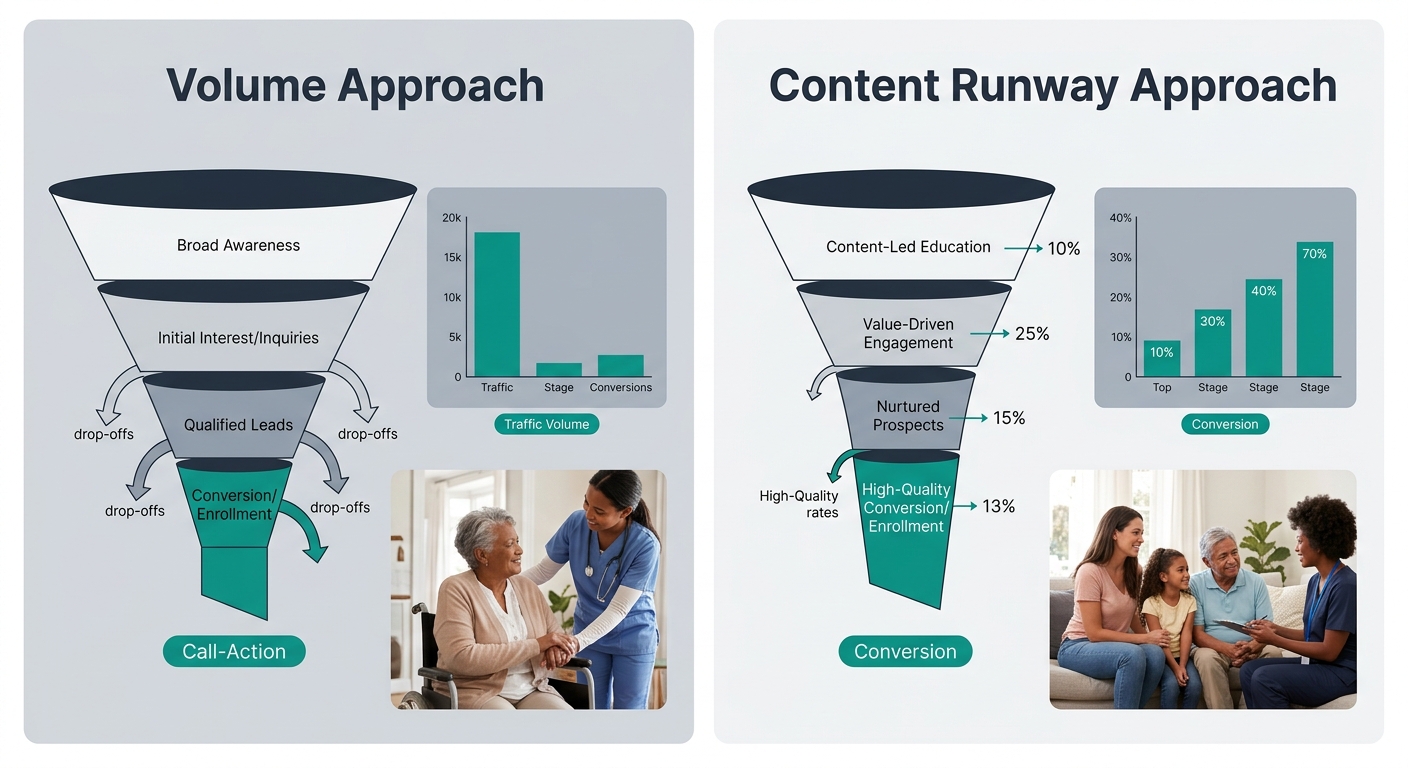
Every conversation about hiring speed in home care defaults to the same playbook: post on more job boards, increase ad spend on Indeed, boost Facebook campaigns. The assumption is that more applicants at the top means faster fills at the bottom. The data tells a different story.
With the industry reporting a 79% caregiver turnover rate, the math doesn’t support a volume-first approach. Agencies running digital onboarding processes see 60% faster onboarding completion times compared to those relying on paper-based workflows, according to current benchmarks. That speed gap doesn’t come from better sourcing. It comes from what happens after someone clicks “Apply.”
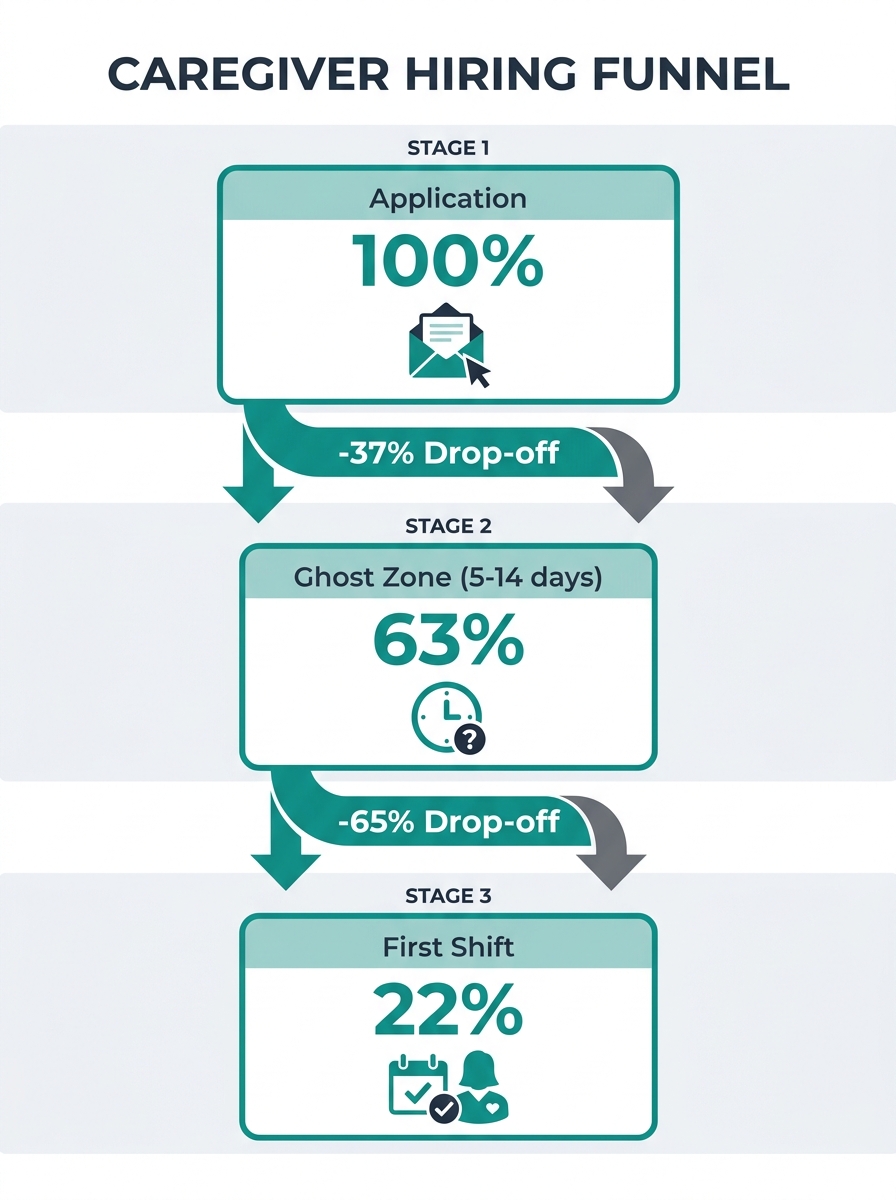
The real bottleneck sits in what I call the ghost zone — the 5-to-14-day stretch between a candidate submitting an application and showing up for their first shift. During this window, candidates ghost. They accept offers from competitors. They get confused about next steps. They lose enthusiasm.
And the agency, meanwhile, sends them nothing but compliance paperwork and radio silence.
This is where recruitment content marketing actually matters. The content you send (or don’t send) between application and Day 1 determines whether your home care hiring funnel converts at 30% or 70%.
Evidence One: Structured Content Beats Faster Paperwork
The instinct when facing slow time-to-fill is to digitize forms, automate background checks, and compress the administrative timeline. Those steps help. But they address logistics, not motivation.
An HR Manager at HomeWell Care Services described what actually moved the needle for their operation: “One onboarding strategy we have implemented is our mentorship program which tackles two crucial issues at once: caregiver retention and client satisfaction. Pairing new caregivers with experienced ones provides the opportunity for new recruits to receive guidance and ask questions on navigating the intricacies surrounding client care,” according to agency executive interviews compiled by Activated Insights.
That mentorship program didn’t exist in isolation. It was wrapped in content — welcome videos, mentor introduction emails, “what your first week looks like” guides — that gave incoming caregivers something to engage with before their start date. The distinction matters. The mentorship itself is a retention tactic. The content announcing, explaining, and contextualizing the mentorship is a hiring funnel conversion tactic. It gives candidates a reason to keep showing up.
Research from HHAeXchange confirms the underlying psychology: poor employer communication ranks among the top factors harming home health worker satisfaction and driving early-stage attrition. When agencies fill the ghost zone with silence, candidates interpret that silence as a preview of what working there will feel like.
If you’ve been wondering why your caregiver ATS keeps losing qualified applicants between stages, the answer often has nothing to do with the software. It’s about what content — if any — reaches the candidate during the wait.
Evidence Two: The Three-Phase Onboarding Content Runway
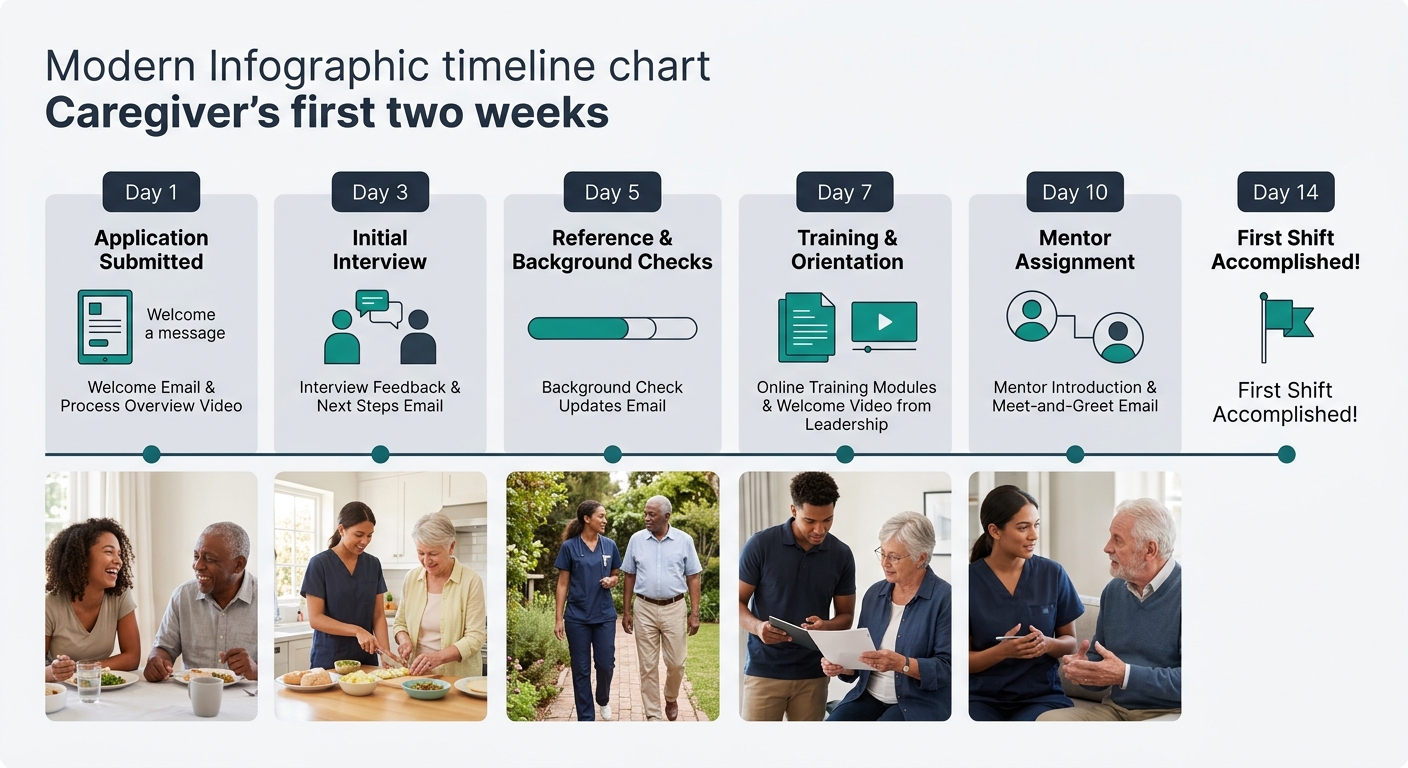
Agencies that have compressed their hiring timelines tend to share a common content architecture, even if they don’t call it that. I’m naming it the Onboarding Content Runway because it functions like one: a sequence of content touchpoints that accelerates a candidate from “interested” to “working” with fewer stalls, fewer ghosting events, and fewer compliance delays.
The Runway has three phases:
Phase 1: Confirmation Content (Days 0–2)
This fires immediately after application. It includes a short welcome video from the scheduler or office manager (not a polished corporate production — a 90-second smartphone video works better), a clear outline of the next three steps, and transparent pay information. The goal is to make the candidate feel seen and informed within 48 hours.
Agencies implementing this phase report that candidates who receive a personal video touchpoint within 24 hours are significantly more likely to complete orientation than those who receive only an automated confirmation email. Trinity In Home Care found that speeding up the in-office education process and increasing paid in-field onboarding directly produced “higher numbers for onboarding and higher retention rates in the first 30 days.”
Phase 2: Expectation Content (Days 3–7)
This phase sends 2–3 short content pieces addressing the specific anxieties that make candidates abandon the process. Common pieces include: a “day in the life” written by a current caregiver, a FAQ document addressing scheduling flexibility, and a short guide on HIPAA and safety procedures using real-world case studies rather than abstract policy language.
The expectation content phase directly targets caregiver drop-off reduction. When a candidate knows exactly what they’re walking into, the fear-of-the-unknown disappears. This content doesn’t need to be fancy. It needs to be specific and honest.
Phase 3: Connection Content (Days 7–14)
Before the first shift, the candidate receives an introduction to their mentor, a brief profile of their first client (appropriate details only), and a “what to bring / what to expect” checklist for Day 1. Well Care Health’s tailored onboarding track demonstrates this principle in action, reinforcing existing skills while introducing new protocols specific to each new hire’s background.
| Phase | Timing | Content Pieces | Primary Goal | Key Metric |
|---|---|---|---|---|
| Confirmation | Days 0–2 | Welcome video, next-steps outline, pay transparency doc | Reduce immediate ghosting | 24-hour response rate |
| Expectation | Days 3–7 | Day-in-the-life story, FAQ, compliance guide with scenarios | Remove anxiety barriers | Orientation show-up rate |
| Connection | Days 7–14 | Mentor intro, client preview, Day 1 checklist | Build belonging before start | First-shift completion rate |
The content you send between application and Day 1 determines whether your hiring funnel converts at 30% or 70%.
Agencies using recognition platforms alongside structured onboarding see 45% lower turnover after two years. Mobile scheduling integration adds another 15% reduction in schedule-related attrition. But these tools only work if the candidate survives the ghost zone long enough to experience them. The Onboarding Content Runway gets them there.
Evidence Three: Content Series Economics Outperform Ad Spend Increases
Here’s the financial argument. The hidden economics of caregiver turnover mean that every candidate who ghosts between application and first shift represents wasted acquisition cost — typically $300–$600 per applicant depending on your market and channel mix.
When agencies implementing structured onboarding strategies see turnover decrease by 20–40% within 12 months, that reduction flows directly to the bottom line. And a structured caregiver onboarding content series costs almost nothing to produce compared to incremental ad spend. A smartphone, a Google Doc, and an email sequence through your existing CRM or scheduling tool cover 90% of the Runway.
Compare that to the alternative: pumping more money into Facebook or Google recruitment ads to replace candidates who were already interested but dropped out because nobody talked to them for 10 days. The cost-per-hire math collapses when your conversion rate from applicant to active caregiver improves even modestly.
This same principle applies across senior care workforce retention more broadly. Whether you’re running a home care operation or managing marketing for assisted living communities, the gap between “attracted” and “retained” is where content does its heaviest work. Job ads generate awareness. Onboarding content generates employees.
Tip: You don’t need a content team to build an Onboarding Content Runway. Record a 90-second welcome video on your phone. Write a single-page “what your first week looks like” document. Send both within 24 hours of application. That two-piece combination alone addresses the largest single source of ghost-zone drop-off.
The agencies that have cracked senior care workforce retention aren’t doing anything exotic. They’re treating the space between “yes, I’m interested” and “here’s my first timesheet” as a content problem rather than an administrative one. Training, ongoing education, and regular touchpoints throughout the first year form the long-term retention strategy. But the content series during the hiring window is what makes those programs reachable in the first place.
The Claim, Revisited
The 40% time-to-fill reduction isn’t a magic number pulled from a single agency’s lucky quarter. It’s the predictable result of eliminating the dead air that kills candidacies. When the industry averages a 79% turnover rate and the primary driver of early attrition is poor communication during the earliest employment stages, the fix is communication — delivered as structured, specific, human caregiver onboarding content during the window when candidates are deciding whether to show up.
Agencies that build an Onboarding Content Runway are doing something counterintuitive in a market obsessed with applicant volume: they’re investing less in getting people into the funnel and more in keeping them from falling out of it. The content itself is simple. A welcome video. A day-in-the-life story. A mentor introduction. A Day 1 checklist. None of these require a marketing budget. All of them require the decision to treat a caregiver’s first two weeks of contact with your agency as something worth designing, rather than something that happens by accident between HR emails. That design choice is where the 40% lives.