
Google “assisted living near me” in any U.S. metro and open the first ten organic results. Seven or eight of those homepages feature “compassionate care” in the hero section or meta description. When every provider makes the same emotional promise, the phrase erases differentiation and pushes families toward the only remaining comparison signal: price.
The word “expensive” here has nothing to do with Google Ads bidding. The cost shows up in lost admissions, compressed margins, and a referral network that can’t articulate why they should send families to you instead of the agency down the road. Every month your site leads with language identical to your competitor’s site, you’re paying a sameness tax that doesn’t appear on any invoice.
The Sameness Tax
Families searching for senior care are conducting a high-stakes comparison under emotional duress. Adult children ages 45 to 65 typically serve as the primary researchers and decision-makers in these situations, according to Craft & Communicate’s analysis of skilled nursing versus lifestyle senior living marketing. Those adult children are opening multiple tabs simultaneously, scanning each provider’s homepage for something that separates one option from another. When they find the same two-word phrase on site after site, the phrase stops registering as a meaningful claim. It becomes wallpaper.
This creates a downstream problem that’s hard to see from inside your own organization. Your admissions team fields calls where the family can’t remember which provider’s website they’re looking at. Your referral partners struggle to recall what makes you different when a discharge planner asks them for a recommendation. SageAge’s research on senior living branding found that “unified messaging and a consistent visual identity signal professionalism and reliability, reinforcing the trust and confidence families seek.” The key word in that finding is consistent, not generic. A brand that consistently communicates a specific promise builds confidence. A brand that consistently sounds like everyone else builds nothing.
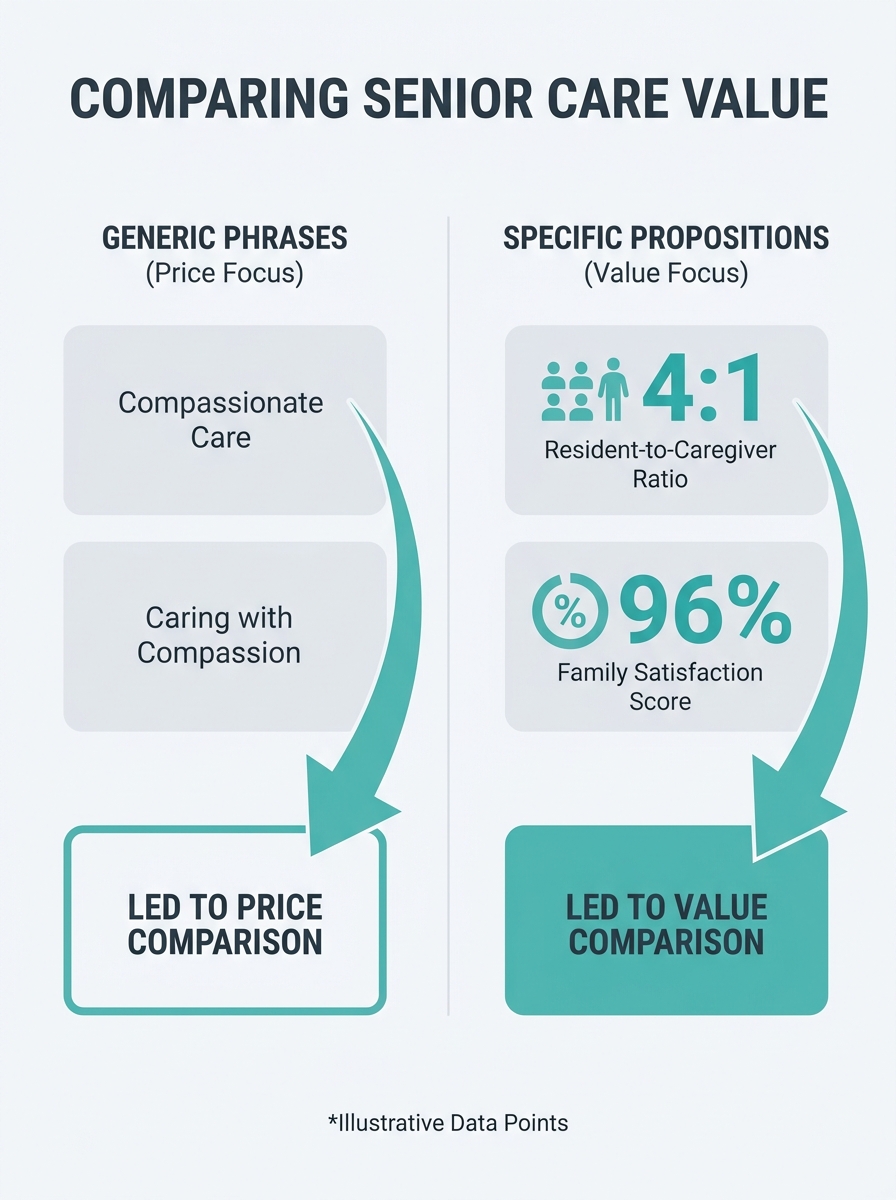
The sameness tax compounds in referral relationships, too. When a hospital discharge planner has three agencies saved in their contacts, the one that communicated a specific capability (say, post-stroke mobility support with certified therapists on staff) gets the referral. The one remembered only as “compassionate” doesn’t, because all three agencies described themselves that way. If you’ve been working on strengthening your referral partnerships after initial meetings, vague emotional language on your website actively undermines that effort. Your referral partners need a concrete sentence to repeat on your behalf, and “they provide compassionate care” gives them nothing to work with.
What Families Are Actually Screening For
Safety, medical care quality, staffing ratios, cleanliness, and cost dominate family decision-making conversations, according to industry research tracking what families prioritize during the evaluation process. Those five concerns share a common trait: they’re all verifiable. A family member can check a staffing ratio. They can look up inspection reports. They can ask about the nurse-to-resident count on overnight shifts. “Compassionate care” asks the family to take your word for it, and families making $5,000-to-$10,000-per-month commitments aren’t in a trusting mood. They’re in a verification mood.
BILD & Co’s work on assisted living marketing techniques makes this point directly: “Copywriting on a website needs to be articulate and answer common queries from website visitors while reducing hesitation.” The phrase “reducing hesitation” is doing heavy lifting in that sentence. Hesitation comes from unanswered questions, and “compassionate care” answers exactly zero of the questions a family is actually carrying into a website visit. How many caregivers will be assigned to my mother during a given shift? What happens at 2 a.m. if she falls? What training do your memory care staff complete? Those are hesitation-reducing answers. “Compassionate care” is a hesitation-maintaining platitude.
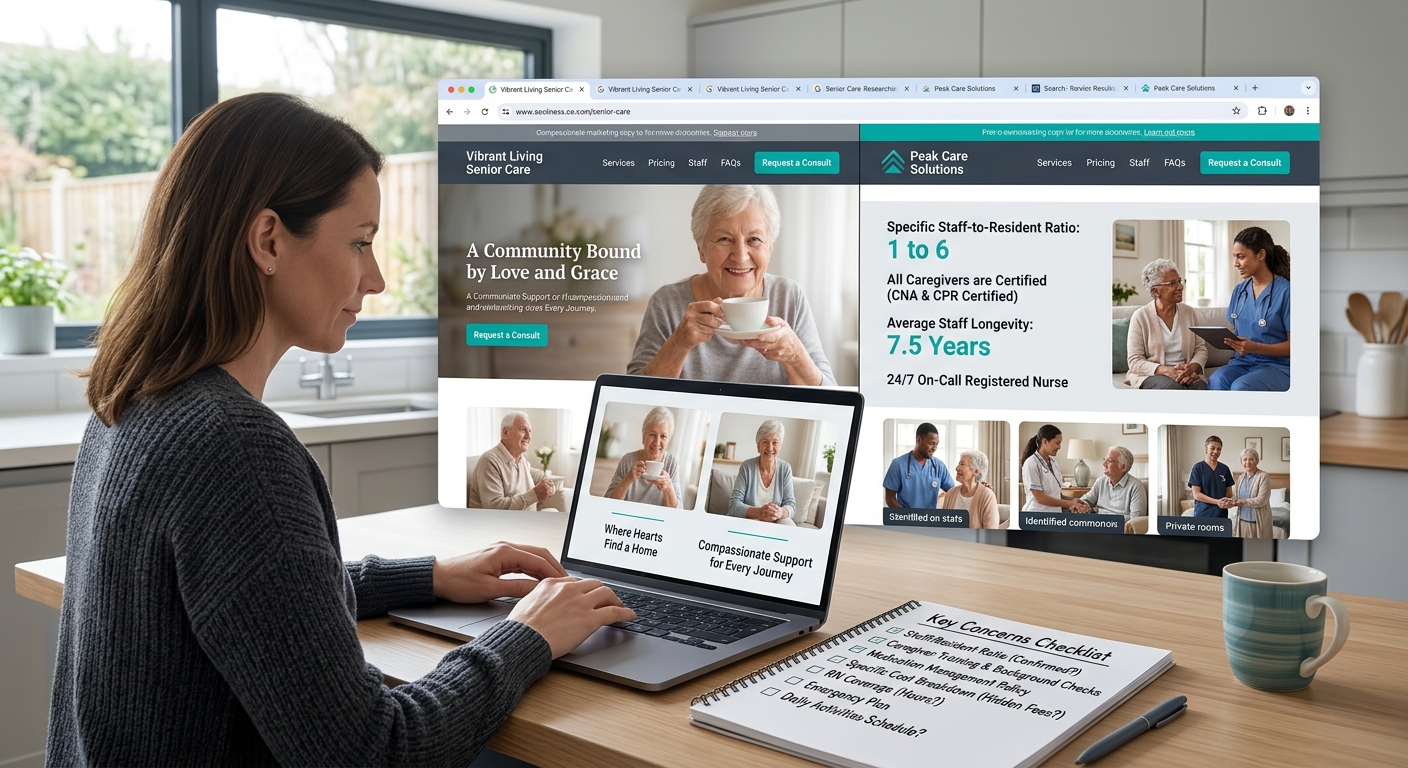
The trust language that actually works in senior marketing operates on evidence, not emotion. When the Care Marketing team audits senior care websites, the pages that convert at higher rates tend to anchor their emotional claims in something countable. “Our caregivers complete 40 hours of dementia-specific training before their first solo shift” communicates compassion more convincingly than the word “compassionate” ever could, because it gives the family member a fact to hold onto. It tells them something about the culture, the investment in staff development, and the seriousness with which the agency approaches care — all without relying on an adjective that every competitor has already claimed.
Replacing Warmth with Evidence
The instinct behind “compassionate care” is correct. Families do want to know that your staff genuinely cares about their loved one. The problem is that the phrase communicates intent without proof, and intent is cheap. Every care provider believes they’re compassionate. The ones that win admissions are the ones that demonstrate it through specifics the family can weigh against alternatives.
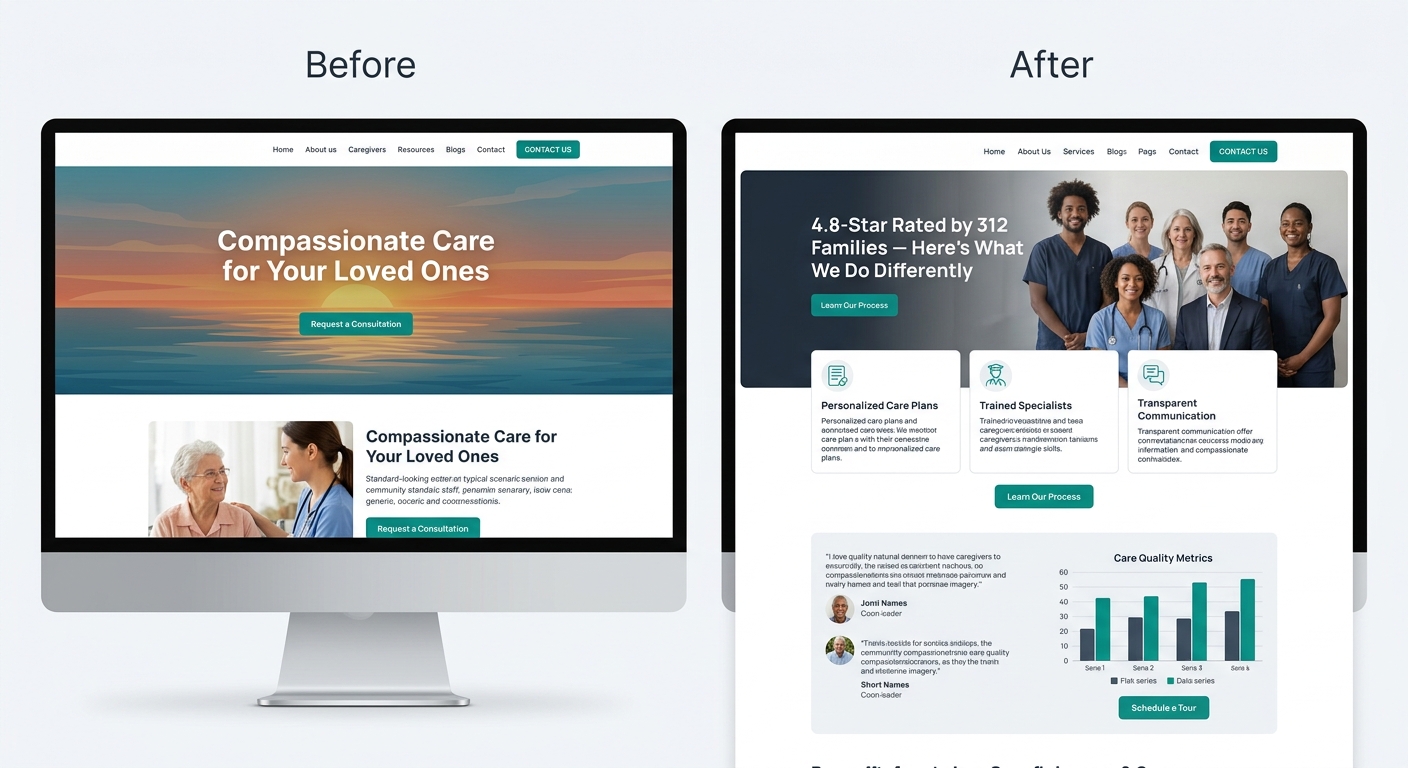
Start by auditing your homepage hero section, your Google Business Profile description, and your About page. Those three surfaces account for the majority of first impressions in the family decision-making process. For each instance of “compassionate care” or a close variant (“caring with compassion,” “where compassion meets quality,” “committed to compassionate service”), ask a single question: what would a family member need to see to believe this claim without us saying it? The answer to that question becomes your replacement copy.
Home Care Association of America data shows that bundled service packages result in 17% cost savings for clients compared to purchasing services individually, and that’s the kind of specific, verifiable claim that a family member can actually evaluate. “We bundle personal care, medication reminders, and meal preparation into flat-rate weekly packages that average 17% less than hourly à la carte billing” tells a family something useful. “We provide compassionate, affordable care” tells them nothing they haven’t read on the previous seven websites.
The same principle applies to your care provider copywriting across every channel: your brochure copy (which, as we’ve explored in the context of why generic brochures kill admissions, has its own set of differentiation failures), your social media, your email follow-ups to families who toured but haven’t committed. Each touchpoint either reinforces a specific, memorable identity or adds another coat of generic paint to an already indistinguishable wall.
Every care provider believes they’re compassionate. The ones that win admissions are the ones that demonstrate it through specifics the family can weigh against alternatives.
Your trust signals should do the same work. Instead of listing “compassionate caregivers” as a selling point, list the credential: “All home health aides complete a minimum 120-hour state-certified training program plus 16 hours of annual continuing education.” Instead of “dedicated to quality care,” name your quality metric: “Our 2025 Home Care Pulse satisfaction survey showed 94% of families rated communication as excellent.” These aren’t marketing tricks. They’re translations of a genuine culture into language a stressed, skeptical family member can actually absorb.
The Question This Raises
There’s a reason “compassionate care” became ubiquitous. It feels safe. Specificity carries risk. If you claim a 4:1 caregiver-to-resident ratio on your website, a family can hold you to that number. If you cite a 94% satisfaction score, someone will ask what happened to the other 6%. Writing vague emotional copy protects you from accountability in a way that precise copy doesn’t, and in a highly regulated industry where lawsuits are a genuine concern, that protection is tempting.
But the question worth sitting with is whether that protection is actually costing you more than the liability it avoids. A home care agency in a market with documented caregiver shortages — where, as Qualicare’s cost analysis notes, limited local availability of qualified caregivers can command premium rates — still needs to justify those rates to families. And “compassionate care” doesn’t justify a premium. It justifies a commodity price, because it’s the same thing the lower-priced competitor says. The agency with the 79% industry-average turnover rate and the agency with a 30% turnover rate can both write “compassionate care” on their homepage. Only one of them can write “our caregiver retention rate is more than double the industry average.” That sentence, uncomfortable as it might be to commit to publicly, is worth more than any two-word emotional claim you could put in its place.
Senior care website messaging lives in a tension between warmth and accountability. Families want both. They want to feel that you care, and they want evidence that you’re competent. The industry’s collective decision to lead with feelings and bury the facts has trained families to distrust the feelings, because every provider expresses them identically. Rebuilding that trust means accepting the discomfort of putting a number, a credential, or a verifiable commitment where a pleasant abstraction used to be. The phrase “compassionate care” isn’t wrong. It’s just doing none of the work you think it’s doing, and every month it sits in your hero section, it costs you the families who needed something real to hold onto before they picked up the phone.