
Senior care video testimonials fail to convert when they lack a results-driven hook, emotional before-state, visual proof, customer-spoken statistics, and strategic page placement. Implementing these five structural elements can increase conversions by up to 34%, according to performance-based conversion audits.
TL;DR: Most senior care providers film testimonials that feel warm but convert poorly. The fix: open with a specific outcome in the first five seconds, narrate the family’s real struggle, show visual proof on screen, let the family cite real numbers, and place the video above the fold on decision pages.
Seventy-nine percent of consumers have watched a video testimonial to learn about a company or service. And 72% say positive testimonials increase their trust in a business. Yet most senior care operators treat testimonial production as a one-afternoon task: set up a camera, ask a family member to say something nice, post it to YouTube.
The result is a talking-head video full of generic praise that gets watched for a few seconds and ignored. This is one of the most common assisted living video production mistakes, and it repeats across home care agencies, memory care communities, and skilled nursing facilities alike.
The five rules below form what I call the Testimonial Conversion Audit, a framework for evaluating whether your existing videos contain the structural elements that actually drive inquiries. Each rule addresses a specific failure point. Apply them in order.
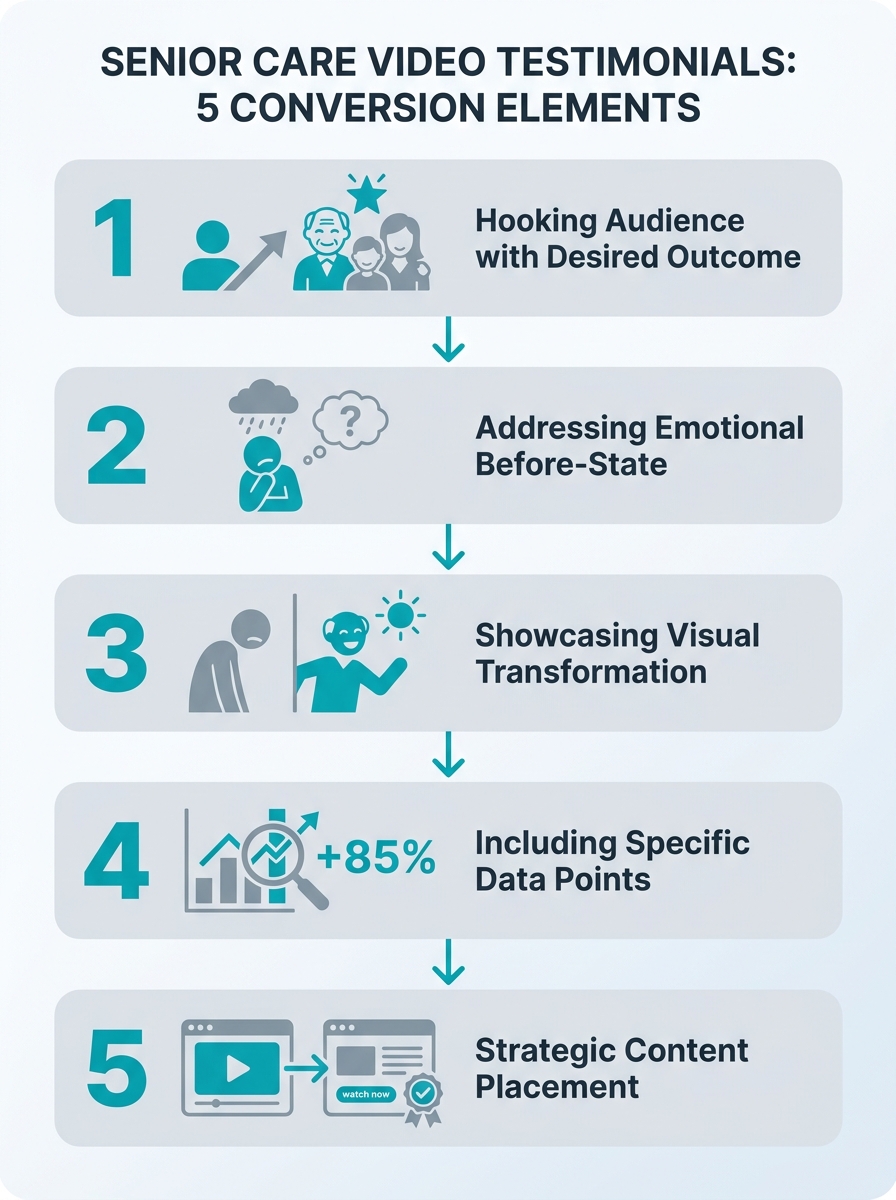
Open with the outcome, not the introduction
Every underperforming senior care testimonial starts the same way: “Hi, I’m Linda, and my mother has been at Sunrise for two years.” By the time Linda reaches her point, the viewer has scrolled to the next section. B2W’s conversion research recommends keeping most placements under 90 seconds, with social proof ads under 60 seconds. That clock starts the moment the video loads.
The fix is structural. Open with a concrete result: “My mom fell three times in six months before we found this agency. She hasn’t fallen once in the past year.” Put Linda’s name and relationship in a lower-third graphic. The viewer needs to feel an information gap (how did that happen?) within the first five seconds, or the video loses its conversion power entirely.
Trust is the buying mechanism when a family chooses who will care for a vulnerable parent. Understanding why families choose care facilities based on trust signals makes this structural choice clearer: 90% of users say seeing a video about a product or service helps them make decisions. A strong opening is what determines whether they see your video at all.
Make the viewer feel the problem before offering the solution
Why do so many testimonials skip the struggle? Because agencies worry that negative emotions will reflect poorly on their brand. The opposite is true. When a daughter describes the anxiety of finding reliable home care, the midnight phone calls to check on Dad, the guilt of not being there, every prospective family watching recognizes their own situation instantly.
Scalable Care’s research on senior family testimonial campaigns confirms that testimonial ROI should be measured by tracking conversions, analyzing data from unique tracking codes, and gathering feedback through post-campaign surveys. The testimonials that perform best in those conversion metrics are the ones where the family’s before-state is vivid and specific.
Generic praise fails this test completely. “They were wonderful” tells a prospective family nothing. Compare that to the kind of authentic voice captured in Family Resource Home Care’s client testimonials, where one client described her caregiver:
“She listens and does not play emotional head games or sound like she is repeating or reading from a script. She treats me with genuine respect and dignity.”
That specificity about the before-state (feeling patronized, feeling scripted at) gives the praise its weight. Without the contrast, satisfaction statements float without anchor.
Tip: During testimonial interviews, ask families to describe one specific moment when they knew the care was working. A single vivid story outperforms five minutes of general satisfaction every time.
Show the transformation on screen, not in words alone
A talking head describing improvement is less persuasive than footage showing it. If a resident in an assisted living community has regained mobility, show her walking the garden. If a home care client’s house went from chaotic pill management to an organized daily routine, film the routine itself.
But “seeing” requires something to look at beyond a face. Pair verbal claims with B-roll footage, on-screen text highlighting key outcomes, or simple before-and-after comparisons. The viral assisted living video that reached millions on YouTube succeeded because it showed a resident’s transformation through music therapy on camera, not because someone described it in a press release. Healthcare Success documented that case as a PR lesson for the broader senior care industry.
This is where senior care video marketing ROI gets measurable. According to Hashmeta’s performance-based guide, you should track three engagement metrics: view rates (percentage of page visitors who start watching), completion rates (percentage who watch to the end), and average watch time. Videos with visual proof of transformation consistently earn higher completion rates than talking-head-only formats.
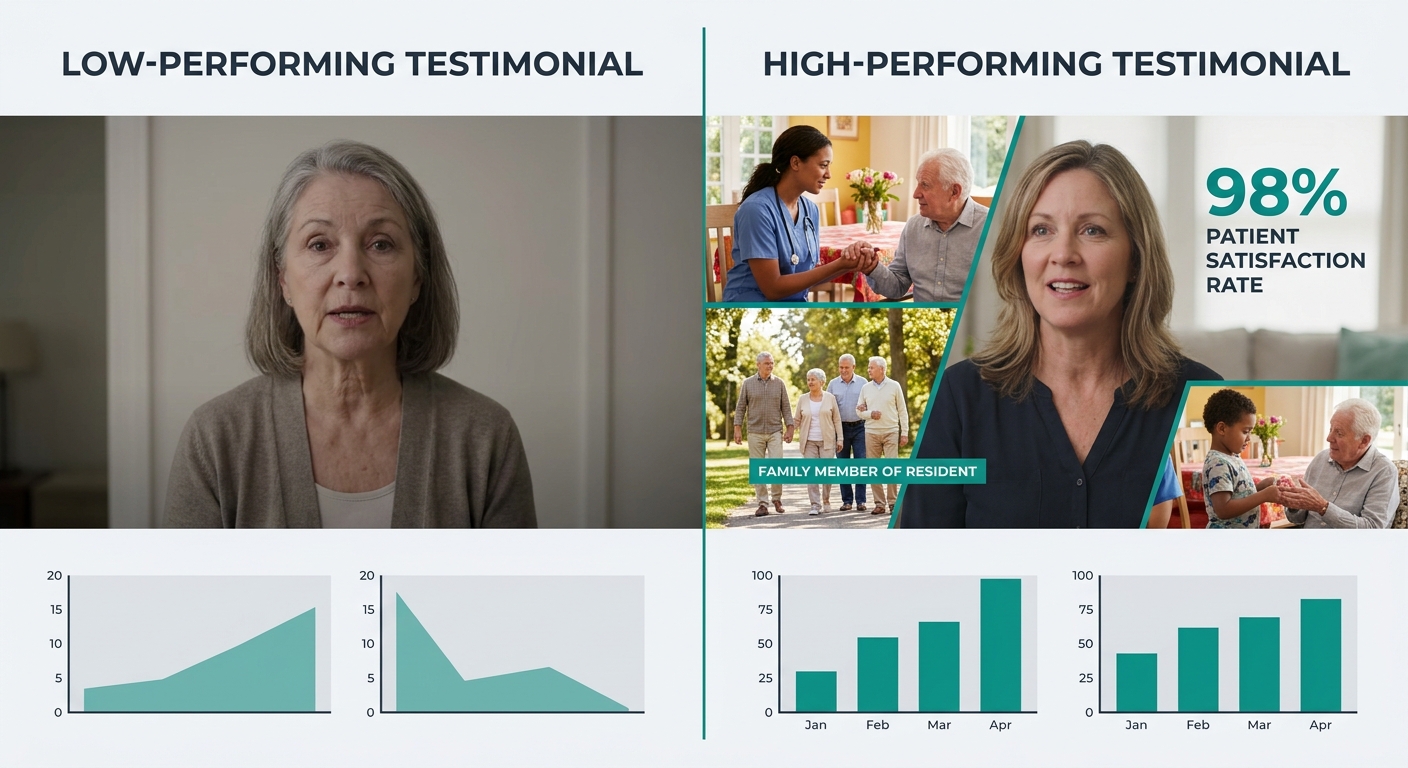
Let families speak specific numbers on camera
“We reduced her hospital visits from four per year to one.” “Dad’s mood scores went from 14 to 6 within three months.” “Our monthly out-of-pocket costs dropped by $800 after switching agencies.” Numbers spoken by real families carry a persuasive force that polished marketing copy cannot replicate. Seventy-one percent of customers say they have purchased a product or service after watching a video testimonial, and the testimonials that drive those purchases contain specific, verifiable claims.
Numbers spoken by real families carry a persuasive force that polished marketing copy cannot replicate.
This principle connects directly to your broader home care client testimonials strategy. If you’re targeting the right decision-maker in the family unit, the adult daughter comparing agencies at 11 p.m. on her laptop needs data points she can relay to siblings. A testimonial with numbers gives her ammunition for the family group chat. A testimonial with “they were great” gives her nothing to forward.
Prompt your interview subjects before filming. Ask them to look up specific dates, cost changes, or health metric improvements ahead of the shoot. The 30 seconds it takes to say “bring your billing statements” before the interview makes the difference between a video that converts and one that feels like a favor someone did for your marketing director.
Place the video where the decision happens, not where it’s convenient
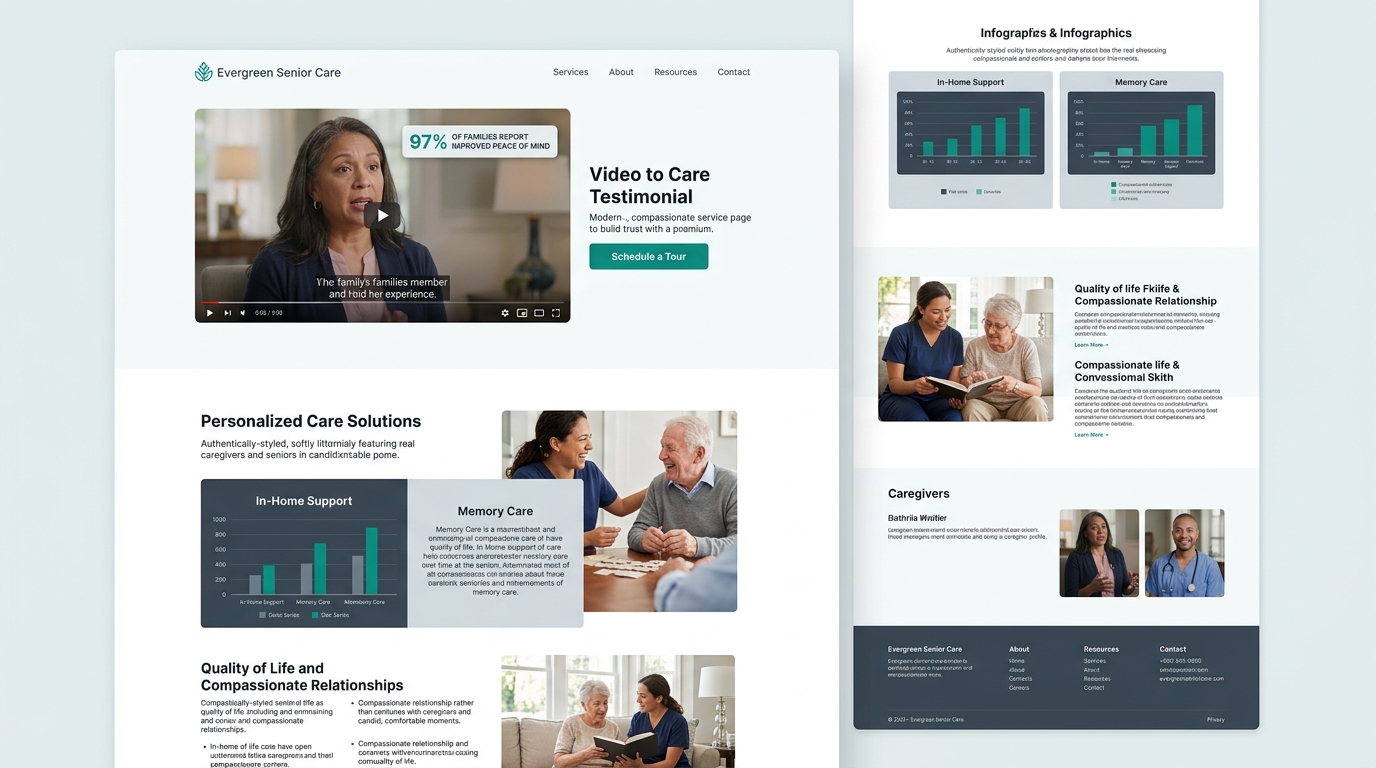
The best testimonial in the world converts at zero percent if it’s buried on a testimonials page that gets 40 visits per month. Video testimonials need to appear above the fold on decision pages, the pages where families are actively weighing their options: your service detail pages, your pricing page, your contact or inquiry form page.
Seventy percent of marketers say video converts better than any other medium. And 72% of marketers report an ROI of 50% to 500% from testimonial videos specifically, with 78% of larger organizations seeing ROI above 100%. But those returns depend entirely on placement strategy, not production quality alone.
For agencies focused on assisted living marketing, this means embedding a relevant testimonial directly on the community tour request page. For home care providers investing in caregiver marketing, the testimonial should appear on the specific service page (dementia care, post-surgical recovery, companionship) that matches the family’s search intent.
| Element | Underperforming Video | High-Converting Video |
|---|---|---|
| Opening | “Hi, I’m Linda from Riverside” | “Mom fell 3 times in 6 months. Then zero.” |
| Before-state | Skipped or vague | Specific struggle described with emotion |
| Visual proof | Talking head only | B-roll, on-screen stats, environment footage |
| Numbers | “They were wonderful” | “Hospital visits dropped from 4 to 1 per year” |
| Placement | Buried on testimonials page | Above the fold on service and inquiry pages |
When These Rules Break
Case study testimonials with rich clinical data can run 2 to 3 minutes and still convert well, as long as the narrative stays tight and the viewer sees measurable outcomes throughout. Not every family needs the 60-second version. Some prospects deep in the comparison stage want detail, context, and the full arc of another family’s experience. The 90-second ceiling applies to top-of-funnel placements and social ads, not to every use case.
These rules also assume you’re filming families who genuinely had a positive experience. If your agency has retention problems, caregiver turnover above industry averages, or communication gaps that leave families frustrated, the testimonial will sound strained no matter how well you structure it. Video testimonials conversion depends on having a service worth testifying about. Fix the operations first. The camera will follow when the story is real.