
Ampleo HR’s 2026 retention data pegs industry-wide caregiver turnover at roughly 80%, with each departure costing $3,500 to $5,000. Families researching your agency see the downstream evidence of that churn every time they click your careers page, and they draw conclusions about care stability that your service descriptions can’t override.
TL;DR: Your careers page functions as a trust signal for families and a recruitment tool simultaneously. When adult children spot perpetual job postings, vague role descriptions, and zero evidence of staff retention, they question care quality before they ever call. A structured three-layer audit of careers page messaging closes that credibility gap.
Why Families End Up on Your Careers Page
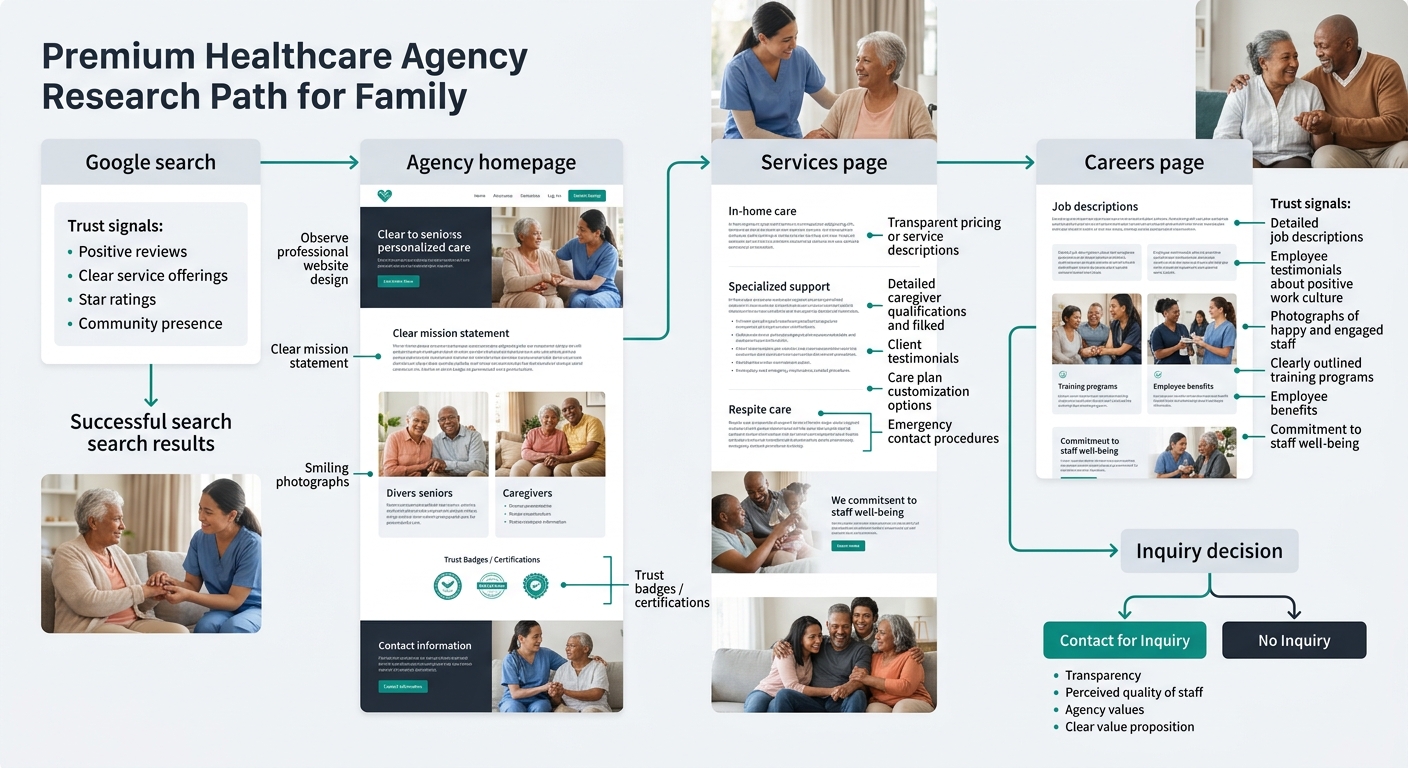
Adult children researching senior care providers prioritize three signals above all others: staffing ratios, safety protocols, and cost transparency, per Terraboost’s 2026 nursing home marketing analysis. Two of those three lead naturally to your careers page. When a daughter types your agency name into Google and sees “We’re hiring 12 CNAs!” as a sitelink, she’s registering a data point about how well-staffed you really are.
CareScout’s guide on choosing a home care agency directs families to “explore online reviews and ratings” and to check social media for engagement quality. That research behavior doesn’t stop at your Google Business Profile. Families click through your entire web presence, and the careers page sits within two clicks of your homepage on the vast majority of agency sites.
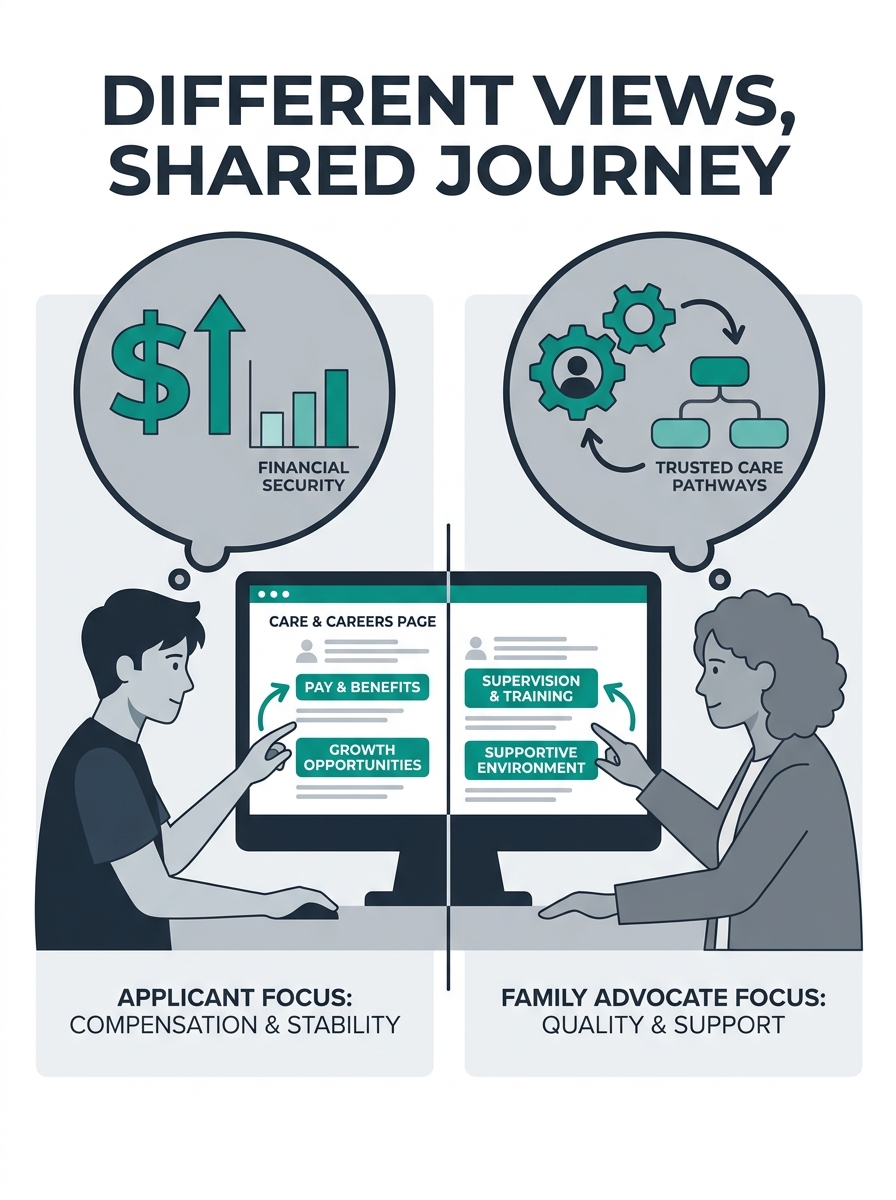
The signal families extract from careers page messaging differs from what your HR team intended. HR writes for applicants. Families read for red flags. A job posting that says “Must be comfortable working independently with minimal supervision” tells a caregiver applicant about autonomy. It tells a family member that their parent might be left alone with someone who has little oversight.
The Three-Layer Careers Page Audit
Evaluating your careers page through the family lens requires checking three distinct dimensions. The Retention-Screening-Culture (RSC) audit gives each layer a concrete scoring rubric, addressing the specific fears families carry into their research.
Layer 1: Retention Evidence
Why does retention matter to families? Because 80% annual turnover means the caregiver who builds rapport with their parent in January may be gone by April. Families know this instinctively. When your careers page shows the same 8 CNA positions posted for 6+ consecutive months, every family visiting that page registers instability.
Retention evidence on a careers page looks like:
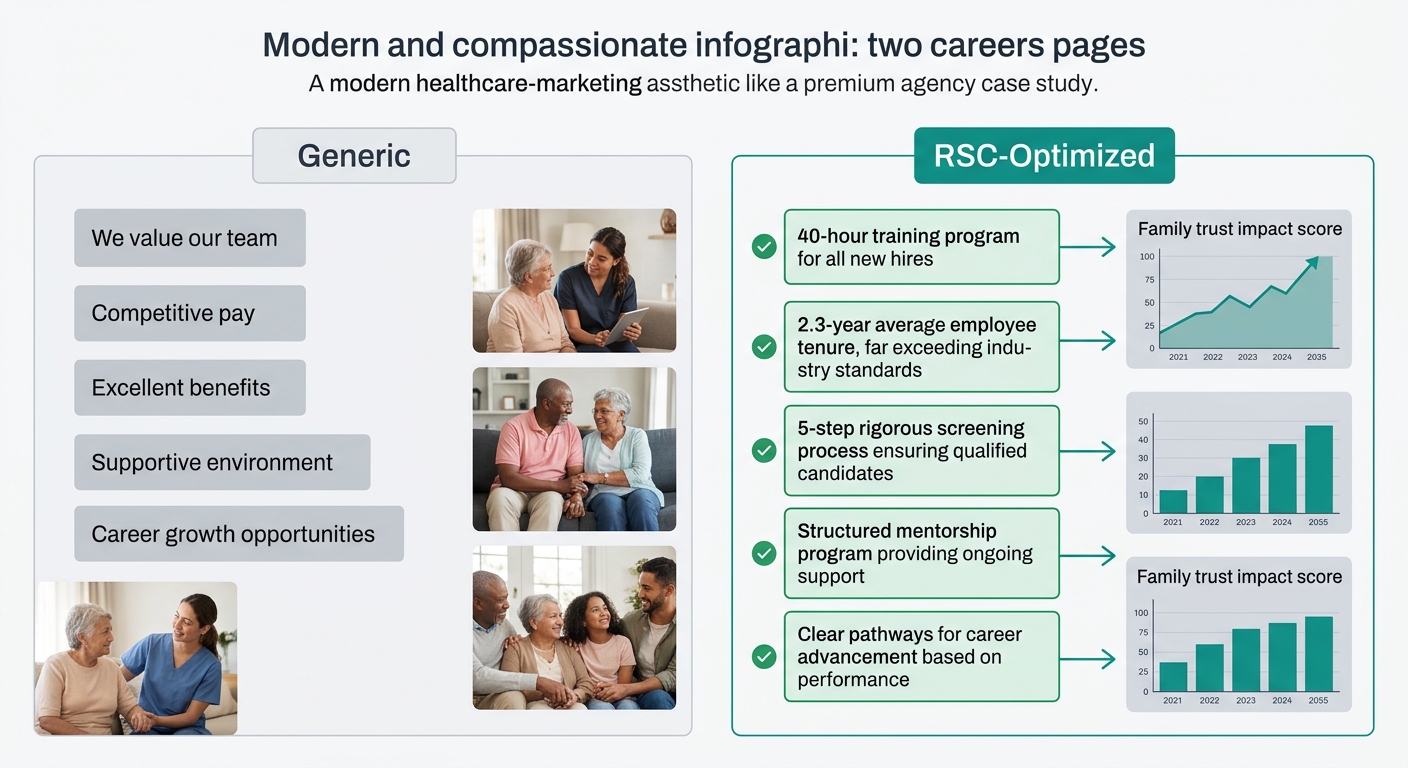
- Average caregiver tenure displayed publicly (e.g., “Our caregivers stay an average of 2.3 years, compared to the industry average of 14 months”)
- Named employee spotlights with hire dates (“Meet Angela, who joined our team in 2021”)
- Internal promotion announcements or career ladder descriptions
A systematic review of aged care workforce retention published in PMC found that “socially supportive colleagues, well-functioning teams with open communication, collaboration, and cooperation, and access to responsive leadership with low management turnover all contributed to positive workplace relationships and retention.” Translating those internal practices into visible careers page content gives families evidence that staff actually stay.
If you’ve been working on structured onboarding content to reduce time-to-fill, the same materials serve double duty as family-facing proof of investment in staff.
Layer 2: Screening Transparency
NBC Right Now’s guide on choosing in-home care providers states that “a reputable provider will conduct thorough background checks on all employees.” BZoeCare’s 2026 evaluation guide reinforces the point: the most trustworthy path is “working with licensed, reputable home care agencies that thoroughly vet their caregivers and provide ongoing support.”
Your careers page either confirms or undermines this expectation. If your job listings mention “background check required” as a one-line bullet buried under 14 other requirements, families barely register it. If your careers page includes a dedicated section explaining your 5-step screening process (application review, interview, reference verification, criminal background check, drug screening), families absorb it as a family trust indicator for home care quality.
The gap between what agencies actually do and what they communicate is enormous. Many providers run thorough screening processes but describe them with a single line: “Must pass background check.” That’s a missed credibility opportunity with the family audience reading alongside applicants.
Layer 3: Culture Proof
When a family reads your careers page and sees stock language about “passionate individuals who love making a difference,” they’ve learned nothing about how their parent will actually be cared for.
LTC News’s 2026 marketing analysis advises senior care providers to “use real stories, not stock messages,” recommending that facilities “replace tired language like ‘world-class care’ or ‘luxury accommodations'” with specific resident and staff stories. This advice applies to careers pages with equal force. We’ve written about why ‘compassionate care’ is costing you more than you realize on service pages, and the same problem compounds on careers pages.
Culture proof means concrete evidence: training hours per month, mentorship program structure, staff-to-resident ratios, team meeting cadence. A careers page that says “We invest in our people” communicates nothing. A careers page that says “Every new CNA completes 40 hours of supervised clinical training in their first 30 days, followed by monthly skills workshops” communicates everything.
What Families See vs. What You Intended
The disconnect between HR intent and family interpretation runs through nearly every element of a standard careers page:
| Careers Page Element | What HR Intended | What Families Read |
|---|---|---|
| “Now hiring 15 caregivers!” | Urgency to attract applicants | Understaffed; high turnover |
| “Must work independently” | Self-directed role description | Limited oversight of care |
| “Competitive pay” | Recruitment pitch | Won’t disclose wages; possible low pay |
| “Fast-paced environment” | Honest work culture | Overworked staff; rushed care |
| “Background check required” | Standard compliance note | Minimum screening; nothing special |
| “Join our family!” | Warm employer branding | Generic; says nothing concrete |
| Named spotlight with tenure | Retention marketing | Evidence of stability |
| Training program description | Recruitment differentiator | Proof caregivers are prepared |
The bottom two rows show how specific, evidence-based careers page messaging serves both audiences simultaneously. You don’t need separate versions for applicants and families. You need messaging that’s specific enough to build trust with anyone reading it.
The Financial Case for Staff Credibility Marketing
At $3,500 to $5,000 per departure and an 80% turnover rate, an agency with 50 caregivers spends roughly $140,000 to $200,000 annually on replacement costs alone. We’ve covered how retention failures quietly drain your marketing budget in detail. But the careers page angle adds a dimension the financial analysis misses: every dollar spent replacing caregivers also degrades your family-facing employer brand reputation.
The admissions correlation works in both directions. Agencies that display strong retention metrics and screening transparency on their careers pages give families one less reason to hesitate during the inquiry process. Agencies that treat the careers page as pure HR real estate leave families to fill the silence with worst-case assumptions about care quality.
For organizations focused on marketing for nursing homes, this connection is even more visible. Nursing home marketing in 2026 requires addressing staffing concerns directly, since adult children research staffing ratios as a primary decision factor. Your careers page is where that research lands.
Scoring Your Own Careers Page
Rate each RSC layer on a 1-5 scale:
Retention Evidence (1–5): A score of 1 means no tenure data, no employee spotlights, and the same positions posted for 3+ months. A 3 requires at least one employee testimonial with a name and hire date, plus some mention of advancement. A 5 means average tenure is displayed, multiple named spotlights include dates, career ladders are documented, and internal promotions are visible.
Screening Transparency (1–5): A 1 means a single line about background checks with no process description. A 3 includes background check and drug screening with some detail. A 5 describes the full screening process step-by-step, with timeline and scope.
Culture Proof (1–5): A 1 means generic language (“passionate team”), stock photos, and no specifics. A 3 offers some training details, real team photos, and at least one concrete metric. A 5 quantifies training hours, describes mentorship structure, states staff-to-client ratios, and shows team photos with real names.
Tip: Run this audit quarterly. Careers pages drift as HR teams post and remove listings without marketing review. A page that scored 12 in January can drop below 8 by June if old postings accumulate and employee spotlights go stale.
An RSC score below 9 out of 15 means families visiting your careers page are building a negative impression of care quality before they ever submit an inquiry. Agencies in the 12–15 range consistently report that family callers reference specific careers page content during intake conversations. Those references are measurable staff credibility marketing in action, and they’re worth tracking in your CRM alongside other trust-building signals across your website.
What The Data Doesn’t Tell Us
The 80% turnover benchmark from Ampleo HR captures the industry average, but individual agency rates vary from under 30% to well over 100%. The direct connection between careers page messaging quality and family conversion rates hasn’t been isolated in a controlled study. We’re working from strong directional evidence: families research staffing, careers pages contain staffing signals, and agencies with specific staff messaging report better inquiry quality. The precise conversion lift remains unmeasured.
What’s also missing is behavioral data on how long families spend on careers pages versus service pages, and at what point in the decision process they visit. Google Analytics can tell you traffic volume and bounce rate, but it won’t distinguish a job seeker from a worried daughter. Until senior care providers start segmenting careers page traffic by intent, the RSC audit framework operates on qualitative pattern recognition rather than hard conversion attribution.
The directional signal is clear enough to act on, though. Every element of your careers page communicates something about care quality to the family audience, whether you designed it to or not. Running the RSC audit makes those signals visible and fixable, with the same rigor you’d bring to your testimonials or service pages. The question the data still can’t answer is exactly how much each point on the RSC scale moves your inquiry numbers. That measurement infrastructure is the next thing worth building.