
Senior living operators developing new communities should simplify service offerings and embrace multiuse spaces to close an affordability gap that now sees assisted living monthly fees exceed residents’ incomes by 174%, according to an American Seniors Housing Association report cited by architecture firm McMillan Pazdan Smith on June 4. Independent living fees surpass monthly incomes by 116%, the ASHA data shows.
TL;DR: ASHA data documents senior living fees exceeding resident incomes by 116-174%, prompting architects to recommend replicable floor plans, multiuse rooms, and location strategies that reduce amenity costs.
Scott Hendrix, senior associate at McMillan Pazdan Smith, told Senior Housing News that operators can address the affordability crisis through design discipline. “Don’t overcomplicate things. That extends to the building, to the staffing, to everything,” Hendrix said in the report published Wednesday.
The design recommendations target operators renovating existing properties or planning new construction in a development environment where middle-market price points increasingly fall short of resident financial capacity.
What “Keep It Simple” Means in Practice
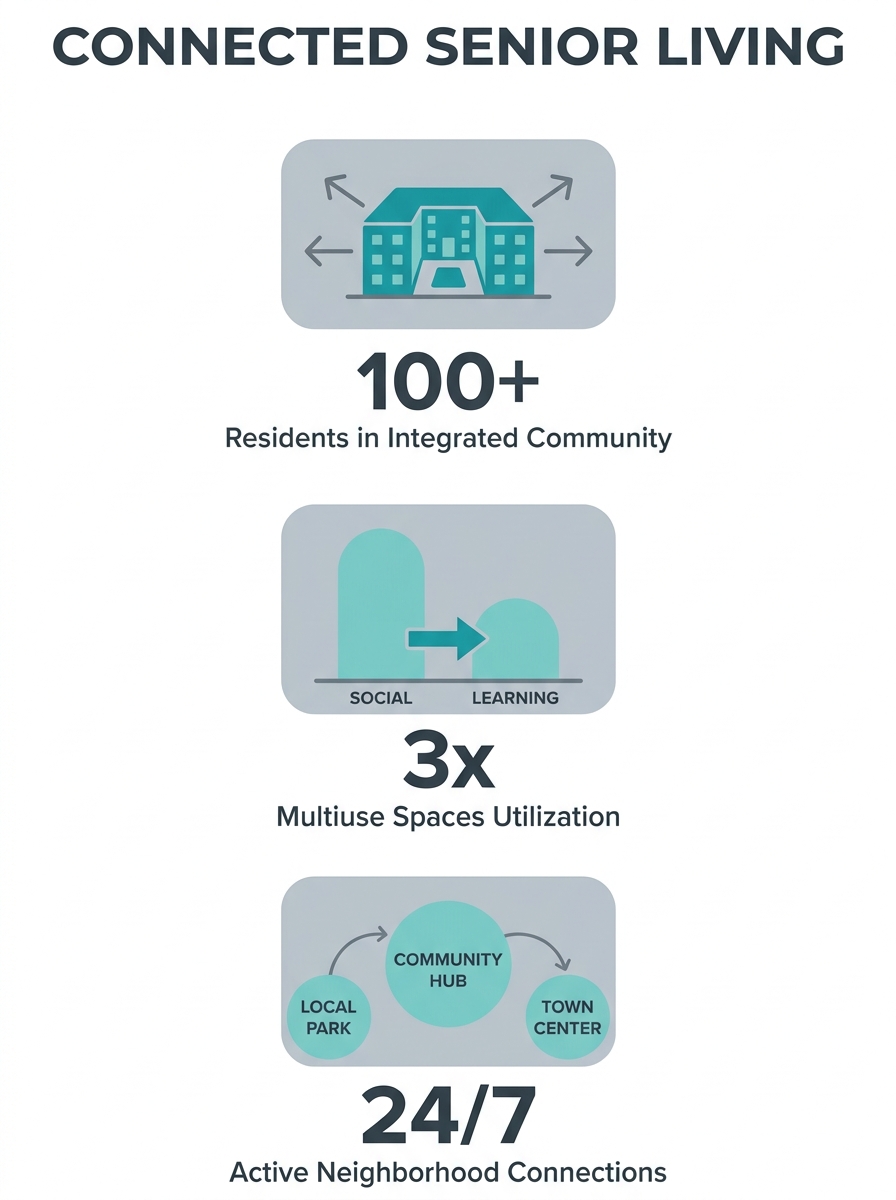
The simplified approach centers on three operational levers: simplified service menus, multiuse rooms that adapt to different activities, and replicable unit floor plans that reduce construction complexity. McMillan Pazdan Smith’s guidance builds on active adult housing models that have long used flexible clubhouse spaces managed by one or two staff members.
The firm worked on Cresswinds Home from Kolter Homes, a master-plan 55-plus community, where planners designed a clubhouse kitchen with a demonstration side and a dining room that transforms into meeting space or grab-and-go meal service. That flexibility keeps staffing costs aligned with lower-acuity models typical in active adult or independent living settings, Hendrix explained.
While 55-plus communities operate as for-sale products rather than rental assisted living properties, the multiuse design principles translate directly to rental operators facing tighter revenue constraints. One or two employees can oversee rooms that serve morning coffee service, afternoon bridge clubs, and evening guest dinners without requiring dedicated spaces for each function.
How Active Adult Models Inform Rental Senior Living
Senior living operators can borrow programmatic elements from the active adult sector even when the underlying business models differ. Active adult communities routinely build specialty rooms—pottery studios, woodworking shops, art classrooms—that adapt throughout the day based on resident demand rather than fixed schedules.
Rental operators applying the same logic reduce the square footage devoted to single-purpose amenities. A room designated “arts and crafts studio” Monday through Wednesday becomes a meditation space Thursday mornings and a community meeting hall Friday evenings. The design saves construction costs upfront and operating costs over time.
Data shows senior living residents prefer larger units, a feature many middle-market developments cannot afford to provide. Operators compensate by giving residents reasons to leave their rooms. McMillan Pazdan Smith’s approach treats unit size as a variable operators can offset through activated common areas and external community connections.
Location Strategy When Unit Size Is Constrained
Operators unable to compete on square footage can compete on location, selecting sites with direct access to city parks, downtown retail, or established neighborhoods. Hendrix cited Williams Terrace in Charleston, South Carolina, as an example. The affordable senior housing project repeated a single floor plan to maintain construction linearity and sited the building adjacent to a city park, effectively extending amenity space beyond the property line.
Deep porches kept residents connected to the surrounding neighborhood, reducing the burden on interior common areas. The location strategy works when operators accept longer timelines to revenue generation or develop partnerships that share costs, Hendrix noted.
While the senior living industry faces constrained new development starts, operators managing existing properties or evaluating acquisition targets can apply the location logic during site selection. Properties near transit, libraries, community centers, or public parks carry embedded amenity value that doesn’t appear on the balance sheet but directly affects resident satisfaction and retention.
Why This Matters Now
The 174% affordability gap in assisted living represents a structural pricing crisis that design alone cannot solve, but simplified operations give operators a margin lever at a time when Medicaid reimbursement rates lag private-pay market pressures. Facilities applying the multiuse-space model reduce capital expenses during development and ongoing staffing costs during operations—both variables that feed into monthly fee structures.
Operators competing for middle-income residents face direct comparisons to aging-in-place alternatives, where home care costs accumulate differently than bundled senior living fees. Communities that demonstrate operational efficiency through simplified design can position affordability as a value proposition rather than a compromise, particularly when locations offer genuine community integration.
The McMillan Pazdan Smith guidance arrives as senior living providers report staffing shortages that make lean operational models operationally necessary, not just financially attractive. Multiuse spaces managed by smaller teams align with workforce realities while addressing the affordability gap ASHA data has now quantified at levels that price out more than half of prospective residents.