
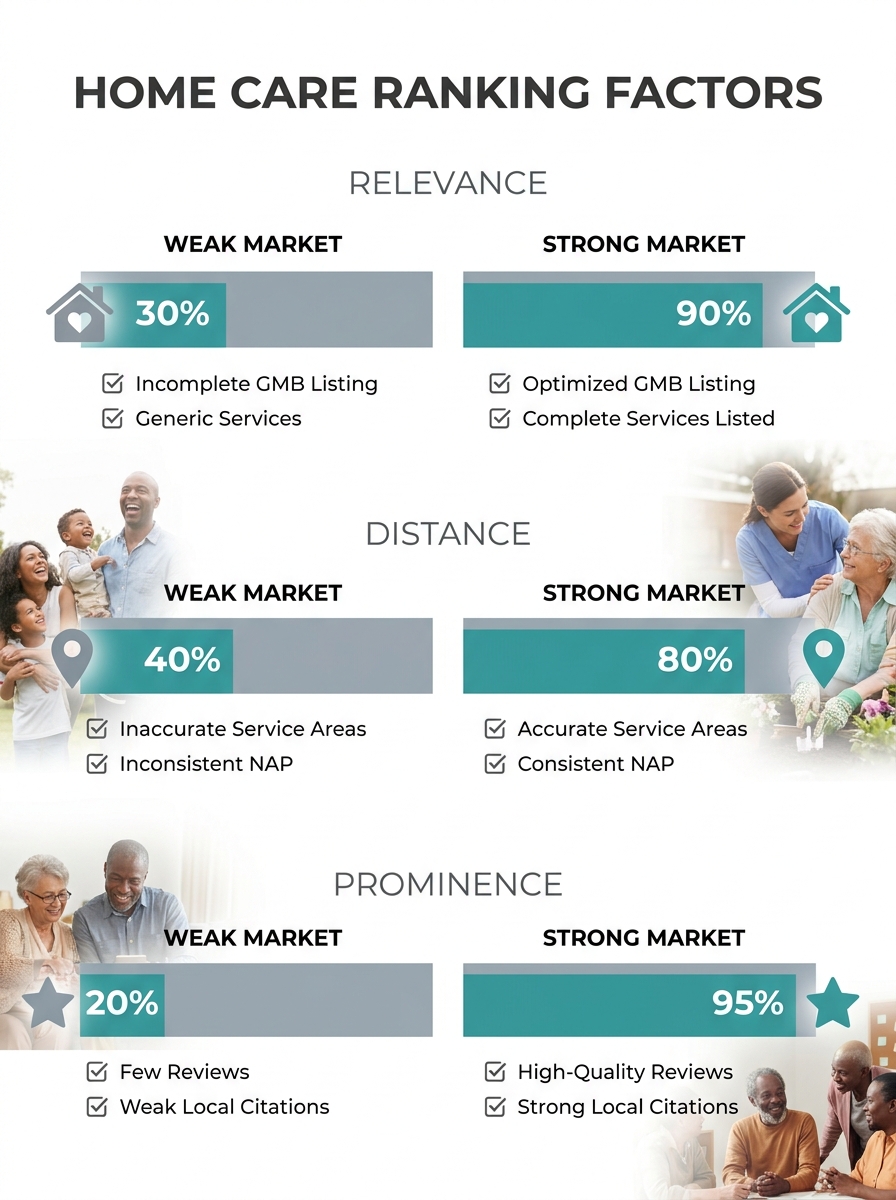
Google scores local business visibility on three independent factors per market: relevance, distance, and prominence. When your home care agency ranks on page one in Tampa but doesn’t appear in Jacksonville’s Map Pack, one or more of those signals has dropped to near-zero in the second city. The fix requires treating each territory as a separate local SEO project with its own infrastructure.
TL;DR: Geographic inconsistency in rankings traces back to weak or missing local signals in the underperforming market. Each city needs its own landing page, citation profile, review strategy, and (if you have a physical presence) its own Google Business Profile. Copy-paste SEO across markets produces copy-paste invisibility.
Running a multi-location home care agency means accepting that local search doesn’t scale the way paid ads do. You can’t pour budget into a single campaign and watch results spread across your service territory. Google’s local algorithm evaluates relevance, distance, and prominence independently for each searcher’s location, which means a family in Jacksonville searching “home care near me” triggers a completely different ranking calculation than a family in Tampa typing the same phrase. The six rules below form a local search visibility audit framework for diagnosing exactly where your weaker markets fall short.
Treat every service territory as an independent local SEO entity
Multi-location home care agencies should give each service territory its own dedicated page, Google Business Profile (where a physical location exists), local citations, and territory-specific content, according to SeniorCareClicks’ 2026 ranking guide. The instinct to manage everything from a single homepage is understandable, but it’s the primary cause of geographic inconsistency in rankings.
Your Tampa operation and your Jacksonville operation compete against entirely different sets of local providers. The agencies ranking above you in Jacksonville have their own pages, their own reviews, their own backlinks from Duval County organizations. Your single “We Serve All of Florida” page can’t match that level of local signal density because Google interprets it as a Tampa business with vague claims about other markets.
If you’ve already started expanding into new geographic markets, this principle should shape your SEO buildout from day one. Build the local infrastructure before you announce service availability, not after you notice the leads aren’t coming. Agencies that wait 6 to 12 months before creating dedicated local assets in a new market lose that entire window to competitors who already have roots there.
Build city-specific landing pages with genuinely local content
A service area page with links to individual city pages is the minimum viable structure for multi-location home care SEO. But the page itself needs substance. Swapping “Tampa” for “Jacksonville” in otherwise identical copy doesn’t fool Google’s algorithms, and it won’t fool the adult daughter researching care options late at night either.
Each city page should include:
- The specific zip codes and neighborhoods you serve in that city
- Names of local hospitals and discharge programs you coordinate with
- Any city-specific licensing or regulatory details relevant to families
- Testimonials from clients in that market (not generic company-wide reviews)
- Driving directions or service radius information tied to your local office or caregiver hub
The content has to reflect genuine operational knowledge of that market. If your Jacksonville page mentions partnerships with Baptist Medical Center or UF Health Jacksonville, that’s a relevance signal Google can match against local searches. If it reads like a template, Google treats it like one. According to Sixth City Marketing’s analysis of senior living SEO, checking Google Analytics geo data reveals where families are actually searching from, which helps you prioritize which city pages to build first.
Agencies investing in content marketing for care providers should prioritize city pages as the foundation layer before building blog content or resource guides for secondary markets. The city page is what Google indexes for local intent queries; everything else supports it.
Audit NAP consistency for each market separately
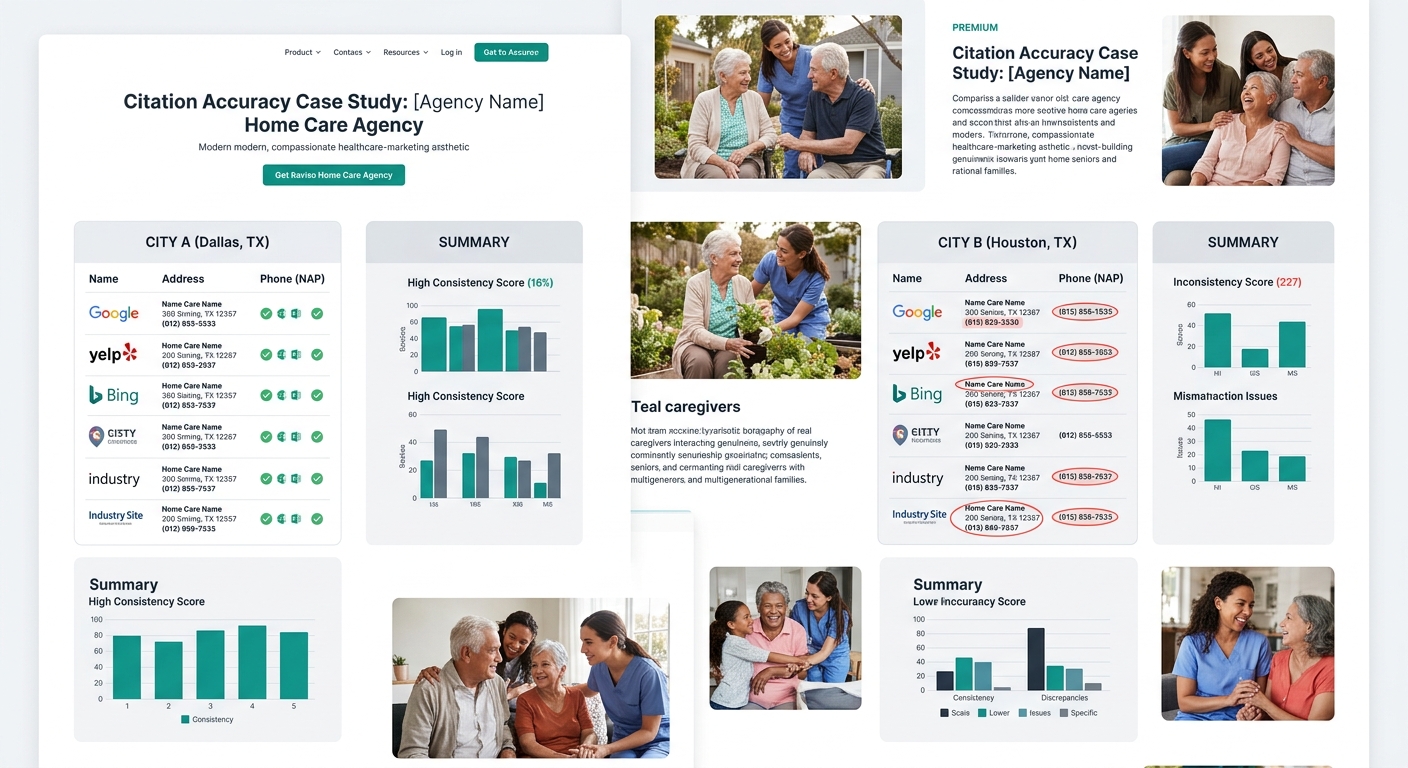
NAP (Name, Address, Phone number) consistency is a prominence signal, and it degrades market by market. Your Tampa listings might show perfect alignment across Yelp, BBB, A Place for Mom, and your Google Business Profile. Your Jacksonville listings might have an old phone number on one directory, a missing suite number on another, and a slightly different business name format on a third.
Data from AI-driven search analysis shows that agencies need to maintain a star rating above 3.4 and a review response rate exceeding 5% to avoid losing visibility in both traditional search and AI recommendation tools. But those thresholds mean nothing if your NAP data is inconsistent enough that Google can’t confidently attribute reviews and citations to the correct location.
Run a citation audit for each city independently. Tools like BrightLocal, Moz Local, or Yext will show you where your Jacksonville listings diverge. The three most common problems in senior care:
- Directory listings that still reference a previous office address after a move
- Phone numbers that route to a central intake line rather than the local office
- Business names that include a location modifier in some directories but not others (e.g., “ABC Home Care” vs. “ABC Home Care – Jacksonville”)
Fix these before you invest in new content or link building for that market. Inconsistent NAP data undermines every other local signal you build.
Earn backlinks and citations from each city’s local ecosystem
Why does your agency rank well in Tampa? Partially because you’ve accumulated local authority signals there over time: links from the Tampa Bay Times’ community directory, a mention on a local chamber of commerce page, a partnership listing on a hospital system’s discharge resources page. Jacksonville has none of that institutional context unless you build it deliberately.
Local backlinks carry disproportionate weight in the prominence calculation. A single link from a Jacksonville nonprofit, news outlet, or healthcare organization tells Google your agency is a recognized entity in that market. Five generic links from national directories don’t deliver the same signal strength.
Tip: Contact the Jacksonville chamber of commerce, local Area Agency on Aging, county elder services office, and any hospital systems whose discharge planners you work with. Ask to be listed in their community resource directories. These are high-trust, location-specific links that directly improve your prominence score in that market.
This work connects directly to your referral source relationship strategy. The same organizations that send you referrals are the ones whose websites carry the most local SEO value. Every relationship-building conversation with a discharge planner or elder law attorney is also a potential backlink opportunity, which means your marketing team and your business development team should be coordinating on outreach rather than working in separate silos.
Match your review strategy to each market’s competitive baseline
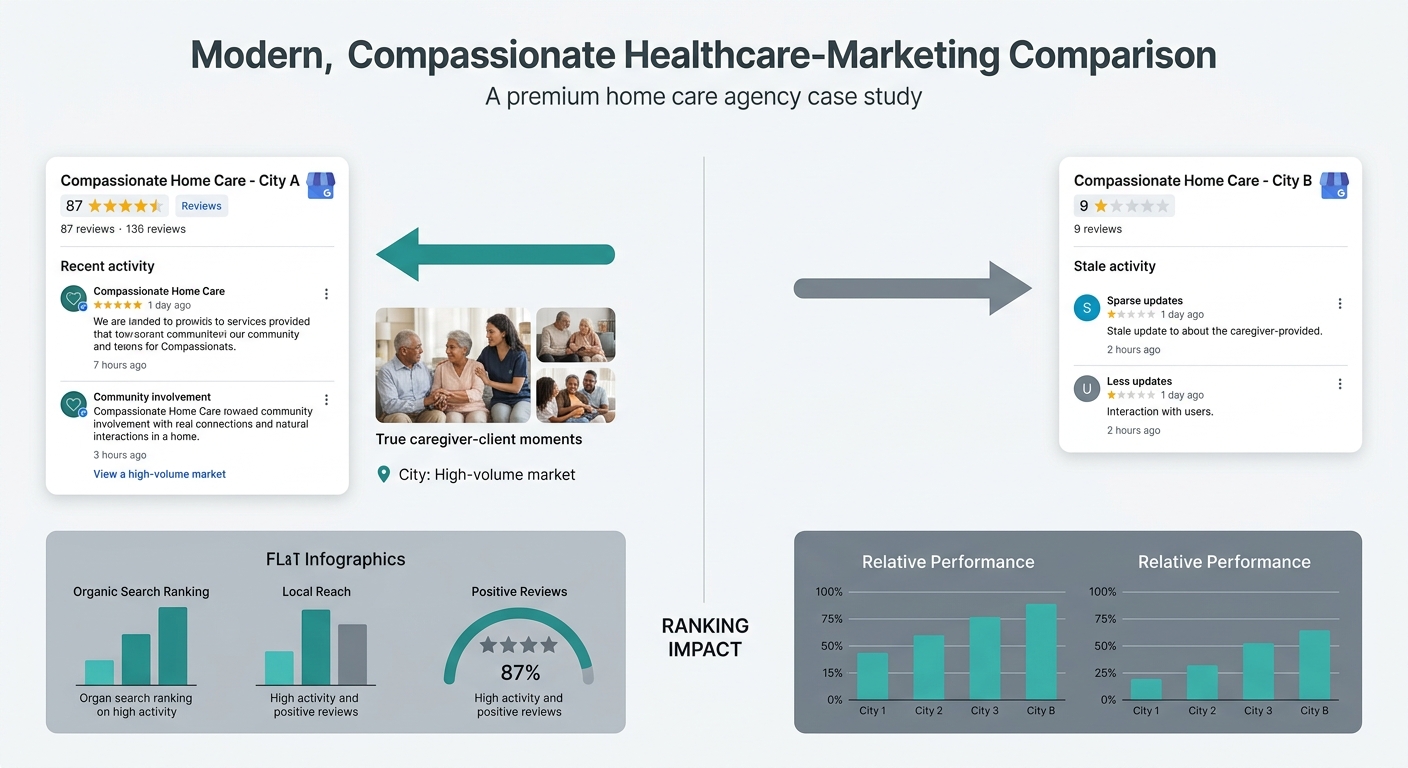
Google weighs review volume, recency, and rating as prominence signals, and the competitive baseline varies dramatically by city. Your Tampa profile might have 87 reviews with a 4.8-star average. Your Jacksonville profile might have 9 reviews, the most recent from 14 months ago. That gap alone explains a significant portion of your ranking disparity.
Check what the top three agencies in Jacksonville’s Map Pack carry for review counts and ratings. If they average 40 or more reviews at 4.5 stars, your 9 reviews at 4.7 stars won’t compete regardless of how good your actual care is. Volume matters because Google interprets it as a signal of established presence in the market. A Thryv analysis of Google Business Profile optimization confirms that consistency and activity, including regular new reviews, directly improve visibility in local search and Google Maps.
The same agency with the same quality of care can rank #1 in one city and disappear entirely in another based solely on the gap between its review profile and local competitors’ review profiles.
Build a systematic review request process for each market. Train caregivers and intake coordinators in Jacksonville specifically to ask satisfied families for Google reviews. Set a target: match the review volume of the #3 competitor in that market’s Map Pack within 90 days. Track it monthly by location, not in aggregate. If you’re already auditing your testimonial and client story strategy, extend that audit to include Google review distribution by market. Strong testimonials on your website help conversion, but they don’t affect local search rankings the way Google reviews do.
Add LocalBusiness schema to every city page
LocalBusiness schema markup tells search engines your business name, address, phone number, hours, services, and review data in a structured format they can parse directly. According to Merchynt’s 2026 local SEO audit guide, agencies should implement this schema on every location page and validate it using Google’s Rich Results Test.
Each city page needs its own schema block with the correct local address, phone number, and service area. A single schema block on your homepage pointing to your Tampa office doesn’t help your Jacksonville page rank. The schema must match the page’s content and the corresponding Google Business Profile data exactly. If you’ve already followed the schema markup checklist for senior care providers, verify that your schema is location-specific rather than company-generic.
Recent AI search analysis reveals that only 45% of brands ranking well in traditional local search maintain visibility in AI-driven discovery tools like AI Overviews and Perplexity. Structured data, including schema, is one of the key signals these systems use to decide which businesses to recommend for location-specific queries. Getting your schema right for each market protects your visibility across both traditional and AI search surfaces as families increasingly use conversational search tools to find care options.
When These Rules Break Down
These six rules assume your agency has some physical presence or established caregiver network in each market you’re targeting. If you’ve listed Jacksonville as a service area but don’t actually have caregivers available there within a reasonable response window, no amount of local SEO work will produce sustainable results. Google’s quality signals eventually catch up: families who call and hear “we don’t currently have availability in your area” leave reviews reflecting that experience, and your prominence score craters.
The other breaking point is resource allocation. A local search visibility audit across six markets might reveal that three of them need significant investment in content, citations, and review generation. You don’t have to fix all of them simultaneously. Prioritize the market with the highest family demand and the weakest competitive landscape, build the local infrastructure there until you’re ranking in the Map Pack, and then move to the next city. Geographic inconsistency in rankings is a solvable problem, but only when you stop treating service area targeting for senior care as a single project and start treating it as a set of parallel, market-specific campaigns that each require their own attention, their own budget line, and their own performance benchmarks tied to the local competitive reality on the ground.