
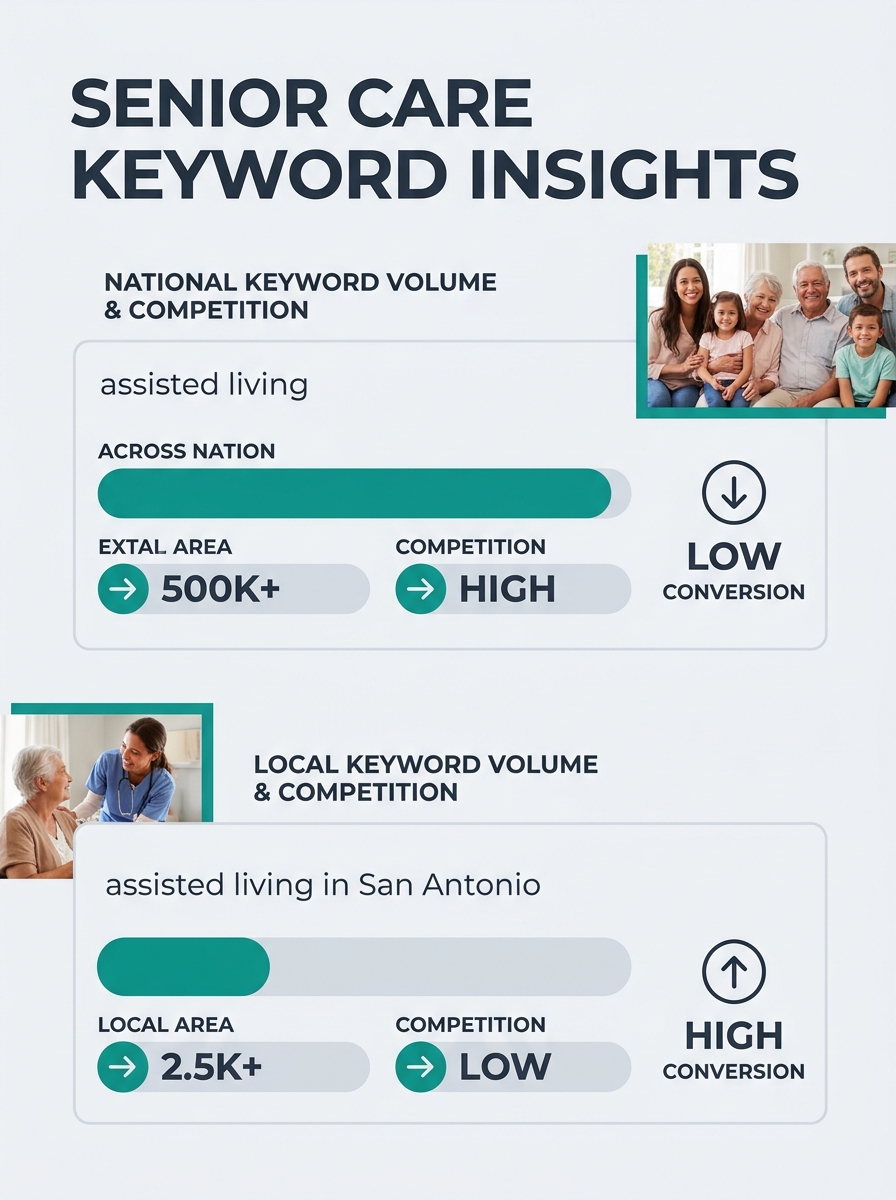
Google Keyword Planner tells a revealing story about the senior care industry’s SEO priorities. The term “assisted living” draws roughly 165,000 monthly searches nationwide. “Assisted living in San Antonio,” serving a metro of 2.6 million people, draws about 1,600. Providers pile their content budgets into the first term, then wonder why the phone doesn’t ring with families who actually live nearby.
This disconnect has a name: the local search intent gap. Seventy-eight percent of senior care searches carry local intent, according to industry benchmarks, yet many provider websites read as though they’re competing for a national audience. The result is pages that rank on page three for “assisted living” and don’t appear at all when a daughter in Alamo Heights types “memory care near me” at midnight after her mother’s third fall this year.
The rules below won’t fix everything, but they address the specific mistakes we see most often when auditing senior care sites that generate traffic without generating calls.
Target the service-plus-location formula before anything else
The foundational keyword pattern for local SEO for senior care follows a simple structure: [target service] + [location]. “Assisted living in San Francisco.” “Memory care Phoenix.” “Home care agencies in Naperville.” As Blossom Strategies explains, this formula should be your original focus when building out keyword targets.
The mistake providers make is skipping the location qualifier because the broader term has higher search volume. Higher volume means higher competition and lower intent. Someone searching “what is assisted living” might be a journalism student writing a term paper. Someone searching “assisted living near downtown Portland” is probably making a decision within weeks.
Smaller communities and agencies benefit even more from specificity. If you serve a suburb of 50,000 people, you’re probably one of three or four providers competing for those neighborhood-based search queries. That’s a race you can win with consistent effort, unlike the national keyword contests where you’re up against A Place for Mom, SeniorLiving.org, and WebMD.
When developing location-specific keywords for assisted living or home care, think about the neighborhoods, ZIP codes, and adjacent towns your families actually come from. Your intake records already contain this data. Pull the last 50 admissions, map where those families searched from, and build your keyword list around those geographies.
Treat your Google Business Profile like a second homepage
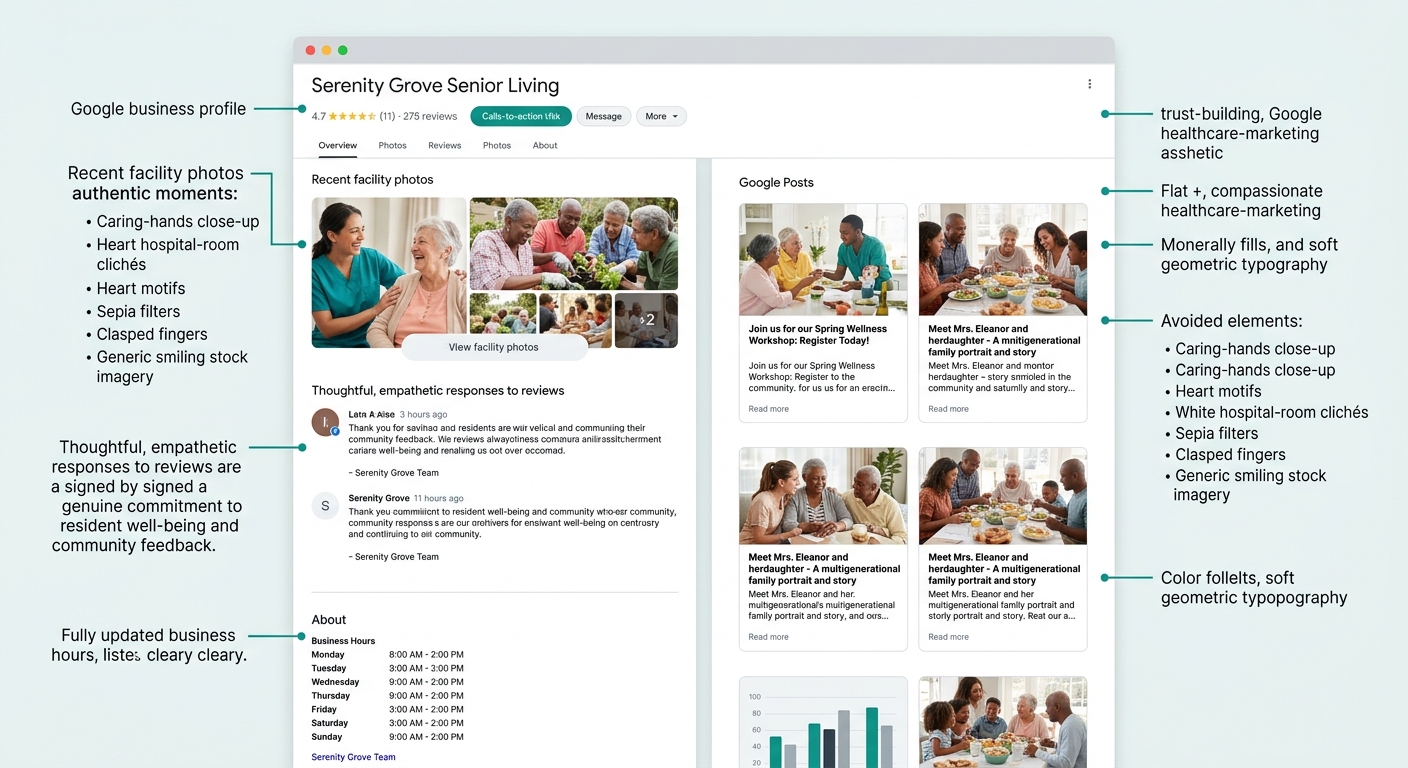
Your Google Business Profile (GBP) controls roughly 25% of your local search ranking influence, and it’s the first thing many families see before they ever visit your website. Ninety-two percent of searchers choose a business from the first page of local results, and the Local 3-Pack at the top of that page pulls directly from GBP data.
Yet we routinely find senior care providers with GBP listings that haven’t been updated in months. The hours are wrong. The photos show a lobby renovation from three years ago. There are unanswered reviews, two of them negative and detailed.
Treat this listing as a living document. Post weekly updates: new activity photos, seasonal programming announcements, staff spotlights. Upload current images of your facility, common areas, and real staff members. Respond to every review within 48 hours. Families read reviews with the same scrutiny they’d apply to choosing a surgeon. BrightLocal’s consumer research shows 75% of consumers always or regularly read online reviews, and 81% use Google as their primary review platform. If your review management for care agencies is an afterthought, you’re losing families before they click through to your site.
GBP also signals proximity. When a family member searches “assisted living near me” from their phone while sitting in a hospital discharge planning office, Google uses their location and your GBP data to decide whether you show up. An incomplete or inconsistent listing means invisibility during the exact moment family search intent for senior living peaks.
Build a dedicated landing page for every service area you cover
One homepage with a paragraph saying “We serve the greater Dallas-Fort Worth area” won’t rank for any specific city within that sprawl. You need individual pages for each meaningful service area: one for Arlington, one for Irving, one for Plano, and so on.
Each page should include genuine local detail. Mention the nearest hospital your care coordinators work with. Reference the specific counties involved in Medicaid assessments. Describe how families from that area typically reach your facility, whether that’s via I-35 or through a referral from the local geriatrician’s office. This is where understanding the geographic SEO hierarchy and building sub-service pages becomes essential to your local ranking structure.
Search engines reward pages that demonstrate genuine relevance to a location. A page that swaps the city name and reuses identical copy across twelve locations will get flagged as thin content. Write each page with the family from that specific ZIP code in mind, and include at least one or two details that could only apply to that geography.
If your website talks about senior care like a national brand but serves families within a 15-mile radius, you’ve built the wrong site.
Write content that matches the emotional language families actually type
The search queries that lead to senior care decisions rarely sound clinical. They sound scared. “Is it time for memory care for mom?” “What to do when dad can’t live alone anymore.” “Affordable assisted living near [city] that accepts Medicaid.”
These are the hyperlocal senior care marketing opportunities that most provider blogs miss entirely. Instead of writing content around those real, emotionally specific questions, providers publish generic pages about “The Benefits of Assisted Living” that compete with aggregator sites and lose every time.
As Active Marketing emphasizes, the winning approach is to pair hyper-local keywords with content highlighting your unique strengths and local regulatory context. Write about what distinguishes your community in your specific town. Cover your state’s Medicaid waiver process and what it means for families in your county. Explain how your facility partners with the area hospital’s discharge team.
Understanding how adult children and seniors search differently shapes everything here. The adult daughter searching at midnight uses different language than the 78-year-old researching options for himself. Your content strategy for care providers needs to account for both personas, and both need answers rooted in the specific place they live.
Earn backlinks from the local institutions families already trust
Backlinks remain a core ranking factor, and for local SEO, the geographic origin of those links matters significantly. A link from your city’s Area Agency on Aging, the local hospital’s patient resource page, or a nearby church’s community services directory carries more local ranking weight than a link from a national healthcare blog with ten times the domain authority.
Think about the referral network you already have. Discharge planners, elder law attorneys, geriatric care managers, local nonprofits serving older adults. Many of these organizations maintain online resource lists, and they’re often happy to include providers they already refer to in person. Sponsor a local health fair and get linked from the event page. Write a guest column for the community newspaper’s website.
This work also reinforces how families evaluate trust signals when comparing providers. A family who sees your name on the hospital’s recommended list, the attorney’s referral page, and the Google 3-Pack within the same afternoon develops real confidence before they ever dial your number.
Tip: Start with the five referral partners who already send you the most leads. Check whether their websites link to you. If not, send a polite email with your URL and a one-sentence description of your services. This is the lowest-effort, highest-return backlink work you can do.
Keep your NAP identical on every directory, every time
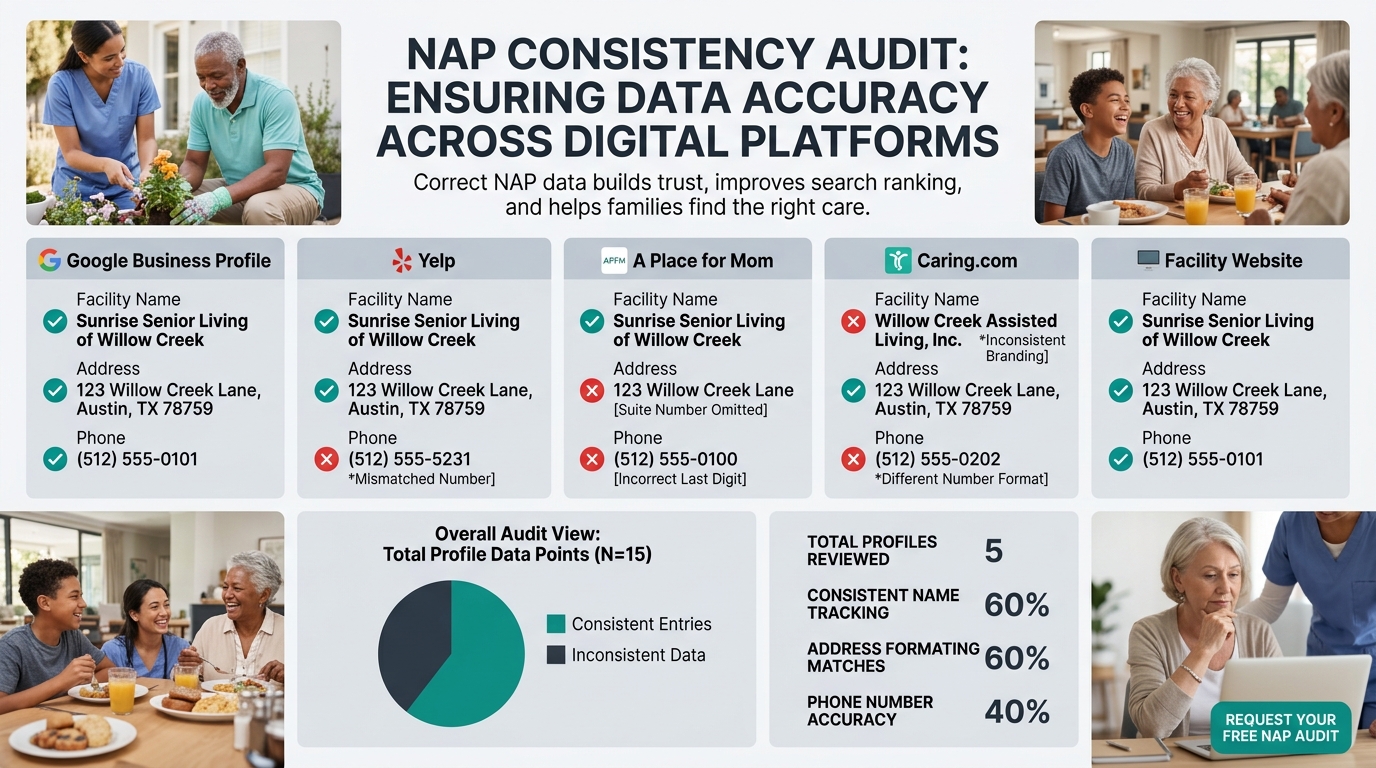
NAP stands for Name, Address, Phone number. When this information varies across your website, your Google Business Profile, your Yelp listing, A Place for Mom, Caring.com, and the local chamber of commerce directory, search engines lose confidence in your location data. That uncertainty translates directly into lower local rankings.
The fix is tedious but straightforward. Audit every directory where your facility appears. Standardize the format: decide whether you abbreviate “Street” or spell it out, whether you include a suite number, and stick with that format everywhere. Tools like Moz Local or BrightLocal can scan for inconsistencies, but someone on your team still needs to log into each platform and make the corrections.
Multi-location providers face this problem at scale. If you operate facilities across a state, each location needs its own GBP listing, its own set of directory entries, and its own home care SEO strategy tailored to that specific geography. Treating locations as interchangeable dilutes the local signals that Google needs to rank each one for its surrounding community.
When These Rules Break Down
These rules assume a provider operating within a defined geographic service area and competing for families who search online before making contact. That describes the vast majority of senior care providers, but exceptions exist.
If your facility draws residents from across a state because of a specialized program, such as a rare dementia intervention, a culturally specific community, or a program for younger adults with early-onset conditions, national visibility may genuinely matter more than hyperlocal ranking. In that case, being visible in AI-powered search results and building topical authority around your specialty could be the better investment.
Similarly, if your community has a 95% occupancy rate and a waiting list, spending resources on local search optimization has diminishing returns. The rules above serve providers with empty beds and phones that aren’t ringing often enough. If your challenge is operational rather than marketing-related, the real overhead might sit in your internal processes rather than your search rankings.
For everyone else, the math is clear. Families search locally. They trust what appears nearby. And 72% of them visit a facility within five miles of where they’re searching from. Providers who’ve spent years building national keyword authority without building local relevance are watching those families drive past their front door on the way to a competitor who showed up when and where it counted.