
Home care management software vendor myEZcare published an analysis April 30 documenting operational costs agencies incur when running paper-based workflows, according to content posted on the company’s website. The analysis cites a 2024 National Association for Home Care & Hospice study finding that agencies using paper processes spent an average of 11 additional administrative hours per week per coordinator compared to agencies using digital care management platforms.
The myEZcare analysis arrives as home care agencies face mounting compliance documentation requirements and tighter Medicare Advantage reimbursement timelines. Paper-based workflows create measurable drag on billing cycles, audit preparation, and visit verification, the analysis found.
Administrative Time Lost to Manual Documentation
The 11-hour weekly figure translates to approximately 572 hours annually per coordinator position, myEZcare’s analysis noted. At a $22 hourly rate for administrative staff, that represents roughly $12,584 in annual payroll cost per coordinator devoted to tasks digital systems handle automatically—data re-entry, signature tracking, and documentation reconciliation.
Paper agencies commonly operate with fragmented systems, the vendor analysis stated. A typical configuration might include Excel scheduling grids, a separate billing platform, physical intake forms, and an electronic medical record system that does not sync with other tools. This setup appears digital but retains most operational friction of paper workflows, according to the analysis.
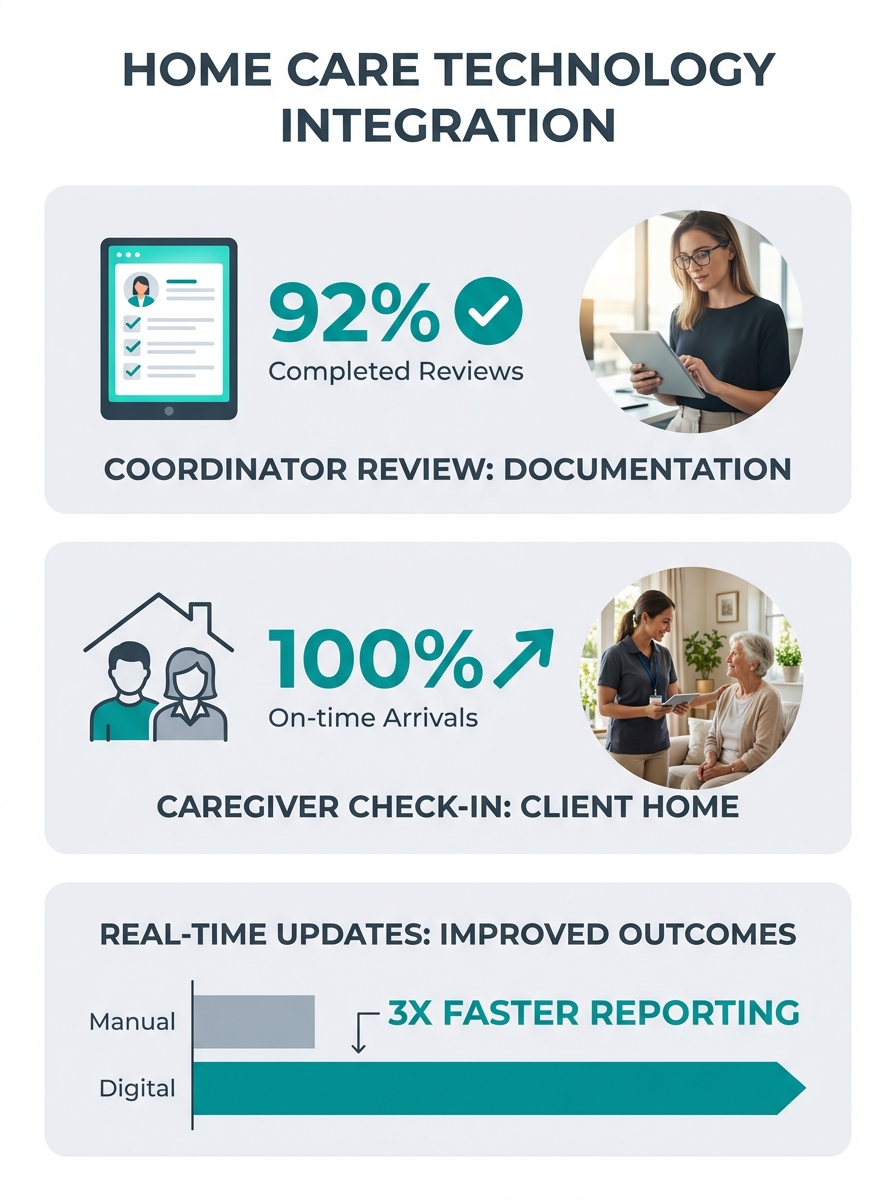
Billing delays represent another measurable cost. When visit notes remain on paper in the field rather than entered into a central system, reimbursement claims cannot be submitted until coordinators manually collect and process documentation. myEZcare stated this typically extends billing cycles by three to five days compared to agencies where field staff complete digital visit notes via mobile app.
Compliance Audit Trail Gaps
Paper and spreadsheet records lack audit trails showing who modified information, when changes occurred, and what prior values were, the analysis noted. Digital care management platforms log every action with timestamps and user credentials—documentation state auditors and Medicare Administrative Contractors request during record reviews.
The compliance dimension becomes particularly relevant as the Centers for Medicare & Medicaid Services tightens oversight of high-risk providers under recent fraud-prevention mandates. Agencies unable to produce timestamped change logs for clinical documentation face higher audit risk and potential claim denials.
Manual visit verification also creates exposure. Paper timesheets signed after the fact cannot prove a caregiver’s physical presence at a client location during service delivery. Electronic visit verification systems using GPS timestamps and mobile check-ins provide the contemporaneous documentation Medicaid EVV mandates require in most states.
Digital Transition Mechanics
The myEZcare analysis described the shift to digital operations as gradual rather than all-at-once. Agencies typically begin by digitizing intake and assessment forms, then add electronic visit verification, followed by integrated billing workflows.
A paperless workflow operates as follows, according to the vendor: Intake forms are completed on tablets during client assessments. Clinical coordinators create and modify care plans inside the same system where scheduling occurs. Caregivers clock in and out using smartphones that capture GPS coordinates. Visit notes entered in the field sync immediately to the billing module. Claims generate automatically once services meet authorization parameters.
The operational model eliminates duplicate data entry—information captured once at intake flows through scheduling, visit documentation, and billing without manual re-keying. This reduces both labor cost and transcription errors, the analysis stated.
Agencies concerned about staff adoption find mobile-first platforms easier to implement than desktop systems, myEZcare noted. Caregivers already familiar with smartphone apps adapt quickly to digital visit check-in workflows. Resistance typically comes from administrative staff accustomed to paper processes, though coordinator workload reductions become apparent within the first billing cycle after go-live.
ROI Calculation Framework
The vendor analysis outlined a return-on-investment calculation agencies can use to evaluate digital platform costs against manual-process overhead. Key inputs include current coordinator headcount, average hourly administrative wage, typical billing cycle length, and frequency of audit requests.
A 15-caregiver agency spending $45,000 annually on coordinator overtime to manage paper documentation could recover that cost within eight months by eliminating manual data entry, myEZcare’s framework suggested. The calculation assumes digital platform subscription costs of approximately $150 monthly per user for coordinator and caregiver licenses.
Agencies also capture revenue faster when billing cycles compress. A three-day reduction in time-to-claim submission improves cash flow by roughly 10 percent for agencies operating on net-30 payment terms with Medicare Advantage plans, the analysis stated.
Providers Implications
Home care agency owners evaluating operational efficiency investments now have a specific benchmark: paper-based workflows consume 11 additional coordinator hours weekly compared to digital platforms. That metric offers a concrete starting point for ROI analysis rather than relying on anecdotal productivity claims.
The compliance dimension matters as much as the time savings. Agencies pursuing Medicare Advantage contracts or facing state Medicaid audits need contemporaneous documentation with clear audit trails. Paper records and unlinked spreadsheets cannot deliver that level of defensibility. Digital platforms create the timestamped change logs and GPS-verified visit confirmations that satisfy auditor requirements without manual reconstruction.
For operators concerned about implementation complexity, the analysis suggests starting with intake digitization and EVV before tackling full billing integration. This staged approach allows staff to adapt incrementally while still capturing measurable time savings within the first quarter. Agencies already using marketing automation for client handoff workflows may find similar efficiency gains from digitizing backend care coordination processes.