
Emitrr, a healthcare communication platform, published a comprehensive reputation management framework July 17 connecting website content strategy, patient review management, and Google search visibility as three interdependent trust signals that drive provider selection, according to guidance authored by Shefali Jain. The framework positions clarity over medical jargon and patient search language over provider terminology as the foundation of healthcare search performance.
TL;DR: emitrr published a three-pillar reputation framework July 17 connecting content structure, patient reviews, and search rankings as interdependent drivers of provider selection and appointment bookings.
The guidance argues most healthcare websites face a clarity problem rather than a ranking problem, noting that Google cannot rank content it doesn’t clearly understand. “In healthcare, patients don’t just choose the ‘best ranked’ provider. They choose the most trusted one,” the framework states, identifying website messaging, Google presence, and patient testimonials as the three trust-building elements.
Search Language Mismatch Limits Visibility
The framework identifies a fundamental disconnect between provider terminology and patient search behavior. While doctors search using medical terms, patients search in four primary patterns: problem-based queries (“knee pain when bending”), service-based searches (“dental implants near me”), condition-based queries (“eczema treatment”), and urgency-driven searches (“emergency dentist near me open now”), according to the guidance.
“Near me” searches remain critical for local healthcare visibility, with Google prioritizing proximity, relevance, and trust signals when surfacing providers for location-based queries. The framework contends that websites stating “We provide orthopedic care” fail to match patient search language, while pages titled “Knee pain treatment” or “Back pain relief” align with actual query patterns.
Senior care providers face parallel dynamics. Families searching for placement options use problem-focused language (“memory care near me,” “assisted living accepting Medicaid”) rather than industry terminology. Agencies that structure content around family pain points rather than clinical services capture more qualified search traffic, a principle that applies equally to home care SEO and marketing for assisted living facilities.
Content Architecture Gaps Leave Ranking Opportunities Unclaimed
The guidance identifies six essential content types most healthcare websites lack: service pages for each major offering, condition pages capturing early-stage search intent, treatment comparison pages, FAQ sections answering question-based searches, authority-building blog content, and location-specific pages for multi-site operators.
Service pages should explain what the service is, who it targets, what patients should expect, recovery or process details, and frequently asked questions. Condition pages help providers capture searches from patients who haven’t yet identified which service they need—positioning “knee pain” content ahead of “arthroscopic knee surgery” pages in the decision journey.
FAQ pages represent what the framework calls “one of the most underrated SEO tools,” helping practices rank for question-based searches while simultaneously reducing inbound phone volume. Location-specific pages for multi-site operators must include unique content for each facility rather than duplicated templates, the guidance notes.
Three Pillars Function as Interdependent System
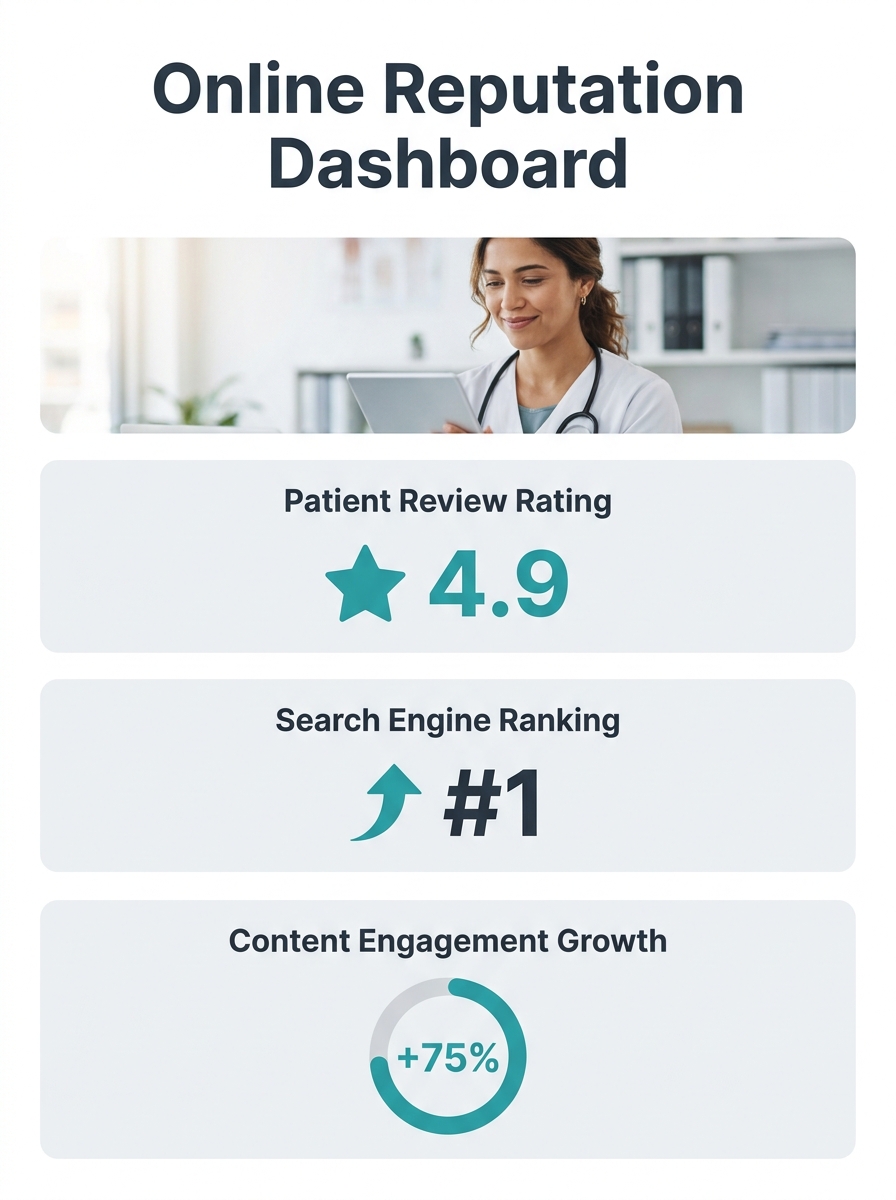
The framework positions content strategy, review management, and search rankings as a connected system rather than isolated marketing tactics. Strong content helps Google understand provider offerings and service areas; patient reviews validate that understanding with social proof; and search rankings reflect the combined signal strength of both elements.
Practices that treat these pillars separately—investing in review solicitation without updating website content, or optimizing service pages without addressing Google Business Profile completeness—underperform competitors who manage all three in coordination, according to the guidance.
The framework advocates long-term content investment over short-term paid advertising, positioning organic content as a durable asset that compounds over time. “Strong medical marketing SEO content helps you get consistent organic traffic, reduce dependency on paid ads, and increase appointment bookings over time,” the guidance states.
What This Means for Owners
Senior care operators managing marketing for assisted living communities or home care agencies can apply the three-pillar framework by auditing whether website content matches family search language, whether Google Business Profiles fully represent service offerings and coverage areas, and whether review solicitation processes capture testimonials at high-value touchpoints. The clarity-over-jargon principle applies directly to senior care: families searching for placement options don’t search for “skilled nursing facilities”—they search for “nursing homes near me” or “memory care for dementia.”
Agencies operating across multiple service territories should evaluate whether each location has dedicated content rather than duplicated templates, and whether condition-focused content (“signs your parent needs help at home”) precedes service-focused pages (“personal care services”) in the site architecture. The framework’s emphasis on FAQ content aligns with family decision patterns—adult children researching care options often have identical questions about costs, Medicaid acceptance, and staffing ratios that FAQ sections can efficiently address.
The interdependence principle matters for budget allocation: operators investing heavily in paid search while neglecting Google Business Profile optimization or review management will see diminishing returns compared to competitors who coordinate all three channels. Content built around patient search language becomes a compounding asset that reduces long-term acquisition costs, particularly valuable for agencies in competitive metropolitan markets where paid search costs continue escalating.