
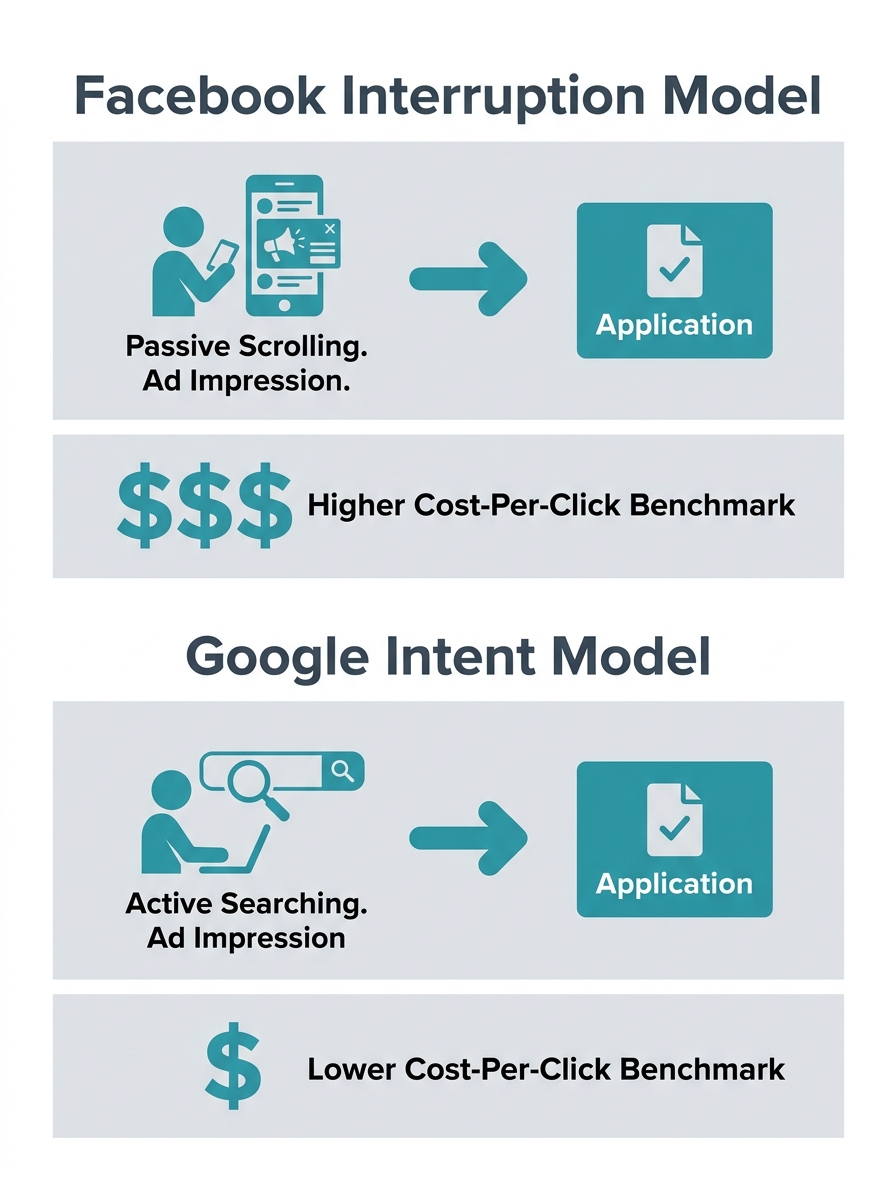
Facebook and Google Ads operate on opposite recruiting mechanics: Facebook interrupts passive scrollers who aren’t job-hunting, while Google captures active searchers typing “caregiver jobs near me.” That distinction determines everything about cost, applicant quality, and which platform your agency should fund first.
TL;DR: Facebook delivers caregiver applicants at $7–$9 per lead with a $0.62 average CPC, making it the volume play for agencies building a pipeline. Google’s $2.69 average CPC captures higher-intent candidates already looking for care work. The strongest paid recruitment strategies run both platforms, but allocate budget based on hiring urgency, market size, and budget per hire.
The Core Mechanism: Interruption vs. Intent
Why does the platform choice matter so much for caregiver recruitment? Because each one catches candidates at a fundamentally different point in their decision-making process.
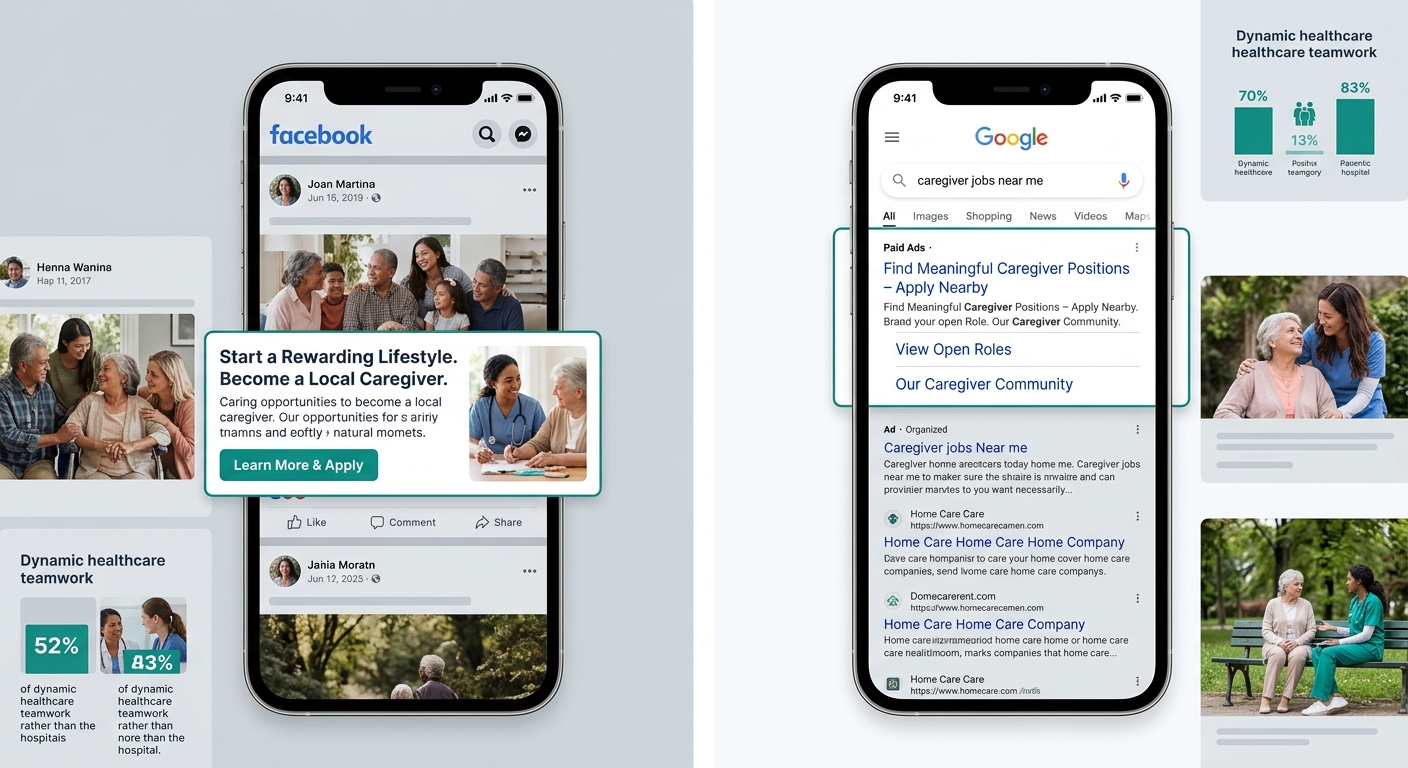
Facebook is an interruption engine. Your caregiver job ad appears between a user’s friend’s vacation photos and a recipe video. The person wasn’t looking for work. They might be a CNA finishing a shift, scrolling during a break, vaguely unhappy with their current employer but not browsing job boards. Your ad plants the idea, and if the offer is compelling enough, prompts an immediate tap on a Lead Generation form.
Google is an intent engine. Someone types “caregiver jobs hiring near me” or “home care aide positions [city].” They’ve already decided to look. They’re comparing options. Your ad competes with Indeed listings, agency career pages, and other home care paid ads targeting the same keywords.
This is a mechanical difference that cascades into every metric you’ll track: cost per click, cost per applicant, show-up rate for interviews, and 90-day retention.
What Facebook Recruitment Ads Actually Cost
Facebook’s average cost per click for caregiver recruitment ads sits around $0.62, compared to Google Search Ads at $2.69. That 4.3x gap grabs attention, but the more useful figure is cost per lead: Facebook Lead Generation Ads average $7–$9 per caregiver applicant when campaigns are structured correctly.
Those numbers hold when you follow a specific formula. Effective Facebook caregiver job ads target working-age adults within a 15–25 mile radius of your service area, layered with interest categories like healthcare, elder care, and community service. Agencies with existing caregiver rosters can upload employee data to build Lookalike Audiences, which tells Meta’s algorithm to find people who resemble your current staff in demographics and online behavior.
The pre-filled Lead Generation form is the critical piece. Facebook auto-populates name, email, and phone number from the user’s profile, which drops form abandonment dramatically. A candidate who would never complete a 12-field ATS application will tap “Submit” on a three-field form without ever leaving the app.
But volume brings noise. A meaningful percentage of Facebook applicants won’t remember submitting the form when you call them the next day. Speed-to-contact matters more here than on any other channel: agencies that call within 5 minutes of form submission report dramatically higher contact rates than those that wait 24 hours. Your ATS and intake process need to support that kind of response time, or the cheap leads become expensive dead ends.
Tip: Emphasize mission, pay transparency, and schedule flexibility in your Facebook ad copy rather than generic job titles. “CNA starting at $18/hr, flexible weekday shifts, paid training” outperforms “Now Hiring Caregivers” because it answers the questions a passive candidate hasn’t yet thought to ask.
What Google Recruitment Ads Actually Cost
Google Search Ads for caregiver recruitment run at an average CPC of $2.69, and senior care keyword auctions push higher in competitive metro markets like New York, New Jersey, and parts of California. Cardinal Digital Marketing’s senior care PPC case study documented a rising trend in conversion rates over sustained campaigns in those markets, showing that Google performance improves as campaign data matures and the algorithm learns which searchers convert.
The advantage is applicant intent. Someone clicking a Google ad for “home health aide jobs in [city]” has already self-qualified as a job seeker. They’re comparing your agency against competitors at that exact moment. Your cost per click is higher, but the applicant is further along in their decision. They’re more likely to answer your call, show up for an orientation, and actually start work.
Google also captures candidates during micro-moments that Facebook can’t replicate: a CNA who just walked out of a bad shift and searches “home care jobs near me” on their phone in the parking lot. That emotional urgency converts at rates no interruption ad can match.
The downside is a hard volume ceiling. Only so many people in your service area are searching for caregiver jobs on any given day. You can bid on every relevant keyword and still exhaust available search traffic quickly, especially in markets under 200,000 population. Agencies in metro areas with populations over 500,000 see enough search volume to sustain Google-only recruitment campaigns. Smaller-market agencies often can’t.
How Targeting Restrictions Change the Equation
Both platforms restrict how you target caregiver recruitment ads in 2026, and this constraint reshapes strategy on each one differently.
Facebook’s Special Ad Category for employment eliminates age targeting, zip code precision, and certain interest-based filters. You can’t target “women aged 25–45 in zip code 30301 interested in nursing.” Instead, you set a broad geographic radius (minimum 15 miles) and rely on Meta’s delivery algorithm to optimize toward users most likely to engage. Lookalike Audiences still work but operate under the same restrictions, producing broader and less precise matches than what was possible before these rules took effect.
Google’s Personalized Advertising Policy similarly restricts employment ad targeting by age, gender, and parental status. Performance Max campaigns use Google’s signals-based modeling to find candidates, which means you’re handing targeting decisions to the algorithm rather than making them manually.
The practical effect: both platforms have moved toward algorithmic targeting where your ad creative and landing page do more filtering work than the audience settings ever can. If your ad says “Certified nursing assistants, $19/hr, weekday shifts in Buckhead,” geography and job specificity do the candidate selection that platform controls used to handle. Writing specific, detailed ad copy is now a targeting strategy, not a copywriting preference.
The Three-Filter Platform Test
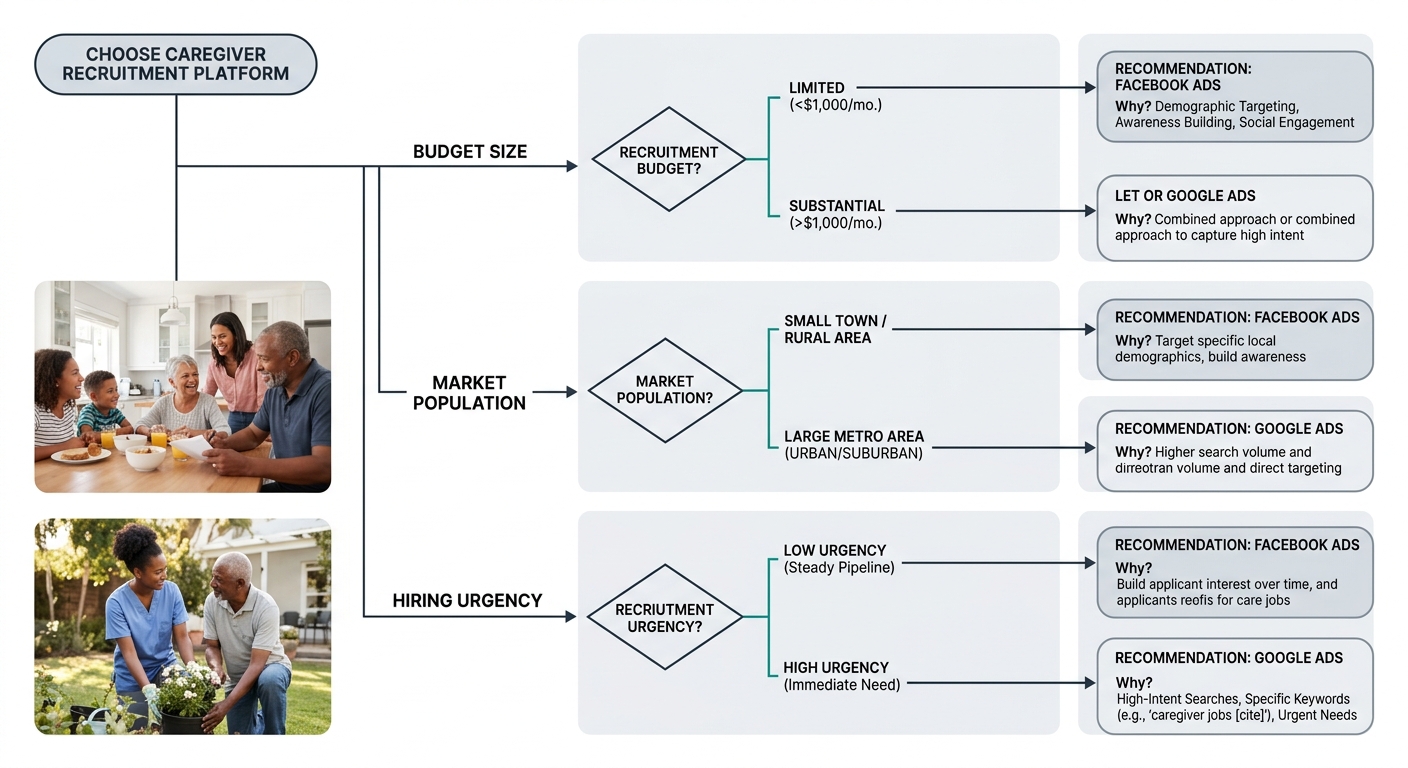
Given that both platforms work and both carry constraints, where should your caregiver recruitment ads budget go? Evaluate through three filters.
Urgency. If you need caregivers this week to fill open shifts, Google captures people who are already job-hunting. Facebook builds a pipeline for next month, not this one. Agencies dealing with the financial drain of caregiver turnover often need both speeds simultaneously.
Market size. In metro areas, Google search volume for caregiver jobs supports a full recruitment campaign. In markets under 200,000 population, you’ll exhaust relevant search traffic within days. Facebook’s interruption model doesn’t depend on search volume. It depends on how many working-age adults live within your radius, which is almost always a larger pool.
Budget per hire. If your total recruitment ad budget is under $1,000/month, concentrate on one platform. Facebook delivers more volume at that spend level. If you’re running $3,000+ monthly, splitting across both platforms lets you capture active seekers on Google while building pipeline on Facebook.
| Filter | Facebook Advantage | Google Advantage |
|---|---|---|
| Urgency | Pipeline building (2–4 week ramp) | Immediate hires (active job seekers) |
| Market size | Works in any population base | Requires 200K+ metro for sustained volume |
| Budget under $1K/mo | Higher applicant volume per dollar | Limited clicks at $2.69 CPC |
| Budget $3K+/mo | Scale with Lookalike expansion | Capture all available search intent |
| Applicant intent | Lower (passive candidates) | Higher (active job seekers) |
| Speed-to-hire | Slower, more screening needed | Faster, self-qualified applicants |
The Saskatchewan Caregiver Experience Study, which used paid Facebook ads alongside community newsletters for caregiver recruitment, found that paid social ads recruited caregiver profiles that didn’t appear through conventional job board channels. That finding matters for home care agencies competing against Indeed and ZipRecruiter for the same limited pool of active job seekers: Facebook reaches a population those boards never touch.
Google captures the caregiver who’s already decided to leave their current job. Facebook reaches the one who hasn’t decided yet but will, given the right offer at the right moment.
What Sits Outside the Duopoly
Neither Facebook nor Google exists in a vacuum. Agencies running paid recruitment in senior care should know what else competes for those ad dollars.
Indeed and ZipRecruiter dominate caregiver job board traffic but operate on per-application or per-click pricing that can exceed Google’s CPC in high-competition markets. Niche platforms like Nurse.com offer healthcare-specific advertising including targeted display, email campaigns, and sponsored content aimed at licensed nurses and CNAs. AI-powered recruiting tools like GoPerfect have entered the space with algorithmic candidate matching that ranks and engages clinical candidates automatically, understanding nursing specializations and state-specific license types.
These channels fill specific gaps. Job boards reach active seekers (similar to Google). Niche platforms reach credentialed professionals. AI tools reduce screening time. But Facebook and Google remain the two largest paid channels for caregiver job ads because they offer the most granular geographic control, the broadest reach, and the most mature optimization algorithms for home care hiring PPC.
And keep in mind: any recruitment spend is working against the industry’s 79% annual caregiver turnover rate. Your ad platform choice matters, but retention economics determine whether the candidates you recruit at $8 per lead or $25 per lead generate positive ROI over 12 months. An agency with 40% turnover gets twice the lifetime value from every recruited caregiver compared to one running at the industry average, regardless of which platform sourced the hire.
Where This Comparison Falls Apart
The Facebook-vs-Google framing assumes your bottleneck is top-of-funnel applicant volume. For many agencies, it isn’t.
If your applicant tracking system creates compliance friction that drops 60% of candidates between form submission and orientation, spending more on either platform won’t fix recruitment. The problem lives downstream. An agency generating 100 Facebook leads per month but only contacting 30 of them within 24 hours has a process problem, not a platform problem.
Similarly, agencies in states exploring skill-based Medicaid reimbursement models face a different recruiting equation entirely. If reimbursement rates rise enough to fund $20+/hr starting wages, the increased pay itself becomes the strongest recruitment tool. Both Facebook and Google ads carrying that wage figure will perform dramatically better than either platform did at $15/hr, because the offer changed, not the channel.
The platform comparison also assumes you’re recruiting in a single geographic market. Multi-location agencies often find that Facebook dominates in their rural territories while Google performs better in their urban ones, making a single organizational “winner” impossible to declare.
The honest answer: Facebook delivers more caregiver applicants per dollar spent. Google delivers applicants who are closer to accepting a position. Running both, with budget weighted by your urgency and market size, outperforms either alone. But neither platform compensates for slow follow-up, below-market wages, or a hiring process that loses candidates somewhere between the click and the first shift.