
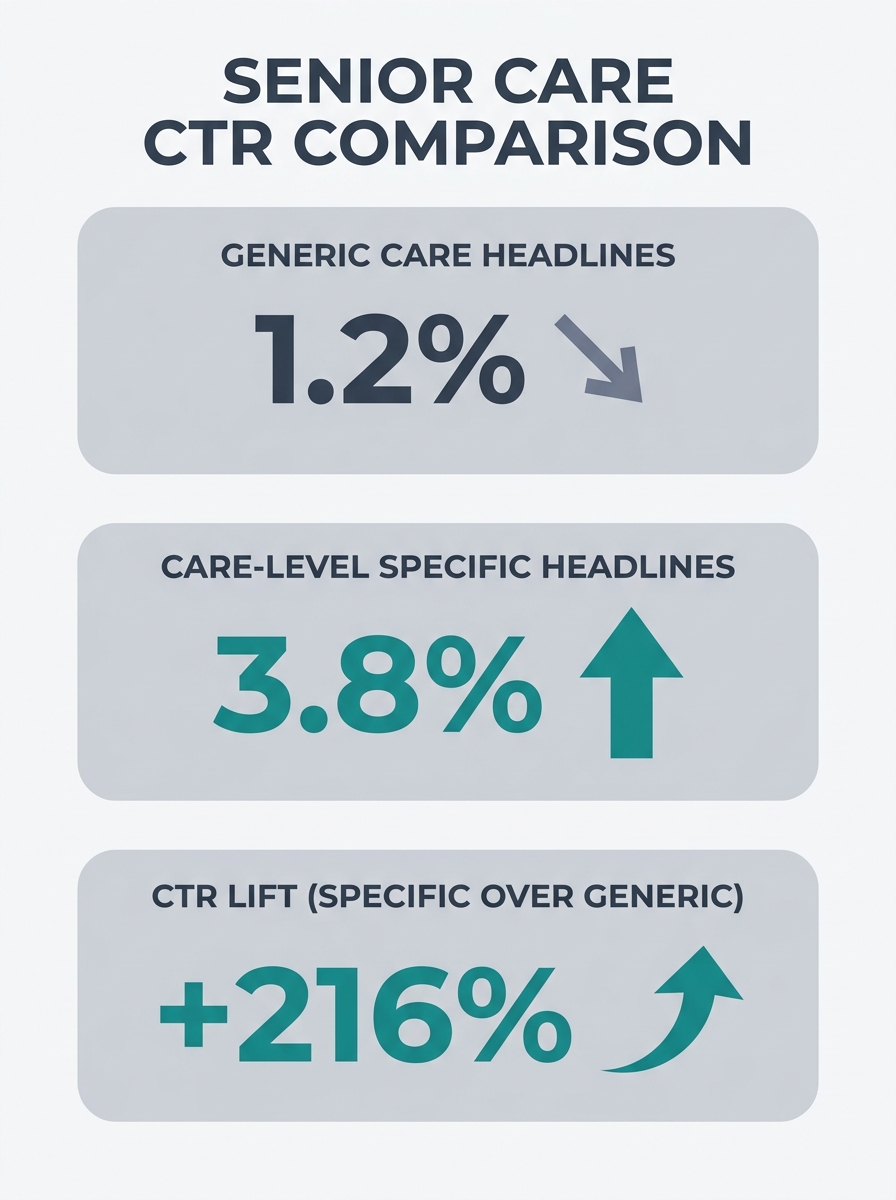
Digital Wolf, a Fort Wayne, Indiana-based marketing agency, released a case study July 7 showing that headlines naming specific care levels outperform generic senior living messaging by three to four times in paid search campaigns, according to findings drawn from seven years managing marketing for more than 80 communities nationwide. The study analyzed data from the past 24 months, a period covering more than $2 million in cumulative ad spend across independent living, assisted living, memory care, skilled nursing, and continuing care retirement communities spanning every price tier.
TL;DR: Fort Wayne agency Digital Wolf found care-specific headlines like “Right Level of Care & Support” drove 32.3% click-through rates and 72% conversions at under $1 cost-per-click, outperforming generic and AI-generated alternatives by 3-4x across 80+ senior care communities.
The highest-performing headline across the portfolio, “Right Level of Care & Support”, generated hundreds of thousands of clicks at a 32.3% click-through rate, a 72% conversion rate, and a cost-per-click below $1, the case study shows. “It works because it mirrors the exact question families are asking themselves in the moment of search,” said Brandon Wolf, founder and CEO of Digital Wolf, in the published findings. Generic headlines such as “Senior Care Community” plateaued at 8.2% click-through rate, while Google’s auto-generated AI headlines including “Relax and recharge” reached only 4.4% despite massive impression share.
Specificity Drives Engagement Across All Ad Formats
Other top-performing headlines shared the trait of naming a specific care type or concrete next action. “Enhanced Personal Care / Assisted Living” drove a 33.2% click-through rate, “Personalized Care” hit 29.5% click-through with 72.8% conversion, and “Schedule A Tour” reached 24.9% click-through with 77.9% conversion, according to the data. The pattern held across sitelinks and description assets: “Floor Plans & Pricing” became the number one sitelink at over 32% click-through, while photo and gallery sitelinks converted at rates exceeding 50%. Description assets that named specific programs outperformed aspirational language by an order of magnitude, the study found.
Digital Wolf’s clients during the study period included high-end luxury communities, value-tier independent living properties, dedicated memory care buildings, CCRCs, and skilled nursing facilities. The case study draws on hundreds of paid campaigns and thousands of pieces of original content published on behalf of these communities. “The pandemic accelerated digital-first decision making,” Wolf said. “AI-generated content flooded organic and paid channels.”
Programmatic Display and Organic Content Patterns
In programmatic display advertising, warm lifestyle imagery showing the physical environment outperformed stock photography and aspirational marketing visuals, the data showed. Trust-building organic content focused on culture, awards, and caregiver support consistently earned the highest engagement rates of any content category tested. Blog posts answering specific decision-stage questions outperformed broad health tips by more than 50% in per-post efficiency, with the top organic post titled “So You’ve Planned Your Visit, What Next?” mirroring the specific question families ask at that stage of research.
The findings align with broader multi-channel attribution patterns in home care marketing, where families interact with seven to thirteen pieces of content before converting into qualified leads. Operators managing marketing for assisted living properties and caregiving agencies face similar pressure to demonstrate transparency about pricing, care levels, and what daily life actually looks like inside the community. The study found that transparency about these elements accelerates every step of the family decision journey.
Five Core Lessons Spanning Paid and Organic Channels
The case study identified five lessons cutting across every channel and format. First, content must answer the specific question families are asking at that exact moment, headlines that name the care type outperform generic labels by 3-4x. Second, families must see before they believe, visual elements showing the physical environment convert at dramatically higher rates than descriptive text. Third, trust signals matter more than aspirational messaging, organic content about caregiver support and community culture earned higher engagement than promotional material.
Fourth, pricing transparency early in the research process reduces friction and accelerates conversions. Fifth, human-crafted care-specific messaging outperforms AI-generated alternatives in every tested scenario. “Every piece of content should be written as a direct answer to one specific question a family member is asking during their research,” Wolf said. “The more specific the question, the higher the engagement.”
Digital Wolf manages campaigns for communities across the United States, including properties in competitive metro markets where local search visibility challenges affect nursing home and home care operators. The agency tested messaging variations across search, display, and organic channels during a period when privacy changes reshaped audience targeting and programmatic placements expanded into channels that did not meaningfully exist for senior care five years ago.
Reading Between the Lines
The data confirms what operators managing admissions already suspect: families researching senior care respond to directness, not marketing polish. The 3-4x performance gap between “Right Level of Care & Support” and “Senior Care Community” reflects a fundamental shift in how families use digital channels, they are looking for specific answers to specific questions, not brand positioning. The collapse of AI-generated generic headlines at 4.4% click-through suggests that Google’s automation, at least in senior care advertising, cannot yet replace human judgment about what constitutes a relevant answer to a family’s immediate concern.
For operators allocating budget across marketing for nursing homes, assisted living properties, and memory care units, the case study offers a clear playbook: name the care level, show the environment, answer the specific question. The “$1 cost-per-click at 72% conversion” benchmark for the top-performing headline creates a concrete reference point for evaluating campaign performance. Operators running generic messaging or relying on auto-generated headlines are leaving conversions on the table, the data shows a fourfold difference in click-through performance between the two approaches.
The emphasis on transparency about pricing and physical environment aligns with the after-hours research behavior that defines senior care decision-making in 2026. Families conduct most of their research alone, late at night, comparing options across multiple tabs. Content that answers specific questions at specific decision stages, What does assisted living cost? What will my parent’s room look like? What happens on move-in day?, captures attention during those critical unsupervised research sessions. The operators who win admissions are the ones whose digital presence anticipates and answers those questions before the family picks up the phone.