
Google’s autocomplete suggestions for “assisted living” diverge sharply depending on who’s typing. Adult children between 40 and 60 trigger crisis-oriented completions: “assisted living after a fall,” “signs mom needs memory care,” “how to convince a parent to move.” Seniors searching for themselves see lifestyle completions surface instead: “assisted living with pets allowed,” “active senior communities near me,” “independent living vs assisted living for couples.” These two query streams have existed for years. But for most of that time, care providers treated them as one audience.
That single-persona approach left enormous gaps in how agencies and communities showed up in search. Understanding the psychology behind each group’s decision-making process, and then building a multi-generational SEO strategy around it, has become the defining difference between providers who fill beds and those who wonder why their traffic doesn’t convert.
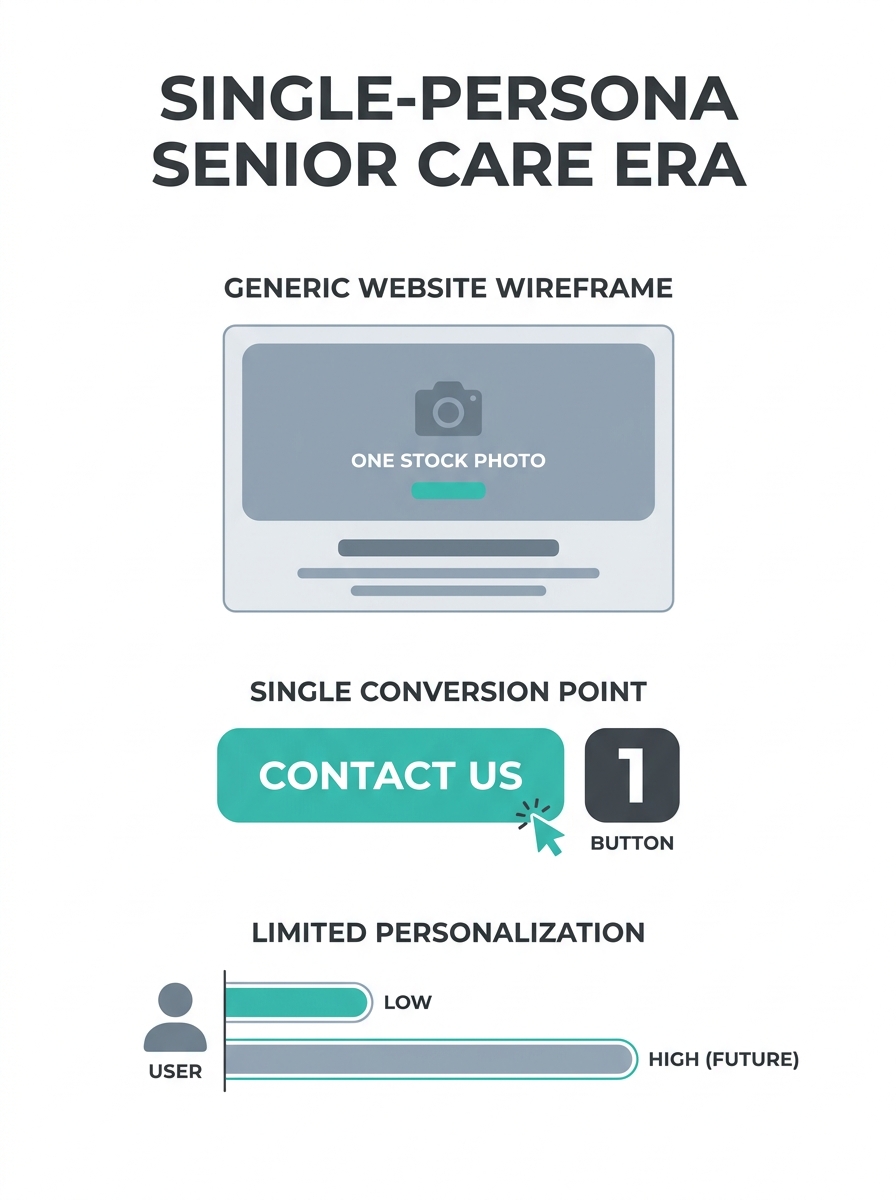
The Single-Persona Era
For a long time, senior care websites talked to “families.” Service pages listed amenities. Blog posts covered generic topics like “what is assisted living?” or “types of senior care explained.” The keyword strategy, if there was one, centered on broad match terms and location modifiers. “Senior living in Phoenix.” “Home care services in Dallas.”
This worked when Google’s algorithm rewarded keyword density and when search behavior was less differentiated. Providers ranked, got clicks, and hoped whoever landed on the page would call. There was no effort to map content to the specific emotional state or informational need of the person searching.
The underlying assumption was straightforward: someone will search for senior care, find our website, and contact us. Who that someone was, what worried them at 2 a.m., what language they used to describe their situation, none of that factored in.
When the Search Data Split in Two
The split became visible as search tools got more granular. Keyword research platforms started surfacing the long-tail queries that revealed intent, and two distinct patterns emerged.
Adult children searched with urgency and guilt. Their queries reflected a crisis already underway or an anxiety building toward one. “Mom fell and I live out of state.” “Is forgetting names a sign of dementia?” “How to talk to dad about leaving his house.” As noted by Keystone Elder Law, even the most harmonious parent-child relationships become fraught when adult children begin observing warning signs: medication left untaken, declining awareness, an accumulation of small worries that eventually demand action.
The senior care decision-making psychology here is deeply emotional. These searchers aren’t comparison shopping. They’re trying to figure out whether the situation they’re witnessing is normal aging or something that requires intervention. Their content needs are educational, reassuring, and empathetic.
Seniors searching for themselves used entirely different language. Their queries were proactive, practical, and focused on preserving autonomy. “Best retirement communities with golf courses.” “Cost of assisted living per month in my area.” “Senior apartments that allow dogs.” Research from the National Library of Medicine on older populations’ online health-information seeking shows that seniors who search independently tend to be “power users” with specific information goals, and they navigate directly toward trusted, authoritative sources.
As Right at Home explains, seniors spend a lifetime making decisions on their own. When someone else tries to do the deciding for them, they resist. This independence shapes everything about how they search, what content they trust, and which providers they engage with.
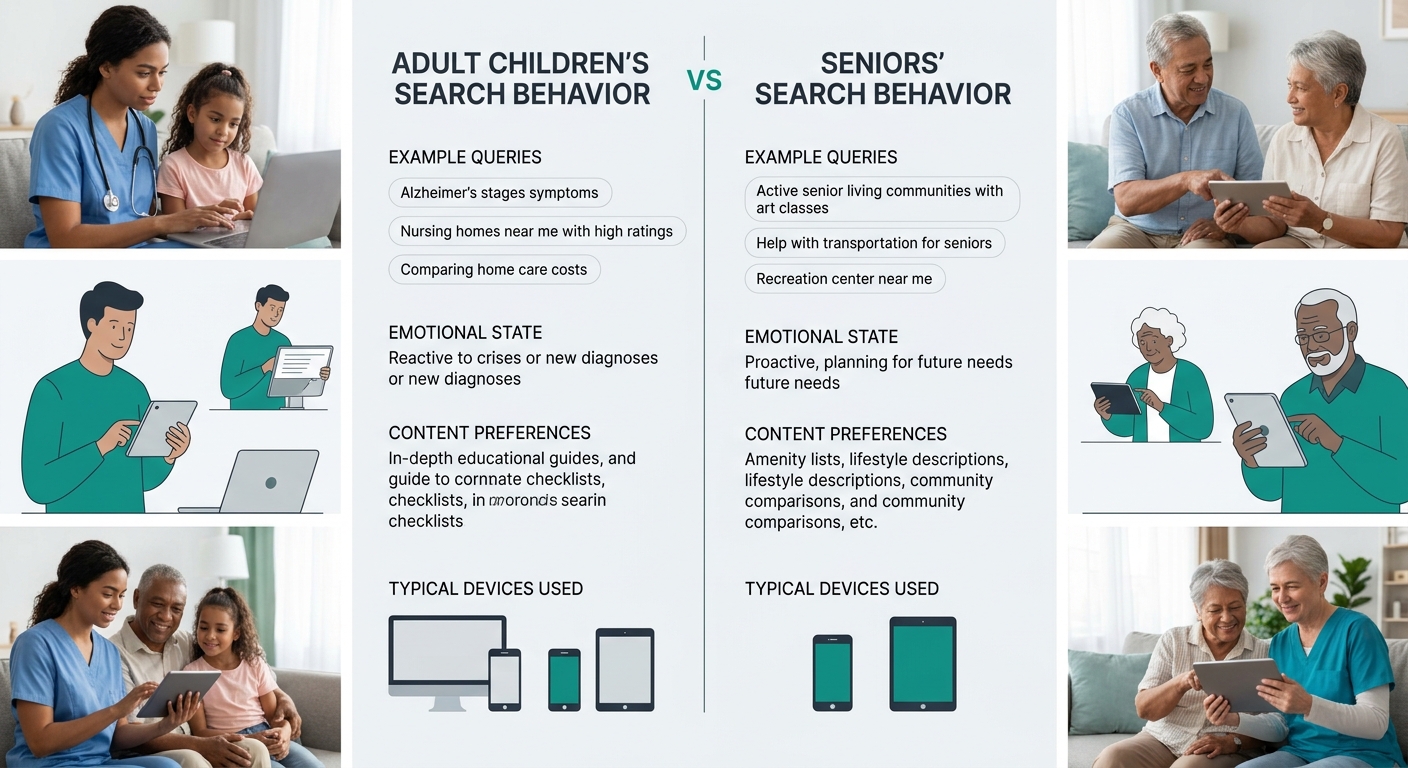
The data made the adult children vs seniors search behavior gap impossible to ignore. Providers who recognized it early gained a measurable advantage in organic traffic and, more importantly, in lead quality.
Building Two Content Paths
Once the behavioral split became clear, the strategic response followed in phases.
Phase One: Separate Keyword Clusters
Agencies and communities started building two keyword lists. One targeted the language adult children use during the consideration stage. The other targeted the language seniors use when they’re exploring options on their own timeline. This mattered enormously for assisted living persona targeting because the same facility needed to rank for both “memory care warning signs” and “active senior community amenities.”
If you’ve already started thinking about how local keywords drive home care leads, layering in persona-specific modifiers is the natural next step. Instead of only targeting “assisted living in [city],” you’d add “how to move mom to assisted living in [city]” alongside “55+ communities with social activities in [city].”
Phase Two: Dedicated Content Hubs
The next development was building separate content hubs for each persona. For adult children, this meant guides like “What to Look for During a Facility Tour,” “How to Handle a Parent Who Refuses Help,” and “Understanding the Cost of Memory Care.” For seniors, it meant pages focused on community life, testimonials from current residents, virtual tours, and clear pricing.
The same facility needs to rank for “memory care warning signs” and “active senior community amenities.” Treating those as one content strategy guarantees you’ll do both poorly.
The content tone had to shift, too. Adult children respond to compassion and authority. They want to know you understand what they’re going through and that you have clinical credibility. This is where building trust through client testimonials becomes essential, because adult children are looking for proof that other families had good outcomes.
Seniors respond to respect and clarity. They want to see what daily life looks like. They want pricing without having to call. They want to know their independence won’t disappear the moment they sign an agreement.
Phase Three: Conversion Path Optimization
Different personas convert differently. Adult children tend to fill out inquiry forms, download checklists, or call during business hours after doing research the night before. Seniors are more likely to request a brochure, attend an event, or schedule a visit directly.
This means your website’s conversion optimization needs persona-specific CTAs. A “Schedule a Tour” button works for seniors who are ready to see the community. A “Download Our Family Decision Guide” works for adult children who are still in the research phase and aren’t ready to commit to a visit.
Tip: Audit your contact forms and CTAs. If every page has the same “Contact Us” button regardless of who the content targets, you’re creating friction for both personas. Tailor the action to the reader’s stage.
The Google Business Profile Factor
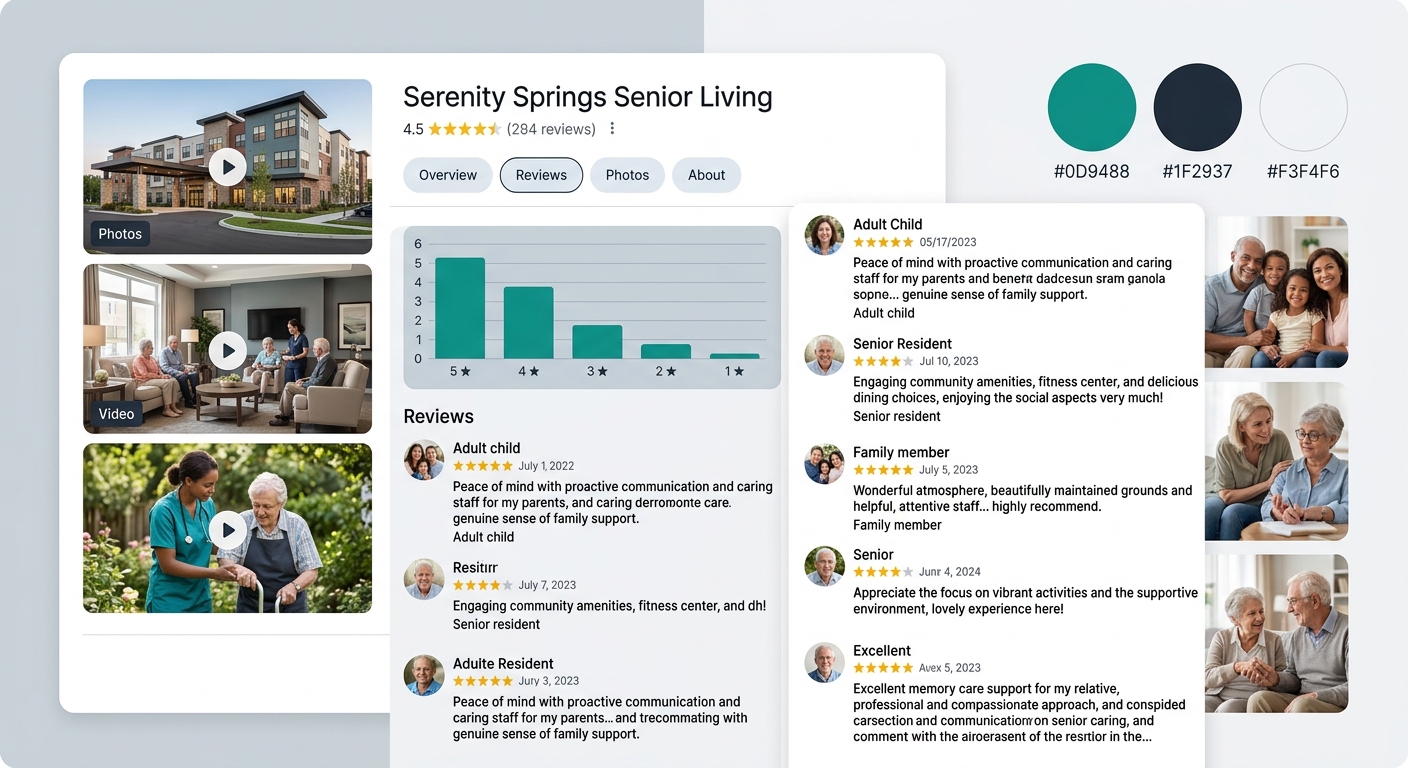
One area where both personas converge is local search. Adult children search for care near their parent’s location or near their own home. Seniors search within their current community or a desired retirement destination. In both cases, your Google Business Profile is often the first impression.
Reviews carry outsized weight here. Adult children look for reviews from other family members describing communication, cleanliness, and staff responsiveness. Seniors look for reviews from residents about community atmosphere, food quality, and social programming. Encouraging both types of reviewers to share their experiences strengthens your profile for each persona.
Any senior living marketing effort that neglects the GBP listing is leaving the most visible real estate in local search unoptimized. Similarly, agencies focused on in-home services need SEO for home care agencies that accounts for these persona differences at the local level.
Where This Lands Now
The agencies and communities seeing the strongest organic growth have fully committed to a multi-generational SEO strategy. They maintain separate content funnels, use persona-specific keyword clusters, and track conversion metrics by audience segment rather than in aggregate.
The providers still struggling tend to have one of two problems. Either they write all their content for adult children (ignoring the 20-30% of seniors who search independently and tend to convert faster with less hand-holding) or they write for a vague “family” audience that doesn’t resonate deeply with either group.
Search engines continue to reward content that matches intent with precision. A page built for an adult child at 11 p.m. wondering if their father’s forgetfulness is serious enough to warrant professional care is fundamentally different from a page built for a 72-year-old comparing communities where she can bring her golden retriever. Both pages need to exist on your site. Both need distinct keyword targeting, distinct tone, and distinct calls to action.
The senior care providers who’ve understood this for the past few years are the ones dominating their local SERPs today. The opportunity for everyone else is that most competitors still haven’t made the shift, which means building a dual-persona content strategy now puts you ahead of a market that’s still treating two very different audiences as one.