
Fifty-five percent of companies produce videos in-house, 14% outsource entirely, and 31% use a hybrid model. For home care agencies weighing the in-house vs outsourced medical video decision, the right split depends on compliance risk, content volume, and whether you can batch enough shoots to justify equipment costs.
TL;DR: Home care video content strategy works best as a hybrid: keep simple caregiver spotlights and social clips internal, outsource compliance-heavy testimonials and brand films to specialists charging ~$2,500/day, and batch every shoot to cut per-video cost by 40-60%.
The six rules below won’t tell you which model is “better.” They’ll help you figure out which model fits your agency’s size, budget, and risk tolerance right now. Video production for senior care agencies doesn’t have a single correct answer. It has a correct answer for your operation this quarter.
Know your content mix before you pick a production model
Why does this decision go wrong? Because agencies buy a camera or sign a vendor contract before deciding what they actually need to produce. The content type determines the production model, not the other way around.
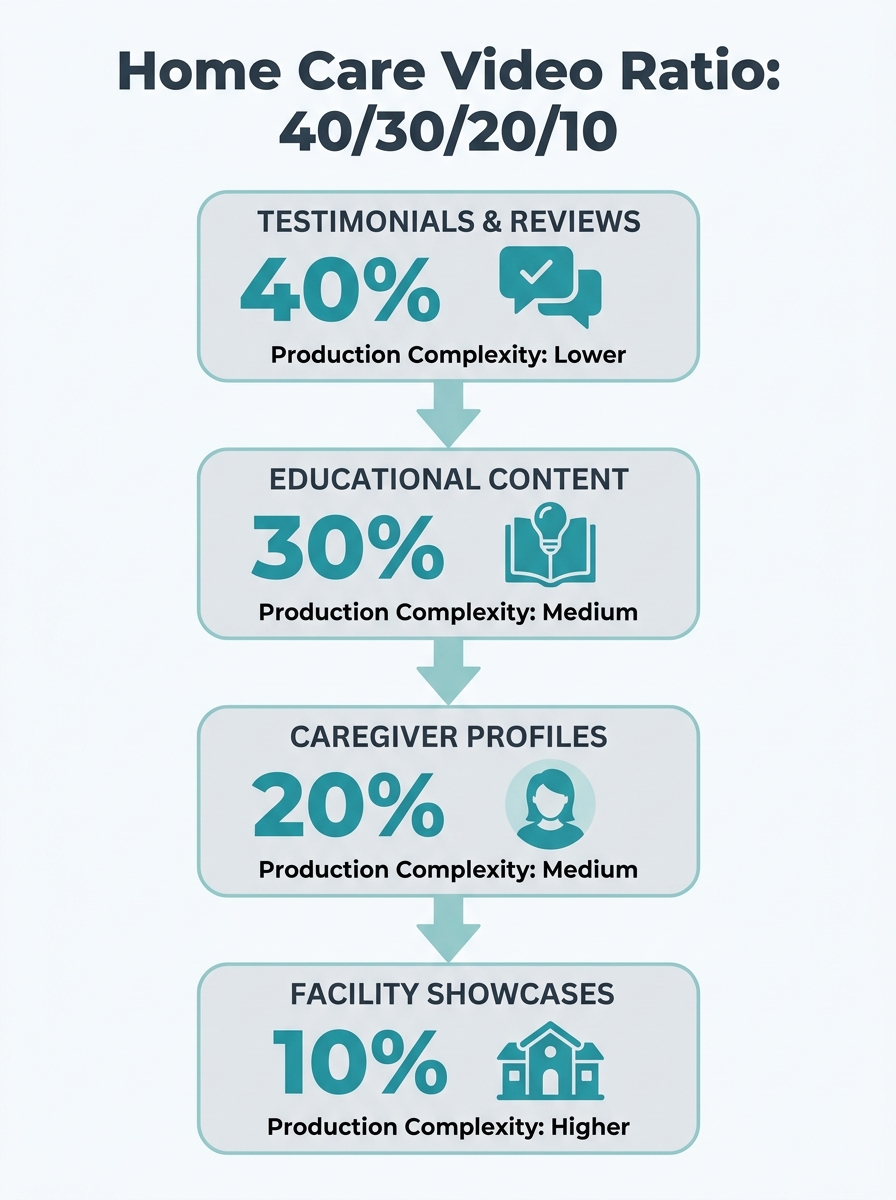
Chasing Illusions Studio analyzed hundreds of healthcare video campaigns and recommends a specific portfolio distribution: 40% patient/client testimonials, 30% educational content, 20% physician or caregiver profiles, and 10% facility showcases. That ratio balances production costs against expected returns across each category.
For a home care agency producing 4 videos per month, that translates to roughly 5 testimonials, 4 educational clips, 2-3 caregiver profiles, and 1 facility or brand piece per quarter. Testimonials and brand pieces carry the highest compliance risk (client consent, HIPAA considerations, visual representation of care). Educational clips and caregiver spotlights carry the lowest.
That split matters. The low-risk, high-frequency videos are your in-house candidates. The high-risk, lower-frequency pieces are where an outside production partner earns their fee.
Price the full cost of in-house before buying a single light
The visible cost of in-house production is equipment: a decent camera, a lavalier mic, a ring light, basic editing software. Call it $2,000-$4,000 upfront. That number tricks people.
The real cost is labor. Someone on your team has to plan shoots, coordinate with caregivers and families, handle lighting and audio, edit footage, add captions, and publish across platforms. At a 15-person home care agency, that “someone” is usually your marketing coordinator or office manager. They’re already stretched thin. According to Intrepy’s 2026 home health marketing guide, video builds trust and drives conversions, but most agencies struggle with production because they underestimate the time commitment.
Meanwhile, healthcare production companies charge around $2,500 per day because crews need specialized expertise in medical environments, plus on-set compliance consultants. That sounds expensive until you calculate what 15-20 hours of your marketing coordinator’s monthly time costs you in missed follow-ups, delayed social posts, and slower family inquiry responses.
Tip: Run a simple math comparison: multiply your coordinator’s hourly rate by the hours they’d spend on video each month, then add the opportunity cost of tasks they can’t do during those hours. Compare that total to a quarterly vendor invoice for the same number of finished videos.
The break-even point for in-house production typically lands around 6-8 videos per month. Below that volume, outsourcing individual projects or batching quarterly shoots with a vendor usually costs less per finished video.
Outsource anything that touches a client on camera
This is the rule with the sharpest consequences for getting wrong. Any video featuring a home care client, their home environment, or their family requires consent documentation, HIPAA awareness, and careful editorial judgment about what details are visible on screen. A prescription bottle on a nightstand. A medical device in the background. A calendar with appointment notes.
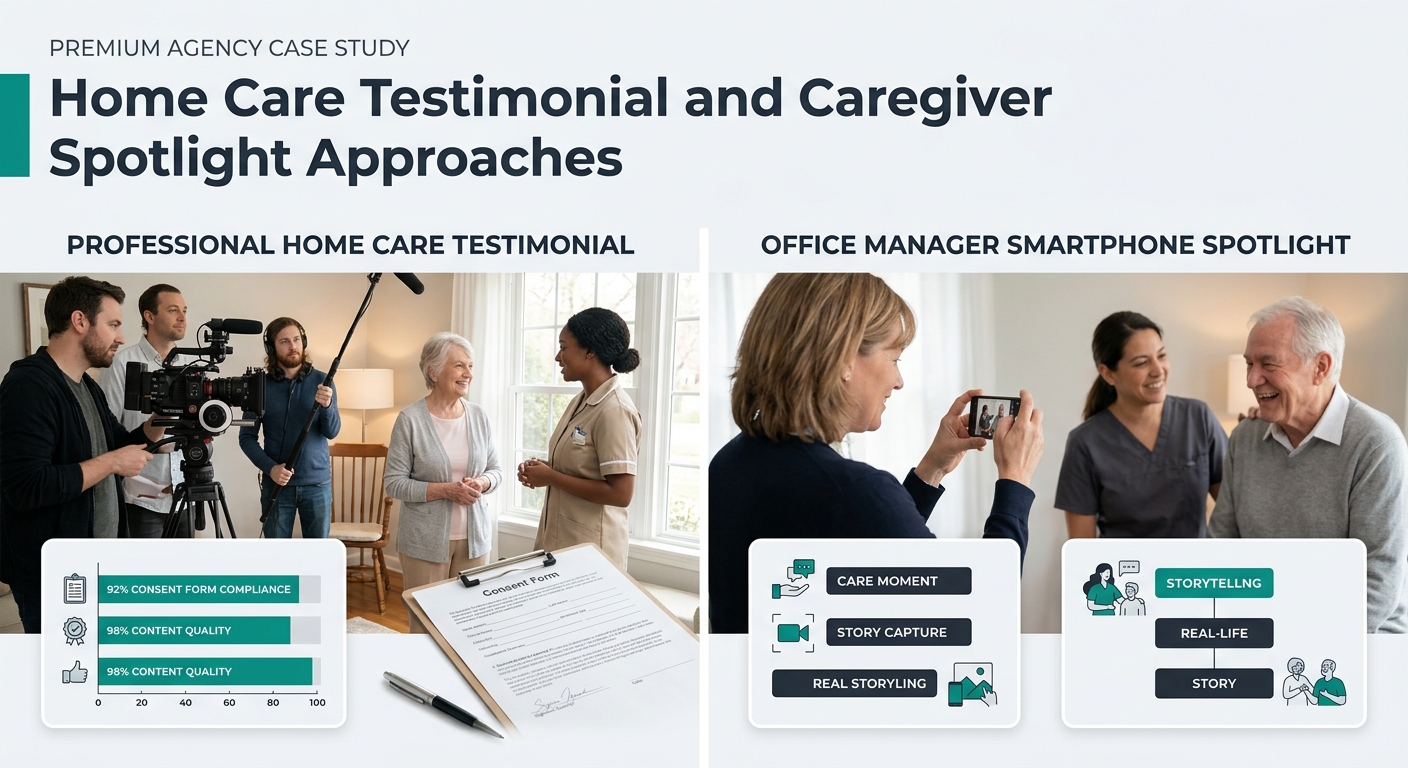
UF Health’s creative services team makes the point plainly: “Polish and professional quality requires an investment of time, resources and, if we can’t produce it internally, money.” That investment includes knowing what not to show. Production companies specializing in healthcare understand these constraints. Your office manager with an iPhone does not.
Keep client testimonial production with vendors who carry their own liability insurance and have experience with healthcare consent workflows. Keep caregiver spotlight videos, “day in the life” social content, and educational tips in-house. The compliance line is clear: if a client or their protected health information appears in the frame, bring in a professional.
This is where your home care video content strategy intersects with risk management. One poorly handled testimonial video can create both a compliance incident and a reputation crisis.
Hire an editor, not a videographer
If you’re building any in-house capacity at all, here’s where to spend your first dollar: editing. Raw footage from a modern smartphone is genuinely good enough for social media and website content. Raw footage that sits on a hard drive because nobody has time to cut it, caption it, and export it is worth nothing.
AI tools have cut post-production time by roughly 24%, and automated captioning has improved both accessibility and engagement on social platforms. But someone still needs to select the best 60 seconds from a 12-minute interview. Someone still needs to match the tone to your brand. Someone still needs to know that the 30-second mark has a visible address on a mailbox that should be blurred.
A part-time video editor (freelance or staff) at $25-$40/hour who spends 10 hours per month on your footage will produce more finished content than a $3,000 camera sitting in a closet. Eighty-nine percent of marketers are maintaining or increasing video investment, according to current industry surveys. The bottleneck is almost never capture. It’s finishing.
If your agency already has someone creating careers page content and social media posts, adding basic editing software and 8-10 hours of training converts them into your most valuable in-house video resource.
Batch every shoot into a single production day
The single biggest cost driver in video production isn’t equipment or talent. It’s setup time. Every time you arrange lighting, test audio, position a subject, and run through a few practice takes, you’ve spent 30-45 minutes before recording a single usable second.
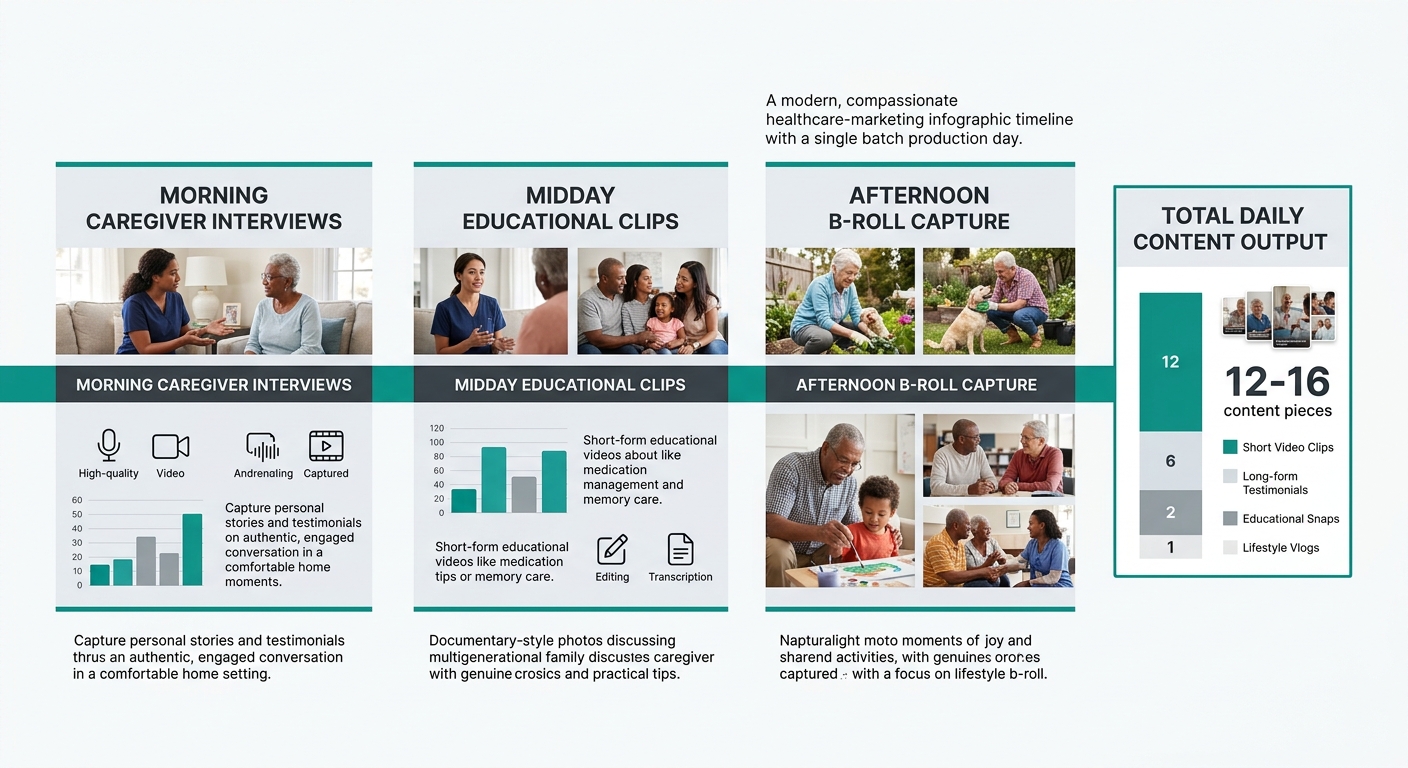
Batching solves this. Block one day per month (or one day per quarter with a vendor) and shoot everything you need in a single session. A well-organized batch day at your office or a client’s home can produce:
- 3-4 caregiver spotlight interviews (20-30 minutes each, raw)
- 5-6 short educational tip clips (2-3 minutes each, raw)
- B-roll footage of your team, office, branded vehicles, and common care scenarios
- Seasonal or holiday greeting content for the next 2-3 months
That single day of shooting yields 12-16 pieces of finished content after editing. Spread across a quarter, that’s a steady drip of video for your website, Google Business Profile, social channels, and family-facing content that supports inquiry conversion.
A well-organized batch day yields 12-16 pieces of finished content. Spread across a quarter, that’s a steady drip of video without a steady drain on your team’s time.
When hiring an outside production company, batching is where you negotiate. A vendor charging $2,500/day who produces 8 finished videos in that session costs $312 per video. The same vendor producing 2 videos per session costs $1,250 each. Volume per shoot day is your primary cost lever for video marketing ROI for home health agencies.
Measure what the video actually does, not how it looks
Home care agencies that invest in video production often evaluate results by production quality. The lighting looks professional. The music feels right. The family smiled. None of that tells you whether the video moved a single family closer to calling your intake line.
Track three metrics for every published video:
- View-through rate on your website (what percentage of visitors watch past 50%?)
- Inquiry attribution (did the family who called mention the video, or did they visit the video page before converting?)
- Search visibility impact (do pages with embedded video rank higher for your target neighborhoods than pages without?)
Agencies building neighborhood-level service pages should test embedding a 60-second caregiver introduction video on those pages and measuring the ranking and conversion difference over 90 days. Video on service pages increases average time-on-page, and that behavioral signal influences local search performance.
Vidyard’s research on production models notes that small and medium companies tend to use exclusively internal resources while larger enterprises split more evenly between internal and external. The determining factor isn’t budget alone. Larger organizations track video performance more rigorously, which makes the ROI case for outside production easier to justify.
When These Rules Break
These rules assume a home care agency with 10-50 caregivers, a small marketing team (1-3 people), and a market presence in 1-3 metro areas. They break in predictable ways at different scales.
If you’re a single-caregiver startup, skip in-house production entirely. Your smartphone and a quiet room are your studio. Post unpolished, authentic 30-second clips to social media. The imperfection signals honesty at your stage.
If you’re a multi-state franchise operation, the calculus flips. You have enough volume to justify a dedicated in-house videographer (or two), a small editing bay, and a compliance review workflow. Outsource only your annual brand campaign and major recruitment videos.
And if you’re somewhere in the middle—which describes the majority of home care agencies reading this—the hybrid model wins. Shoot casual content internally. Bring in a production partner quarterly for testimonials and brand pieces. Batch everything. Edit constantly. Track results.
The agencies that stall on video usually stall because they treated the production model as a binary: all in-house or all outsourced. The real decision is which types of content belong where, and that answer changes as your agency grows, your team’s skills develop, and your compliance requirements shift. Revisit the split every six months. The right ratio this quarter probably isn’t the right ratio next year.