
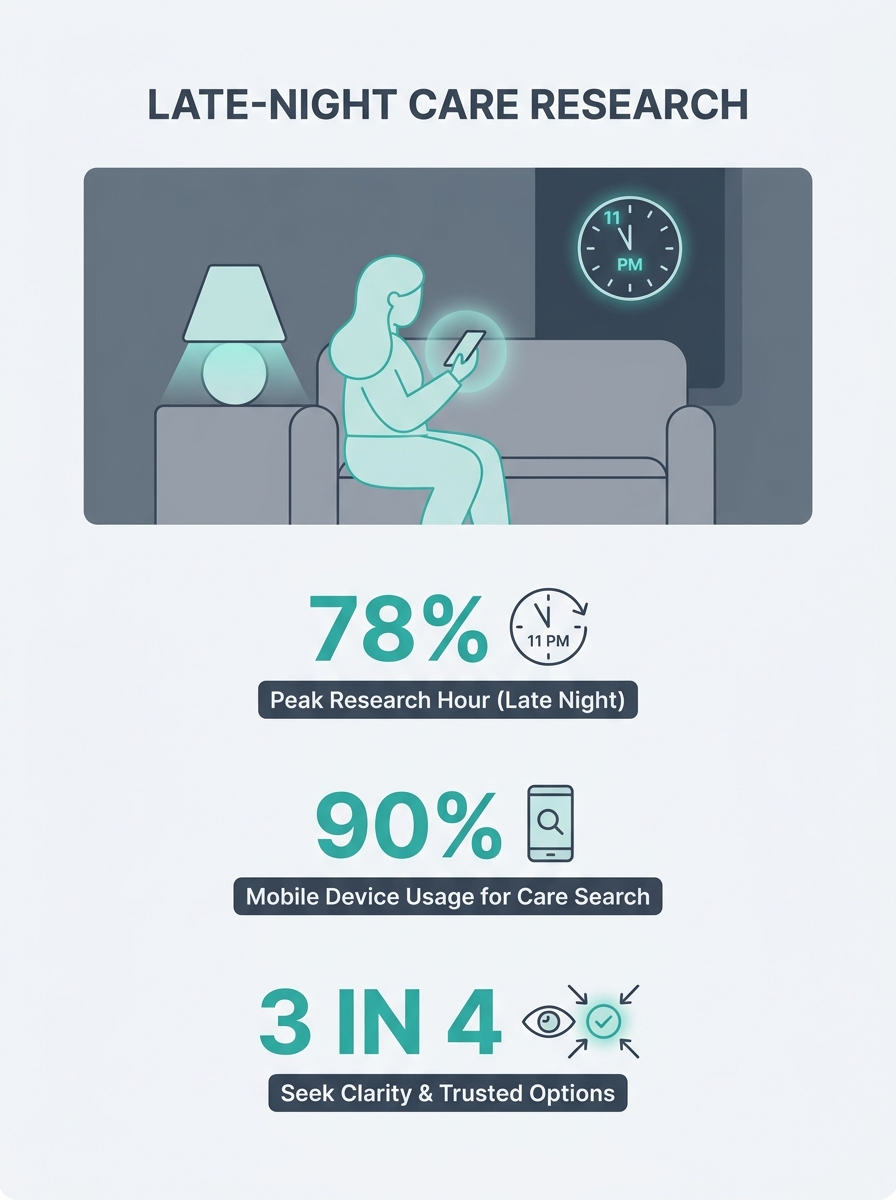
The contact form on your home care website sends the same “we’ll be in touch” confirmation at 11pm that it sends at 11am, but 70% of web leads arrive outside business hours. The mechanism behind this after-hours conversion failure involves three layers: traffic timing, trust-signal architecture, and response infrastructure. Each one breaks differently after dark.
TL;DR: Home care agencies lose the majority of their potential inquiries because their websites go functionally dormant at 5pm. Fixing after-hours lead capture requires changes at three layers: trust signals that work without a human to explain them, chatbot or SMS automation that qualifies leads overnight, and mobile-first form design built for a tired person on a phone.
Why the Surge Happens Between 9pm and Midnight
The after-hours traffic pattern on home care websites follows caregiver biology, not random browsing habits. Research published by the National Center for Biotechnology Information documents that sleep disturbance is one of the most consistent effects of family caregiving, with nighttime wakefulness becoming a defining feature of the adult child’s daily life.
Evening research family decision-making unfolds on a predictable timeline. A daughter notices her father’s mobility declining during a weekend visit. She brings it up with her spouse at dinner. By 10:30pm, after the kids are in bed, she’s on her phone searching “home care near me” or “in-home care costs [city].” She’s emotionally activated, sleep-deprived, and carrying a mix of guilt and urgency. The Johns Hopkins Center on Aging and Health has documented that while caregiving is stressful and burdensome for many family members, the majority also report a deep drive to do right by their loved ones. That motivation peaks at night, when the distractions of work and errands fade.
Your website gets roughly 8 seconds of her attention. If the site reads like a brochure that closed for the evening, she clicks back to Google and visits your competitor’s page instead.
The Trust Signals That Replace Your Receptionist After 5pm
During business hours, a visitor with questions can call your office, get reassurance from a real person, and hear warmth in someone’s voice. After 5pm, on-page trust signals must do 100% of that emotional work. As Nu Life Digital’s conversion research puts it, effective care websites require “creating engaging content, trust signals, and a user-friendly design to turn passive visitors into inquiries.”
For the 11pm researcher, five specific trust elements carry disproportionate weight:
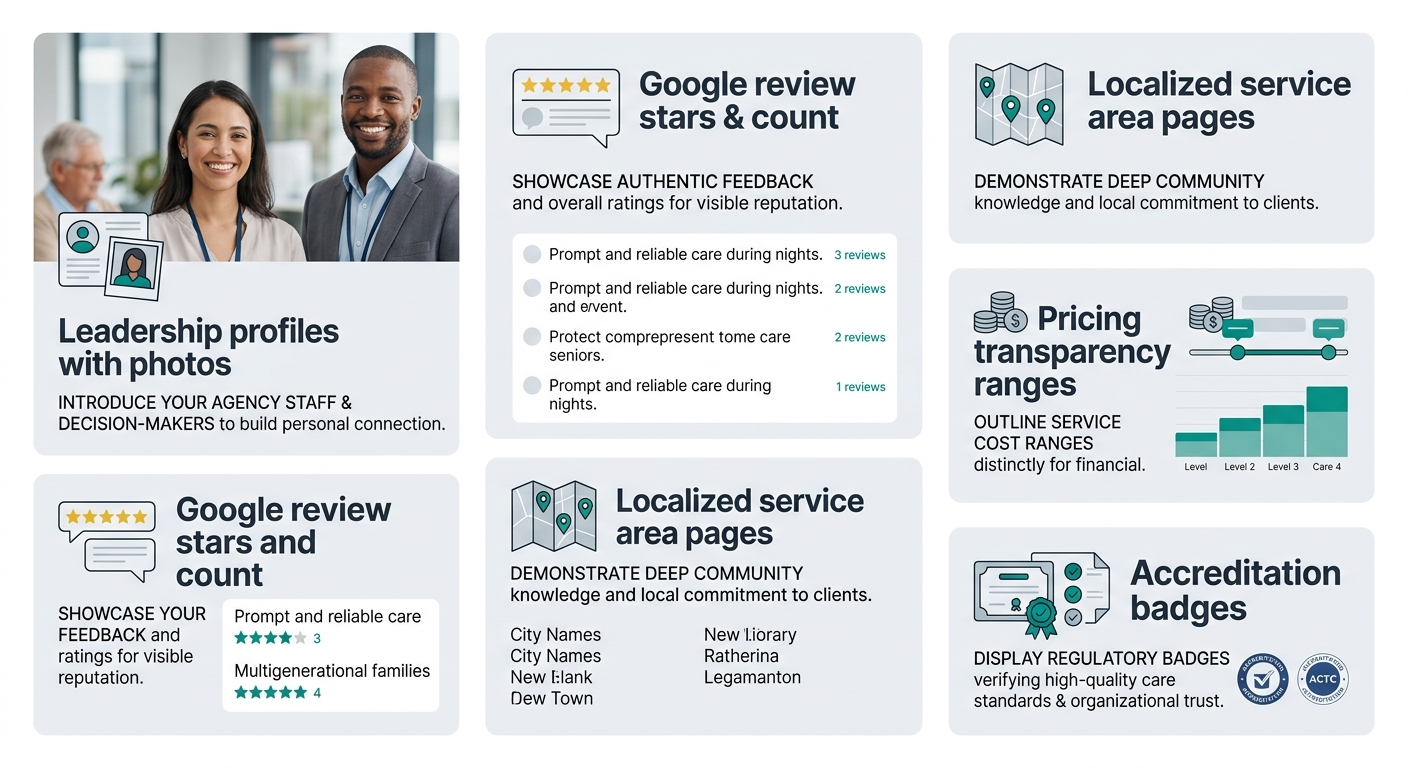
Named leadership profiles with photos. A 2026 review of top-performing home care websites found that sites featuring named founder stories and 4 or more leadership bios consistently outperformed anonymous agency pages on time-on-site and inquiry rates. The 11pm visitor wants to know who runs the company, not read a mission statement.
Verified review counts displayed on the homepage. Agencies averaging 4.5+ stars across 50 or more Google reviews convert after-hours visitors at higher rates because social proof replaces the phone-call reassurance that isn’t available. If your Google Business Profile needs attention, fixing it before investing in after-hours chat tools will produce better returns.
Specific service-area pages with localized content. A single “Areas We Serve” dropdown doesn’t build confidence. Creating neighborhood-level service pages with custom content for each coverage zone signals that you actually operate where the family lives.
Transparent pricing information. Families researching at 11pm can’t call for a quote. A pricing comparison page that walks visitors through cost ranges keeps them engaged instead of pushing them toward A Place for Mom or Caring.com for rough estimates.
Accreditation badges and insurance details above the fold. State license numbers, bonding information, and any relevant certifications belong near the top of the page, not buried in the footer where a tired visitor will never scroll.
How Senior Care Chatbot Automation Fills the Gap
The response gap between 5pm and 9am is where after-hours lead capture in home care succeeds or fails. A contact form that generates an email to an intake coordinator who reads it the next morning isn’t a response system. It’s a suggestion box. And 60-80% of after-hours form submitters never answer the follow-up call the next day, because the urgency that drove them to your site at 11pm has been replaced by the overwhelm of a Tuesday morning.
Senior care chatbot automation addresses this gap through three functional layers.
Layer 1: Greeting and qualification. An automated chat widget opens on key pages (homepage, services, contact) and asks 2-3 structured questions about the visitor’s situation, covering who needs care, what type of help they’re looking for, and their zip code. Zellyfi’s 2026 lead-capture playbook describes the core promise: “An AI chatbot captures, qualifies, and books them while you sleep.”
Layer 2: Intent routing. A visitor asking about caregiver job openings needs a different path than a family member asking about hourly rates. Platforms like Intercom, which combines chat, email, and help desk capabilities in a single interface, can route inquiries based on keyword detection and page context. LeadTruffle takes a different approach, focusing on home service businesses specifically and qualifying leads through SMS conversations rather than web chat.
Layer 3: Appointment booking. The chatbot offers 2-3 available consultation slots for the next business day and sends a calendar confirmation via email and text. This converts the 11pm browser from “I should call tomorrow” into “I have an appointment Tuesday at 10am.”
| Feature | Basic Contact Form | Live Chat (Business Hours) | AI Chatbot (24/7) | SMS Qualification |
|---|---|---|---|---|
| After-hours response | Confirmation only | Unavailable | Immediate | Immediate |
| Lead qualification | None | Manual | Automated | Automated |
| Appointment booking | No | Manual | Automated | Automated |
| Personalization | None | High | Moderate | High |
| Typical monthly cost | Free | $200-500 | $100-400 | $150-350 |
For agencies already running marketing automation platforms, integrating a chatbot into the existing CRM workflow means after-hours leads enter the same pipeline as daytime inquiries, with the same tagging, scoring, and follow-up sequences.
The Mobile Layer That Breaks First
Home care website conversion optimization efforts tend to focus on desktop layouts, but the 11pm researcher is almost always on a phone. She’s in bed or on the couch, scrolling with one thumb. If your site requires pinching and zooming to read service descriptions, or if your contact form has 9 fields with tiny input targets, the experience fails before the content gets a chance to work.
Three mobile-specific elements determine whether after-hours visitors convert or abandon:
Clickable phone numbers that trigger a tap-to-call prompt. Even at 11pm, some families want to leave a voicemail. If the phone number renders as flat text instead of a tappable link, you lose those calls. Prominent call-to-action buttons and mobile-responsive design are baseline requirements for any functional home care site.
Sticky contact bars that remain visible during scrolling. A fixed bar at the bottom of the screen with “Call,” “Chat,” and “Request Info” buttons gives the 11pm visitor a persistent path into your intake funnel regardless of how far she’s scrolled.
Form length under 5 fields. Name, phone number, zip code, care type, and an optional message. Every additional field beyond 5 reduces completion rates by approximately 10-15%, and after-hours visitors are less patient with long forms because they’re tired and emotionally drained.
These same design principles apply whether you run a home care agency or market assisted living communities, because the after-hours researcher is the same person across care settings: an anxious adult child on a phone, making a shortlist before she falls asleep.
24/7 Inquiry Management Across Four Surfaces
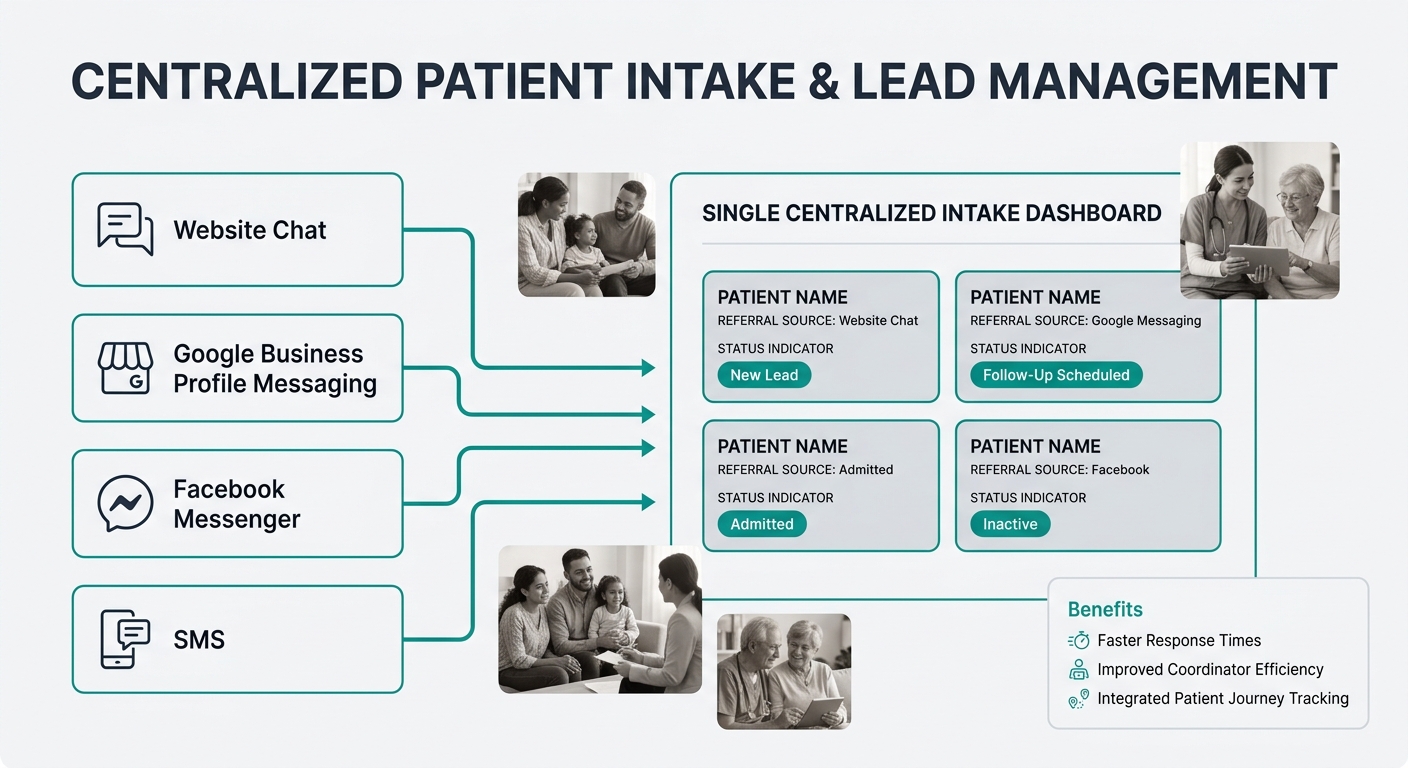
The 11pm researcher doesn’t always start on your website. She might find your Google Business Profile, read 3 reviews, and tap “Message” directly from the listing. If GBP messaging is turned off or unmonitored after hours, that lead evaporates. Agencies serious about 24/7 inquiry management need coverage across at least four surfaces: website chat, GBP messaging, Facebook Messenger, and SMS.
Each surface requires its own response protocol. A centralized intake dashboard that aggregates messages from all four channels into one queue gives the overnight chatbot (or the on-call intake coordinator, for agencies that staff evening shifts) a single workspace. The alternative, four separate notification streams that nobody checks until morning, guarantees lost leads and duplicate responses.
The 11pm researcher makes a shortlist of 2-3 providers tonight and calls them tomorrow. If your site didn’t make the cut at 11:15pm, your 9am follow-up email arrives too late.
This multi-channel approach connects directly to marketing for caregiving agencies because the same families who find you through organic search also encounter your brand on review sites, social platforms, and directory listings. Consistency across every touchpoint after hours determines whether you make the shortlist or get filtered out.
Where the Model Breaks
The after-hours conversion model has real limits, and agencies that ignore them risk doing more harm than a missed lead.
AI chatbots can qualify a visitor and book an appointment, but they can’t replicate the empathy of a trained intake coordinator who hears the fear in a daughter’s voice when she says, “I think Dad needs help.” Families dealing with sudden health crises, like a fall, a hospital discharge, or a dementia episode, need human contact. A chatbot that responds to “my mother fell and I don’t know what to do” with a structured questionnaire will damage your brand more than silence would.
The model also assumes your website content is strong enough to hold attention in the first place. If your site leads with stock photography and vague promises about “compassionate care” (a phrase that costs agencies real money in wasted ad spend), no chatbot will rescue the conversion. The after-hours problem sits on top of a content quality problem. Fix the foundation first.
Overnight chatbot responses carry compliance risk too. If the bot collects health information like diagnosis details, medication lists, or mobility limitations, that data needs handling according to your state’s privacy requirements. An AI chatbot that stores protected health information in a third-party platform without a Business Associate Agreement creates liability that no amount of lead volume justifies.
And the 70% after-hours figure, while well-documented, varies by market. Agencies in regions with younger family demographics (adult children aged 35-50 who are digitally fluent) see higher after-hours concentrations than agencies serving communities where the primary decision-maker is a spouse in her 70s who prefers calling during the day. Know your audience data before rebuilding your entire intake infrastructure around a national average that may not match your local reality.