
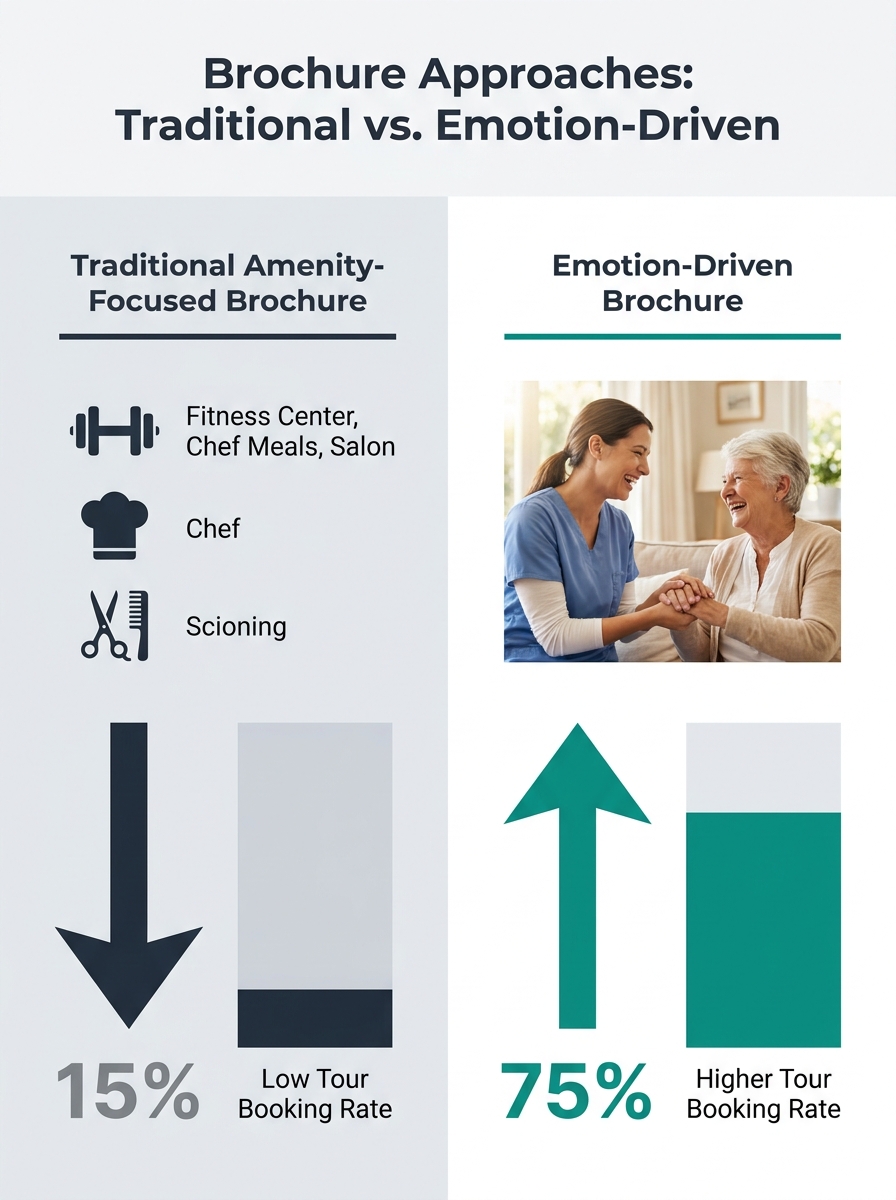
The typical assisted living brochure features a tri-fold layout with a sunset-lit building exterior on the cover, an amenity grid listing “chef-prepared meals,” “fitness center,” and “salon services” on the inside panels, and a floor plan with square footage callouts on the back. This format fails because modern families aren’t selecting communities based on amenities. With 55% of assisted living residents now 85 or older and 77% needing help with bathing, the actual decision drivers are guilt, safety, and caregiver exhaustion. Brochures that address those emotions convert at meaningfully higher rates, while brochures listing square footage get recycled without generating a single tour.
The Amenity Arms Race That Built Today’s Brochure
For most of the 2000s and 2010s, assisted living marketing materials followed a hospitality playbook borrowed from hotel and resort advertising. Communities competed on visible luxury: granite countertops, movie theaters, putting greens, wine bars. The brochure became a highlight reel of physical features, and the sales team’s job was to get that brochure into a prospect’s hands during a tour or a hospital discharge meeting.
The logic made sense at the time. Early assisted living residents were younger, healthier, and often making the move voluntarily. A 72-year-old downsizing from a four-bedroom house genuinely cared about the fitness center and the dining options. The brochure spoke their language.
But the resident population shifted. According to industry reporting, 55% of assisted living residents are now 85 or older, and acuity has climbed sharply: 77% need assistance with bathing, many require medication management, memory care support, or mobility assistance throughout the day. The person reading your brochure in 2026 is rarely the person who will live in your community. It’s their adult daughter, sitting in a hospital waiting room at 11 p.m., trying to figure out what happens after Dad’s second fall.
When the Decision-Maker Changed
The shift didn’t happen overnight. Through the mid-2010s, referral coordinators at hospitals and rehab centers reported a gradual change in who was asking the questions during discharge planning. The prospective resident attended fewer initial tours. Adult children, primarily daughters between 45 and 65, became the primary researchers, the tour schedulers, and the financial decision-makers.
This created a fundamental mismatch in care facility sales content. The brochure still talked about what the resident would experience: the activities calendar, the dining menu, the apartment layout. But the person holding the brochure needed to hear something entirely different. She needed reassurance that her father would be safe. She needed evidence that moving him out of his home wasn’t an act of abandonment. She needed to understand what would happen if his cognitive decline worsened.
Understanding how family decision journeys actually unfold reveals that the average senior care buyer touches 25 different information sources across up to 14 months. A brochure that lists amenities addresses maybe one of those 25 touchpoints. The other 24 center on trust, emotional processing, financial anxiety, and peer validation.
The Guilt Gap in Senior Care Brochure Conversion
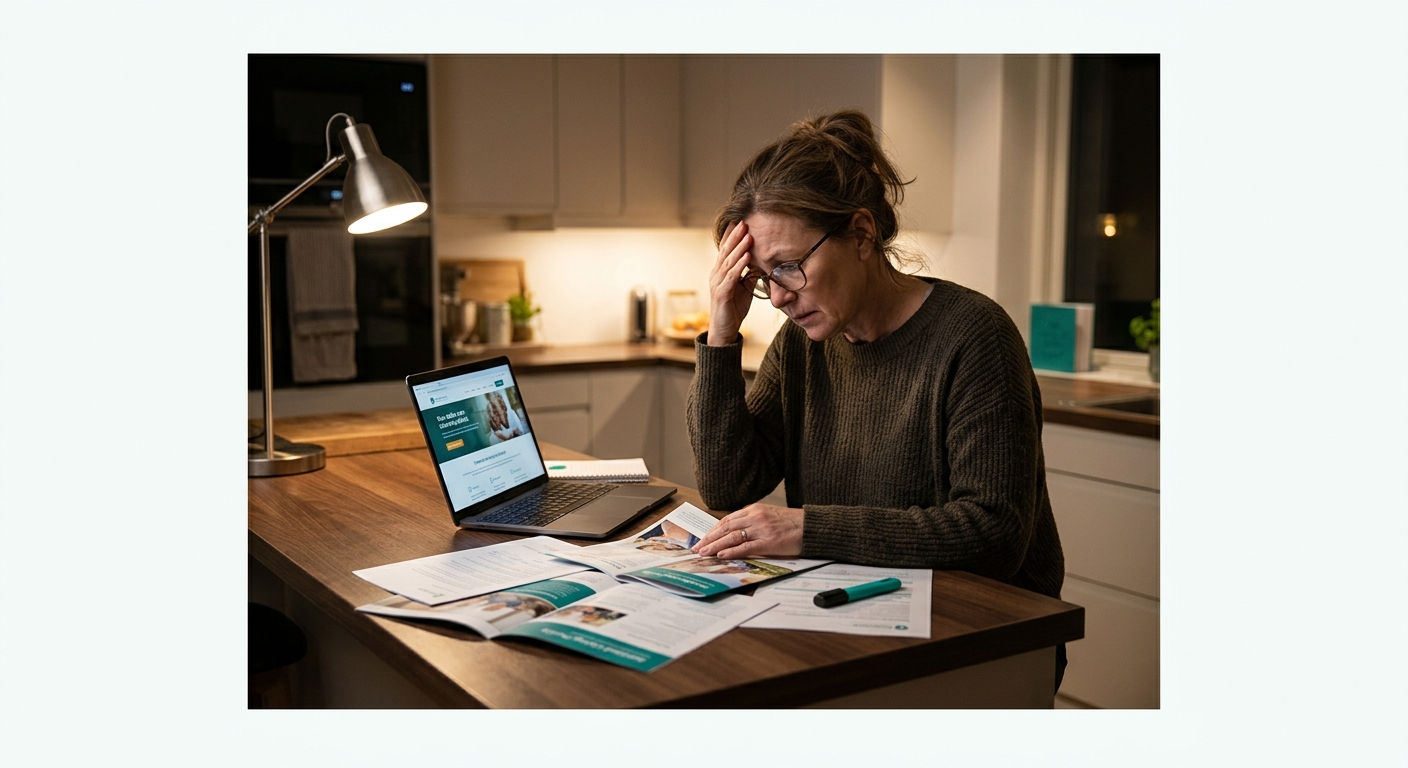
Why does the standard brochure fail to move families toward a tour booking? Because it ignores the single most powerful emotion driving the decision: guilt.
As one I Advance Senior Care analysis put it, “We ultimately make decisions to solve an internal problem, the emotions we’re able to connect with in a story will better connect us with the product or service being marketed.” The internal problem for a daughter researching assisted living isn’t “Where can Dad get a good meal?” The internal problem is “Am I failing him by not caring for him myself?”
Admissions collateral that acknowledges this guilt directly, and then resolves it with evidence and empathy, outperforms feature sheets by a wide margin. Communities that shifted their messaging to frames like “relief and support for overwhelmed family caregivers” or “a place where your parent rediscovers daily purpose” saw meaningful upticks in tour scheduling and move-in rates.
The internal problem for a daughter researching assisted living isn’t “Where can Dad get a good meal?” It’s “Am I failing him by not caring for him myself?”
Alexa Justine Callada, marketing and accounting specialist with Dream Chasers, told I Advance Senior Care that “senior care organizations can share stories with their audience in many potential ways,” pointing to day-in-the-life narratives, family testimonials, and staff spotlights as formats that outperform traditional benefit lists.
Regional context matters here too. Angell Marketing’s analysis of storytelling in senior living found that emotional marketing for senior living communities works best when tied to local realities. A community in a cold-weather state gets more traction highlighting maintenance-free living and on-site healthcare access. A community in a sprawling suburban area converts better by emphasizing walkability, social connection, and accessible activities. Your brochure can’t be a national template plugged into a local logo.
From Print Artifact to Conversion Engine
The physical brochure didn’t die; it changed jobs. Communities that figured this out earliest treated the brochure as one node in a multi-touch conversion system rather than a standalone sales document.
According to SSDM’s senior living brochure blueprint, the highest-performing communities now create digital versions of their brochures available on their websites, use brochure downloads as lead magnets in PPC campaigns, and integrate them into email nurturing sequences. The brochure becomes the entry point for a relationship, not the entirety of one.
The content inside these updated brochures looks radically different from the amenity grids of five years ago. Here’s what the shift looks like in practice:
| Element | Old Brochure | Conversion-Focused Brochure |
|---|---|---|
| Cover | Building exterior at sunset | Real resident photo with family member |
| Panel 1 | Amenity checklist (20+ items) | One family’s story (150 words) |
| Panel 2 | Floor plan with dimensions | “What Your First Week Looks Like” timeline |
| Panel 3 | Dining menu sample | 3 specific care scenarios with staff responses |
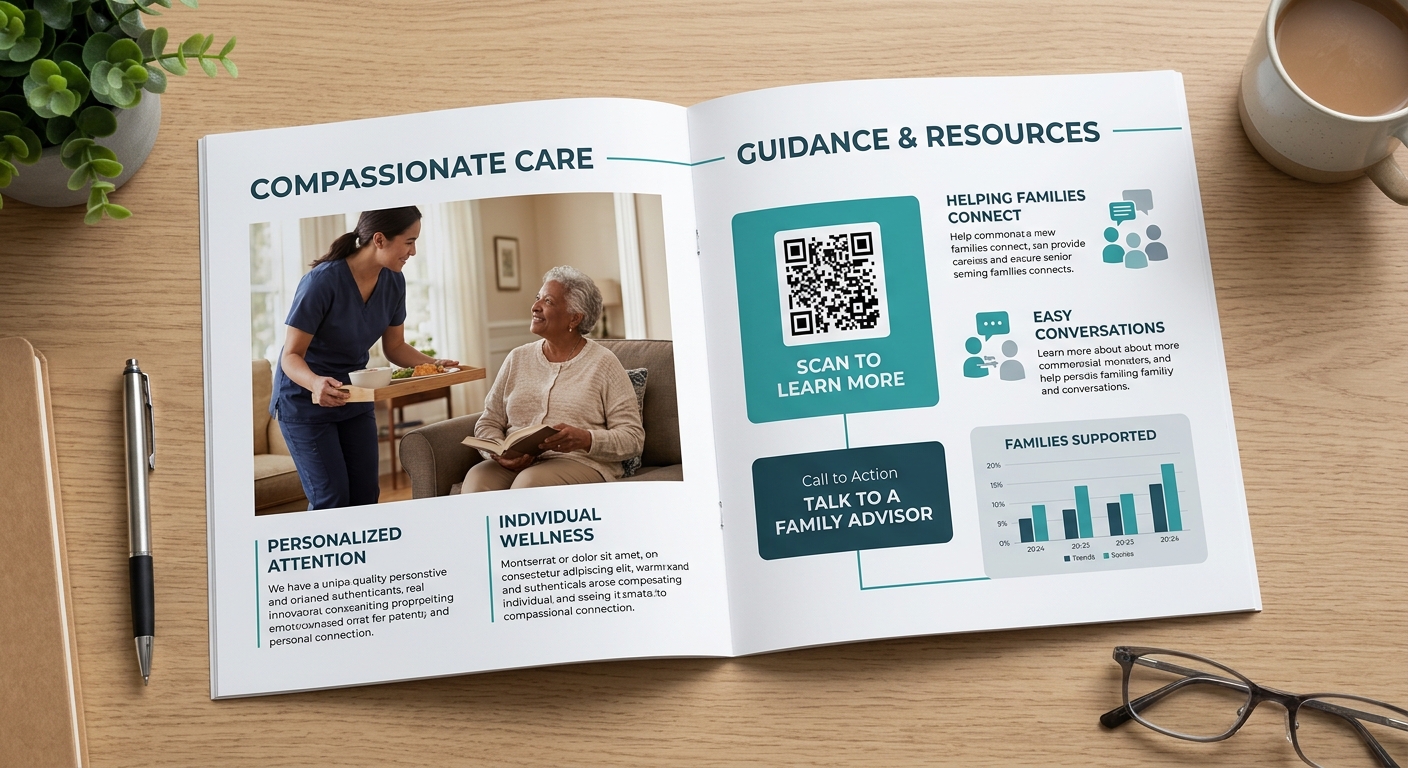
| Back panel | Phone number + address | QR code to virtual tour + “Talk to a Family Advisor” CTA |
| Digital version | PDF of the print file | Interactive guide with embedded video testimonials |
For communities investing in content marketing for care providers, the brochure redesign often becomes the catalyst for a broader content overhaul. The same emotional narratives that work in a tri-fold translate directly into website copy, social media posts, and the educational content families consume during their 14-month research phase.
And if your community already publishes educational content targeting family decision-making pain points, your brochure should feel like a physical extension of that same voice, rather than a disconnected sales piece from a different era.
Tip: Test your current brochure with a simple exercise: hand it to someone unfamiliar with your community and ask them to tell you, in one sentence, what makes this place different. If they default to an amenity (“nice dining room”), the brochure is failing. If they mention a feeling (“it seems like they really take care of families”), you’re on the right track.
Bringing Video and Testimonials Into the Collateral Stack
The brochure redesign opened the door for another format shift: video. Families who respond to emotional narratives in print respond even more strongly on screen, where tone of voice, facial expressions, and real environments carry authenticity that no stock photo can match.
But video testimonials underperform when they lack structure. A three-minute clip of a family member saying “we love it here” doesn’t move the needle on senior care brochure conversion or tour bookings. Communities seeing real admissions impact from video have learned to pair each testimonial with a specific conversion framework that includes the family’s initial fear, the moment of decision, the transition experience, and a concrete outcome like “Dad has gained 8 pounds and calls us less worried.”
These video assets then feed back into the admissions collateral stack. A QR code on the brochure links to a testimonial playlist. An email nurturing sequence triggered by a brochure download serves one video per week for three weeks. Each touchpoint reinforces the same emotional throughline: your parent will be safe, cared for, and connected. You are making a good decision.
What the Data Looks Like Today
The communities that made this content shift between 2022 and 2025 are now operating with a measurably different admissions funnel. Their assisted living marketing materials lead with care scenarios instead of amenity lists. Their brochures function as the first step in a multi-touch digital nurturing sequence, not as a one-and-done handoff at a discharge desk. And their conversion rates from tour to move-in reflect the difference.
The communities still printing the old tri-fold aren’t getting zero inquiries. They’re getting the wrong kind: price shoppers comparing amenity lists across five facilities, families who tour once and disappear, leads from aggregator sites who never heard your community’s actual story. The cost per admission climbs while the sales cycle stretches, and the brochure winds up in a recycling bin before the family ever books a second visit.
The fix requires honesty about what your current collateral actually communicates. Pull out your brochure right now and count the number of times it mentions an amenity versus the number of times it addresses a family’s fear. If the ratio runs higher than 2:1 in favor of amenities, you’re handing families a document that answers questions they aren’t asking while ignoring the ones keeping them awake at 2 a.m. The content shift starts with that single honest count, and with the willingness to rewrite what you find.