
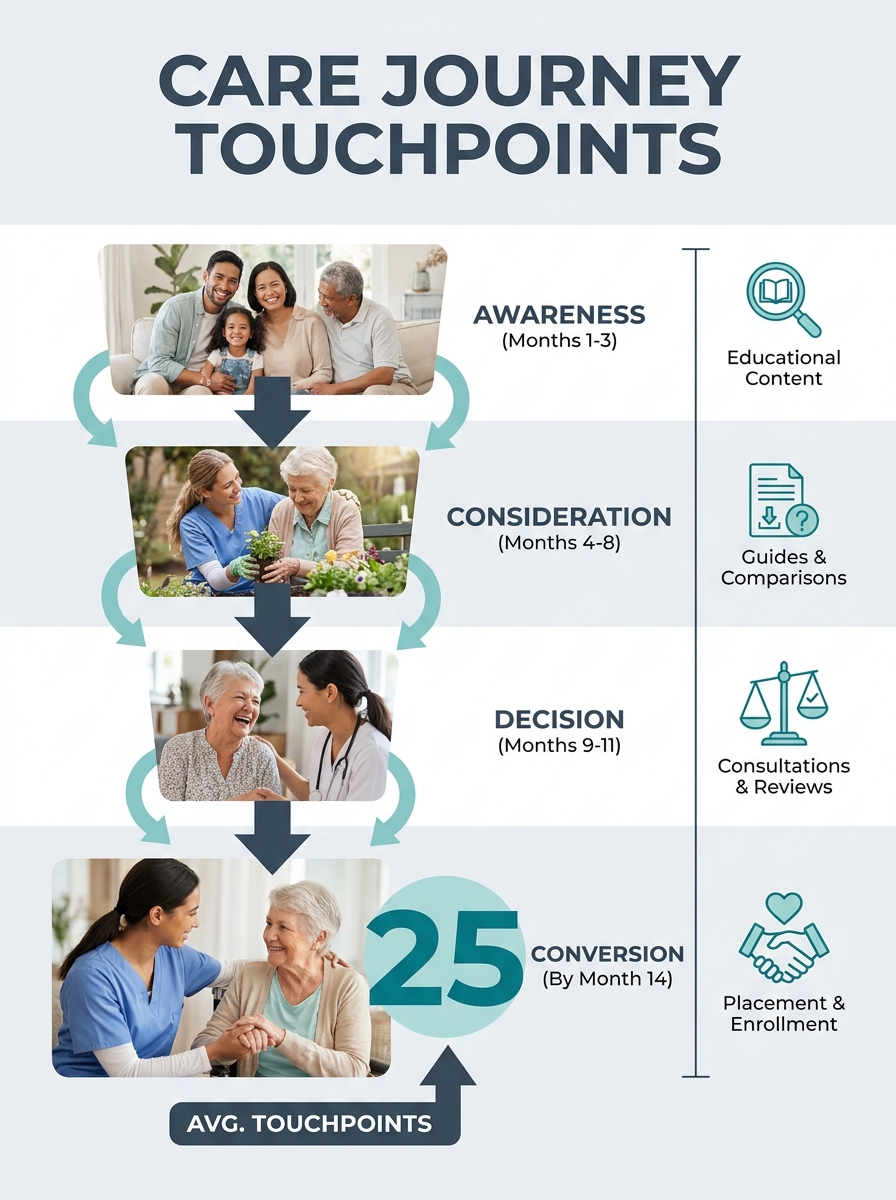
The senior care buyer journey takes an average of 25 touchpoints across multiple channels and up to 14 months to complete, according to EVR Advertising’s analysis of the senior living buying cycle. Families move through research, tours, financial planning, and staff conversations before signing. These seven rules map each stage of the family decision funnel for home care and assisted living marketers.
TL;DR: Families spend up to 14 months and 25 touchpoints deciding on senior care. The adult child is the primary researcher in 70% of cases, starting with “near me” searches and reading reviews before ever calling a provider. Winning the senior care conversion path means building trust at every stage with visible pricing, AI-optimized content, and multi-channel follow-up.
Map the 14-Month Timeline, Not the 2-Week Crisis
The outdated model of assisted living admission marketing assumes families arrive in crisis mode, ready to decide within days. Some do. But the data shows the modern senior care buyer journey begins up to 14 months before move-in, with 70% of family caregivers starting their research online long before any urgency forces their hand.
This timeline creates a problem for providers who only staff their sales pipeline for the final weeks. If your first meaningful contact with a family happens when they call to schedule a tour, you’ve already missed 12 months of care search touchpoints where competitors were building trust through blog content, Google Business Profile posts, and email nurture sequences.
The senior care conversion path looks roughly like this:
| Funnel Stage | Typical Timeframe | Family Behavior | Your Content Priority |
|---|---|---|---|
| Awareness | 14-8 months out | Googling symptoms, reading articles about aging parents | Educational blog posts, “near me” pages |
| Consideration | 8-3 months out | Comparing 3-5 providers, reading reviews, watching videos | Pricing guides, video tours, Google reviews |
| Decision | 3-1 months out | Scheduling tours, calling admissions, checking insurance | Tour booking pages, FAQ pages, staff bios |
| Conversion | Final 2-4 weeks | Signing paperwork, planning logistics | Move-in checklists, family coordination emails |
If you’re treating the family decision funnel for home care or assisted living as a 30-day sales cycle, you’re investing all your budget in the bottom 10% of the timeline.
Treat the Adult Child as Your Primary Conversion Target
The person making phone calls, reading reviews, and comparing costs is almost always the adult child, not the senior who will receive care. 78% of senior care searches begin with “near me” queries on Google Maps, and the person typing those queries is usually a daughter or son sitting at a desk 50 or 200 miles away from the care facility.
This creates a messaging gap that’s painfully common: providers write website copy and ad text that speaks to the senior (“You’ll love our community!”) when the person reading it is a 48-year-old professional trying to figure out if Mom can afford this and whether the staff will actually pay attention to her. We’ve written extensively about why marketing often speaks to the wrong person in the family unit, and the fix starts with rewriting your top-of-funnel content for the adult child’s fears, not the resident’s lifestyle preferences.
Adult children researching senior care want three things: safety evidence, cost clarity, and proof that staff will communicate proactively. Lead with those in every piece of content you publish.
Earn 25 Touchpoints Before Expecting a Signed Agreement
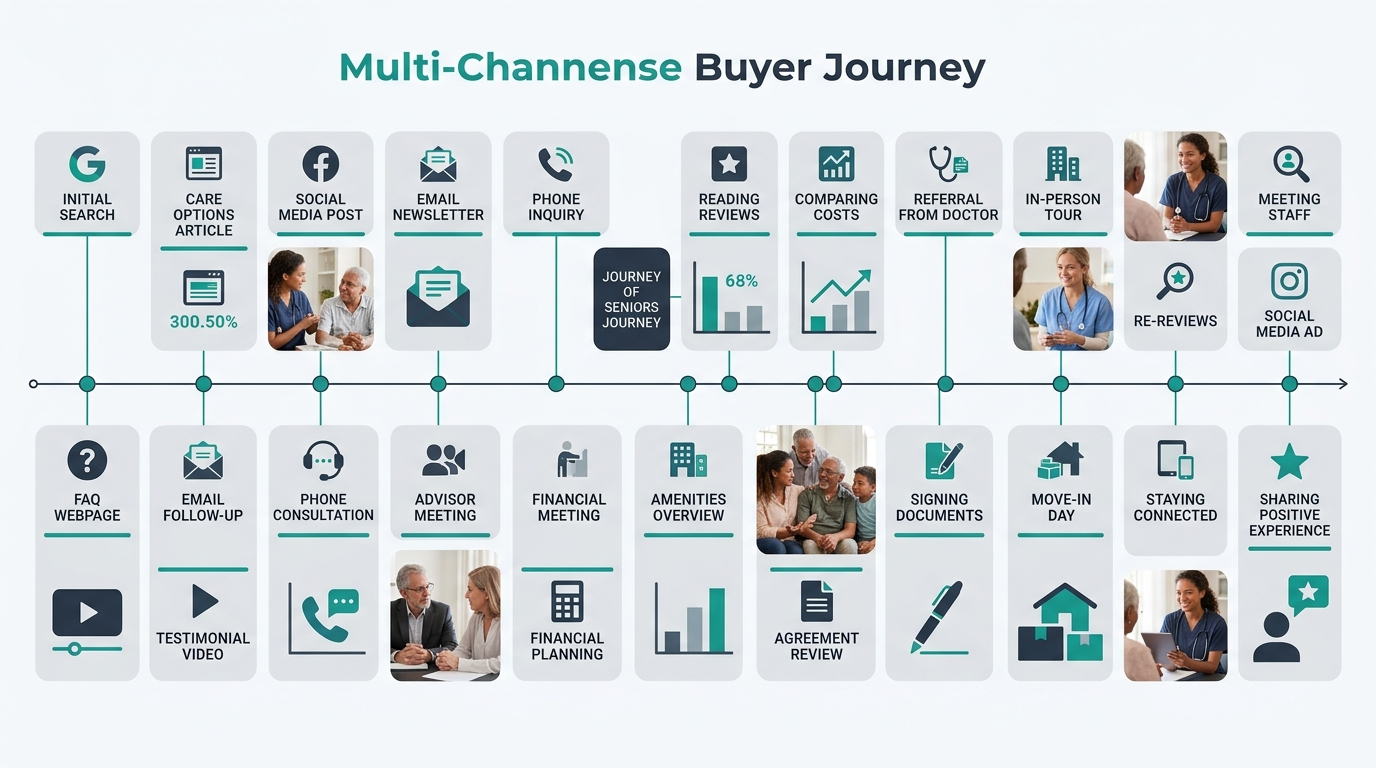
The average senior living conversion requires 25 touchpoints across multiple channels before a family commits. That number should reshape how you allocate budget and measure success. A single Google ad click that doesn’t convert into a tour request isn’t a failure if it’s touchpoint 4 of 25.
What counts as a touchpoint? A blog post read. A Google review scanned. A Facebook ad seen. A phone call answered (or missed). A tour taken. An email opened. A referral from a hospital discharge planner. A conversation with a friend whose parent uses your service. Each interaction either builds or erodes trust in your senior care conversion path.
If you’re measuring your marketing on last-click attribution, you’re crediting touchpoint 25 and ignoring the 24 interactions that made it possible.
This is why building a referral attribution system matters so much. Providers who track only “how did you hear about us?” on their intake form get an answer like “Google” and assume paid search drove the conversion. In reality, that family may have seen a Facebook testimonial (touchpoint 3), read a blog post about dementia care (touchpoint 9), noticed a yard sign at a neighbor’s house (touchpoint 14), and then finally Googled the name they already knew (touchpoint 25).
Make Pricing Visible Before the First Phone Call
87% of families read reviews before choosing a senior care provider, and cost clarity now ranks alongside safety and staffing as a top trust factor. Families who can’t find pricing information on your website assume you’re expensive and move to the competitor who posts a range.
This is a persistent blind spot in assisted living admission marketing. Operators resist publishing rates because costs vary by care level, room type, and acuity. That’s a legitimate operational reality, but it’s a terrible marketing excuse. Families don’t need an exact invoice. They need a starting range, a list of what’s included, and a clear explanation of what triggers additional fees.
The National Institute on Aging’s guidance for family caregivers emphasizes that families need to navigate both health decisions and financial planning simultaneously. When your website forces them to call for pricing, you add friction at exactly the moment they’re already overwhelmed. Senior care providers who publish starting rates, insurance accepted, and Medicaid eligibility information on their website convert more tour requests because they’ve already answered the question that kills 40% of inquiries before they start.
Tip: Add a “What Does Care Cost?” page with starting monthly rates, a breakdown of included services, and a clear note about what factors affect final pricing. This single page often becomes the second most-visited page on a senior care website, right after the homepage.
Structure Every Page for AI Discovery and Human Empathy
Families are increasingly using AI tools like ChatGPT, Perplexity, and Google’s AI Overviews to research and compare care options. A study found that 89% of families trust AI-generated summaries when researching care decisions, yet most senior care providers remain invisible in AI search results because their content isn’t structured for extraction.
AI search engines pull from pages that have clear direct answers in the first 100 words of each section, specific statistics with named sources, and structured data like comparison tables. A page that opens with “Welcome to Sunrise Senior Living, where we believe in the power of community” gives an AI nothing to extract. A page that opens with “Sunrise Senior Living in Portland, OR provides assisted living starting at $4,200/month with 24-hour nursing staff, memory care certification, and a 4.6-star average across 127 Google reviews” gives both AI and human readers exactly what they need.
Your Google Business Profile also feeds AI results. Keep it updated with current photos, accurate service categories, and weekly posts. Providers who post at least once per week to their GBP see measurably higher local visibility, and that visibility compounds when AI search tools pull GBP data into their answers.
Follow the Family Unit Through Your CRM, Not Individual Leads
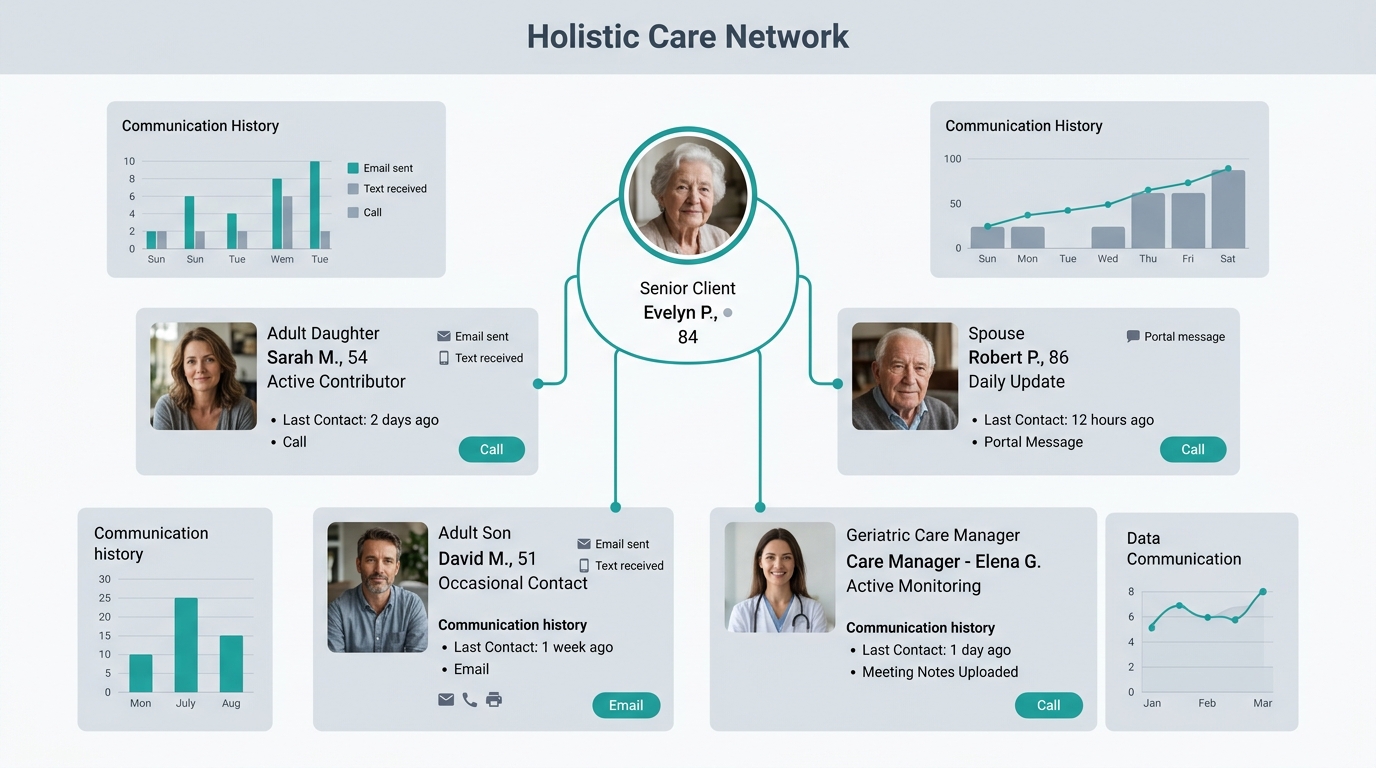
Senior care decisions involve an average of 2-4 family members. The daughter does the initial research. The son handles the finances. The spouse has opinions about location. And sometimes a geriatric care manager or hospital social worker is coordinating behind the scenes.
If your CRM treats each of these people as a separate lead, you’ll send the daughter a nurture email about “schedule your tour” while the son is still waiting for the pricing PDF he requested two weeks ago. Effective caregiver marketing services connect these contacts into a single family record so your sales team sees the full picture: who’s been contacted, what questions remain open, and where the family sits in their decision timeline.
As Senior Living SMART notes in their customer journey mapping, the sales rep should never disappear once the family has signed. The post-admission touchpoints matter enormously for referrals, reviews, and retention. A family that feels abandoned after move-in won’t recommend you to the three coworkers who will face this same decision within the next two years.
Match Content to the Emotional Stage, Not the Funnel Label
Families don’t think in marketing terms like “awareness” and “consideration.” They think in emotional terms: denial, guilt, fear, urgency, relief. The content that works at each stage of the senior care buyer journey needs to mirror the emotion, not the funnel position.
At the awareness stage, families are often processing guilt about even considering outside care. Content that leads with educational framing around family decision-making pain points performs better than content that leads with facility features. A blog post titled “How to Know When It’s Time to Get Help for Mom” will outperform “Our Amenities” every time at this stage, because it meets the family where they emotionally are.
During the consideration phase, fear drives behavior. Families worry about abuse, neglect, financial ruin. Your trust signals need to address these fears directly with staff credentials, regulatory inspection results, and family testimonials that speak specifically to how communication works after move-in. Providence House Assisted Living’s research confirms that family involvement in care planning leads to better outcomes, and content that shows how your facility enables that involvement converts families who are comparing you against two or three alternatives.
Info: Longer sales cycles correlate with longer resident stays, according to Aline’s assisted living marketing analysis. Rushing families through the funnel to hit monthly occupancy targets often produces shorter stays and lower lifetime revenue. Patience in the senior care conversion path pays off financially.
When These Rules Break Down
Every one of these rules assumes a non-crisis timeline. But roughly 30% of senior care admissions still happen within 7-14 days of a triggering event: a fall, a hospitalization, a sudden cognitive decline. For those families, the 14-month timeline compresses into a week, and the 25-touchpoint model collapses into 3-5 frantic interactions.
Your marketing system needs both tracks. The long nurture sequence for the 70% of families moving through the full decision funnel. And the fast-response infrastructure for the 30% who need care this week. That means a website that answers every critical question without requiring a phone call, a CRM that can flag urgent inquiries for same-day response, and intake staff trained to compress the trust-building process into a single tour visit.
The providers who win in both scenarios are the ones who’ve done the work of publishing clear pricing, earning strong reviews, and building content that answers real questions. When a family in crisis Googles “assisted living near me” at 11 PM on a Tuesday, your website needs to do the selling that 24 touchpoints would normally handle. The content you built for the long funnel becomes the safety net for the short one.