
When a caregiver quits after 60 days, the agency loses more than a staff member. It loses the client referrals it can’t accept next week, the Google reviews that caregiver would have earned, and the family trust built through consistent visits — assets the marketing budget already paid to create.
The Turnover Tax That Activated Insights Put a Dollar Figure On
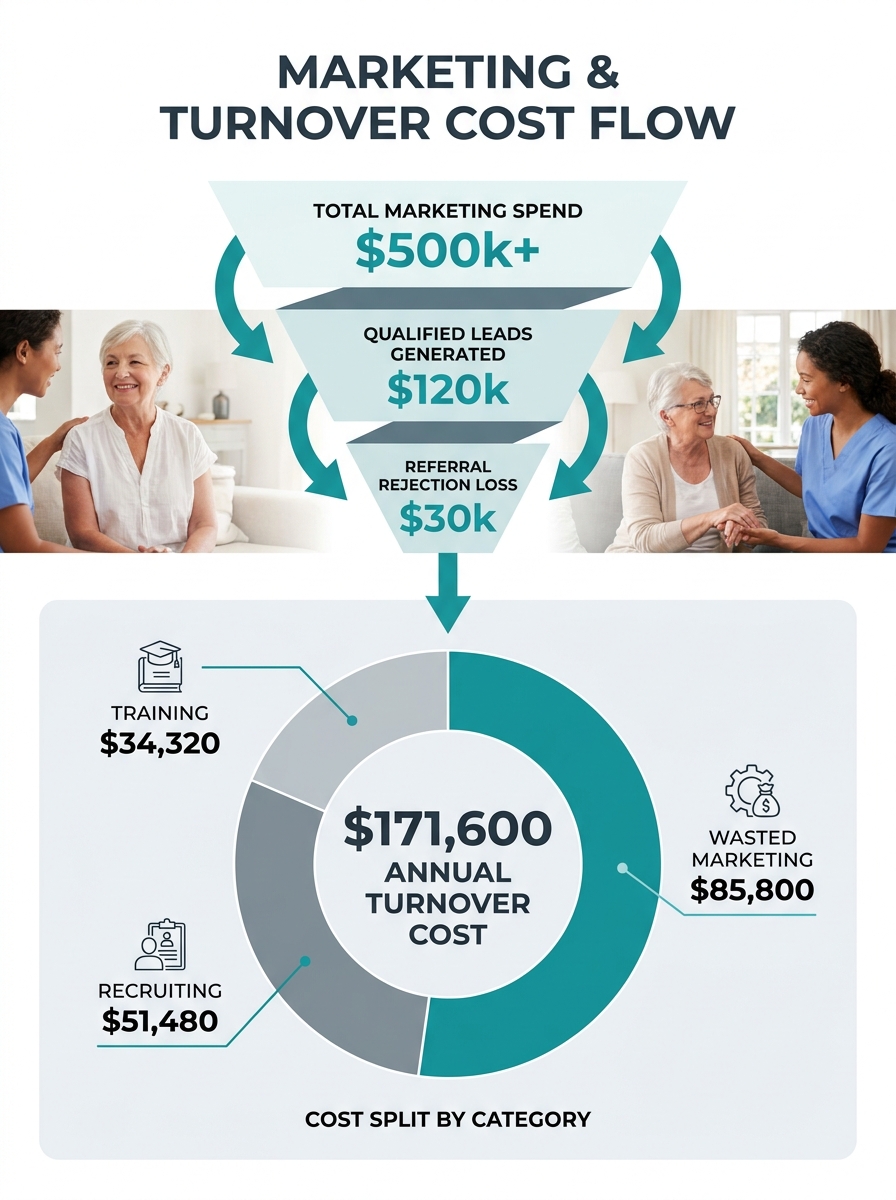
Activated Insights, the benchmarking arm formerly known as Home Care Pulse, tracks a number that should appear on every agency owner’s marketing dashboard: $171,600 in average annual caregiver turnover costs per home care agency. That figure covers recruiting, onboarding, training, and productivity losses. It does not include the downstream marketing damage.
The industry’s median caregiver turnover rate sits between 77% and 79% annually. For a mid-size agency employing 50 direct care workers, that means replacing roughly 38 to 40 caregivers every year. At $2,600 to $5,000 per replacement — depending on local labor market conditions and the complexity of training — the direct cost math alone is severe. But the caregiver turnover cost that agencies rarely track is the one that hits the marketing budget sideways.
Here’s the mechanism. An agency spends $8,000 per month on Google Ads, referral development, and local SEO to generate inbound client inquiries. Those efforts produce, say, 40 qualified leads per month. If the agency’s staffing gaps force it to decline or delay 25% of those referrals — a figure consistent with industry reporting on capacity constraints — then $2,000 of that monthly marketing spend produced leads the agency couldn’t serve. That’s $24,000 per year in wasted marketing investment, and the loss is invisible unless you’re tracking referral acceptance rates alongside ad spend.
Forty Percent Gone Before the Training Investment Matures
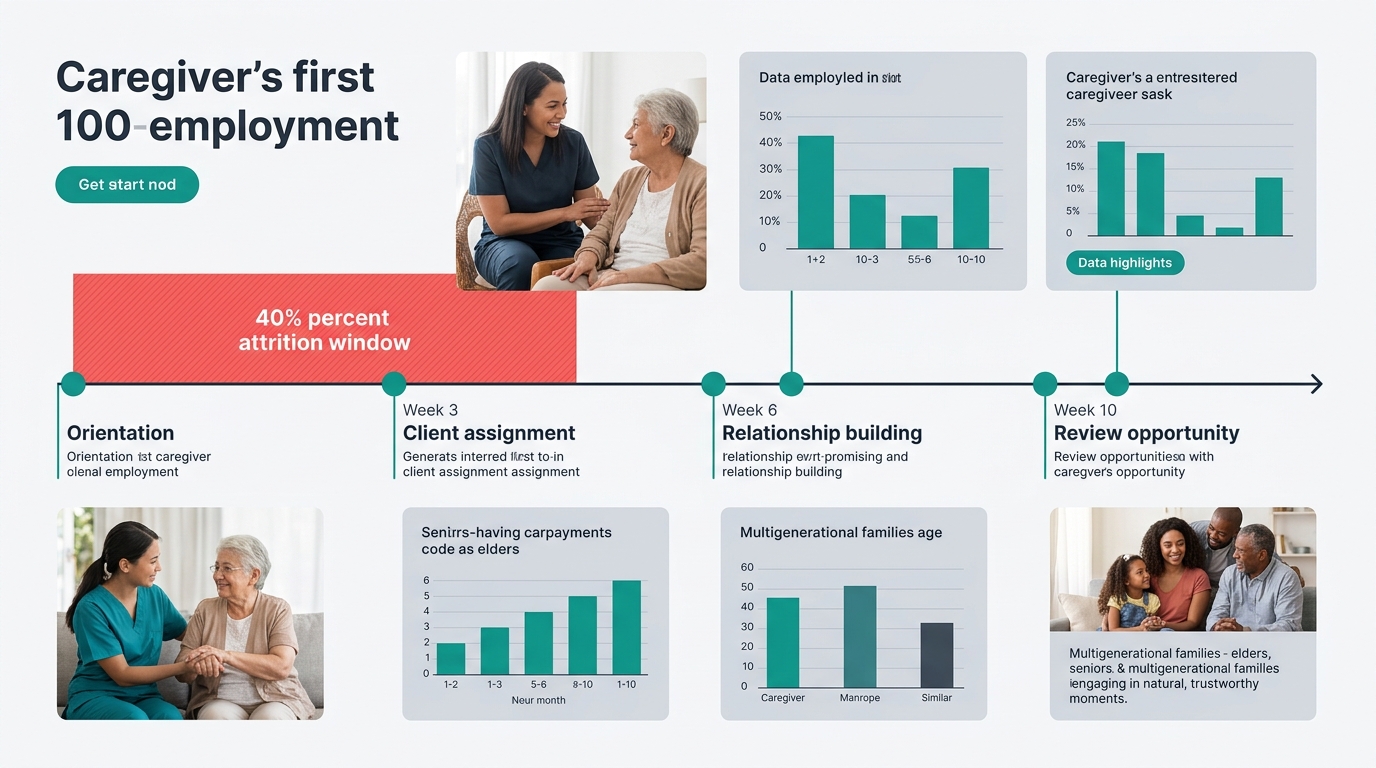
The first 100 days of a caregiver’s employment represent the highest-risk window for marketing ROI destruction. According to Activated Insights’ Retain survey data, 40% of care staff leave within their first 100 days. That percentage reshapes every marketing calculation an agency makes.
Consider the timeline. A new caregiver completes orientation in week one. By week three, they’re assigned a regular client roster. Families begin to recognize them. The relationship starts building the kind of continuity that generates positive word-of-mouth, Google reviews, and referral source confidence. By week six, a good caregiver is producing marketing value the agency never pays for directly: families telling friends, discharge planners requesting that caregiver by name, satisfaction scores climbing.
When that caregiver walks out at day 45 or day 80, the agency resets to zero with that client group. The family gets a new face. Trust drops. Satisfaction scores dip. The review you were going to ask for vanishes. The discharge planner who was about to send a second referral hesitates and calls another provider instead. The profitability pressures documented across the home care industry’s workforce shortfall compound this effect, because agencies operating on thin margins can’t absorb the double hit of turnover cost and marketing waste simultaneously.
And the early attrition pattern concentrates the damage. An agency that loses 40% of new hires in the first 100 days isn’t spreading that loss evenly across the calendar. It’s experiencing rolling disruptions to the client relationships that marketing dollars worked to establish. Every scheduling gap caused by early departures creates the kind of service inconsistency that directly erodes revenue — a phenomenon one industry analysis pegged at $780,000 in annual revenue loss per mid-size agency from scheduling gaps alone.
The Referral Rejection Spiral
Why does caregiver attrition impact marketing budgets so disproportionately? Because the damage compounds through referral networks in ways that don’t appear on a P&L for months.
A home care agency’s referral pipeline depends on trust relationships with hospital discharge planners, physician offices, elder law attorneys, and senior living communities. These referral sources send clients based on two factors: clinical capability and capacity to accept the case. When an agency declines a referral because it doesn’t have staff to cover the hours, the referral source doesn’t wait. They call the next agency on their list.
One declined referral is a lost case. Three declined referrals in a month from the same hospital system is a broken relationship. The discharge planner mentally recategorizes your agency from “reliable first call” to “check if they have availability.” You’ve spent months building that referral relationship through territory mapping and relationship development, and turnover-driven capacity constraints can undo that investment in weeks.
The numbers make the spiral visible. If an agency’s marketing and business development efforts generate 480 qualified referrals per year, and staffing shortages force the agency to turn away 25% of them, that’s 120 lost cases. At an average annual client value between $15,000 and $25,000, the revenue impact runs between $1.8 million and $3 million in forgone annual billings. The marketing spend that generated those 120 referrals — the Google Ads clicks, the referral lunches, the conference sponsorships, the SEO content — produced zero return.
Every referral you can’t accept represents ad dollars that generated a lead your operation couldn’t serve. That wasted spend is invisible unless you track referral acceptance rates alongside cost-per-lead.
This is where senior care workforce economics gets tangled with marketing performance in ways that traditional agency dashboards miss entirely. Your marketing team reports lead volume is up 15%. Your operations team reports staffing is down 20%. Nobody connects those two facts into a single financial story: the agency is spending more to generate leads it can’t convert because it doesn’t have the people to serve them.
Tracing the Bleed From Recruiting Spend to Ad Waste
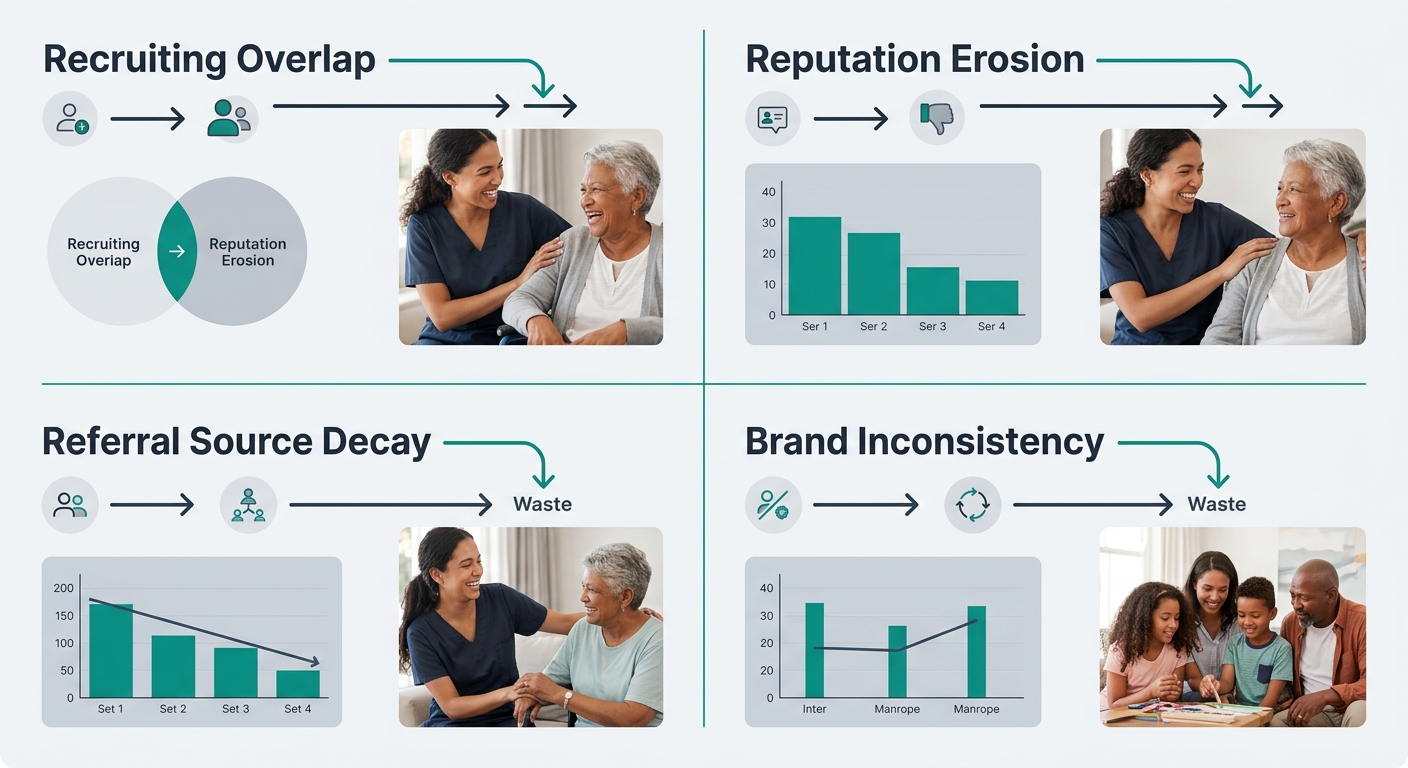
The financial bleed follows a specific path that agencies can map once they know what to track. The caregiver attrition impact on marketing shows up in four distinct budget lines.
Recruiting overlap. When turnover hits 77%, recruiting becomes a permanent cost center rather than an intermittent one. Agencies report spending on job boards, Indeed sponsorship, and caregiver recruitment campaigns year-round. This spending competes directly with client acquisition marketing for budget dollars. Every additional $500 spent on a caregiver recruiting campaign is $500 not spent on the Google Business Profile optimization or local SEO work that drives family-facing visibility. Marketing budgets across industries have already fallen to about 6.4% of overall company revenue, and home care agencies carving off recruiting expenses from that same pool feel the squeeze acutely.
Reputation erosion. Staffing instability shows up in online reviews within 60 to 90 days. Families notice when caregivers change every three weeks. The resulting 3-star and 4-star reviews drag down the aggregate rating that controls whether your agency even appears in Google’s local pack. Agencies with turnover rates above 75% annually carry lower average satisfaction scores, which directly reduces the return on every marketing dollar spent on review generation and reputation systems.
Referral source decay. The relationship capital invested in referral development depreciates faster when the agency can’t accept referrals consistently. A $30,000 annual investment in business development — salaries, travel, event sponsorships — generates diminishing returns when operations can’t fulfill what sales promises.
Brand inconsistency. Families increasingly research agencies online before calling. They read caregiver bios, check credentials, and look for continuity signals. Agencies with high turnover struggle to maintain the kind of updated caregiver credential pages that actually convert families, because the staff featured on the website keeps leaving. That gap between marketing materials and operational reality erodes the trust signals driving conversion rates.
Warning: If your agency tracks marketing performance and retention metrics in separate dashboards that never talk to each other, you’re missing the connection between your two largest controllable expenses. Combine referral acceptance rates with cost-per-lead data in a single monthly report.
When Retention Spending Became the Marketing Line Item
The agencies that have recognized this caregiver turnover cost loop didn’t fix it by spending more on marketing. They redirected a portion of their marketing budget into retention infrastructure and got better marketing results as a byproduct.
The math supports this shift. If an agency spending $96,000 per year on marketing ($8,000 per month) is wasting 25% of that spend on leads it can’t serve due to staffing gaps, that’s $24,000 in annual marketing waste. Redirecting even half of that waste — $12,000 — into retention programs like scheduling stability tools, structured mentorship during the first 100 days, or competitive pay adjustments would reduce the turnover rate enough to accept more of the referrals that the remaining $84,000 in marketing spend generates.
Agencies that have invested in structured caregiver support programs have documented reduced absenteeism by up to 50% and achieved ROI of up to 72% on those investments. Tuition assistance programs alone have been shown to reduce turnover by 35.5% compared to agencies that don’t offer them.
The home care retention marketing calculation changes when you frame it this way: every dollar spent on keeping a caregiver past the 100-day mark is a dollar that protects the marketing investment already made in the clients that caregiver serves. The agency staffing ROI of retention spending is simultaneously a marketing ROI, because a stable workforce converts more of the leads that marketing generates.
This doesn’t mean agencies should gut marketing budgets to fund retention programs. It means the two budget lines belong to the same economic system, and agencies that manage them in separate silos will always overspend on one while starving the other. The profitability pressures hitting home care right now make this connection impossible to ignore. An agency running at 79% annual turnover with a $100,000 marketing budget is functionally operating with a $75,000 marketing budget. The other $25,000 generated leads that walked out the door with the caregiver who quit in month two.
The agencies closing the gap between what they spend and what they earn are the ones that put referral acceptance rates next to cost-per-lead on the same dashboard, that connect caregiver tenure data to client satisfaction scores, and that report retention metrics directly to their marketing teams. Everyone else is refilling the same leaking bucket month after month, convinced the problem is that they need a bigger hose.