
Sixty-three million Americans provided unpaid eldercare in 2025, per AARP’s national caregiving survey. That population drives the actual buying decision for home care services, yet agencies consistently address “families” as a monolith. The person researching your services, the person authorizing payment, and the person receiving care are rarely the same individual.
TL;DR: Home care inquiries typically involve 2-3 distinct decision-makers: adult children doing research, seniors weighing autonomy, and professional referral sources routing patients. Agencies that build separate messaging tracks for each audience on their websites, intake forms, and follow-up sequences close more inquiries than those treating “families” as a single persona.
Three Decision-Makers, One Intake Form
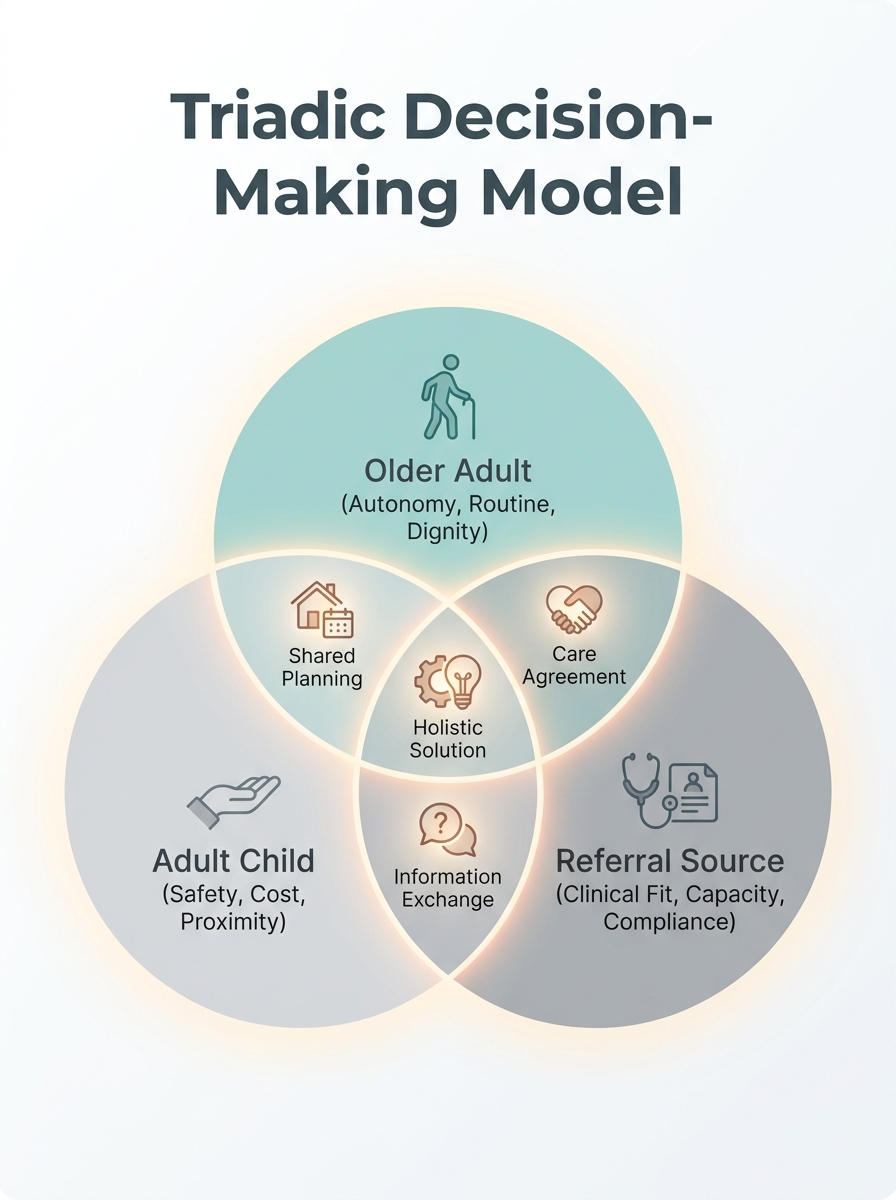
Research published in IntechOpen’s study on decision-making patterns in residential care documented a consistent triadic structure: older residents, family members, and care staff each bring separate priorities to the same care decision. The older resident values autonomy and routine. The adult child prioritizes safety and proximity. The care professional evaluates clinical appropriateness and capacity. Three agendas converge on your agency’s single “Request a Consultation” button.
A parallel finding from a Springer Nature study on decision guides for location-of-care choices reinforced this gap: caregivers involved in the DOLCE study “did not perceive that a shared decision-making process was occurring between them, the senior, and the home care team when deciding about whether or not to relocate care.” The decision was happening, but the participants didn’t recognize it as collaborative. Your marketing can’t afford to replicate that confusion.
And ScienceDirect’s 2025 analysis of family participation in geriatric decision-making found that the triadic process is “shaped by interactional, institutional, and socio-cultural dynamics,” meaning cultural background, family hierarchy, and clinical setting all shift who holds the most influence in any given inquiry. A one-size message fails across every dimension.
Who Actually Calls (and Who Actually Searches)
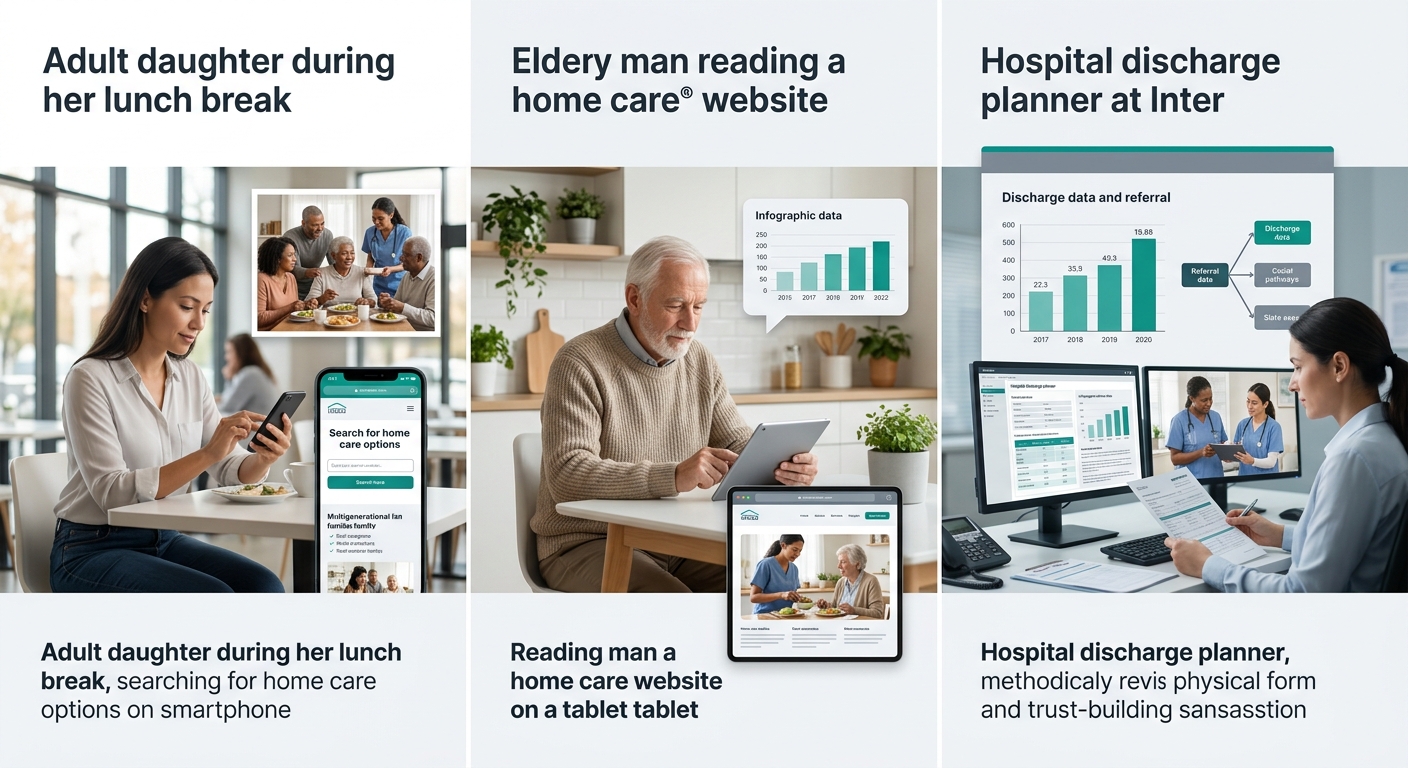
The Bureau of Labor Statistics’ American Time Use Survey identifies the typical informal caregiver as a midlife adult managing eldercare alongside employment. This demographic detail has direct implications for caregiver inquiry sources and demographics. Midlife adults (ages 45-65) search during work breaks, on mobile devices, between 11 a.m. and 2 p.m. Seniors (ages 70+) tend to search on tablets or desktops, often in the morning, and prefer phone calls over form submissions. Professional referral sources, hospital discharge planners and physicians, route patients through fax, EHR-integrated referral platforms, or direct phone lines with zero web interaction at all.
These 3 inquiry pathways produce fundamentally different lead profiles:
| Audience | Primary Channel | Peak Search Time | Preferred Follow-Up | Key Concern |
|---|---|---|---|---|
| Adult children (45-65) | Mobile Google search | Midday, weekdays | Text or email within 2 hours | Safety, cost, reliability |
| Seniors (70+) | Desktop search or phone | Morning hours | Phone call, printed materials | Autonomy, dignity, routine |
| Referral professionals | Fax, EHR, direct call | Business hours | Structured intake response | Clinical fit, availability, compliance |
As home care marketing strategist resources at Intrepy note, effective marketing requires “building trust with diverse communities across multiple service lines” and communicating value distinctly “to caregivers, patients, and referring physicians.” An agency running one Google Ads campaign with one landing page and one follow-up sequence is ignoring at least 2 of these 3 audiences.
The Triadic Messaging Framework
Family decision-making in senior care demands what we call the Triadic Messaging Framework: a structured approach to website messaging for different care audiences that assigns distinct language, page architecture, and calls-to-action to each of the 3 primary stakeholder groups.
For adult children, lead with safety outcomes, caregiver screening processes, and transparent pricing. These visitors arrive anxious and time-compressed. They want to know your caregivers are background-checked, your scheduling is reliable, and your agency can start within 72 hours. The headline they need to see: “Your parent is safe with us, and here’s exactly why.”
For seniors themselves, lead with independence. The IntechOpen study documented that residents in care settings consistently prioritized their own autonomy, yet family members and staff frequently made decisions on their behalf. Your website should include at least one dedicated page, or a clearly marked section, that speaks directly to the senior: “You choose your caregiver. You set your schedule. You stay in charge.” The National Institute on Aging advises clinicians to “offer information through more than one channel,” including fact sheets, drawings, and videos alongside verbal explanation. The same principle applies to your website. Text-heavy pages lose seniors; short videos and large-print PDFs keep them engaged.
For referral professionals, lead with capacity, licensure, and response time. Discharge planners processing 15-20 referrals per week don’t read your “About Us” story. They need a dedicated referral portal with intake forms, service area maps, and a direct phone number staffed during business hours.
The person researching your agency at midnight, the person signing the service agreement at noon, and the person greeting your caregiver at the front door each need a different first sentence from you.
If you’ve already explored how adult children and seniors choose care differently, the Triadic Messaging Framework extends that thinking by adding the referral-professional audience as a third distinct track. And for agencies wondering how to build trust signals that resonate with each group, the research on why families choose care based on trust signals, not features provides the emotional foundation this framework sits on.
Matching Channels to Stakeholders
Communication preferences diverge as sharply as messaging needs. A practical guide from Curogram on texting elderly patients recommends agencies “state your practice name, the key detail (like date and time), and one clear action such as ‘Reply YES to confirm'” while avoiding abbreviations, all-caps, and medical jargon. That’s solid guidance for the senior audience. But for the 45-year-old daughter who submitted an inquiry at 11:30 a.m. from her office, a text with your agency name and a scheduling link within 90 minutes outperforms a phone call she can’t take during a meeting.
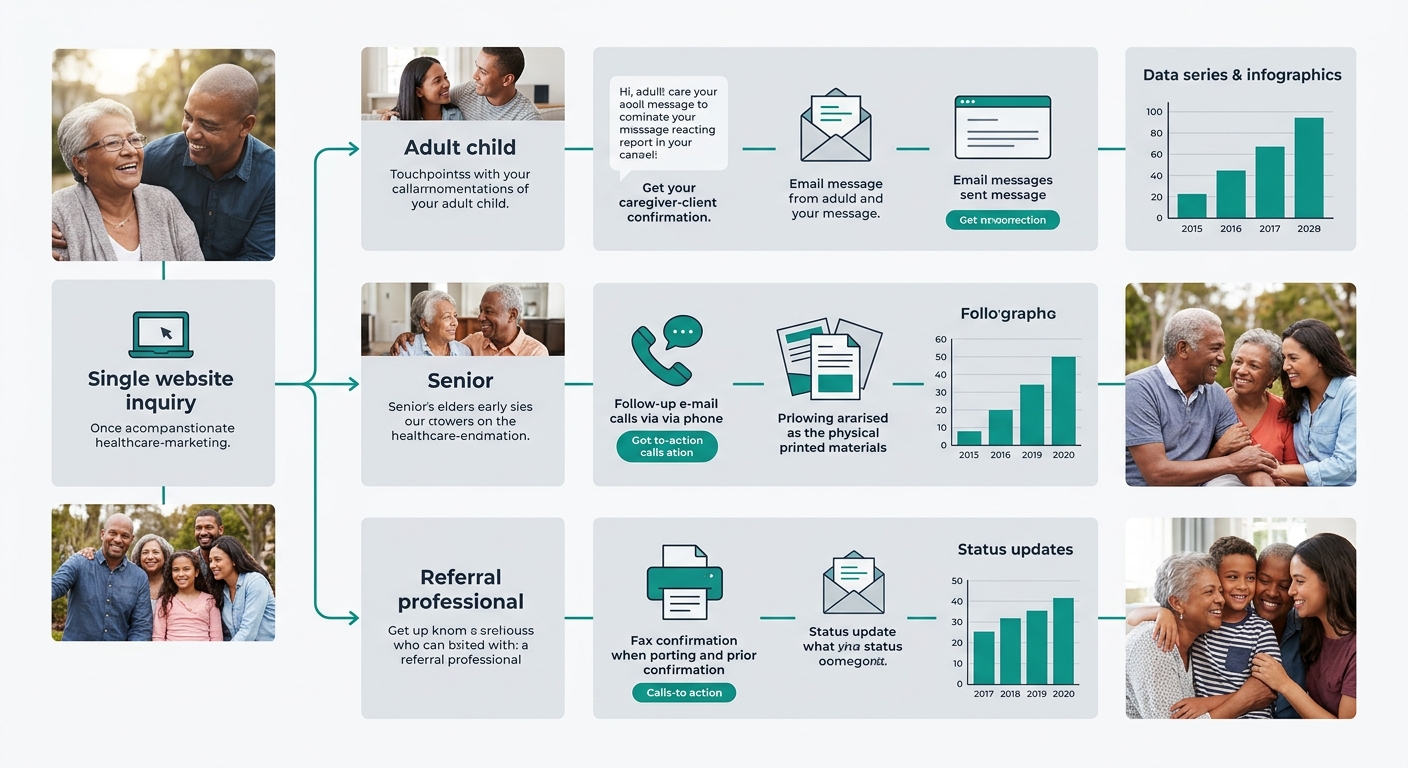
Multi-stakeholder marketing for home care means building at least 2 follow-up sequences: one optimized for phone and simple text (seniors), another optimized for email and scheduling links (adult children). Professional referral sources get a third track entirely, with structured confirmations and status updates sent to the referring provider within 4 business hours.
This channel segmentation connects directly to attribution. If you’re running a client-source attribution system, tagging each inquiry by stakeholder type adds a layer of insight that raw source data misses. A Google Ads click from an adult child and a Google Ads click from a senior have identical source tags but completely different conversion paths.
Rebuilding Your Website Around Three Audiences
Applying this framework requires structural changes to your site, not cosmetic ones. Dedicated landing pages for each audience, distinct navigation paths, and persona-specific calls-to-action are the minimum. Working with a team experienced in web design for home care providers ensures that these pages are accessible (large fonts, high-contrast for seniors) while still performing well on mobile (fast load, thumb-friendly forms for adult children).
Pair the design work with content marketing that produces separate content tracks: blog posts and guides written for family caregivers searching “how to find home care for mom,” educational resources for seniors exploring “staying independent at home,” and a professional resource section with referral forms and service-area documentation. An experienced SEO for home care agencies partner, or a knowledgeable seo company, can help ensure each content track targets the right long-tail queries for its intended audience rather than competing against your own pages.
Tip: Audit your top 5 website pages by traffic. For each page, identify which of the 3 stakeholders it speaks to. If every page targets the same audience (usually adult children), you’ve found the gap that’s costing you senior-direct and referral-professional leads.
Agencies that addressed educational content targeting family decision-making pain points have already begun this work for the adult-child audience. The next step is building equivalent depth for the other two.
Questions The Numbers Still Can’t Answer
The 63 million caregiver figure from AARP tells us the scale of the opportunity. The IntechOpen and Springer studies confirm the triadic structure of care decisions. The BLS time-use data reveals the demographic profile of the primary searcher. What none of these datasets captures is the conversion-rate difference between agencies that segment by stakeholder and those that don’t.
No published study has measured, across a statistically significant sample of home care agencies, whether triadic messaging produces 10% more closed inquiries or 40% more. The framework is grounded in decision-science research and demographic data, but the precise ROI remains agency-specific and unmeasured at scale. Until that data exists, the strongest evidence comes from your own intake records: track which stakeholder type initiated each inquiry, which page they landed on, which follow-up sequence they entered, and whether the case converted. Six months of that data will tell you more about your market than any national survey can.