
IHPS, a national home care provider, now lists a formal caregiver sponsorship program on its website, offering international home care workers a path to permanent residency through the I-140 immigrant petition process. The program page isn’t buried behind an HR portal. It’s positioned as front-and-center marketing copy, designed to attract candidates before competitors do.
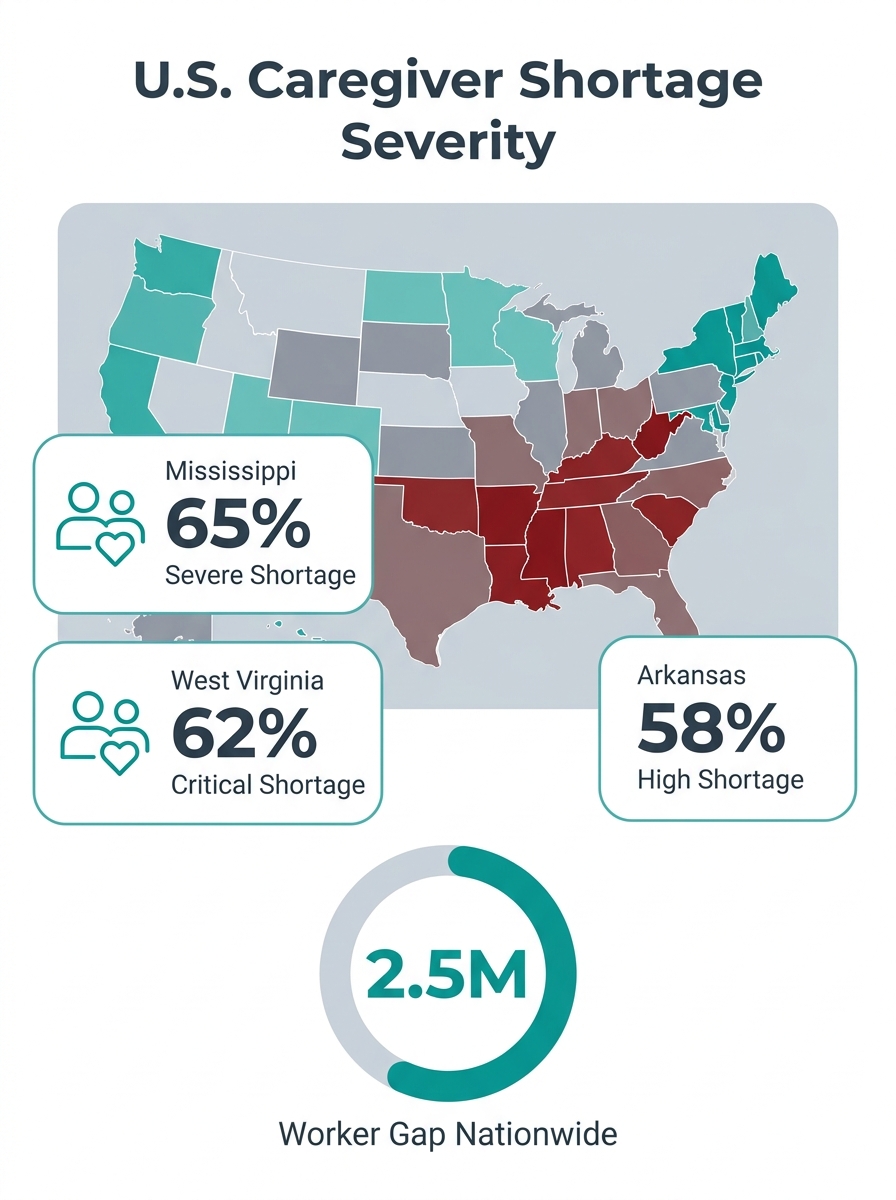
IHPS is doing this because the domestic caregiver pipeline can no longer keep pace with demand in most U.S. markets. A nationwide analysis of caregiver shortages by state gathers employment volume, salary levels, job growth projections, and future demand metrics for direct service caregivers across all 50 states. The picture is bleak in nearly every geography. The agencies treating migrant caregiver recruitment as a genuine strategic channel, with compliance infrastructure, dedicated onboarding systems, and marketing that speaks directly to international candidates, are the ones positioning themselves to grow while competitors scramble to fill shifts.
Here’s what the data says, how the compliance framework actually works, and where your caregiver onboarding marketing needs to meet international candidates where they’re already searching.
The Shortage Isn’t Evenly Distributed, But It’s Everywhere
Some states face catastrophic caregiver shortfalls while others manage with tighter margins. The nationwide shortage rankings show states like Mississippi, West Virginia, and Arkansas sitting near the bottom for caregiver availability relative to aging population size. Even states with higher absolute numbers of caregivers, like California, Texas, and New York, report significant gaps in rural and suburban markets where commute distances and lower pay scales compound the problem.
AxisCare’s analysis of caregiver shortages as a growth barrier identifies a clear dividing line between agencies that will struggle and those that will thrive. The agencies on the winning side treat caregivers as a competitive advantage and tap into their talent pool’s specialized skills to expand into higher-acuity service areas like post-surgical recovery and chronic disease management. International home care workers often arrive with clinical training that domestic hires lack, creating a natural fit for these service lines.
The EB-3 workforce research reinforces the investment case: training and education programs that prepare individuals for caregiving careers are among the most effective long-term responses. But training takes time. Agencies that need staff today are looking at international pipelines as a parallel strategy running alongside domestic recruitment, and the numbers justify the effort.
How Visa Pathways Actually Work for Home Care
If you’ve never sponsored a worker, the visa landscape looks intimidating. It’s more navigable than most agency owners assume, and understanding the main categories is the first compliance step.
B-1 Domestic Servant Visa
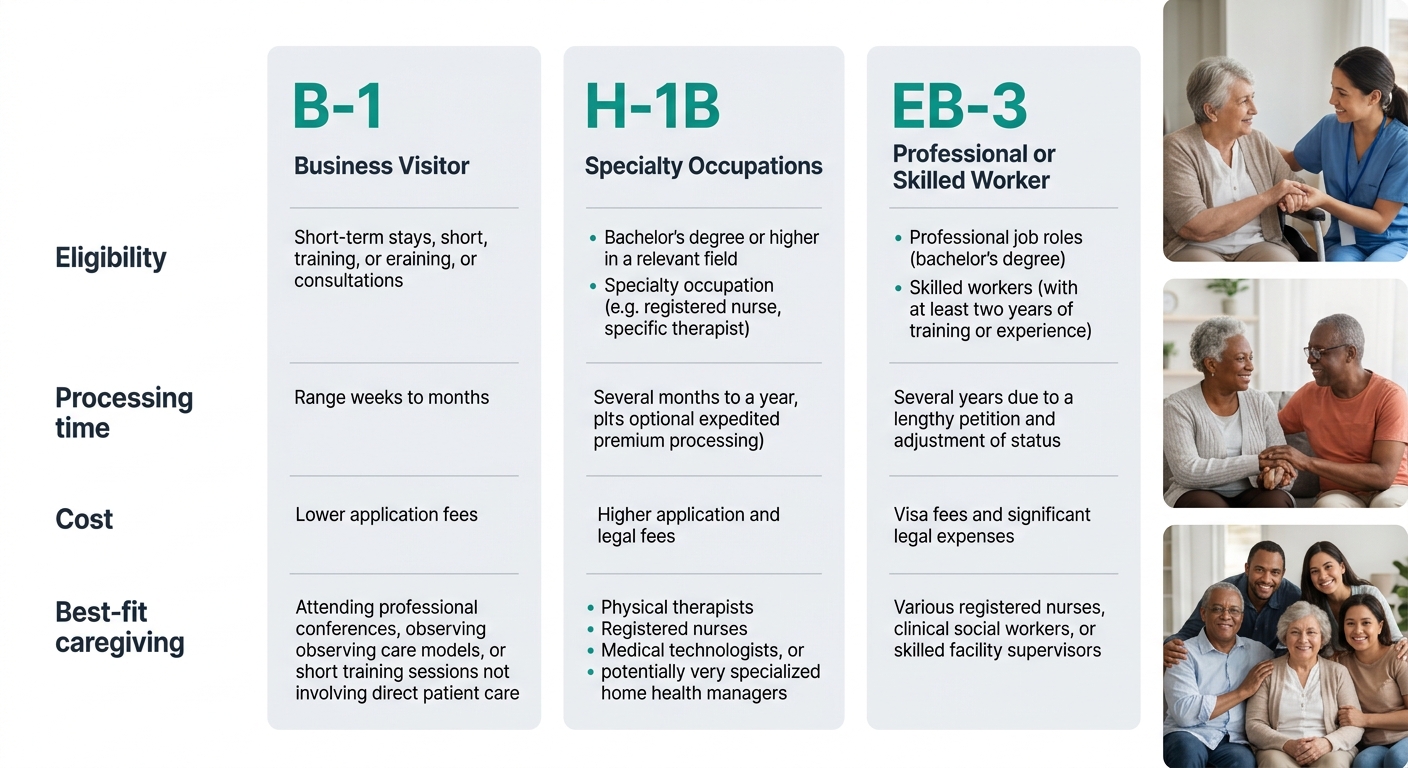
Foreign nationals working as domestic servants, including nannies, housekeepers, and personal assistants, may qualify for a B-1 visa to accompany their employer to the United States. This is a narrow category with strict requirements. It rarely applies to agency-based home care because the worker must be employed by the individual they’re accompanying, not by a staffing company. Worth understanding so you can explain to families why this path has limitations for your business model.
H-1B Sponsorship
Indeed job listings already show home care positions advertising H-1B work visa sponsorship, particularly for LPN and RN roles. New graduates are encouraged to apply as long as they hold a license or have their NCLEX exam scheduled. This pathway works best for clinical caregiving positions where a bachelor’s degree or professional licensure is part of the job requirement.
The I-140 / EB-3 Route
IHPS’s sponsorship program uses the I-140 immigrant petition process, offering a path to permanent residency. The EB-3 category covers skilled workers, professionals, and “other workers,” and that last bucket is where many direct care roles land. Processing times often stretch 18-24 months, so this is a medium-term investment rather than an immediate staffing fix.
Info: Canada’s Labour Market Impact Assessment (LMIA) process for caregiver immigration offers a useful comparison. Employers must demonstrate they’ve attempted domestic hiring first and ensure contracts meet specific program requirements. The U.S. lacks an equivalent single-pathway program, which is why agencies need to understand multiple visa categories simultaneously.
Where Labor Compliance for Care Agencies Goes Wrong
The compliance piece is where most agencies stall. And it’s where real risk accumulates if you cut corners.
The International Organization for Migration’s research on migrant care workers in aging societies identifies four broad policy challenge domains: recruitment practices, skill requirements and recognition, working conditions, and pathways to integration. For a U.S. home care agency, each of these translates into specific operational requirements.
Recruitment practices means documenting your hiring process thoroughly. If you’re sponsoring workers through an EB-3 petition, you’ll need to demonstrate that you’ve conducted good-faith domestic recruitment first. This typically involves posting the position through the state workforce agency and running advertisements for a set period. Agencies that skip this step or treat it as a formality risk having their petitions denied outright.
Skill recognition is another stumbling block. International caregivers may hold certifications from their home countries that don’t automatically transfer to U.S. equivalents. Your agency needs a clear protocol for evaluating foreign credentials, identifying gaps, and providing bridge training. This connects directly to the training standards that affect both marketing and liability in any care operation. Documented training protects you legally whether your workers are domestic or international.
The IOM research identifies the relationship between caregivers and care users as central to quality of care, arguing that person-centered care demands more attention to the education and training of all caregivers, regardless of origin.
Working conditions compliance means paying prevailing wages (a Department of Labor requirement for most sponsored worker categories), providing the hours and duties described in the petition, and maintaining a non-retaliatory environment. Wage-and-hour violations in sponsored worker situations draw enhanced scrutiny from both USCIS and the DOL.
Integration pathways matter for retention. A worker who feels isolated or unsupported will leave. And in the context of CMS’s increasing oversight of provider quality, including the condensed timelines for Medicaid provider revalidation, your workforce stability directly affects your compliance standing with payers.
Reaching International Candidates Through Targeted Marketing
Your recruitment marketing likely targets domestic job seekers on Indeed, ZipRecruiter, and local job boards. That covers one segment of your talent pipeline. But international home care workers search differently, and your caregiver onboarding marketing needs to reflect that.
Here’s what actually moves the needle for migrant caregiver recruitment:
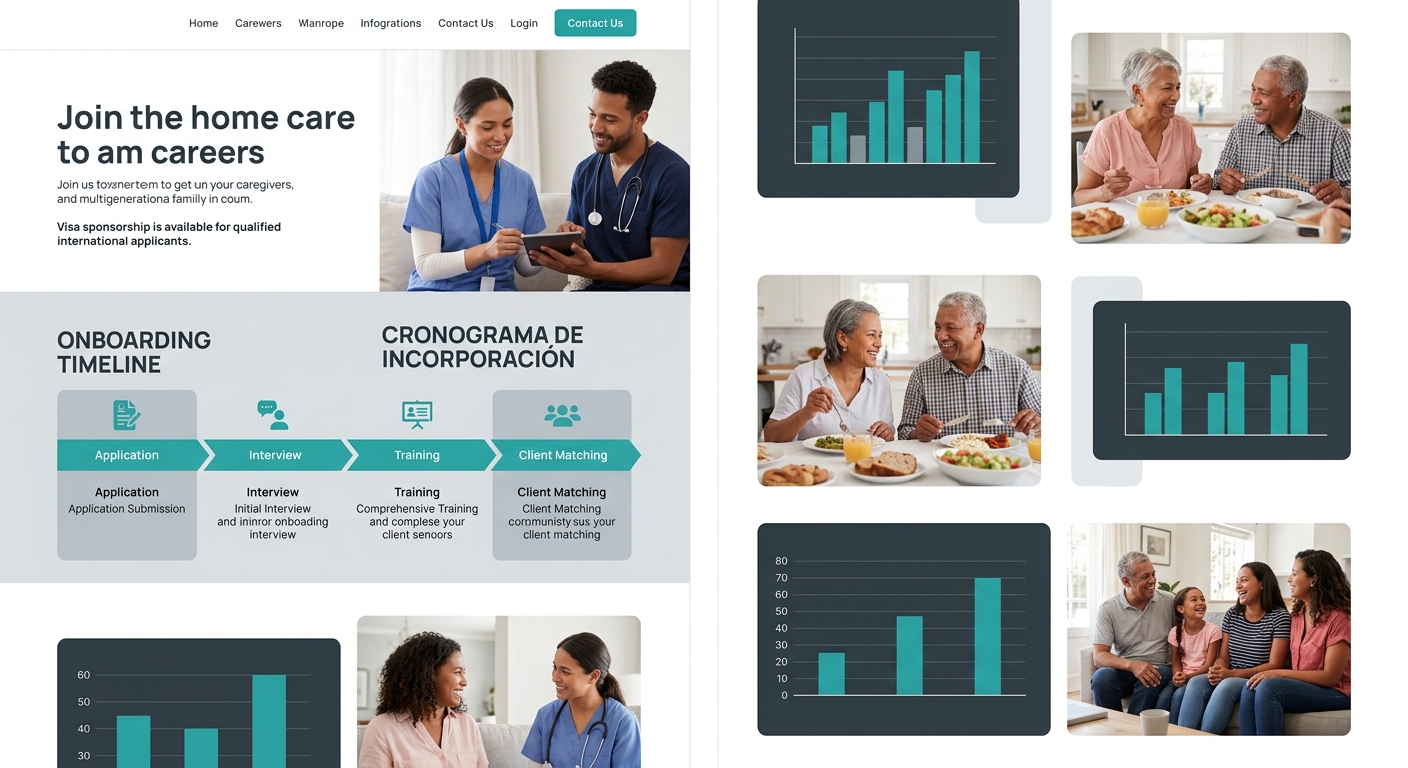
- Dedicated careers pages with explicit visa sponsorship language. IHPS does this well. If you sponsor, say so prominently. Candidates searching “visa sponsorship home care jobs” need to find your agency in that search. If your careers page never mentions sponsorship, you’re invisible to this audience entirely.
- Multilingual content where warranted. If you’re recruiting from specific countries or language communities, even a single-page summary of your sponsorship program in the relevant language signals genuine commitment. You don’t need to translate your entire site.
- Partnerships with immigration-focused job platforms. Beyond the standard boards, sites like EB3.work connect international workers directly with sponsoring employers in care fields. If you’re exploring recruitment channels beyond Indeed and ZipRecruiter, immigration-focused platforms belong on your list.
- Clear documentation of your onboarding timeline. International candidates want to understand exactly what happens after hiring. How long is orientation? What training do you provide? Do you assist with housing, transportation, or credential verification? Specificity builds trust before the first interview ever happens.
Your international recruitment content should demonstrate the same discipline you bring to client-facing marketing. If you’re already investing in caregiver marketing for client acquisition, extending that rigor to recruitment materials is a natural and high-value next step.
Retention Determines Whether the Math Works
Recruiting international caregivers costs more per hire than domestic recruitment. Sponsorship fees, legal costs, and extended onboarding timelines mean your return on investment depends almost entirely on how long those caregivers stay.
The IOM research makes this point directly: quality of care hinges on the caregiver-to-client relationship, and that relationship takes time to develop. Agencies investing in integration support through mentorship programs, cultural orientation sessions, and genuine career advancement pathways retain sponsored workers at significantly higher rates. And retained workers become your most effective recruitment marketing asset, because word-of-mouth within immigrant communities carries extraordinary weight.
AxisCare’s 2026 analysis describes the same dynamic from a business perspective. When a sponsored caregiver with geriatric nursing training from the Philippines or Ghana helps your agency launch a chronic disease management program, that’s revenue growth tied directly to your international recruitment strategy. Build the feedback loop: recruit well, onboard thoroughly, retain through real investment in people, then let those successful hires help recruit the next cohort.
Track the numbers that matter: cost per hire, 90-day retention rate, client satisfaction scores segmented by caregiver origin, and time-to-productivity for international versus domestic hires. Let the data guide where you spend.
What The Numbers Still Can’t Answer
The data on caregiver shortages is strong. The data on international recruitment outcomes within U.S. home care is thin. We know agencies like IHPS are sponsoring workers. We know Indeed listings increasingly mention H-1B sponsorship for care roles. We know the IOM has documented the central importance of migrant care workers across aging societies globally.
What we don’t have yet is a reliable national dataset on how many U.S. home care agencies actively sponsor international workers, what their average cost-per-hire looks like relative to domestic recruitment, or how retention rates for sponsored caregivers compare to domestically hired staff over 12- and 24-month windows. Home Care Pulse and similar benchmarking organizations haven’t broken this out as a distinct reporting category in their annual surveys.
That gap matters. Agencies considering international recruitment are making decisions based on anecdotal evidence from a handful of providers, regulatory guidance that varies by state, and general immigration data that doesn’t segment cleanly into home care operations. If your agency starts tracking these metrics internally, you’ll build an information advantage that compounds over time, both for your own operational decisions and for the marketing story you tell to candidates and referral partners who want evidence that your program delivers results.
The shortage is well-documented and the immigration pathways exist. What’s missing is the operational playbook connecting those two realities in a way that’s measured and replicable. The agencies building that playbook now will accumulate something more valuable than a full staff roster. They’ll have proof that the model works, and proof is what turns a pilot program into a scalable recruitment strategy.