
Plante Moran’s occupancy analysis for skilled nursing facilities surfaced a finding that should reshape how every care operator thinks about marketing: rising occupancy rates aren’t being driven by better amenities or expanded service menus. Partner Denise Leonard attributed the momentum to “renewed trust in SNFs as a post-acute destination.” Trust, not features, is filling beds. And the mechanism behind that trust is worth understanding in detail, because most operators are still marketing as if families comparison-shop for care the way they shop for hotels.
They don’t. The decision-making process runs on a different engine entirely, one built from emotional risk assessment, social proof, and what researchers call perceived decisional control. When you understand how each component works, you’ll see why your amenity list rarely moves the needle, and why a handful of trust signals can determine whether an inquiry becomes a move-in.
How the Pre-Contact Filter Works
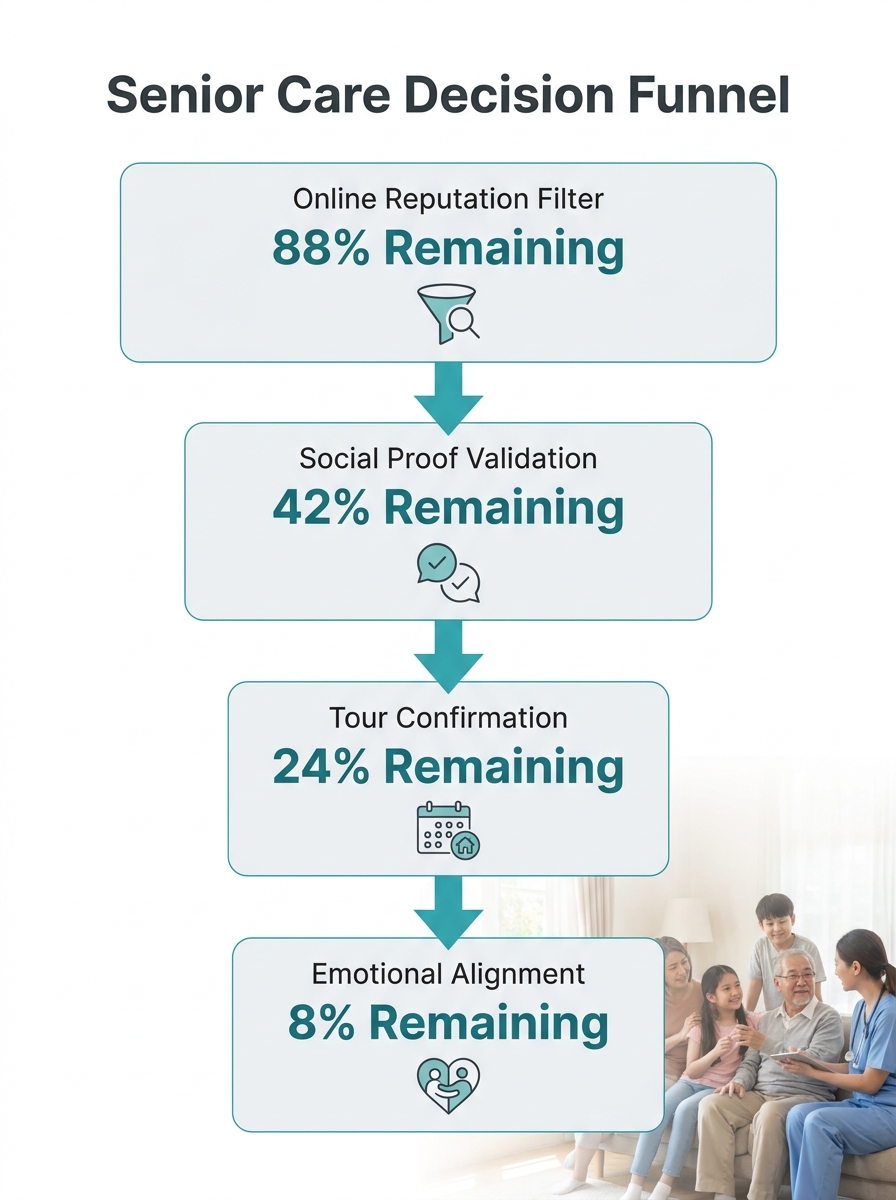
Before a family ever calls your admissions office or schedules a tour, they’ve already made a significant screening decision. That screening happens almost entirely through trust signals found online.
Families evaluate care facilities using multiple sources simultaneously: personal recommendations, online reviews, state inspection reports, licensing records, and in-person visits. But the order matters enormously. Online reputation acts as the first gate. A facility with thin or negative reviews on Google Business Profile, Caring.com, or SeniorLiving.org simply doesn’t make it to the tour stage for most families.
This is where reputation management for care agencies becomes a direct revenue driver. It’s the pre-contact filter that determines your inquiry volume. A facility can have the best activity calendar in the state, but if its review profile shows unresolved complaints or radio silence from management, families screen it out before they ever see the brochure.
The mechanism at this stage is cognitive trust: families are looking for evidence of reliability and competence. They’re scanning for patterns. Do responses to negative reviews sound defensive or accountable? Are positive reviews specific (mentioning staff names, describing real interactions) or generic? Do inspection reports reveal recurring issues? Every one of these data points either opens the gate or closes it.
Emotional Stakes Rewire the Comparison Process
Here’s where senior living decision-making psychology diverges sharply from how families buy almost anything else. Research published in the Journal of Qualitative Social Work examined how older adults and family members experience the decision-making process around assisted living and found that the two groups often hold fundamentally different views of the same transition. Adult children frequently carry guilt, fear, and a sense of failing their parent. The older adult may feel loss of independence, grief, or relief, sometimes all three at once.
This emotional weight changes how families process information. When someone is buying a car, they can calmly weigh horsepower against fuel efficiency. When an adult daughter is researching memory care for her father after a fall, she’s operating under acute stress, compressed timelines, and moral pressure. Under those conditions, the brain doesn’t optimize for features. It optimizes for safety signals.
The practical result: families gravitate toward whichever facility makes them feel their loved one will be protected and cared for. Research from Accushield confirms this directly, finding that when families evaluate communities, they’re looking for tangible evidence of safety and well-being, not a longer list of services. Understanding how adult children and seniors approach care decisions differently is critical here, because the trust signals that reassure a 78-year-old prospective resident aren’t the same ones that reassure her 52-year-old daughter.
Families Often Decide Before the Tour
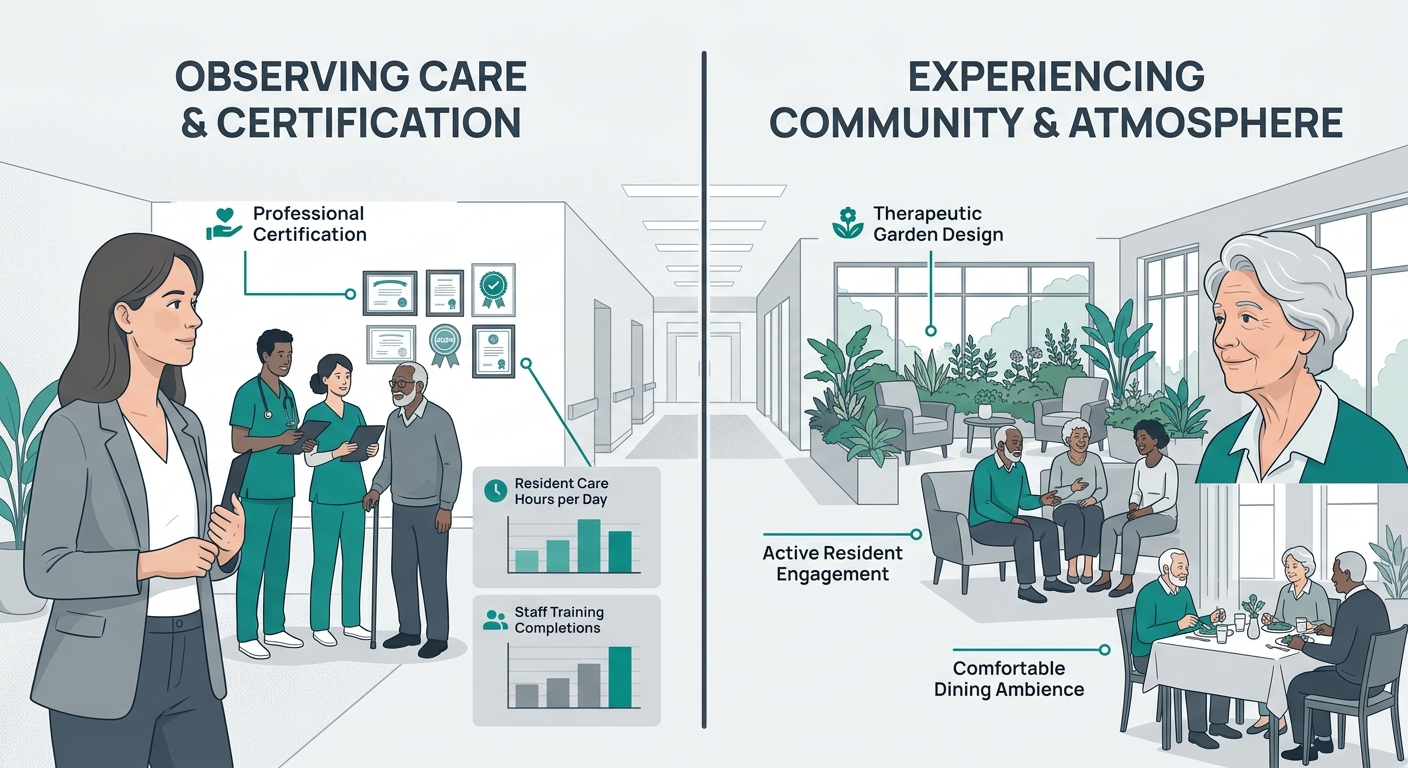
This is the component of the mechanism that surprises operators most. By the time a family walks through your front door, the emotional decision is frequently already made. The tour functions as confirmation, not evaluation.
Think about what’s already happened: the family found you through a referral or search, vetted your online reputation, read reviews, possibly checked state inspection data, and decided you were trustworthy enough to invest an hour of their time during an incredibly stressful period. The tour is where they’re looking for evidence that confirms what they already want to believe.
The tour functions as confirmation, not evaluation. By the time a family walks through your front door, the emotional decision is frequently already made.
This means the highest-stakes moments in your conversion funnel happen before any face-to-face interaction. Your Google Business Profile, your review responses, your website’s tone, and the warmth (or coldness) of your phone intake process carry more weight than the physical walkthrough. If those early touchpoints feel right, the tour becomes a formality. If they feel wrong, the family cancels or no-shows.
The research on shared decision-making in long-term care transitions supports this pattern. Decisional support tools that help families weigh whether to move a loved one to a care setting or remain at home show that the emotional and relational factors consistently outweigh clinical feature comparisons. Families aren’t running spreadsheets. They’re seeking permission to trust.
What Converts an Inquiry Into a Signed Agreement
If the pre-contact filter runs on cognitive trust and the comparison stage runs on emotional safety, the final conversion stage runs on something researchers call perceived decisional control. A study published in PMC found that families who felt they had meaningful control over the decision to relocate a loved one adjusted far better after the transition. Conversely, when the move felt forced or dictated by circumstances, adjustment suffered.
For operators, this translates into concrete care facility inquiry conversion factors. The families most likely to sign are the ones who feel they chose you, rather than feeling cornered into a decision by a hospital discharge planner or caregiver burnout. Your intake process either reinforces that sense of agency or strips it away.
What reinforces it: giving families real information (not just a sales pitch), letting them set the pace of follow-up, being transparent about costs and what’s included, acknowledging the difficulty of the decision out loud. What strips it away: high-pressure sales tactics, vague answers about pricing, rushed tours, and follow-up calls that feel like they’re working from a script.
Building trust through transparency in your operations isn’t a soft branding exercise. It’s the mechanism that converts inquiries into residents. And when families do choose you under conditions of perceived control, they become your best referral source, because they’ll describe the experience to other families in emotional terms: “They made us feel like we had a choice.”

The Ownership Problem Underneath Everything
There’s an external force that’s quietly complicating these trust dynamics. An NPR investigation found that over the past decade, real estate investment trusts have acquired thousands of buildings housing nursing homes and assisted living facilities, often exerting more influence over operations than the public realizes, including selecting management companies and setting lease terms that squeeze operating budgets. When families sense that a facility is run to serve investors rather than residents, trust erodes at every stage of the funnel.
This matters for your marketing because family trust signals in senior care are increasingly shaped by ownership transparency. Families are googling corporate structures. They’re reading investigative journalism. The ones paying attention will ask pointed questions during tours. And if your facility is independently owned or mission-driven, that’s a trust signal worth communicating clearly.
For operators working with marketing for nursing homes, this means the competitive landscape has shifted. The differentiator isn’t a renovated dining hall. It’s evidence of genuine accountability and local decision-making authority.
Tip: If your facility is independently operated, make that visible on your Google Business Profile, website, and in tour conversations. Ownership transparency is an emerging trust signal that families actively look for.
Where the Model Breaks Down
This trust-signal mechanism has real limits. It works well for families with the time, literacy, and internet access to research options. It works less well for families in crisis, like those navigating a sudden hospital discharge where the social worker provides a short list and the decision must be made in 48 hours. In those compressed-timeline scenarios, the facility that answers the phone fastest often wins, regardless of its trust profile.
The model also struggles when the family decision-maker and the future resident disagree. Research consistently shows that when an older adult feels the move was involuntary, their adjustment to the new setting is significantly worse. A facility can earn the adult child’s trust completely while failing to earn the trust of the person who actually lives there. The best operators recognize this gap and design their intake process to address both parties separately.
And the model can’t account for geography. In rural areas with one or two care options within driving distance, trust signals matter less because there’s no alternative to compare against. The mechanism described here applies most powerfully in metro and suburban markets where families have genuine choice.
The professionals at the Care Marketing team who work with care providers on these dynamics will tell you that no single channel or tactic fixes trust. Trust accrues across every touchpoint, and one bad experience with a phone receptionist can undo months of five-star reviews. The mechanism is powerful precisely because it runs on pattern recognition. Families are reading dozens of small signals and assembling a composite picture. Getting 90% of those signals right while neglecting the other 10% can still cost you the move-in.
That fragility is worth sitting with. You can invest heavily in client testimonials that build credibility, optimize your profiles on every senior care directory, and train your tour guides beautifully, and still lose families if your follow-up emails feel impersonal or your voicemail box is full. Trust is a system, and systems fail at their weakest component.