
Nursing home providers ranked recruiting and retaining clinical staff as their greatest operational challenge, with 36.8% naming workforce pressures as the top issue facing facilities today, according to a survey conducted by Skilled Nursing News in late August 2026 ahead of the RETHINK conference. Financial pressure from low reimbursement rates against rising costs placed second at 21.1%, the publication reported.
TL;DR: More than a third of nursing home operators cited recruiting and retaining clinical staff as their biggest challenge, while 42.1% identified AI adoption and automation as the issue with the greatest near-term impact on care delivery.
The survey results reveal a dual timeline for nursing home transformation: workforce challenges are expected to have the most significant long-term effect on the sector, while artificial intelligence adoption is emerging as the more immediate operational priority. About 55.6% of respondents named workforce evolution as the biggest transformational force over the next decade, while 50% identified the expansion of value-based care and alternative payment models alongside AI and predictive analytics integration as equally transformational.
AI and Technology Adoption Outpaces Other Near-Term Concerns
Providers identified AI adoption and automation in care delivery as the issue with the greatest impact to care quality in the next 12 months, with 42.1% selecting this option, the survey showed. Rising acuity and complexity of resident care needs placed second at 36.8%.
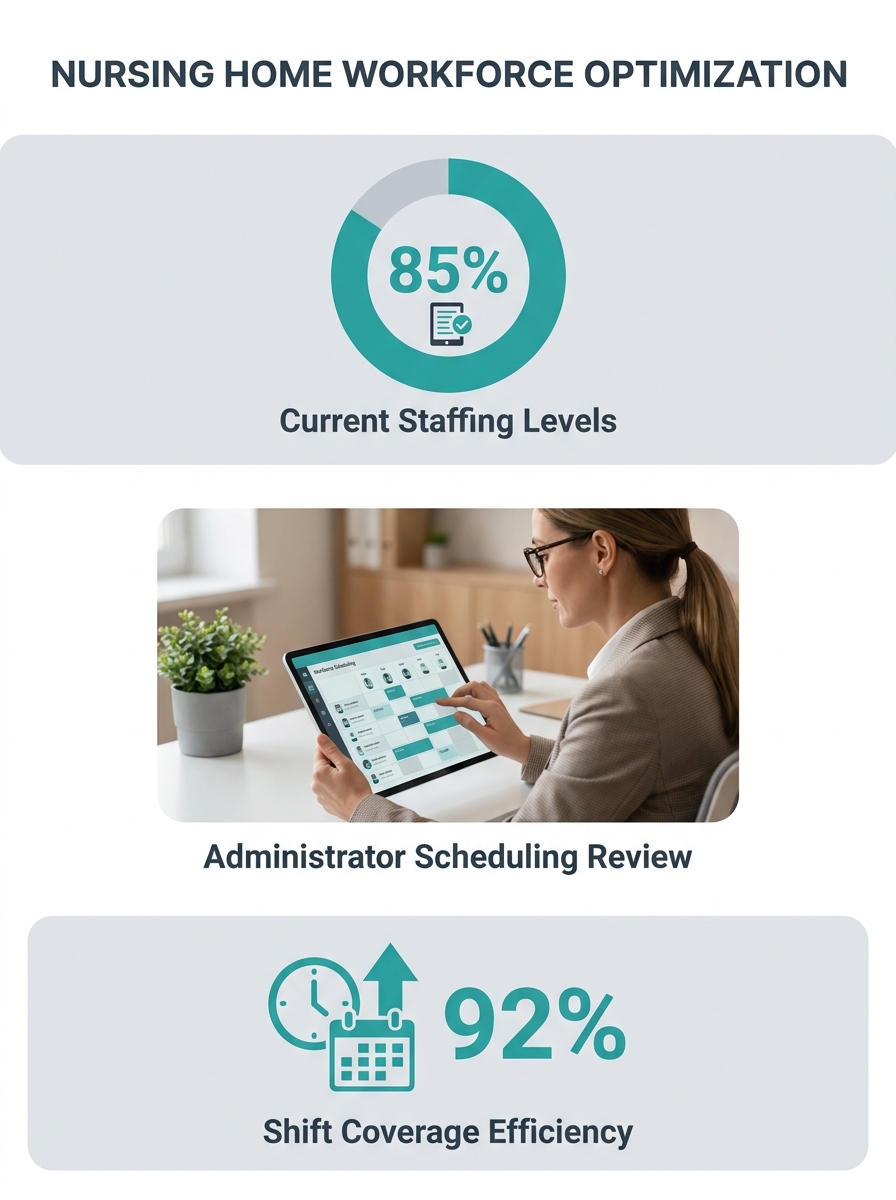
When asked specifically about technology opportunities, operators said remote patient monitoring holds the most promise, followed by workforce management and smart scheduling platforms, then advanced electronic health records systems. The rankings suggest providers view technology as a lever to address staffing pressures rather than a replacement for clinical staff.
Recruitment and Retention Outlook Remains Mixed
More than half of nursing home providers expect the recruitment and retention landscape to remain unchanged over the next six months, according to the survey. About 26.3% expect conditions to worsen, while 15.8% anticipate improvement.
Certain staffing strategies demonstrated positive impact over the past year. Flexible scheduling and career development training programs led retention efforts, the survey found. Higher wages and better benefits, technology and automation, and agency reduction showed moderate effectiveness. International recruitment received the least attention, with only 11.1% of operators reporting positive effects from this approach.
The workforce outlook connects to broader employment trends: the Bureau of Labor Statistics projects home health and personal care aide positions will add 847,300 jobs between 2025 and 2035, more than any other occupation in the United States.
Partnership and Growth Strategies Center on Hospital Relationships
Expanding partnerships with hospitals, accountable care organizations and health systems emerged as a primary growth opportunity, with 33.3% of respondents identifying this as a top priority. Using technology focused on care quality and operational efficiency, and enhancing workforce development and career pathways to attract talent, received equal priority at 33.3% each.
Providers planning to pursue hospital and health system partnerships said demonstrating reduced hospital readmissions and strong clinical outcomes would deliver the most negotiating power in such relationships. Faster admissions and care transitions, along with value-based care capabilities, ranked as secondary factors, the survey indicated.
About 22% of respondents said increased demand for skilled nursing services will emerge as a top driver for sector change, while 16.7% identified shifts in referral patterns as the primary growth driver. A minority of providers—11.1%—selected consolidation and merger-and-acquisition activity as having the greatest transformational effect.
New Service Lines and Clinical Initiatives
When asked about launching new service lines in 2026, 57.9% of operators said they were unsure or considering the possibility, while 31.6% confirmed they would not launch new services this year. The small percentage of providers planning new initiatives—slightly over 10%—expressed interest in outpatient therapy and dialysis services.
For clinical priorities, 31.6% of operators named improving quality measures and outcomes as their top initiative, with 21.1% prioritizing building and retaining clinical leaders. Enhancing interdisciplinary care, reducing hospital readmissions, and strengthening clinical documentation received equal attention as secondary priorities.
Payment Policy Shifts Dominate Near-Term Financial Concerns
Providers identified shifts in Medicare and Medicaid reimbursement policies as having the greatest impact on payment over the next 12 months, with 26.3% selecting this option. Labor market dynamics and wage pressures ranked second at 21.1%.
Five opportunity areas received equal attention from operators, with 16.7% selecting each: partnering with payers for value-based models, expanding into high-acuity or specialty services, strengthening care transitions, diversifying services, and capitalizing on an aging population.
What This Means for Owners
Nursing home operators face a bifurcated strategic timeline that requires simultaneous investment in workforce development and technology adoption. The survey data shows that facilities prioritizing flexible scheduling, career pathways, and AI-driven operational tools are positioning themselves to address both immediate staffing gaps and long-term transformation pressures.
The partnership emphasis suggests a clear admissions growth path: facilities that can demonstrate reduced hospital readmissions and strong clinical outcomes gain access to hospital and ACO referral networks, which represent higher-acuity, higher-revenue census opportunities. Operators should track hospital readmission rates and prepare outcome data for partnership discussions now, even if formal value-based contracts remain months away.
The 57.9% “unsure” response on new service lines indicates many operators are waiting for clearer market signals before committing capital. Facilities evaluating expansion should consider outpatient therapy and remote patient monitoring as dual-purpose investments—both generate revenue and strengthen the workforce management capabilities that survey respondents identified as critical to operational success.