
Federal Medicaid law requires states to recover long-term care costs from the estates of deceased recipients aged 55 or older, but an enhanced life estate deed—recognized in Florida, Michigan, Texas, Vermont, and West Virginia—transfers a home to heirs at death outside probate, placing it beyond the reach of estate recovery in most cases, according to an AOL explainer published August 27. The deed allows owners to retain full control during their lifetime while avoiding the five-year Medicaid look-back period that disqualifies applicants who transferred assets.
TL;DR: An enhanced life estate deed passes a home to heirs outside probate in five states, shielding it from Medicaid’s mandatory recovery of nursing home costs—but only where state law limits recovery to probate assets.
The legal mechanism addresses a financial barrier that families frequently encounter during nursing home admissions conversations: the prospect of losing the family home to state recovery after a parent’s death. Estate recovery programs, mandated under 42 U.S.C. § 1396p(b), require states to reclaim Medicaid expenditures for long-term care from the estates of enrollees who were 55 or older when they received benefits. For many families, the home represents the only significant asset, and heirs often discover the state’s claim only after the funeral, the article notes.
How the Enhanced Life Estate Deed Functions
The enhanced life estate deed—commonly called a Lady Bird deed—performs two simultaneous legal actions. It names beneficiaries who automatically receive the property at the owner’s death, while the owner retains full control during life, including the right to sell, mortgage, or revoke the transfer without beneficiary consent. Because the home passes outside probate, it generally remains beyond estate recovery’s reach in states that define “estate” narrowly as probate assets only.
A standard life estate deed operates under different legal constraints. The remainderman, or designated heir, acquires immediate legal rights, and Medicaid treats the transfer as a gift subject to the five-year look-back period. During that window, applicants who transferred assets can be disqualified from benefits. Mistakenly drafting a standard life estate instead of an enhanced version triggers the look-back and can block nursing home coverage when families need it most, according to the article.
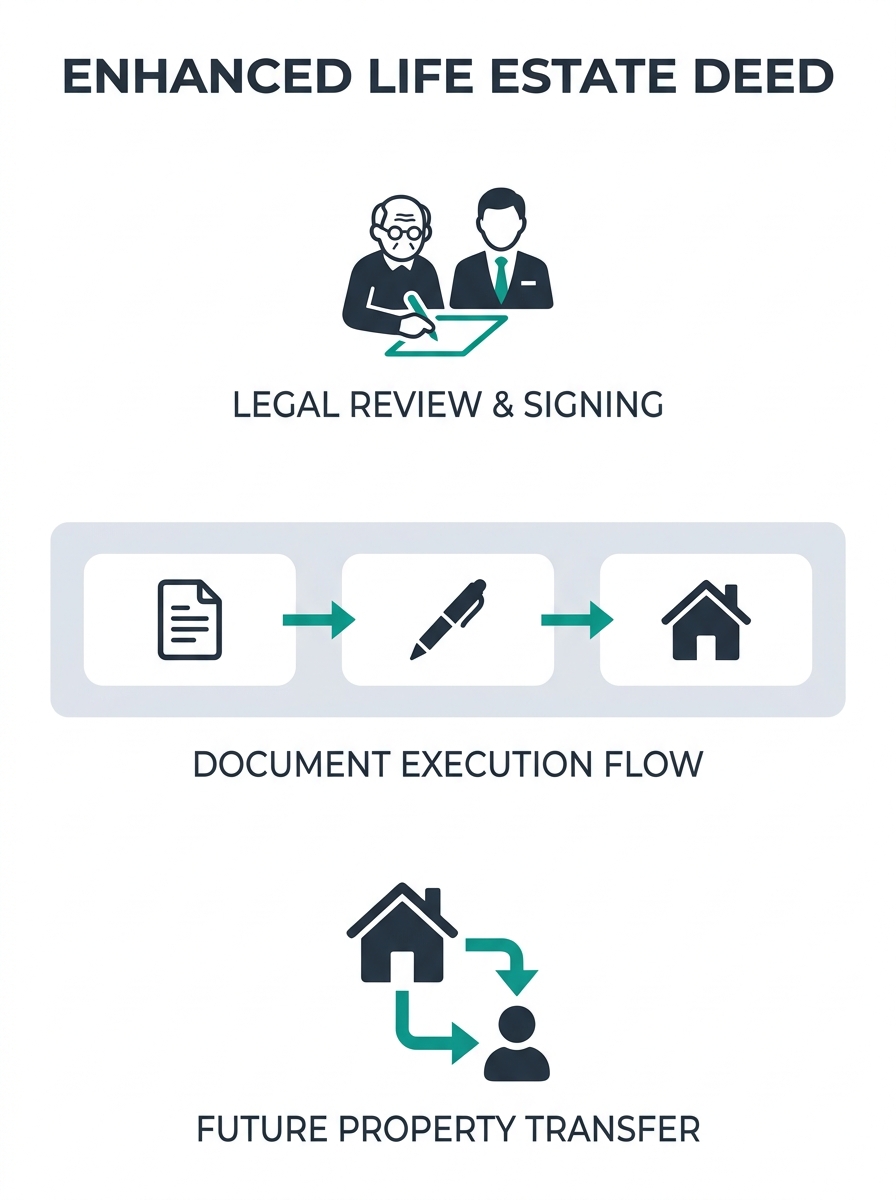
The Estate-Definition Split Creates Geographic Disparities
State definitions of “estate” determine whether the deed succeeds. States using the narrow probate-estate definition limit recovery to assets passing through probate court. States using an expanded federal definition can reach assets that pass outside probate, including homes transferred via enhanced life estate deeds. The article emphasizes that a Lady Bird deed performs its intended function only where the state’s recovery program is confined to probate assets.
The five states that recognize the enhanced life estate deed and apply probate-limited recovery represent a small subset of jurisdictions. Families in the remaining 45 states must pursue alternative strategies, often involving irrevocable trusts or outright gifts that trigger look-back periods and relinquish owner control.
Tax Treatment and Recording Requirements
Beneficiaries generally receive a stepped-up basis under this structure, meaning the home’s cost basis resets to fair market value at the owner’s death. That adjustment eliminates the capital gains tax that a lifetime gift of the property would generate. The deed must be recorded with the county where the property sits to become effective, and legal experts recommend working with a licensed elder law attorney to draft language that explicitly preserves the owner’s right to sell, mortgage, or revoke the transfer.
The deed addresses estate recovery exposure only and does not affect Medicaid eligibility. Owners who expect to need nursing home care and want to leave the home to specific heirs should confirm state recognition of the deed, identify remaindermen and decide on shares, and complete recording before applying for benefits.
Why This Matters Now
Nursing home administrators and admissions coordinators encounter family financial anxiety in nearly every intake conversation. Senior living operators who help families plan transitions before medical emergencies force placement decisions report smoother admissions and higher family satisfaction. Understanding which states allow enhanced life estate deeds gives admissions staff a factual baseline when families ask whether they will lose the home.
The Lady Bird deed is not a universal solution—it works in five states and fails where estate recovery reaches non-probate assets—but for families in Florida, Michigan, Texas, Vermont, and West Virginia, it removes one significant barrier to seeking nursing home care when a parent needs it. Administrators who can explain the estate recovery landscape during pre-admission counseling position their facilities as trusted advisors rather than transactional providers. States that spend more on home-based care see fewer nursing home placements, and family concerns about asset loss contribute to the delay in seeking facility-based care even when medical needs escalate.
Admissions teams that clarify the limits of estate recovery—and refer families to elder law attorneys for state-specific guidance—differentiate their facilities in a market where financial transparency builds trust and accelerates decision-making.