
Home care agency owners who track only quantitative metrics like caregiver turnover and billable hours miss emerging customer service problems, while those focused solely on qualitative feedback overlook stagnating growth, according to a framework published August 26 by Visiting Angels CEO Joan Ekobena in Forbes Business Council. The framework identifies five company-wide quantitative metrics and five qualitative data sources that home care operators should track concurrently to identify problems before they escalate.
TL;DR: Visiting Angels CEO Joan Ekobena published a dual-data framework on August 26 naming specific quantitative metrics (caregiver turnover ratio, billable hours per client, hospital readmission rates) and qualitative sources (client surveys, referral partner feedback, online reviews) that home care owners must balance to catch operational blind spots.
Ekobena, who leads Homecare Solutions dba Visiting Angels and serves as a Forbes Business Council member, wrote that agencies relying exclusively on financial and operational dashboards fail to detect patterns in customer dissatisfaction, while agencies prioritizing client testimonials and caregiver conversations often miss stagnating revenue or rising administrative costs. “Both home care business owners might think they’re doing well—great, even,” Ekobena wrote. “But they’ve both missed crucial information by overfocusing on one type of data at the expense of the other.”
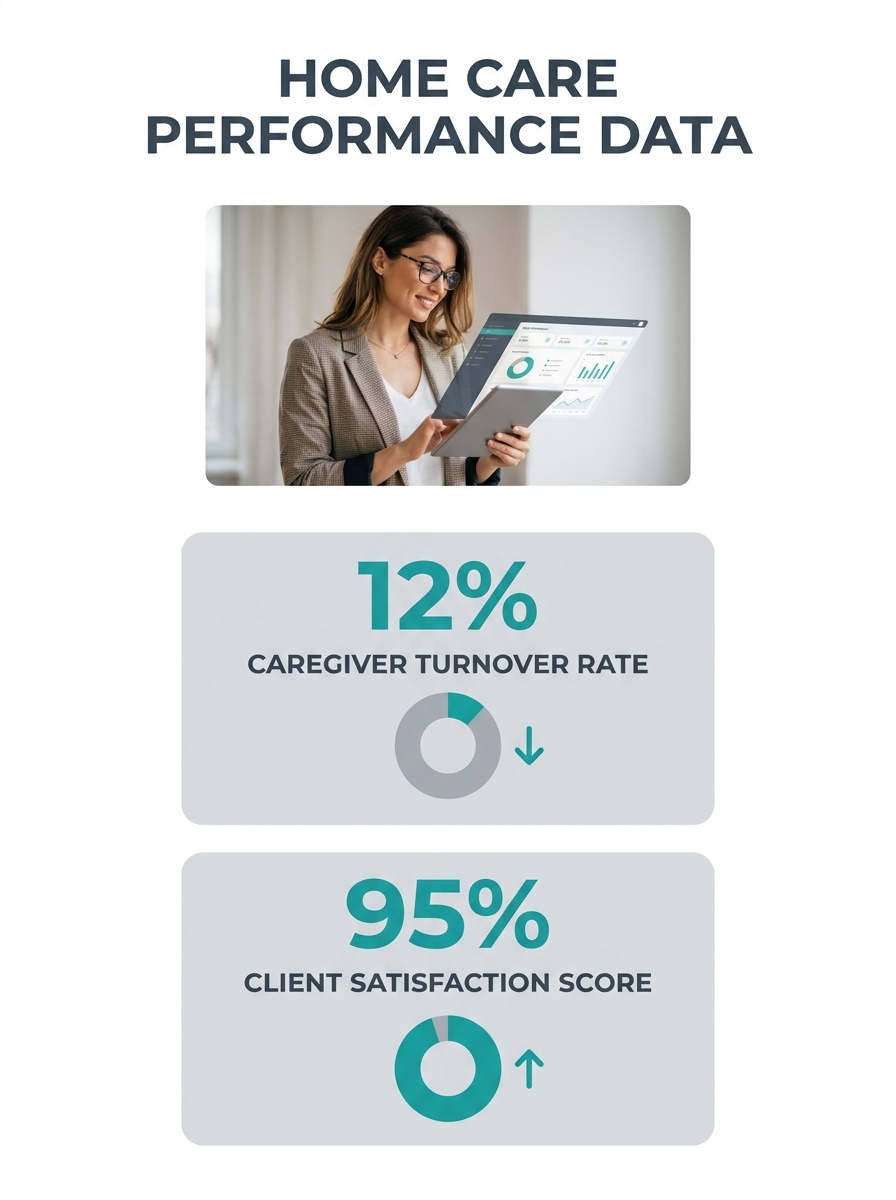
Quantitative Metrics Named in the Framework
Ekobena’s framework identifies five company-wide quantitative metrics: year-over-year growth rate, caregiver turnover ratio, billable hours per client, administrative staff-to-revenue ratio, and hospital readmission rates. Marketing departments should separately track conversion rate, customer acquisition cost, and customer lifetime value, according to the framework, while finance teams monitor net profit, gross profit margins, and line-item expenses.
The framework recommends comparing internal metrics against industry benchmarks from third-party sources including Activated Insights, the National Alliance for Care at Home, and the Home Care Association of America. Internal data showing positive trends may still indicate underperformance against sector averages, Ekobena noted. Agencies focused on marketing for caregiving agencies should track turnover ratios alongside acquisition costs to identify whether recruitment spending compensates for retention failures, the framework states.
Hospital readmission rates function as a downstream quality indicator for home care agencies serving post-acute patients, signaling whether care plans prevent avoidable returns to emergency departments. The framework positions this metric as a shared accountability measure between clinical and operational teams.
Qualitative Data Sources Recommended
Five qualitative data sources form the framework’s second pillar: online reviews, caregiver feedback forms, client satisfaction surveys, one-on-one conversations with clients and caregivers, and referral partner feedback. Ekobena wrote that in-house feedback collection often produces incomplete data because respondents worry about anonymity or “saving face.” Her company uses Activated Insights as a third-party vendor to administer client and caregiver surveys, a practice the framework recommends for agencies seeking candid responses.
Competitive intelligence gathering through local senior community events and mystery shopping rounds out the qualitative toolkit, according to the framework. “I’ve found both to be effective approaches,” Ekobena stated. Agencies building referral networks through professional certification programs should systematically collect feedback from hospital discharge planners and geriatric care managers to identify service gaps that competitors fill, the framework advises.
The framework distinguishes between solicited feedback (surveys, forms) and unsolicited signals (online reviews, spontaneous caregiver comments during shift handoffs). Both categories require documentation systems, Ekobena wrote, because patterns emerge only when qualitative data accumulates over weeks or months rather than being treated as isolated incidents.
Third-Party Benchmarking and Accountability Practices
Accountability in data documentation determines whether agencies can act on trends or simply collect numbers, according to the framework. Ekobena recommends designating team members responsible for recording and analyzing specific metrics, then reviewing data daily in stand-up meetings, monthly in comprehensive reports, and annually in deep-dive sessions identifying improvement areas.
“By regularly reviewing your data, you can identify problems before they turn into larger issues,” Ekobena wrote. The framework cites rising caregiver turnover as an example: monthly reviews might reveal that turnover increased after a policy change or shift-scheduling adjustment, allowing leadership to intervene before the ratio reaches crisis levels. Similarly, client survey data showing repeated complaints about front-office responsiveness should trigger process audits and training, the framework states.
The framework positions data review cadence as a forcing function for operational adjustments. Agencies that collect metrics without scheduled analysis meetings often accumulate dashboards that no one consults during decision-making, Ekobena noted. This pattern mirrors findings in multi-channel attribution research showing that home care operators struggle to act on data when accountability for analysis remains undefined.
Third-party benchmarking sources provide context that internal trend lines cannot. An agency showing 5 percent year-over-year revenue growth may consider that performance acceptable until industry data reveals the sector averaged 12 percent growth during the same period, indicating market-share losses despite nominal gains.
What Happens Next
The Forbes Business Council platform, a fee-based expert network, distributes frameworks like Ekobena’s to an audience of small and mid-size business owners seeking operational guidance. Home care agency owners implementing dual-data tracking systems will need to designate staff hours for both quantitative reporting (financial dashboards, turnover calculations, CAC/CLV analysis) and qualitative synthesis (review monitoring, survey coding, conversation documentation). Agencies currently tracking only financial metrics may face upfront costs hiring third-party survey vendors or mystery shopping services, while agencies relying primarily on testimonials and anecdotes will need accounting or EHR platform integrations to automate quantitative reporting.
The framework’s emphasis on hospital readmission rates as a company-wide metric positions home care agencies to demonstrate value in post-acute referral conversations with Medicare Advantage plans and accountable care organizations, which increasingly tie reimbursement to readmission prevention. Agencies that document both low readmission rates (quantitative) and high patient satisfaction scores (qualitative) gain use in contract negotiations that competitors tracking only billing metrics cannot match.
Ekobena’s use of Activated Insights as a named third-party vendor for client and caregiver surveys may drive adoption of similar tools among agencies that previously conducted feedback collection in-house. The framework’s call for competitive intelligence through mystery shopping suggests that larger multi-location operators may formalize practices that independent agencies have used informally, creating standardized protocols for evaluating competitor service delivery and pricing models in each local market.