
California seniors are remaining in their homes to protect property tax assessments frozen under Proposition 13, even as home care costs required to age in place exceed the monthly cost of assisted living communities by $2,400 or more in most markets, according to a report released by the American Seniors Housing Association. A homeowner paying $2,000 annually in property taxes under the 1978 law preserves a $667 monthly tax savings while spending $7,920 per month for 44 hours of weekly home care, compared to California’s $7,000 statewide assisted living average.
TL;DR: California seniors paying $35-45/hour for home care to stay in Prop 13-protected homes are spending $6,160-$7,920 monthly for modest care levels—exceeding what most assisted living communities charge—to preserve a $667 monthly tax benefit and defer capital gains taxes on appreciated home values.
The calculation driving the decision centers on property tax protection. Proposition 13 freezes assessed values at purchase price, meaning a California senior who bought a home in 1985 for $180,000 pays taxes on that original assessment even as the property’s market value reaches $850,000 or higher. The tax savings versus full market-rate assessment total approximately $8,000 annually, or $667 per month. Capital gains considerations compound the anchor effect: homes purchased decades ago carry $500,000 to $700,000 in appreciation, creating taxable events of $60,000 to $90,000 for single filers above the $250,000 federal exclusion threshold when sold.
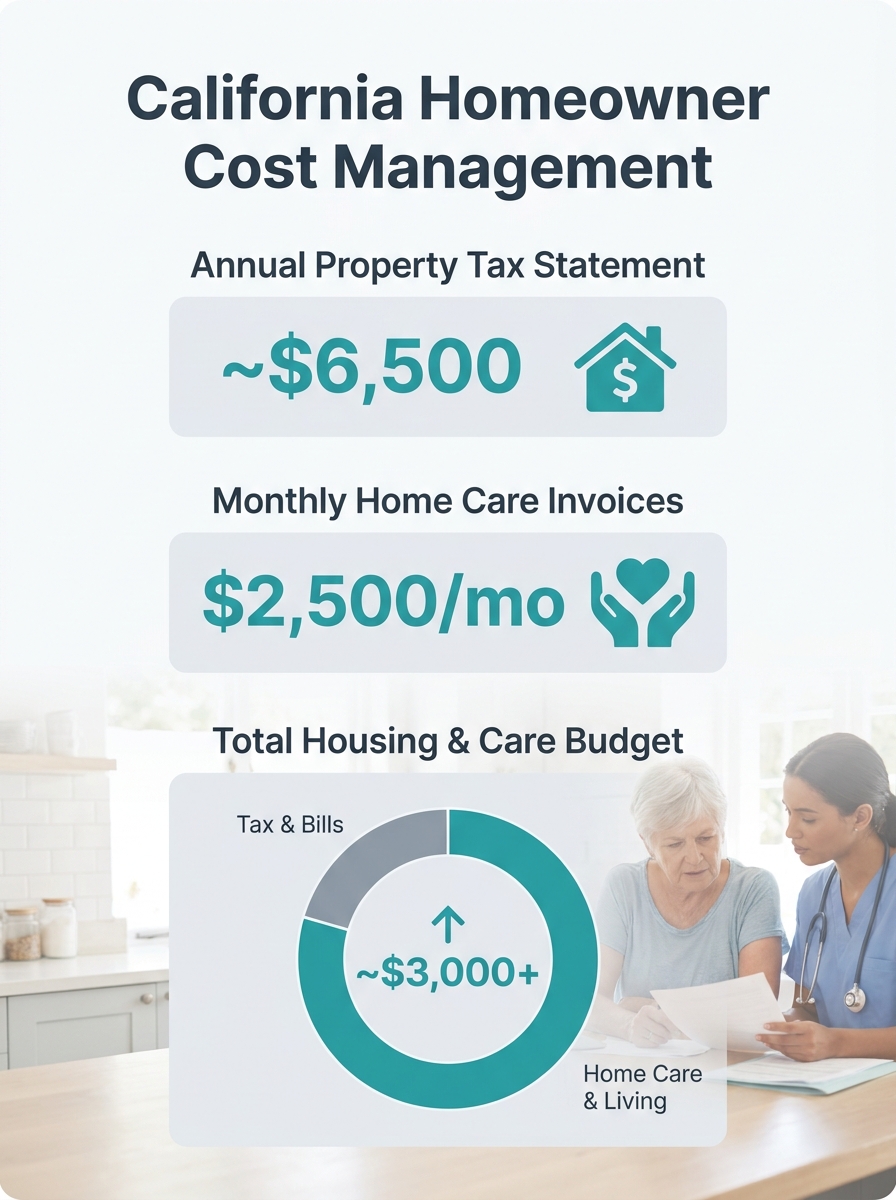
Home Care Labor Costs in California Markets
In-home care agencies in California charge between $35 and $45 per hour in most markets, Genworth’s 2025 Cost of Care data shows. Bay Area markets—San Francisco, San Jose, Oakland, Marin County—run toward the upper end and above. At 44 hours per week, the monthly total at $35 per hour reaches $6,160; at $45 per hour, $7,920. Those figures exclude property taxes, utilities, groceries, transportation, and home modifications that aging in place typically requires.
Seniors needing 12-hour daily care—84 hours weekly—pay $12,600 to over $16,000 monthly depending on market. Around-the-clock live-in care in San Francisco reaches $21,000 to $24,000 per month. The American Seniors Housing Association report frames the crossover point directly: the cost of living in a house with even modest home healthcare levels can exceed assisted living community costs. In California, that crossover occurs at lower care thresholds than in most states because the state’s home care labor costs rank among the nation’s highest.
A similar pattern emerged in Florida, where seniors pay $8,500 monthly to stay home with modest care while assisted living averages $4,750, creating a $3,750 monthly cost differential that families rarely calculate explicitly before making placement decisions.
Assisted Living Pricing Across California Counties
California assisted living averages approximately $7,000 per month statewide—13 percent above the national median—though variation by market is significant. San Jose carries the highest median assisted living cost of any major California market at approximately $10,495 monthly, driven by Silicon Valley real estate values and intense competition for healthcare workers. San Francisco Bay Area communities broadly run $6,500 to $9,000 per month. Los Angeles averages approximately $7,350. Southern California markets outside Los Angeles—San Diego, Orange County—range from $5,300 to $7,900 depending on location and care level.
Memory care adds 20 to 30 percent on top of assisted living in most California markets. Los Angeles memory care averages $7,800 to $8,200 per month for a private room. Bay Area memory care frequently exceeds $10,000 to $11,000 per month. These figures include room, board, and care services—distinct from home care arrangements where housing costs layer on top of hourly care expenses.
The Capital Gains Calculation Most Families Skip
A California senior paying $7,920 per month for 44 hours of weekly home care plus $1,500 in property taxes, utilities, and maintenance spends $9,420 monthly to preserve a $667 monthly tax savings and defer a one-time capital gains event. The federal capital gains exclusion covers $250,000 for single filers and $500,000 for married couples; appreciation above those thresholds is taxable at capital gains rates. A home purchased for $180,000 in 1985 and now worth $850,000 carries $670,000 in appreciation, creating potential federal tax liability of $60,000 to $90,000 or more for a single filer above the exclusion threshold.
The Prop 13 savings and capital gains expense together create what the ASHA report characterizes as a financial anchor. Most California families have not laid out the comparison explicitly: monthly home care costs versus monthly assisted living costs, net of the Prop 13 savings and amortized capital gains liability. Whether staying in place makes financial sense depends on individual circumstances and professional tax advice, but the ASHA analysis indicates many California seniors are paying substantially more per month to avoid a taxable event that could be offset by months of care cost savings.
California’s Medi-Cal program includes an Assisted Living Waiver that covers some service costs for qualifying low-income seniors in participating counties. The waiver expanded under California’s 2026 asset test changes that reduced barriers to Medi-Cal eligibility. But the waiver does not cover room and board—only care services—and county participation remains uneven. Medicare covers none of the custodial home care or assisted living costs central to the Prop 13 calculation.
Provider Implications
Home care agencies and assisted living operators in California face a prospect base anchored by property tax law that predates the modern senior care industry by decades. Marketing messaging that positions assisted living or home care as premium options competing against “free” aging in place misses the financial reality families are navigating. Families need total-cost-of-care calculators that account for Prop 13 savings, capital gains liability, home maintenance, and hourly care expenses—not just monthly rent comparisons.
Admission conversations that surface the actual cost of staying home with adequate care—rather than assuming families have run the numbers—create clarity that benefits decision-making. A prospect paying $7,920 monthly for home care may not realize they are spending $920 more per month than the $7,000 statewide assisted living average, or $2,420 more than a $5,500 community in their county. The ASHA report provides the data foundation for these discussions; providers need marketing messaging frameworks that translate cost data into family-facing educational content that respects the emotional stakes of housing transitions while presenting verifiable financial comparisons.
Referral partners—elder law attorneys, financial planners, discharge planners—are positioned to surface the Prop 13 calculation earlier in the care planning process, before home care costs compound for months or years. Providers who equip referral sources with total-cost tools and Prop 13-specific scenarios gain influence in a market where tax policy drives placement timing as much as care acuity does.