
A Florida senior living at home with 40 hours of weekly paid care spends $8,500 or more monthly when property taxes, insurance, utilities, and maintenance are included, while the state’s assisted living communities average $4,750 per month all-inclusive, according to an August 3 report from the American Seniors Housing Association titled “The Surprising Price of Staying in a House: Cost Comparisons Often Favor Senior Living.”
TL;DR: ASHA’s Florida data shows families miscalculate aging-in-place costs by excluding ongoing home expenses, creating a perception gap where 59% believe senior living is unaffordable despite the math favoring communities once any paid care begins.
The report addresses what ASHA analyst Daniel Bernstein describes as a widespread calculation error: Florida families compare a senior living community’s monthly fee against zero housing costs because the home is paid off, leaving out property taxes, insurance, utilities, groceries, transportation, and maintenance that continue regardless of mortgage status, according to the analysis published on Live Insurance News. Florida’s 4.5 million residents aged 65 and older represent the nation’s largest senior population, with another 250,000 residents projected to arrive annually through 2030, 57% of them age 60 or older.
The cost perception gap directly affects admissions decisions at Florida’s 2,953 assisted living communities. Fifty-nine percent of Florida families believe senior living is unaffordable, the ASHA report states, even as statewide pricing runs $645 per month below the national median of $5,419.
Florida Senior Living Costs Run Below National Rates Across Care Levels
Florida’s assisted living monthly average of $4,750 benefits from supply density and lower labor costs outside coastal markets, the report shows. Independent living for seniors not requiring daily assistance runs $2,000 to $5,000 monthly statewide, with most communities priced between $3,200 and $3,800. Memory care communities providing the highest support level average $6,000 to $7,000 monthly across Florida markets.
Geographic variation is significant within the state. Miami assisted living averages $6,800 monthly, while Naples and Palm Beach communities run $4,800 to $6,600. Ocala, Gainesville, Tallahassee, and Pensacola markets offer comparable care at $4,000 to $4,500 monthly, according to the ASHA data.
The monthly community fee covers housing, meals, housekeeping, activities, transportation, and basic utilities as a bundled rate. Home-based alternatives rarely total their ongoing costs the same way, Bernstein noted in the report.
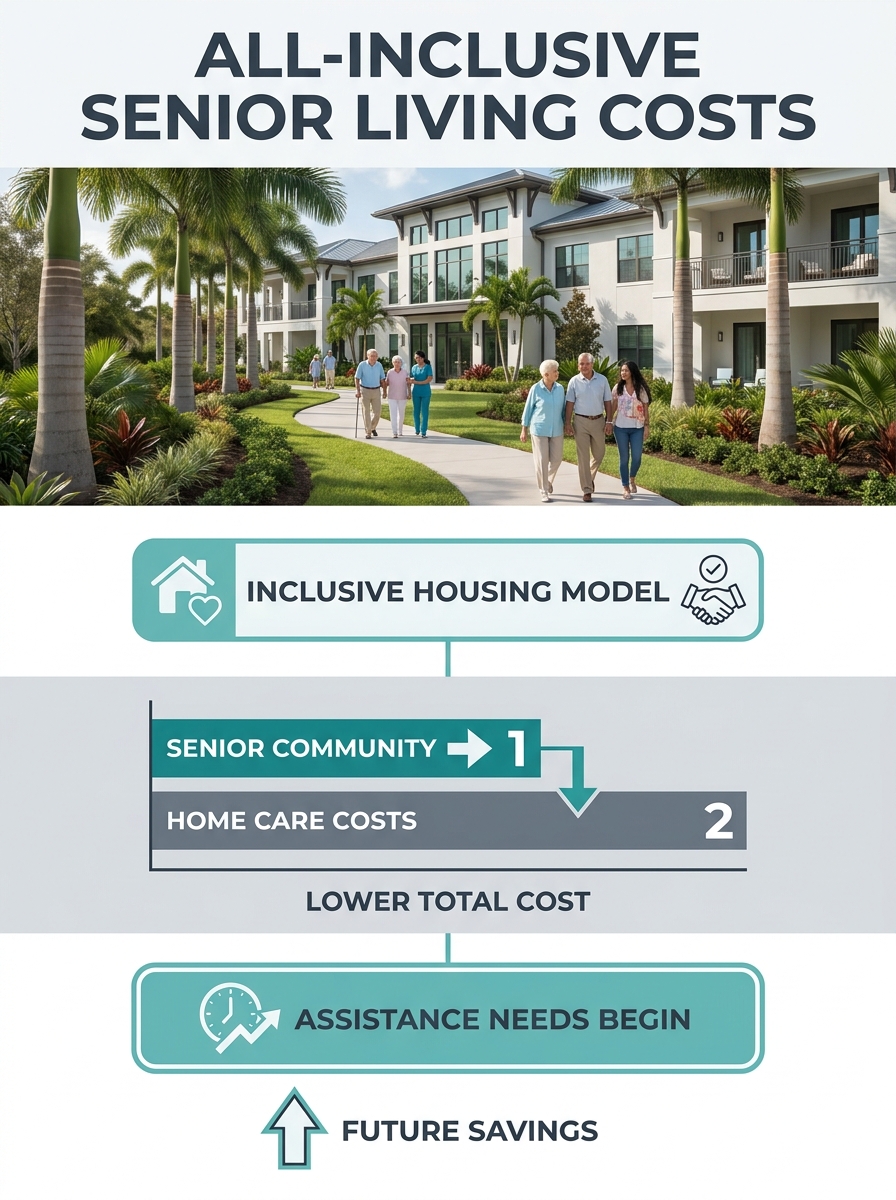
Home Care Costs Exceed Community Pricing Once Daily Assistance Begins
The Genworth Cost of Care Survey places 40-hour weekly home care at $6,300 monthly nationally, with Florida rates comparable and South Florida labor markets in Miami-Dade, Broward, and Palm Beach counties running above that figure, the ASHA report states. Property taxes on Florida’s median $350,000 home add approximately $400 monthly. Homeowners insurance in Florida averages $280 or more monthly, well above national rates. Utilities, groceries, maintenance, and transportation for a senior living independently add $1,500 to $2,000 monthly.
The combined home-based cost reaches $8,500 monthly for modest care needs in a mortgage-free home. Florida assisted living at $4,750 monthly includes all housing, care, and support services, creating a $3,750 monthly savings for families, according to the analysis.
Seniors requiring 84 hours of weekly care face home costs approaching $12,000 monthly nationally, the report shows. Around-the-clock home care exceeds $20,000 monthly in most markets, making assisted living and memory care communities financially advantageous for families needing intensive support levels.
Sixty Percent Prefer Aging in Place Before Calculating Actual Care Costs
A 2026 Pew Research study found 60% of adults 65 and older want to remain home with a caregiver when assistance becomes necessary, while only 18% would choose assisted living, the ASHA brief notes. The preference reflects planning done before families project care needs three to five years forward or calculate complete home-based costs.
“The cost advantages of staying home disappear as soon as any degree of paid home care is added,” Bernstein stated in the report, noting that Florida seniors move from needing minimal help to requiring consistent daily care faster than most families anticipate.
The progression timeline matters for Florida’s demographics. The state is projected to add 142,500 residents aged 60 or older annually through 2030, creating sustained demand for senior living communities built to meet that growth. Most families begin comparing costs only after a medical event or caregiver burnout forces placement decisions, the report indicates, often discovering the financial case for community living after months of exhausting higher-cost home arrangements.
Market Strategies to Address the Cost Perception Gap
Operators serving Florida’s senior market face a documented perception barrier where 59% of families assume communities are unaffordable before calculating their current home-plus-care spending, the ASHA data shows. Marketing strategies for assisted living increasingly focus on cost-comparison tools that include property taxes, insurance, and maintenance in the aging-in-place column rather than treating the existing home as a zero-cost baseline.
Families arriving at cost awareness through crisis placement see shorter sales cycles but often select communities based on immediate availability rather than fit, according to senior living industry research. Operators reaching families earlier in the decision journey with accurate cost projections report higher satisfaction scores and longer lengths of stay.
Florida’s below-national pricing creates a competitive advantage for in-state communities marketing to families comparing regional options. The $645 monthly savings versus the national median of $5,419 positions Florida assisted living as a value market for retirees relocating from higher-cost states, the ASHA analysis notes.
Reading Between the Lines
This report hands Florida operators the math they need to reframe the affordability objection. When a family says “we can’t afford senior living,” they’re comparing your $4,750 monthly rate to zero, because in their accounting, staying home is free. The ASHA data shows that the moment any paid care enters that home, the family is actually spending $8,500 or more monthly and calling it “staying independent.”
The marketing implication is straightforward: stop defending the community’s monthly fee and start auditing what families are already paying to piece together care at home. Property taxes don’t disappear when mobility declines. Florida homeowners insurance isn’t waived for 80-year-olds. Groceries still cost money when you’re hiring a caregiver to shop for them. Most families have never added those columns together because they think of them as “house costs,” not “care costs.” Your cost-comparison tool should do that math for them, in their specific county, with their actual home value, before they visit.
The 60% who say they want to age in place are answering a question about preference, not affordability. The ASHA study gives you the dollar figures to show that preference becomes unaffordable faster than families expect, and that the community model delivers predictable costs where the home-based model escalates every time care needs increase. That shift from “I prefer my house” to “I can’t afford to stay there safely” is the window where accurate cost education converts inquiries into tours.