
Replacing “competitive,” “aggressive targets,” and “strong leadership” with “collaborative,” “patient impact,” and “team development” in clinical coordinator job descriptions produced a measurable increase in female candidate applications at one healthcare network, according to a case study in Avua’s 2026 hiring glossary. That same kind of coded language sits inside caregiver job postings across the home care industry right now, silently filtering out qualified applicants before your recruiter ever sees a résumé.
TL;DR: Your caregiver job descriptions carry word-level bias, structural problems, and brand misalignment that suppress application rates. A structured messaging audit across three layers—language screening, readability design, and employer brand signal—reveals exactly where your recruitment pipeline leaks candidates. The fixes are specific, fast, and directly tied to applicant volume.
How Word Choice Shrinks Your Applicant Pool
The language in a job description will attract or repel talent whether candidates are consciously aware of it or not, as Gem’s hiring research team documented in their inclusive job description guide. This finding has direct, measurable consequences for healthcare worker recruitment messaging. When a home care agency writes “must be strong enough to lift 50 lbs” instead of “ability to assist clients with mobility needs,” it doesn’t just describe a physical requirement differently. It introduces a gendered filter that screens out candidates who could perform every aspect of the job.
The Avua case study detailed the specific swaps: “competitive” became “collaborative.” “Aggressive targets” became “patient impact.” “Strong leadership” became “team development.” The revised descriptions eliminated credential inflation—dropping requirements that exceeded what the role actually demanded—and the result was a broader, more representative applicant pool.
Home care agencies face the same dynamic, often worse. A typical caregiver job posting uses phrases like “must have reliable transportation,” “must be available for all shifts,” and “must pass rigorous background check.” Each “must” adds a psychological gate. Monster’s caregiver job description template recommends making descriptions inclusive by avoiding jargon or exclusionary language and ensuring accessibility for candidates from diverse backgrounds. The gap between that recommendation and what most agencies actually publish is enormous.
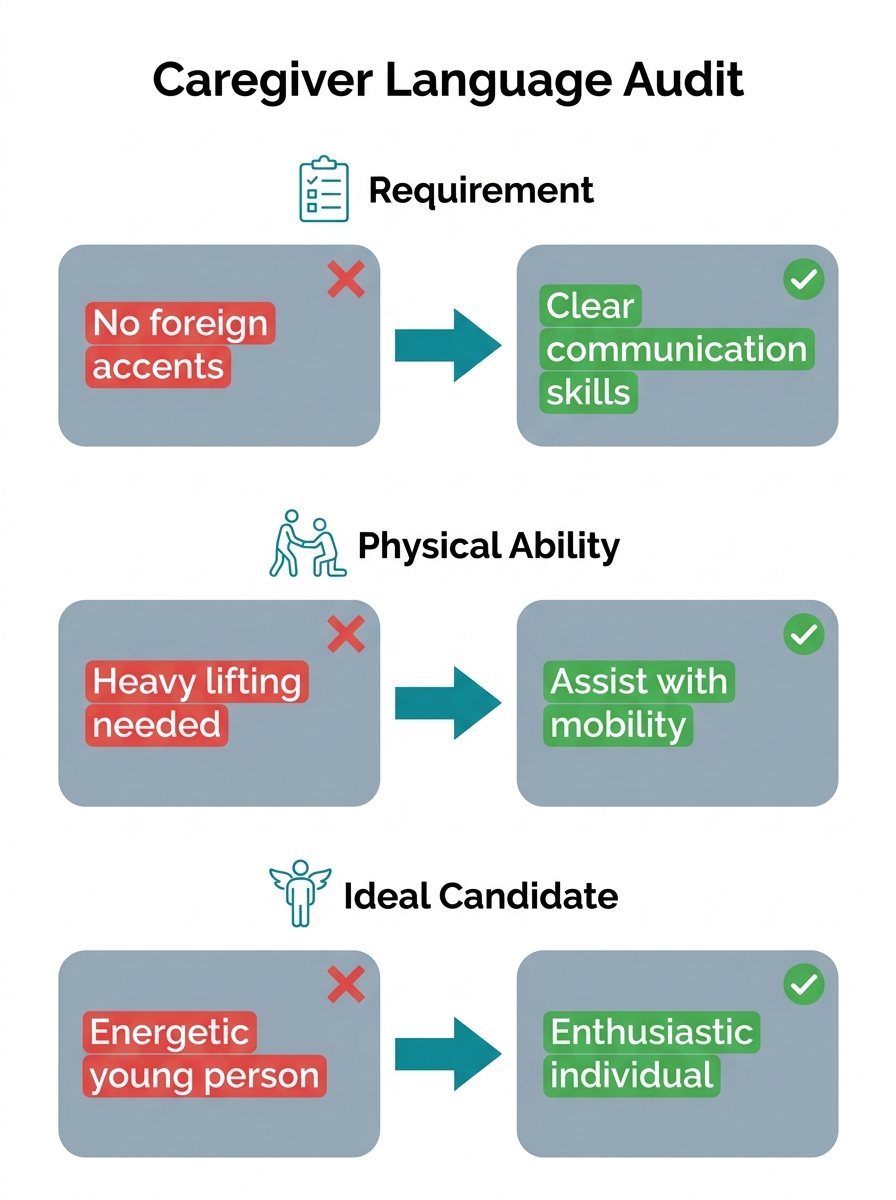
Consider what your current job descriptions look like next to how your careers page messaging communicates staff credibility. If the service pages promise compassionate, person-centered care while the job postings read like compliance checklists, candidates notice the disconnect before they finish scrolling.
The Three-Layer Messaging Audit
Caregiver job description optimization works best when you evaluate postings across three distinct layers rather than making ad hoc edits. Each layer catches a different category of problem that contributes to pipeline loss.
Layer 1: Language Screening. Pull every adjective, requirement phrasing, and verb from your active job postings. Flag masculine-coded words (dominant, competitive, assertive, aggressive), unnecessary physical descriptors (“must be strong”), and credential inflation (requiring a CNA certificate for companion care roles that don’t legally need one). The healthcare network in the Avua study found that simply swapping 6 coded terms produced a measurable applicant-pool shift. Your list will likely be longer—most caregiver postings contain 8-12 terms worth revising.
Layer 2: Structural Readability. Aaniie’s recruitment guide emphasizes using concise bullet point lists for duties and responsibilities, and the reasoning is practical. Caregiver candidates are often browsing postings on mobile devices between shifts. A job description formatted as 4 dense paragraphs with 300+ words per block will lose candidates who would’ve applied had they been able to scan the role in under 90 seconds. Target 5-7 bullet points for core duties, 3-4 for requirements, and keep total word count between 400 and 700 words. Anything above 800 words shows diminishing application completion rates.
Layer 3: Employer Brand Signal. As the HCMP team notes in their employer branding guide, clients and caregivers should be able to recognize both your client and employer brand at a glance. Your job description is an employer brand artifact. Does it mention training opportunities, schedule flexibility, peer mentorship, or advancement paths? Or does it read identically to every other Indeed posting in your market? The brand signal layer audits whether your posting communicates an employment value proposition or merely a task list.
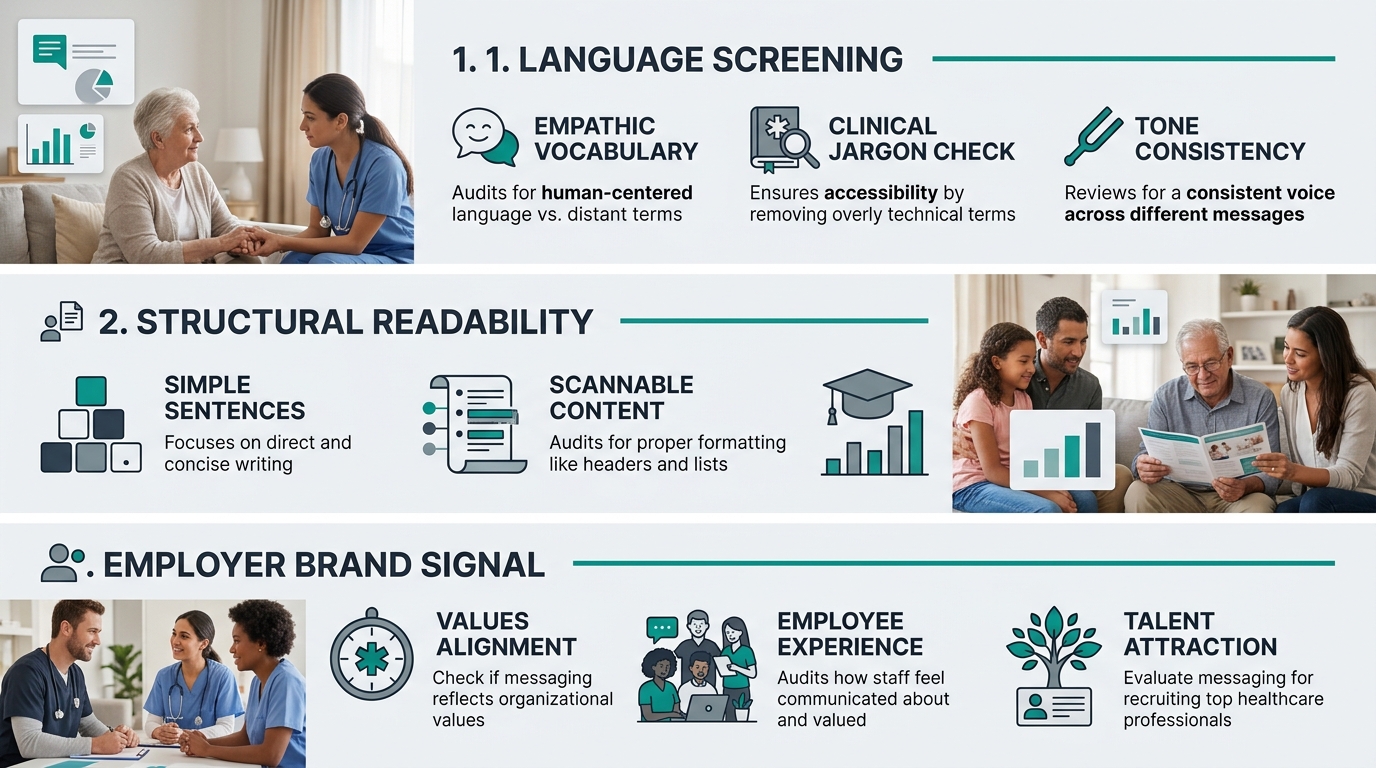
Your job description is an employer brand artifact. If it reads identically to every other Indeed posting in your market, you’ve already lost the differentiation war before a single candidate clicks “Apply.”
Running the Audit on Your Active Postings
Grab your 3 most-used caregiver job descriptions and score each one across the three layers. You don’t need specialized software for this first pass.
For language screening, count every instance of gendered or exclusionary phrasing. According to Breezy HR’s inclusive job description research, job descriptions do far more than list responsibilities—they’re a first signal to potential candidates about whether the workplace is genuinely inclusive. If your posting contains more than 3 exclusionary phrases, the language layer alone is likely suppressing your applicant volume by a meaningful percentage.
For structural readability, time yourself scanning each posting on your phone. If you can’t identify the role title, top 3 duties, pay range, and schedule within 15 seconds, the structure needs work. Indeed’s updated 2026 caregiver job description template defines the role simply: a Caregiver, or Personal Care Aide, provides assistance and support to another person who needs help with daily activities. That kind of clarity should appear in the first 2 sentences of your posting, not buried in paragraph 3.
For employer brand signal, check whether your posting mentions any of these 5 elements: compensation range, training or certification support, schedule flexibility, career advancement, and team culture. Postings that include 4 or more of these elements consistently outperform postings that include 1 or fewer. If your current descriptions mention zero, you’re competing purely on geography and timing—which means you lose every candidate who has even one other option.
| Audit Layer | What to Count | Red Flag Threshold | Fix Priority |
|---|---|---|---|
| Language Screening | Gendered/exclusionary phrases | 3+ phrases per posting | High—immediate rewrite |
| Structural Readability | Seconds to identify role, duties, pay on mobile | Over 15 seconds | Medium—reformatting |
| Employer Brand Signal | EVP elements present (out of 5) | Fewer than 2 | High—content addition |
Connecting Recruitment Messaging to Retention
Attrition data reinforces why caregiver job description optimization matters beyond the initial application. Research from employer surveys shows 75% of employees planning to leave their current employer within 12 months cite caregiving responsibilities as a primary or contributing factor. Of those, 32% take a leave of absence and 27% shift to part-time work. These numbers reflect a workforce under constant pressure, and your job description sets the first expectation about how much pressure your agency will add versus absorb.
When a job posting promises “competitive pay” but lists no range, or describes “flexible scheduling” without specifying what flexibility actually looks like (self-scheduling? shift swaps? guaranteed minimum hours?), you’re creating an expectation gap that accelerates early-stage turnover. The caregiver who quits at 90 days often made the decision to leave within the first 2 weeks, when the reality of the role didn’t match the posting that attracted them.
A systematic review published in PMC on healthcare worker retention found that the COVID-19 pandemic and retirement wave accelerated turnover rates, making retention interventions even more critical. Caregiver retention marketing begins at the job description itself. Agencies that reduced time-to-fill by building structured onboarding content series found that the improvements started upstream, in how accurately the job posting described the actual day-to-day experience.
Tip: Add a “Day in the Life” section of 3-4 sentences to your caregiver job posting. Describe a realistic shift—morning personal care assistance, medication reminders, companionship during meals, documenting care notes. Applicants who self-select based on honest descriptions stay longer than those who apply based on vague promises.
Home care employment branding works when there’s continuity between what the job posting says and what the caregiver experiences on day one. If your agency invests in reputation management for home care to attract families, the same consistency principle applies to attracting staff. Families read your Glassdoor and Indeed reviews. Caregivers read them more closely.

Where Family Decision-Makers Fit Into This
Your caregiver job descriptions don’t only affect recruitment. Families researching your agency will visit your careers page, and what they find there shapes their perception of your care quality. This connection—between how you describe employment and how families judge your service—is the subject of our detailed analysis of how employee messaging influences family decision-makers.
An agency whose job descriptions are vague, demanding, and impersonal sends an unintended message to families: this is how we talk to the people who will care for your parent. An agency whose postings describe meaningful work, real support structures, and specific growth opportunities signals something very different about organizational culture.
What These Numbers Still Don’t Capture
The data points here—the language audit results, the 75% attrition correlation, the structural readability benchmarks—measure inputs and correlations. They don’t yet measure causation at the posting level with the precision home care operators need. No published study has isolated the exact application-rate lift from swapping specific phrases in caregiver job descriptions across a statistically significant sample of home care agencies.
The healthcare network case from Avua’s glossary is directional, not definitive. The 75% attrition figure describes a workforce-wide pattern, not a home-care-specific one. And structural readability benchmarks come from general recruiting research, not caregiver-specific A/B testing.
What this means practically: you should run these audits and make these changes, because the directional evidence is consistent and the cost of revision is near zero. But you should also track your own numbers. Measure application completion rates before and after your rewrites. Compare 30-day retention for caregivers hired under old postings versus new ones. Build your own dataset, because the industry-wide data your competitors are waiting for doesn’t exist yet. The agencies generating that data right now will have a 12-to-18-month head start on everyone who waits for someone else to publish the proof.