
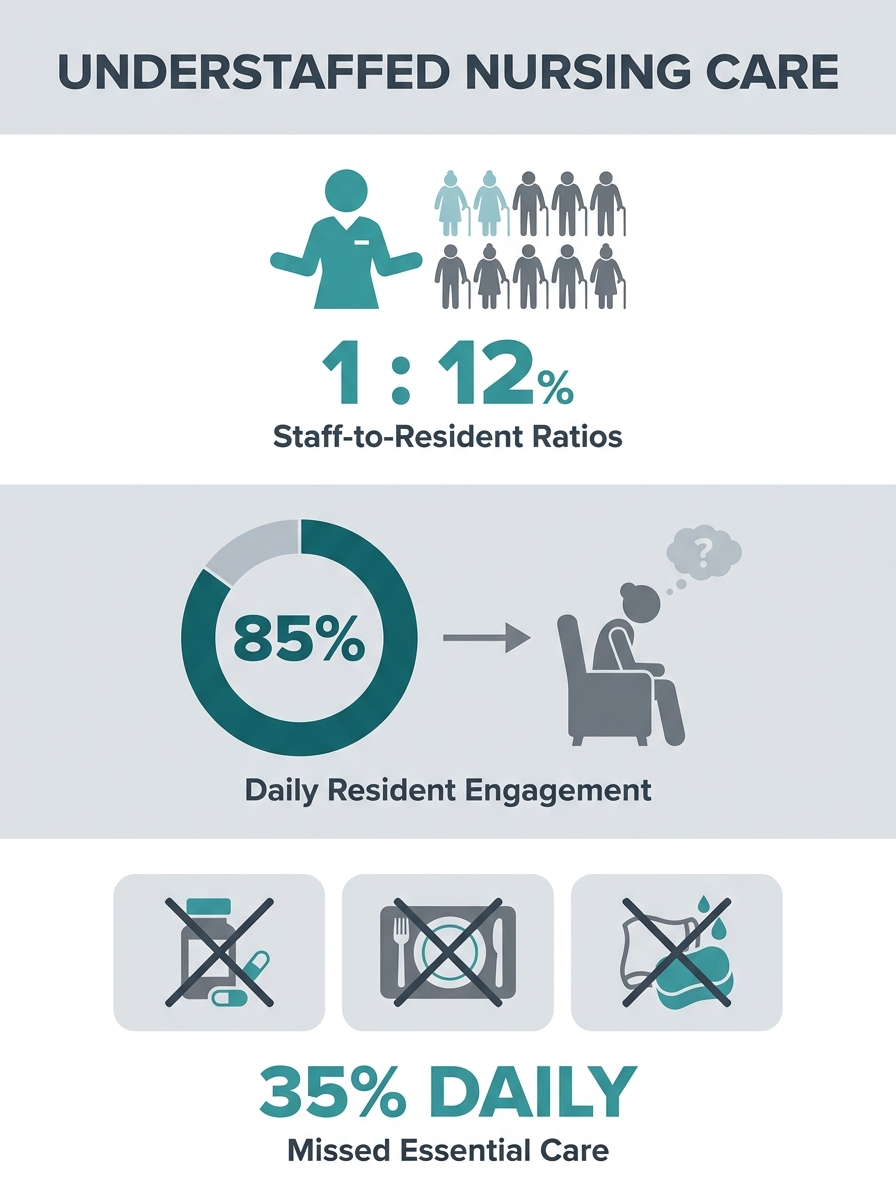
Approximately one-third of Utah’s 97 nursing homes currently hold “below average” or “much below average” staffing ratings from the Centers for Medicare and Medicaid Services, according to federal data reviewed by Fox 13 News in a May 20 investigation. The federal government recently repealed Biden-era minimum staffing mandates for nursing homes nationwide, leaving state facilities without a uniform care-staff threshold amid documented incidents linking understaffing to delayed hygiene care, medication errors, and preventable injuries.
TL;DR: One-third of Utah nursing homes operate with below-average staffing levels after federal minimum-staff rules were repealed, with inspection records documenting residents left without showers for days and prolonged wait times for assistance.
A Fox 13 News analysis of thousands of pages of federal inspection reports and dozens of court complaints filed since 2019 found that staffing shortages emerge as the most frequent regulatory concern across Utah long-term care facilities. “Staffing is the root cause of almost all concerns that we see in facilities,” said Alianne Sipes, Utah’s Long-Term Care Ombudsman, in a statement to the news outlet.
Federal Rule Reversal Removes Minimum Thresholds
The Biden administration created minimum staffing thresholds for nursing homes across the United States, but the federal government repealed the mandate following legal challenges and sustained lobbying from the nursing home industry. Utah Health Care Association opposed the standards, citing workforce shortages in the state and nationally.
“We would love to hire more nurses and nurses’ aides, but we cannot find qualified caregivers to fill open positions,” wrote Allison Spangler, president and CEO of the group, in an email statement. Spangler argued that a staffing mandate was unlikely to “magically solve the nursing crisis” while the industry pursues other solutions.
Sam Brooks, director of public policy with the National Consumer Voice for Quality Long-Term Care, told Fox 13 News that the rule’s repeal leaves understaffing as the status quo in many facilities. “You’re going to continue to see residents that are not being fed on time, not getting their medicine on time,” Brooks said.
The repeal follows documented workforce shortfalls across multiple care sectors, with senior living operators facing a projected combined shortfall of 512,000 licensed care staff by 2030.
Case Documents 12-Hour Delay in Hospital Transport
Court filings detail specific incidents in which staffing gaps allegedly contributed to resident harm. Leu Togiola, 79, died April 5, 2023, hours after undergoing surgery for a broken femur sustained while living at a Taylorsville nursing home. Her daughter, Lesa Fonoti, a registered nurse who worked weekends at the facility to monitor her mother’s care, filed a complaint alleging the nursing home left Togiola suffering with the broken leg for at least 12 hours before transporting her to a hospital.
The complaint contends the facility documented no explanation for how the injury occurred to an immobile patient and never investigated the cause of the bruising that preceded discovery of the fracture. “What happened to my mom, I feel like that’s what ultimately cost her her life,” Fonoti told Fox 13 News.
Barry Toone, an attorney with the Elder Care Injury Group pursuing medical malpractice complaints against several Utah nursing homes, described inadequate staffing as life-threatening. “If you don’t have enough people to take care of these residents, things will get missed,” Toone said. “Mistakes will get made. And those mistakes have very real consequences.”
Federal inspection reports reviewed by Fox 13 News documented residents not receiving showers for multiple days, prolonged wait times for assistance, and patients left lying in their own feces.
Industry Points to Recruitment Pipeline Gaps
The Utah Health Care Association framed the issue as a caregiver recruitment crisis driven by a shortage of qualified applicants rather than insufficient hiring efforts. “Nursing facilities are still grappling with a historic labor crisis coupled with a growing caregiver shortage,” Spangler wrote.
The statement echoes workforce challenges documented in Pennsylvania, where nearly half of nursing homes have turned away hospital discharges due to staffing shortages and Medicaid underfunding. Ohio legislators have proposed mandatory nurse staffing ratios in response to similar concerns, while Virginia hospitals face a projected 17,000-nurse shortage by 2030.
Experts say consequences of understaffing extend beyond delayed care. Sexual abuse incidents and residents wandering out of facilities without staff awareness occur more frequently when employee counts fall short, according to advocates interviewed by Fox 13 News.
Context and Outlook
The repeal of federal minimum staffing standards returns authority to individual states at a time when facility operators face competing pressures: families evaluating placements based on visible care ratios, regulators documenting deficiencies tied to staffing gaps, and hiring pipelines constrained by limited certified nursing assistant supply. Utah’s one-third of facilities rated below average on staffing now operate without a federal floor, leaving residents and their families to rely on CMS star ratings and state inspection reports as proxies for adequate coverage.
For nursing home operators, the staffing debate reframes marketing priorities. Facilities able to demonstrate consistent care ratios, measurable resident outcomes, and transparent incident response may gain competitive advantage in local markets where families increasingly research staffing metrics before tours. Ombudsman Sipes’ statement that “staffing is the root cause of almost all concerns” underscores the operational reality: recruitment investments directly shape regulatory risk, family satisfaction, and census stability.
The Togiola case illustrates liability exposure when documentation gaps coincide with unexplained injuries. Facilities that cannot demonstrate how a fracture occurred to an immobile resident face both wrongful-death litigation and reputational damage that erodes referral partnerships. As federal CMS fraud mandates compress state timelines for identifying high-risk providers, nursing homes with persistent staffing deficiencies may encounter heightened scrutiny from payers and discharge planners. The absence of federal minimums shifts accountability to market forces and individual state action, making local compliance records and workforce stability key differentiators in admissions competition.